Skip to content
The packing and export stage of a plush toy production project is where most buyers’ active engagement ends — and where a significant proportion of commercial problems actually originate. By the time goods are being packed, the quality has been established, the compliance has been verified, and the buyer’s attention has moved to inventory planning, marketing preparation, and the next development project. Packing and export is assumed to proceed as a routine logistics function.
This assumption is expensive when it is wrong. Incorrect inner packaging allows products to arrive compressed and deformed. Inadequate carton construction creates damage in transit that cannot be attributed to any single handling event. Missing or incorrect shipping marks hold goods at customs. Incomplete documentation creates clearance delays that turn a well-executed production project into a late, disrupted delivery.
Understanding what correct packing and export management looks like — specifically, concretely, and verifiably — transforms this stage from an assumed routine into an actively managed quality gate that protects the commercial value of the production investment made in every preceding stage.
Why the Packing and Export Stage Is More Commercially Significant Than Most Buyers Expect?

The packing and export stage is commercially significant because it is the stage that determines whether a correctly manufactured, quality-verified product reaches its destination in the same condition and within the same timeline that the production process delivered it — or whether problems introduced at this stage degrade the product’s condition, delay its arrival, or complicate its market entry.
The commercial stakes of packing and export failures are higher than they appear because they are irreversible by the time they manifest. A product that is discovered to have incorrect documentation cannot have its documentation corrected once it is at the destination port. A product that arrives compressed and deformed from inadequate packaging cannot be restored to its original condition at the destination. A shipment that is held at customs for missing markings cannot be moved until the issue is resolved — on the importer’s timeline and at the importer’s cost.
Here is a framework for understanding the commercial impact of packing and export failures:
| Packing/Export Failure | When Discovered | Commercial Consequence | Estimated Cost |
|---|---|---|---|
| Inadequate inner packaging — product compression | On delivery | Customer-facing quality problem | Returns, negative reviews, replacement cost |
| Carton damage in transit | On delivery | Product damage from inadequate carton protection | Replacement or discount cost |
| Missing CPSIA tracking label | At retail or platform audit | Compliance violation | Relabeling cost, potential listing suspension |
| Missing or incorrect shipping marks | At destination customs | Customs hold | Clearance delay, demurrage fees |
| Incorrect declared value | At customs | Customs examination, potential penalty | Examination delay, potential duties adjustment |
| Missing test reports | At retailer compliance check | Retailer compliance failure | Product return, supplier listing risk |
| Wrong HS code | At customs | Duties recalculation, potential examination | Additional duties, clearance delay |
| Ocean container moisture damage | On delivery | Product damage from condensation | Replacement or discount |
| Incorrect packing list quantity | At delivery | Quantity discrepancy | Reconciliation delay, potential dispute |
How Are Plush Toys Packed at the Unit Level — Inner Packaging Options and Standards?

Unit-level packaging — the packaging applied to each individual plush toy unit before it is packed into a shipping carton — serves multiple functions simultaneously: protecting the product during transit and storage, presenting the product correctly at the point of sale or distribution, communicating compliance and safety information to the end user, and in some cases creating the first brand impression the customer experiences.
Understanding the options available at the unit packaging level — and the specific requirements each option imposes on the production and packing process — enables buyers to specify packaging that serves all these functions without creating cost or logistics inefficiencies.
Here is a complete guide to unit-level packaging options for plush toys:
| Packaging Type | Description | Best Application | Advantages | Limitations |
|---|---|---|---|---|
| Plain polybag | Clear polybag without print | Wholesale, B2B distribution | Lowest cost, flexible sizing | No brand impression, minimal protection |
| Printed polybag | Polybag with brand print or product information | E-commerce fulfillment, branded wholesale | Brand presence at low cost | Printing setup cost, MOQ for custom print |
| Header card + polybag | Card attached above polybag — hangs at retail | Retail point-of-sale display | Retail-ready presentation at low cost | Card adds cost, less protection |
| Window box | Cardboard box with clear window panel | Retail gift, mid-premium positioning | Product visible in packaging, premium feel | Higher cost, higher MOQ for custom |
| Printed retail box | Full wrap retail box | Premium retail, licensed merchandise | Maximum brand impact | Highest cost, significant MOQ, design lead time |
| Gift box with tissue | Rigid box with tissue paper wrapping | Premium gift, corporate gifting | Excellent unboxing experience | High cost per unit, slow packing process |
| Hang tag only | Product displayed without primary packaging | Large display plush, retail floor display | Lowest cost, direct product contact | No individual protection |
Compression Management in Unit Packaging
One of the most commercially important packaging decisions for plush toys is whether the unit packaging design allows the product to be stored and shipped without sustained compression. A plush toy that is compressed in its packaging for the duration of a transit journey — typically 15 to 35 days for ocean freight — may not recover its original shape when unpacked, producing the deformation problem that generates customer complaints and returns.
The packaging dimension decision must account for the product’s unstuffed-to-stuffed ratio — a product that is significantly larger than its packaging dimensions are allowing will be in sustained compression throughout transit. The correct packaging dimension allows the product to fit without compression, or with only light contact that does not create sustained load.
For products where packaging dimensions are constrained by retail shelf size or shipping density requirements, testing the specific product and packaging combination at the counter sample stage — packing a counter sample in the intended packaging and storing it for a period equivalent to transit duration, then assessing recovery — provides direct evidence of whether the packaging design creates a compression problem before it is committed to bulk production.
CPSIA Tracking Label Requirements for US Market
For products sold in the US market that are subject to CPSIA — which includes all children’s plush toys — every unit must carry a tracking label that enables the product to be traced to its production batch. This tracking label must include:
| Tracking Label Element | Required Content |
|---|---|
| Manufacturer name | Legal name of the manufacturing entity |
| Location of manufacture | Country and, for US manufacturers, city and state |
| Date of manufacture | Month and year of production |
| Cohort information | Batch or production run identification |
| Product name or SKU | Identification of the specific product |
This label must be permanently attached to the product — not just to the packaging — in a location that is accessible without destroying the product. Common placement locations include sewn-in fabric labels at the back seam, hang tags with permanent attachment, or labels integrated into the product’s care instruction tag.
Failure to include the CPSIA tracking label is one of the most common and most easily preventable compliance failures in US market plush toy distribution. It is also one of the most disruptive when discovered post-production, because retroactive label application to finished and packaged goods requires unpacking, labeling, and repacking — a significant labor cost with timeline implications.
We confirm CPSIA tracking label specification and placement as part of our pre-production checklist — so that labels are produced and applied during production rather than discovered as missing at the pre-shipment stage.
How Are Plush Toys Configured into Cartons for Safe Transit and Efficient Logistics?
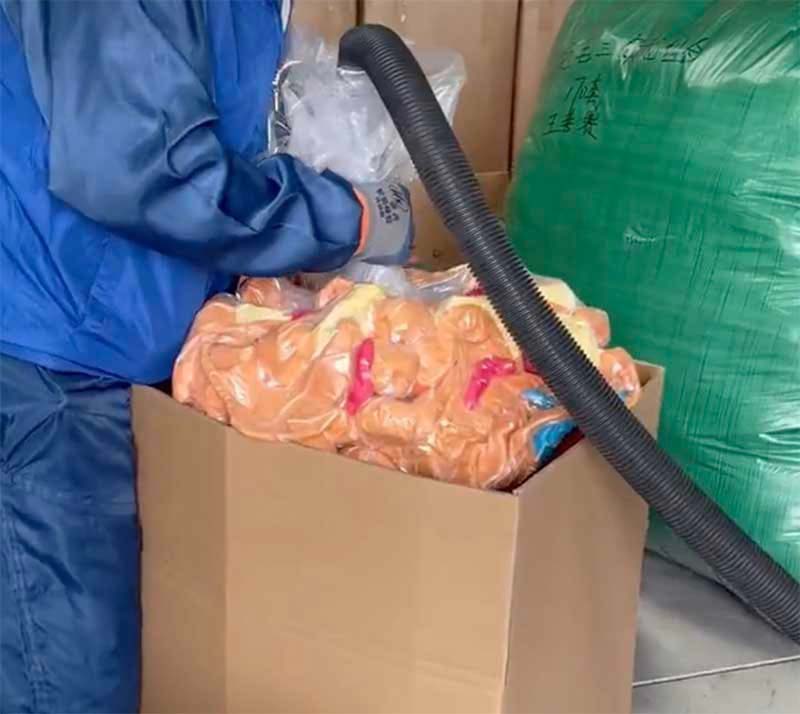
Carton configuration — how individual units are arranged within the shipping carton and how the carton itself is constructed — determines whether products arrive at their destination in the same condition they left the factory, and whether the logistics cost of moving them is optimized against the freight pricing structure that applies to the specific shipment.
Professional carton configuration for plush toys addresses four dimensions simultaneously: product protection, dimensional efficiency, weight limits, and stacking strength.
Inner Carton Configuration
For products that are sold in individual retail units, inner cartons — also called master cartons or export cartons — typically contain 6 to 24 units of the same product, depending on product size and carton strength requirements.
Here is a practical carton configuration guide by product size:
| Product Size | Typical Units Per Carton | Carton Configuration | Protection Consideration |
|---|---|---|---|
| Small (under 20cm) | 12–24 units | Grid configuration with polybag protection | Lightweight — stacking damage risk low |
| Medium (20–35cm) | 6–12 units | Staggered or grid configuration | Compression risk moderate |
| Large (35–55cm) | 4–6 units | Single layer or alternating orientation | Compression risk high — layer separation recommended |
| Extra large (55cm+) | 1–4 units | Individual placement with cushioning | Shape protection critical |
| Weighted plush | 6–12 units (depending on unit weight) | Weight-aware configuration — carton weight limit critical | Weight plus stacking creates compression risk |
Carton Construction Standards
The carton construction — the material weight and flute configuration of the corrugated cardboard — must be adequate for the specific product weight and the stacking loads the carton will experience during transit and storage.
| Carton Application | Recommended Construction | Stack Height Support |
|---|---|---|
| Standard small plush | Single-wall B-flute (BC double wall for heavier units) | 6–8 carton stack |
| Medium plush | BC double-wall corrugated | 5–7 carton stack |
| Large or heavy plush | BC or EB double-wall corrugated | 4–6 carton stack |
| Weighted plush | Heavy-duty double-wall or triple-wall | 3–5 carton stack |
Dimensional Weight and Freight Cost Optimization
Plush toys are typically volume-heavy relative to their actual weight — occupying significant cubic volume per kilogram of product weight. For air freight, this means dimensional weight (calculated from package dimensions) typically exceeds actual weight, and freight is charged on dimensional weight. For ocean freight charged by container volume, the cubic efficiency of the carton configuration directly affects the cost per unit.
Optimizing carton configuration for dimensional weight efficiency — configuring units to minimize the carton’s external dimensions while maintaining adequate protection — reduces the freight cost per unit for air shipments. This optimization is most effectively done at the packaging design stage when carton dimensions can be freely adjusted, rather than after packaging has been produced.
The dimensional weight calculation for air freight: (length × width × height in cm) ÷ 5,000 = dimensional weight in kg. If dimensional weight exceeds actual weight, freight is charged at dimensional weight.
A practical example: a carton of 12 medium plush toys measuring 60cm × 40cm × 40cm has a dimensional weight of (60 × 40 × 40) ÷ 5,000 = 19.2kg. If the actual weight is 8kg, freight is charged at 19.2kg — 2.4 times the actual weight. Reducing the carton height by 10cm through a more efficient configuration reduces the dimensional weight to 14.4kg — a 25 percent freight cost reduction at no quality cost.
What Shipping Marks, Labels, and Compliance Markings Are Required on Export Cartons?

Export carton markings serve multiple functions: customs identification and clearance, logistics routing, product compliance confirmation, and handling guidance. Missing or incorrect markings are one of the most common causes of customs delays and retailer compliance failures — and one of the most easily prevented through systematic marking specification before packing begins.
Here is a complete guide to the markings required on export cartons:
Standard Export Carton Markings
| Marking Element | Required Content | Placement | Why Required |
|---|---|---|---|
| Consignee information | Buyer’s company name, address, and contact | At least one face of each carton | Customs routing and delivery identification |
| Shipper information | Factory name and address | At least one face | Customs origin identification |
| Country of origin | “Made in China” or equivalent | All outer cartons | Customs requirement in all markets |
| HS tariff code | Harmonized System classification code | Commercial invoice and typically carton | Customs duties determination |
| Carton number | Sequential numbering — “Carton 1 of 24” | Each carton | Shipment tracking and receiving verification |
| Gross weight | Total weight including carton | Each carton | Freight billing and customs documentation |
| Net weight | Product weight excluding carton | Each carton | Product quantity verification |
| Product description | Brief description of contents | Each carton | Customs declaration matching |
| Quantity | Units per carton | Each carton | Receiving verification |
| PO number or order reference | Buyer’s purchase order number | Each carton | Buyer’s receiving and inventory system |
US Market Additional Markings
| Marking | Content | Requirement |
|---|---|---|
| FCC marking (if applicable) | FCC ID for electronic components | Required for products with electronic/radio components |
| CPSC compliance statement | “Complies with all applicable CPSC regulations” (where applicable) | Required for children’s products |
| Age grade warning | “Not suitable for children under X years” | ASTM F963 / CPSIA requirement |
EU Market Additional Markings
| Marking | Content | Requirement |
|---|---|---|
| CE mark | CE symbol on product and packaging | Required for all toy products sold in EU |
| UKCA mark | UKCA symbol | Required for products sold in Great Britain post-Brexit |
| Age warning symbol | Triangle warning symbol with age grade | EN71 requirement |
| Importer information | EU-based importer name and address | Required for non-EU manufactured goods |
Retailer-Specific Marking Requirements
Many major retailers — Walmart, Target, Amazon, and others — have specific carton marking requirements beyond regulatory minimums. These may include specific barcode formats on cartons, specific label placement standards, vendor codes, department codes, or routing stickers for distribution center processing.
Retailer-specific marking requirements should be confirmed directly with the retailer’s vendor compliance documentation before carton specifications are finalized. Non-compliance with retailer marking requirements does not typically create customs problems but consistently creates receiving and processing delays at the retailer’s distribution center — and may trigger compliance chargebacks under the retailer’s vendor agreement.
How Are Export Documents Prepared and What Does Each Document Cover?

Export documentation is the paper and digital record set that supports every stage of the goods movement from factory to buyer — customs clearance, freight billing, payment, and the compliance evidence that retail channels and regulatory authorities require. Missing, incorrect, or incomplete documentation is one of the most avoidable delay causes and one of the most disruptive when it occurs.
Here is a complete guide to the export documents required for plush toy shipments:
Core Trade Documents
| Document | What It Contains | Who Prepares | Purpose |
|---|---|---|---|
| Commercial invoice | Product description, quantity, unit price, total value, terms of sale, buyer and seller information | Factory (Kinwin) | Customs valuation and duties calculation |
| Packing list | Carton-by-carton breakdown of quantities, weights, and dimensions | Factory (Kinwin) | Customs clearance and buyer receiving |
| Bill of lading (ocean) or air waybill (air) | Carrier’s receipt of goods, shipment routing, terms of carriage | Freight forwarder / carrier | Title transfer, freight billing, customs clearance |
| Certificate of origin | Declares goods are manufactured in China | Chamber of Commerce or factory | Preferential duty treatment where applicable |
Compliance Documents
| Document | What It Contains | Who Prepares | Purpose |
|---|---|---|---|
| Children’s Product Certificate (US) | Declaration of CPSIA compliance based on third-party test reports | Buyer (as importer of record) | CPSIA compliance — required for US market children’s products |
| CE Declaration of Conformity (EU) | Declaration that product meets applicable EU directives | Buyer or authorized representative | CE marking requirement |
| UKCA Declaration of Conformity (UK) | Declaration that product meets UK regulations | Buyer or authorized representative | UKCA requirement for Great Britain |
| Third-party test reports | Laboratory testing results for applicable standards | Testing laboratory | Compliance evidence for CPC, CE, and retailer requirements |
| Material compliance certificates | OEKO-TEX, REACH compliance for fabrics and materials | Material suppliers | Chemical compliance evidence |
Financial Documents
| Document | What It Contains | Purpose |
|---|---|---|
| Letter of credit (if applicable) | Bank-guaranteed payment terms | Payment security for high-value shipments |
| Insurance certificate | Shipment insurance coverage details | Cargo insurance evidence |
| Proforma invoice | Pre-shipment invoice for payment and customs pre-clearance | Payment processing, advance customs clearance |
Document Accuracy Requirements
The commercial invoice is the most scrutinized document in the customs clearance process — and errors in the commercial invoice are the most common cause of customs examination and clearance delays. Critical accuracy requirements include:
| Commercial Invoice Field | Accuracy Requirement | Consequence of Error |
|---|---|---|
| Product description | Must accurately describe the goods — cannot be generic or misleading | Customs examination, potential misdeclaration penalty |
| HS code | Must correctly classify the product | Incorrect duties, potential examination |
| Country of origin | Must accurately state manufacturing origin | Trade compliance violation |
| Declared value | Must reflect actual transaction value | Customs undervaluation investigation |
| Incoterms | Must match the agreed terms of sale | Liability and insurance disputes |
| Quantity | Must match packing list and bill of lading exactly | Receiving discrepancy, customs examination |
How Does the Export Process Work from Factory to Port?

Understanding the physical flow of goods from the factory through the export process to the destination port helps buyers understand what is happening during the period between production completion and delivery confirmation — and where delays and problems most commonly originate.
Here is the complete export process flow for a standard ocean freight shipment from a China-based plush toy factory:
| Export Stage | Activity | Typical Duration | Key Risk |
|---|---|---|---|
| Production completion and FQC | Final units completed, FQC conducted | Per production schedule | Quality failure requiring rework |
| Packing and carton sealing | Units packed, cartons sealed and marked | 1–3 days for standard orders | Incorrect markings, packing errors |
| Packing list and invoice finalization | Documents prepared and verified | 1–2 days | Document errors that create customs problems |
| Factory cargo pickup | Freight forwarder collects from factory | 1–2 days | Driver availability, access issues |
| Inland transport to port | Goods transported from factory to port area | 1–3 days depending on distance | Traffic, inspection at highway checkpoints |
| Export customs declaration | China customs declaration submitted | 1–3 days | Documentation issues triggering examination |
| Customs examination (if triggered) | Physical inspection by Chinese customs | 1–5 days if triggered | Random selection or documentation red flags |
| Port storage and loading | Goods stored at port, loaded onto vessel | 1–5 days | Space availability, vessel schedule |
| Ocean transit | Vessel transit from China port to destination | 14–35 days depending on destination | Schedule disruption, transshipment delays |
| Destination port arrival | Vessel arrives at destination port | Per transit schedule | Port congestion delays |
| Import customs clearance | Destination country customs processing | 1–5 days typically | Missing documents, examination |
| Delivery to buyer’s warehouse | Final inland transport to buyer | 1–5 days | Appointment scheduling, inland logistics |
China Export Customs Declaration
The China customs declaration — submitted by the freight forwarder on behalf of the exporter before goods leave China — is the primary Chinese regulatory document for every export shipment. It declares the product classification, origin, value, and quantity, and is the document against which Chinese customs may select shipments for examination.
Key China export customs considerations for plush toys:
| Consideration | Detail | Impact |
|---|---|---|
| HS code classification | Plush toys typically classified under HS 9503 (toys) | Determines export duty treatment and any applicable restrictions |
| Export license requirements | Standard plush toys do not require special export licenses | Verify for products with electronic components |
| China export inspection | Some product categories require China Exit-Entry Inspection and Quarantine (CIQ) inspection | Verify applicable requirements at project planning stage |
| Document matching | Invoice, packing list, and customs declaration must match exactly | Document inconsistencies trigger customs examination |
Destination Import Customs Clearance
Import customs clearance at the destination country is the buyer’s primary customs responsibility — typically managed through a customs broker (freight forwarder with customs brokerage capability) who prepares and submits the import declaration on behalf of the importer of record.
Key import customs considerations by destination:
| Destination | Import Duty | Key Documentation | Common Clearance Issue |
|---|---|---|---|
| United States | 0% or varies by HS code and origin | Commercial invoice, packing list, CBP entry, ISF filing | ISF filing timing — must be submitted 24 hours before loading |
| European Union | Variable by HS code | Commercial invoice, packing list, CE declaration | Importer of record establishment, AEO status |
| United Kingdom | Variable — UK Global Tariff post-Brexit | Commercial invoice, UKCA compliance, import declaration | Post-Brexit customs complexity |
| Australia | Variable | Commercial invoice, AQIS biosecurity compliance | Biosecurity requirements for organic filling materials |
| Canada | Variable by HS code and CUSMA eligibility | Commercial invoice, B3 customs entry | Origin documentation for duty preference |
How Are Different Shipping Modes Selected and What Are Their Trade-offs?

The shipping mode selection — ocean freight, air freight, or express courier — is one of the most commercially significant logistics decisions in any plush production project, because it determines the balance between transit cost, transit time, and risk exposure during shipment. Understanding the trade-offs of each mode helps buyers make informed decisions based on their specific commercial requirements rather than defaulting to the lowest cost option regardless of commercial context.
Here is a complete comparison of the primary shipping modes for plush toy exports:
| Mode | Transit Time | Cost Level | Dimensional Weight Impact | Risk Profile | Best Application |
|---|---|---|---|---|---|
| Ocean FCL (Full Container Load) | 14–35 days | Lowest per kg | Not applicable — charged by container | Low — sealed container, minimal handling | Large volume orders — 500+ units |
| Ocean LCL (Less than Container Load) | 18–40 days | Low per kg | Not applicable | Medium — consolidated with other cargo | Medium volume — 100–500 units |
| Air freight | 3–7 days | High per kg or dimensional kg | High — low density products pay premium | Low — fast transit, direct handling | Urgent shipments, small volume, high-value products |
| Express courier (DHL, FedEx, UPS) | 3–5 days | Highest per kg | Very High — courier dimensional weight strict | Very Low — tracked, fast | Small orders, samples, urgent replenishment |
Ocean Freight for Plush Toys — FCL vs LCL
The choice between Full Container Load (FCL) and Less than Container Load (LCL) shipping is primarily a volume decision with important commercial trade-off considerations.
FCL shipping — where the buyer’s goods fill or share a dedicated container — provides lower per-unit freight cost, more direct handling (goods are not consolidated with other cargo), lower damage risk, and faster clearance at destination. It is the appropriate choice for large production orders where the volume justifies the container commitment.
LCL shipping — where the buyer’s goods are consolidated with other cargo to fill a shared container — provides flexibility for smaller volumes but adds handling events (consolidation at origin, deconsolidation at destination), transit time (consolidation scheduling adds time), and documentation complexity (house bill of lading in addition to master bill). For plush toys specifically, LCL adds the compression risk of consolidation — goods may be placed under weight from other cargo during consolidation handling.
Air Freight Economics for Plush Toys
Plush toys are among the product categories most disadvantaged by air freight dimensional weight pricing — because their low actual weight-to-volume ratio means dimensional weight typically exceeds actual weight by a factor of two to four. This means air freight costs for plush toys are consistently higher per unit than for comparable-value products with higher density.
The decision to use air freight for plush toys should account for this dimensional weight premium rather than comparing air freight cost against actual weight. The practical approach is to calculate the dimensional weight for the specific carton configuration and apply the carrier’s dimensional weight factor before comparing air freight to ocean freight costs.
Despite this cost premium, air freight is often commercially justified for plush toys in specific scenarios: urgent delivery to recover from production delay, seasonal product that has missed the ocean freight window, small initial order where speed to market is commercially more valuable than freight savings, or high-value products where inventory carrying cost of ocean transit duration exceeds the air freight premium.
How Should Buyers Manage the Packing and Export Stage to Protect Their Commercial Interests?

Active buyer management of the packing and export stage — rather than assuming it will proceed correctly without attention — is the commercial practice that prevents the specific failures described in this guide from materializing.
Here is a complete buyer management framework for the packing and export stage:
Pre-Packing Verification
| Verification Action | What It Confirms | Timing |
|---|---|---|
| Packaging specification review | All unit and carton specifications correct before packing begins | Before packing day 1 |
| CPSIA tracking label confirmation | Label content and placement verified before application | Before production completion |
| Carton marking specification | All required markings specified to factory before packing | Before packing day 1 |
| Compliance documentation status | All required documents available or on schedule | Before packing day 1 |
During Packing Verification
| Verification Action | What It Confirms | Method |
|---|---|---|
| Packing photograph review | Carton markings correct, unit packaging correct | Request photos from factory during packing |
| Label placement confirmation | CPSIA and other required labels correctly placed | Request close-up photos of label placement |
| Carton count confirmation | Total carton count matches purchase order quantity | Request packing list draft for verification |
Pre-Shipment Documentation Review
| Document | Verification Action | Common Error to Check |
|---|---|---|
| Commercial invoice | Review all fields before customs submission | Value, HS code, description, quantity |
| Packing list | Verify against purchase order | Quantity per carton, total units, weight |
| Test reports | Confirm currency and scope | Issue date, standard version, product coverage |
| CPSIA CPC | Review content and test report references | Test report references, manufacturer information |
| CE Declaration | Review product and standard coverage | Standard references, product description |
Post-Shipment Tracking
| Tracking Action | What It Monitors | Frequency |
|---|---|---|
| Bill of lading receipt | Confirm shipment details and routing | At shipment |
| Vessel tracking | Monitor transit progress | Weekly |
| Destination ETA monitoring | Identify transit delays early | Weekly |
| Import customs appointment | Confirm customs broker preparation | 5–7 days before arrival |
At Kinwin, packing and export management is part of our standard client service — not a separate logistics function that buyers must manage entirely independently. We prepare packing specifications, confirm marking requirements, organize compliance documentation, coordinate with freight forwarders, and provide complete shipping documentation packages as standard outputs of every production project.
Our packing process includes a pre-packing specification review that confirms all marking and packaging requirements before packing begins, a during-packing photo confirmation that allows buyers to verify carton markings and label placement, and a complete documentation package that provides all required trade and compliance documents in organized, accessible format before the shipment departs.
If you are planning a production project and want to understand specifically how our packing and export management process would apply to your product, your target market, and your delivery requirements — what documentation will be required, what markings will need to be applied, and what the export timeline looks like — we would be glad to discuss it with you.
Reach out to our team at [email protected] or visit kinwintoys.com to start that conversation.
Conclusion
The packing and export stage is where the commercial value of every preceding stage of a plush toy production project is either preserved or degraded. Products that were correctly designed, accurately sampled, compliantly manufactured, and quality-verified at FQC can still arrive deformed, delayed, or non-compliant if the packing and export stage is not managed with the same systematic attention as every preceding stage.
The specific risks — compression damage from inadequate packaging, carton damage from insufficient construction, customs delays from incomplete markings or documentation, compliance failures from missing labels — are each preventable through specific, verifiable practices that professional manufacturing partners execute as standard rather than exception.
Understanding what these practices are, and verifying that a manufacturing partner executes them systematically, is the completion of the buyer’s due diligence process — because a factory that produces excellent goods but manages packing and export inadequately delivers a worse commercial outcome than one that manages the entire process, including this final stage, with professional discipline.
FAQ
Q1: How should buyers specify inner packaging requirements to avoid compression damage, and what information is needed to make the correct specification?
Specifying inner packaging to avoid compression damage requires three pieces of information: the product’s unstuffed-to-stuffed dimensional ratio (how much larger the stuffed product is than a flat, compressed product), the expected transit duration for the primary shipping mode, and the stacking load the packaged product will experience during storage and transit. With this information, the packaging specification should establish minimum internal dimensions that allow the product to sit without compression — meaning the packaging interior is at least as large in all dimensions as the product at its natural stuffed state, without forcing the product to compress to fit. The specification should also define the packaging material construction — polybag gauge for polybag packaging, or carton material weight for box packaging — that provides adequate structural support to resist the stacking loads the package will experience. For products where the retail packaging must be a specific size for shelf fit, the solution is typically a protective inner polybag inside the retail packaging that supports the product shape, combined with testing of the specific product-packaging combination at counter sample stage to verify that transit duration compression does not cause permanent deformation.
Q2: What is the Importer Security Filing (ISF) requirement for US-bound ocean shipments, and how does it affect packing and export timing?
The Importer Security Filing — commonly called ISF or “10+2” — is a US Customs and Border Protection requirement that mandates advance electronic submission of shipment information 24 hours before the cargo is loaded onto the vessel at the foreign port. The 10 refers to the 10 data elements that the importer of record (the US buyer) must provide, including shipper and consignee information, HS codes, country of origin, and loading port. The 2 refers to 2 additional elements provided by the carrier. The ISF requirement affects packing and export timing because it requires that specific information about the shipment — HS codes, manufacturer and seller information, country of origin — is confirmed and submitted to the customs broker for ISF filing at least 24 hours before vessel loading. This means packing specifications, carton markings, and commercial invoice details must be finalized before the ISF deadline, not after the shipment departs. Late or incomplete ISF filing results in CBP penalties of up to $5,000 per violation. Buyers working with US customs brokers should confirm the ISF filing workflow with their broker at the project planning stage to ensure the required information is available at the required time.
Q3: How does the CE marking requirement affect the packing and export process for EU-bound plush toys, and what documentation must be available at the time of export?
CE marking is the EU’s conformity marking for toys, indicating that the product meets the requirements of the EU Toy Safety Directive (2009/48/EC). For plush toys exported to the EU, the CE marking must be affixed to the product and packaging, and the manufacturer or EU importer must have prepared a Declaration of Conformity (DoC) — a document declaring that the product meets applicable EU directives and standards. The CE mark itself does not require application from a certification body — it is a self-declaration by the manufacturer or importer based on the technical documentation (test reports, risk assessment, compliance evidence). At the time of export, the DoC must be prepared and available — it does not need to accompany every shipment physically, but it must be available to EU market surveillance authorities on request. The test reports that support the DoC must be from accredited laboratories and cover the applicable EN71 standard scope for the specific product. For buyers exporting to the EU for the first time, we recommend engaging a compliance specialist or EU importer representative to confirm that the DoC is correctly prepared and that the technical documentation file is complete before the first shipment departs.
Q4: What is the most efficient approach to managing export documentation when shipping to multiple markets simultaneously — for example, splitting a production run between US and EU destinations?
When a production run is split between multiple destination markets — common for brands distributing in both the US and EU — export documentation must be prepared separately for each destination because the compliance requirements, duty treatments, and customs documentation differ between markets. The most efficient approach is to organize the split at the production completion stage — separating the US-bound quantity and EU-bound quantity into distinct carton groups before packing, with market-specific markings applied to each group. Separate commercial invoices and packing lists are then prepared for each destination, each reflecting the specific quantity, value, and compliance documentation applicable to that market. Compliance documentation — US CPSIA certificates for the US portion, EU CE documentation for the EU portion — is prepared in parallel and confirmed complete for each destination before either shipment departs. For the freight booking, the two portions can be shipped on the same vessel if the timing aligns (with separate house bills of lading for each destination), or on separate shipments if the destination timelines differ. The additional administrative overhead of this split-shipment documentation is typically modest — one to two days of additional preparation — compared to the compliance risk of applying uniform documentation to destinations with different requirements.
Q5: How should buyers handle a situation where they discover a carton marking error after goods have already been loaded onto the vessel — and what is the most efficient path to resolution?
Discovering a carton marking error after vessel loading is a stressful situation but one with defined resolution paths depending on the specific error type and severity. For errors that affect customs clearance — incorrect HS code, missing or wrong country of origin, significant value discrepancy — the importer’s customs broker should be notified immediately so that the correct information can be provided in the import customs declaration rather than the incorrect information on the physical carton. US CBP and most destination customs authorities allow the commercial invoice and customs declaration to control over physical carton markings in many circumstances, provided the correct information is clearly declared. For errors that affect retailer receiving — incorrect PO number, wrong carton numbering sequence — these can typically be resolved through communication with the retailer’s receiving team, providing a corrected packing list that references the actual carton markings versus the correct information. For errors that affect regulatory compliance — missing CPSIA tracking labels or CE marks — the resolution is more complex because the labels must be physically present on the product. For these cases, relabeling at the destination warehouse (under buyer supervision) is typically the most practical path, and the cost of this relabeling should be documented as part of the supplier quality failure record. Preventing this scenario through the pre-packing and during-packing verification steps described in this guide is consistently less expensive than any post-loading resolution.