Every plush toy production project carries risk. The design brief may be interpreted differently than intended. Materials may not meet compliance requirements for the target market. The sample may require more revision rounds than budgeted. The bulk production may not match the approved sample. The delivery may arrive late. The quality may generate returns and negative reviews that affect the brand’s commercial performance.
These risks are real, they are specific, and they are consistently manageable — when the manufacturing partner has built the right systems, maintains the right processes, and brings the right expertise to every stage of the production relationship. They are consistently unmanageable — or manageable only at significant additional cost and delay — when the manufacturing partner has not made these investments.
At Kinwin, reducing manufacturing risk for our clients is not a service we offer as a premium. It is the organizational purpose that shapes every investment we have made in our production infrastructure, quality systems, development processes, and communication standards. This page explains specifically how we reduce each category of manufacturing risk — not through general quality claims but through specific operational practices that produce specific, verifiable risk reduction outcomes.
What Manufacturing Risks Do Plush Toy Buyers Face and Why Do They Matter?

Manufacturing risk in plush toy production is not a single threat — it is a portfolio of distinct risks, each operating through a different mechanism, at a different stage of the production process, with a different commercial consequence when it materializes.
Understanding this risk portfolio is the foundation for evaluating how effectively a manufacturing partner manages each dimension — and for assessing whether the risk management approach claimed by a factory is actually built into its operations or simply described in its marketing materials.
Here is the complete manufacturing risk portfolio for plush toy buyers:
| Risk Category | Mechanism | Stage | Commercial Consequence |
|---|---|---|---|
| Brief interpretation risk | Design intent misunderstood — wrong product built | Development | Excess revision rounds, timeline extension, development cost overrun |
| Material compliance risk | Non-compliant materials used — product fails testing | Pre-production | Batch rework, market access failure, recall risk |
| Material quality risk | Lower-grade materials substituted — quality below specification | Pre-production / production | Quality complaints, returns, brand damage |
| Development accuracy risk | Pattern engineering inadequate — sample inaccurate | Sampling | Revision rounds, development timeline extension |
| Sample-to-bulk risk | Bulk production does not match approved sample | Production | Batch quality failure, rework, delivery delay |
| Production consistency risk | Quality drifts across long production runs | Production | Mixed quality in batch, increased defect rate |
| Compliance testing risk | Product fails safety testing — market entry blocked | Pre-shipment | Rework, retest costs, delayed market entry |
| Timeline risk | Production delayed — delivery misses target window | Production / shipping | Missed seasonal window, expedited freight cost |
| Communication risk | Problems develop undisclosed — buyer discovers late | Throughout | Compounded problems, reduced correction options |
| Reorder consistency risk | Reorder quality differs from original — brand inconsistency | Reorder | Customer complaints, review decline |
Why These Risks Are Higher When They Are Not Actively Managed
The risks listed above are not equally likely across all manufacturing relationships — they are systematically higher when working with factories that have not invested in the specific systems and processes that prevent each category. A factory without structured brief review generates higher brief interpretation risk. A factory without certified material sourcing generates higher compliance risk. A factory without IPQC generates higher production consistency risk. A factory without proactive communication protocols generates higher communication risk.
This is why risk management is not a customer service feature — it is an operational capability that either exists in a factory’s production system or does not. Evaluating manufacturing partners against this capability framework is the most reliable predictor of which relationships will deliver consistent, low-risk outcomes.
How Do We Reduce Risk at the Design and Brief Stage?
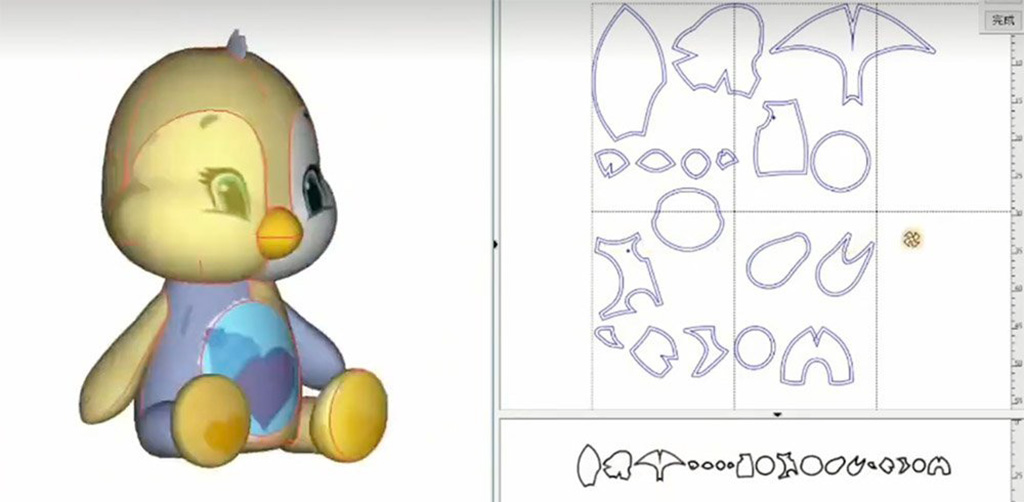
Brief interpretation risk — where the factory understands the design differently from the buyer’s intent — is the earliest risk in the production cycle and one of the most commercially significant. Mistakes made at the brief stage propagate forward through every subsequent stage: wrong proportions in the brief produce wrong proportions in the pattern, which produce wrong proportions in the sample, which require revision rounds that consume time and budget.
We reduce brief interpretation risk through a structured pre-sampling design review that resolves ambiguities and technical challenges before any physical sampling begins.
Here is what our design and brief stage risk reduction process covers:
| Brief Review Element | Risk Reduced | How We Do It |
|---|---|---|
| Scale and dimension confirmation | Wrong-size product | We confirm all specified dimensions and request clarification when scale references are ambiguous |
| Multi-view design verification | Incorrect 3D form interpretation | We identify when single-view artwork is insufficient and request additional views before pattern making begins |
| Material specification review | Material shortcut or substitution | We review all specified materials against our available certified range and flag any gaps |
| Compliance requirement identification | Missing compliance documentation, testing scope errors | We identify the applicable standards for the target market and confirm material sourcing covers those requirements |
| Design feasibility assessment | Design elements that are not producible as specified | We identify construction challenges and propose alternatives before they become sampling problems |
| Cost optimization review | Over-specified elements that add cost without quality benefit | We identify optimization opportunities and present them for buyer decision before sampling investment |
The Pre-Sampling Clarification Protocol
Before any sampling begins on a new design, our development team reviews the complete brief and produces a pre-sampling clarification document — a structured list of any elements that require buyer confirmation before pattern making proceeds.
This document identifies specific ambiguities: a pile height range where a single value is needed, a color that has no Pantone reference, a construction detail that is referenced but not specified, an accessory type that is described without specifying size or supplier code. Each item in the clarification document is a potential first-sample error if assumed rather than confirmed.
The clarification protocol adds one to three days to the pre-sampling stage. It reduces first-sample accuracy failures by eliminating the assumption-based errors that most commonly produce significant first-sample deviations. The time investment in the clarification protocol is consistently shorter than the time consumed by the additional revision rounds that unresolved ambiguities produce.
How Do We Reduce Material and Compliance Risk Before Production Begins?
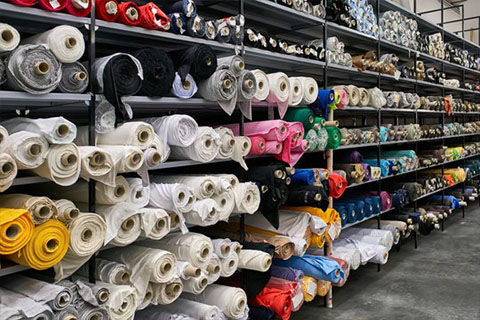
Material and compliance risk — the risk that the materials used in production are non-compliant, lower quality than specified, or different from what was approved — is one of the highest-consequence risks in plush toy manufacturing. A compliance failure discovered after bulk production is complete creates costs in the range of $5,000 to $30,000 or more. A material quality substitution that reaches customers creates brand damage that compounds through negative reviews and reduced repeat purchase.
We reduce material and compliance risk through a compliance-first material sourcing approach that addresses these risks before they can enter production:
Our Material Compliance Infrastructure
| Compliance Element | What We Do | Risk Reduced |
|---|---|---|
| Certified supplier relationships | We source fabrics and materials from suppliers who maintain current OEKO-TEX, REACH, and CPSIA-compatible documentation | Chemical compliance failures from undocumented materials |
| Per-delivery compliance verification | We verify compliance documentation at each material delivery — not just at supplier qualification | Compliance gap from expired or inapplicable certificates |
| Material change prohibition | We do not change approved materials without explicit buyer authorization | Unauthorized substitution |
| Bulk material swatch approval | We require buyer approval of bulk production swatches against the approved reference before cutting begins | Color deviation and fabric quality gaps between sample and bulk |
| D65 standardized color assessment | All fabric color assessments conducted under D65 standardized lighting | Lighting-dependent color variation |
| Roll tracking and lot management | All fabric rolls tracked to lot, lots managed in production sequence | Within-order color inconsistency |
Our Material Sourcing Risk Reduction in Practice
When a new product brief specifies materials for a target market — US, EU, or both — our material sourcing team identifies the compliance requirements before selecting any materials. For US market products, we source CPSIA-compatible fabrics with documented lead content compliance and phthalate-free accessories. For EU market products, we source REACH-compliant materials with current EN71-3 chemical documentation and OEKO-TEX-certified fabrics where required.
This compliance-first approach means that the materials entering sampling have already been verified against market requirements — so that the tested product is built on compliant materials from the beginning, rather than discovering compliance issues when testing the finished product.
When a buyer’s preferred material is not available with appropriate compliance documentation for their target market, we identify this at the brief review stage and present compliant alternative options — before any investment has been made in sampling with the non-compliant material.
How Do We Reduce Development Risk Through Our Sampling Process?
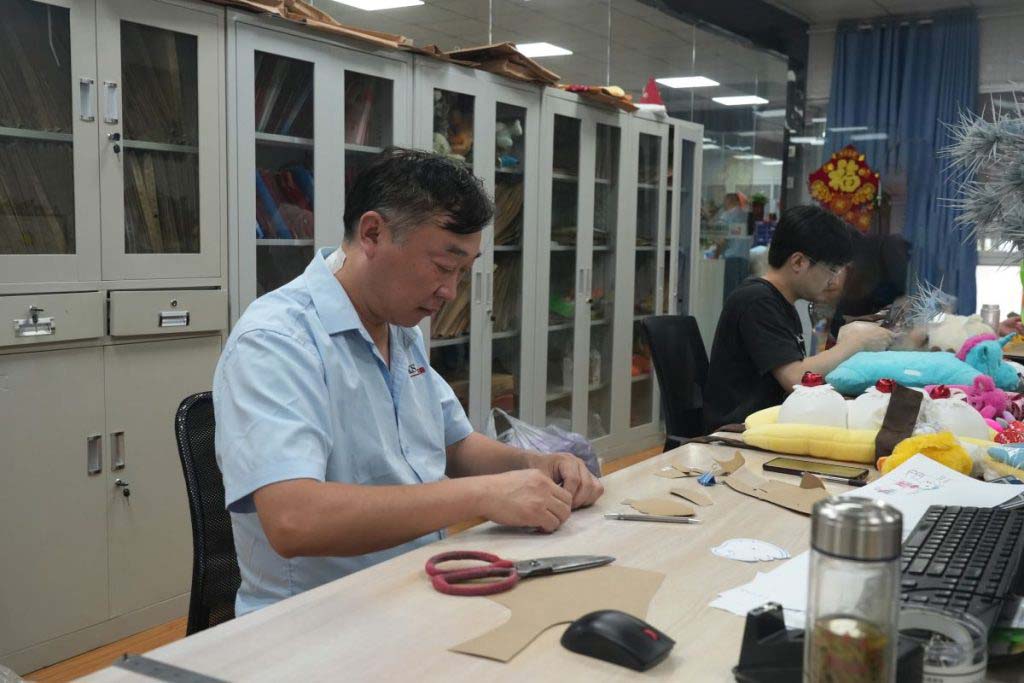
Development risk — the risk that sampling produces inaccurate prototypes requiring excessive revision rounds, extends the development timeline, and consumes more budget than planned — is reduced through the specific sampling process capabilities that distinguish professional development from improvised sampling.
Here is how our sampling process addresses each component of development risk:
Development Accuracy Risk
| Process Element | Risk Addressed | How We Do It |
|---|---|---|
| Dedicated experienced pattern makers | Pattern engineering errors that compound across revision rounds | Our pattern team works exclusively on development — not production workers handling sampling as secondary duty |
| Multi-view design reference | Incorrect 3D form interpretation | We work from front, back, and side views — requesting additional references when the brief does not provide complete 3D guidance |
| Proportion engineering expertise | Stuffed proportions differ from design intent | Our pattern makers adjust panel dimensions to account for stuffing effect — producing correct proportions in the finished product |
| Deviation documentation | Buyer unaware of what changed between brief and sample | We document every deviation from brief in our sample dispatch communication |
| Action list confirmation | Revision items addressed partially or incorrectly | We confirm a specific action list with the buyer before beginning any revision — preventing misunderstood or missed items |
| Revision convergence discipline | Circular revision patterns — same problems recurring | We track each revision item to confirmed resolution before closing the revision stage |
Counter Sample — Our Standard Pre-Production Step
The counter sample — a prototype built under actual bulk production conditions using the approved bulk materials — is our standard requirement before any production is authorized. It is not an optional additional service. It is the step that bridges the gap between sample-stage development and production-scale manufacturing.
Our counter sample process:
| Counter Sample Step | What It Confirms | Why It Matters |
|---|---|---|
| Built with approved bulk materials | Material quality consistent between sample and bulk | Prevents material shortcut from appearing only in bulk |
| Constructed by production operators | Production team can replicate approved quality | Identifies operator skill gaps before production investment |
| Assembled on production equipment | Equipment produces correct quality at production settings | Identifies calibration requirements before run begins |
| Compared against approved sample | All quality dimensions verified | Catches any dimension where production environment cannot replicate sample |
| Weight measured | Filling density achievable in production | Confirms density specification is calibrated before run |
| Buyer approved before production authorization | Buyer confirms production-ready quality | Prevents sample-to-bulk quality gap from surprising buyer at delivery |
When the counter sample reveals a gap between the approved sample and production-environment quality — which happens — we address the gap before production is authorized rather than after it has affected the full batch. This may require equipment recalibration, material adjustment, or work instruction refinement — each of which is far less expensive at the counter sample stage than at the post-production stage.
How Do We Reduce Production Quality Risk Through Our Quality Management System?

Production quality risk — the risk that the bulk production run does not meet the quality standard established in the approved sample — is the category of risk that most directly determines what customers experience when the product reaches them. Managing it requires a quality management system that is designed to prevent quality failures during production rather than discover them afterward.
Our quality management system addresses production quality risk through a complete three-stage structure:
Stage 1 — Incoming Quality Control (IQC)
Before any material enters production, it is verified against the approved specification.
| IQC Activity | What Is Checked | Risk Reduced |
|---|---|---|
| Per-roll fabric inspection | Color against approved swatch under D65, pile height measurement | Fabric quality deviation entering production |
| Compliance documentation review | Current certificates for all materials | Non-compliant materials entering production |
| Filling material verification | Loft, whiteness, contamination check | Filling quality below specification |
| Accessory dimensional check | Size and color against specification | Wrong accessories built into production |
| Roll tracking log | Each roll assigned to lot, cutting sequence planned | Unmanaged within-order color variation |
Stage 2 — In-Process Quality Control (IPQC)
Throughout the production run, quality is monitored at defined intervals to catch drift before it accumulates.
| IPQC Activity | Interval | What Is Detected | Corrective Action |
|---|---|---|---|
| Fill weight monitoring | Every 150–200 units | Stuffing density drift | Machine recalibration |
| Embroidery position check | Every 50 units | Position drift across run | Hoop adjustment |
| Fabric roll transition check | Every new roll | Color variation between rolls | Roll hold or strategic mixing |
| Seam quality inspection | Every 90 minutes | Stitch tension changes | Machine adjustment |
| Accessory pull force test | Every 2 hours | Attachment technique drift | Operator technique reinforcement |
| Pre-closing distribution check | Every 50–100 units | Filling distribution before sealing | Manual redistribution before close |
Stage 3 — Final Quality Control (FQC)
Before shipment is authorized, a statistically adequate sample from the completed batch is inspected against all quality criteria.
| FQC Activity | AQL Level | What Is Verified |
|---|---|---|
| Unit weight check | AQL 2.5 | Batch density consistency |
| Shape assessment | AQL 2.5 | Batch shape consistency against counter sample |
| Color accuracy | AQL 2.5 | Batch color consistency against approved swatch |
| Embroidery accuracy | AQL 2.5 | Feature position and quality |
| Seam integrity | AQL 1.5 | Seam strength across batch |
| Accessory pull test | AQL 1.5 | Attachment security |
| Label compliance | AQL 2.5 | Correct content and placement |
| Packaging check | AQL 4.0 | Packaging specification compliance |
Independent QC Authority
Our QC team reports to management independently of production — not to production supervisors with throughput targets. This structural independence ensures that quality decisions are made on quality grounds rather than being compromised by production pressure when the two conflict.
When our FQC assessment identifies a batch failing the AQL threshold, production does not ship until the issue is resolved — regardless of the timeline pressure this creates. The quality standard is not negotiable against delivery urgency.
How Do We Reduce Communication Risk Through Our Production Transparency Approach?
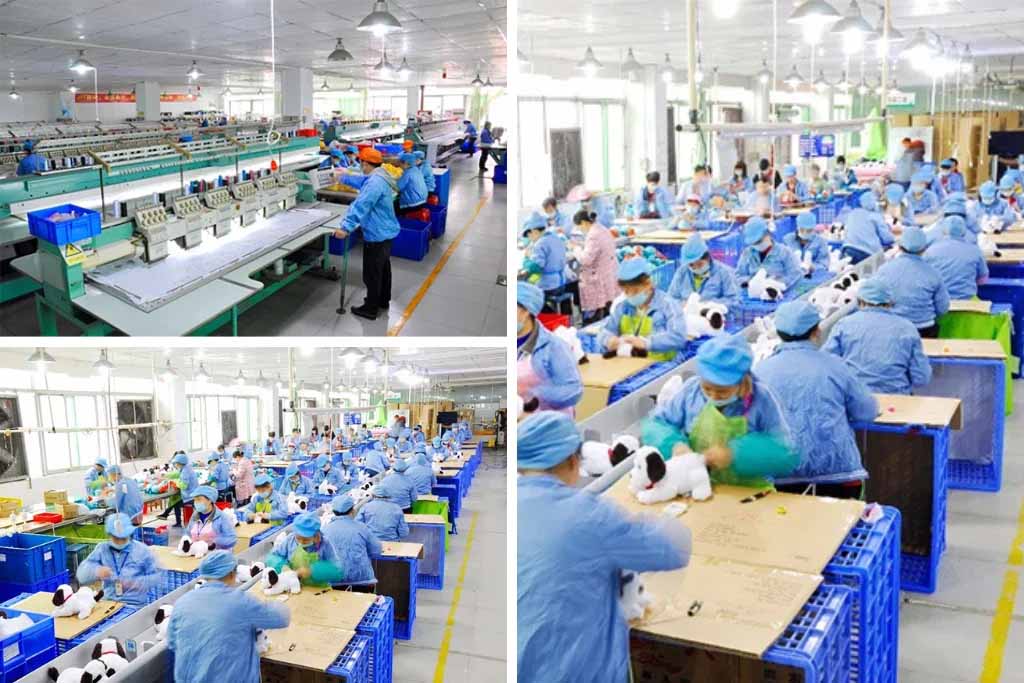
Communication risk — the risk that problems develop during production without the buyer’s knowledge, compounding before the buyer has the opportunity to respond — is one of the most commercially damaging risks in remote manufacturing relationships. Its commercial impact is not primarily the communication failure itself but the compounding that occurs in its absence: a problem that is disclosed when it develops costs far less to manage than the same problem disclosed after it has affected the full production batch.
We reduce communication risk through a proactive production transparency protocol that provides buyers with documented production information at defined milestones — without waiting for buyers to ask.
Here is our standard production communication schedule:
| Communication Event | Timing | Content | Format |
|---|---|---|---|
| Pre-production confirmation | Before production day 1 | Materials IQC passed, counter sample placed at QC station, work instructions distributed, production schedule confirmed | Written report |
| First-off inspection report | Production day 1 | First completed units assessed against counter sample — photos of first-off units with quality notes | Written report with photos |
| Early IPQC summary | Day 2–3 of production | Initial weight measurements, embroidery position checks, any early findings | Written summary with data |
| 25% completion update | At 25% production | Progress, any quality findings, timeline status | Written update |
| 50% completion update | At 50% production | IPQC summary to date, production pace, any issues and corrective actions | Written report with IPQC data |
| 75% completion update | At 75% production | Production status, timeline confirmation, any late-stage findings | Written update |
| Production completion notification | At 100% production | Completion confirmed, FQC scheduled | Written notification |
| FQC report | After FQC completion | Complete inspection results with photos — before balance payment request | Formal inspection report |
| Shipment notification | Day of shipment | Tracking information, complete shipping documentation | Written notification with documents |
Our Problem Disclosure Commitment
Our communication standard requires immediate disclosure of any quality finding that may affect the batch result — not at the next scheduled milestone update but as soon as the finding is identified.
When an IPQC weight check reveals a density deviation outside tolerance, we notify the buyer immediately — explaining what was found, what corrective action is being taken, and what the expected scope of affected units is. When a fabric roll transition reveals a color variation that falls outside the approved tolerance, we notify the buyer with the options available — hold the roll and source replacement, accept with documented deviation, or implement a strategic mixing approach.
This immediate disclosure commitment is operationally demanding — it requires QC personnel to communicate findings to project managers immediately rather than waiting for scheduled reporting. We maintain this standard because we understand that immediate disclosure preserves the buyer’s ability to participate in the resolution decision — while delayed disclosure eliminates that ability and forces the buyer into reactive management of a problem that has already compounded.
How Do We Reduce Delivery and Timeline Risk?
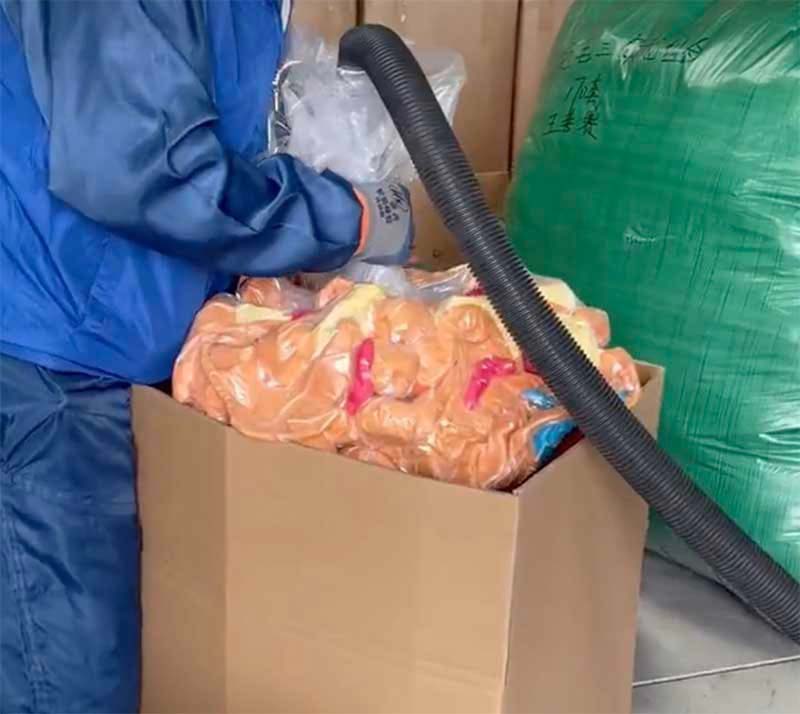
Timeline risk — the risk that production is delayed and goods arrive after the buyer’s target window — creates commercial consequences that extend beyond the delay itself: expedited freight costs, missed seasonal selling windows, retailer commitment failures, and the cascade of downstream disruptions that late delivery causes.
We reduce timeline risk through proactive production scheduling, buffer planning, and early intervention when production pace creates a risk of timeline deviation.
Here is our timeline risk reduction framework:
| Risk Reduction Element | How It Works | Risk Reduced |
|---|---|---|
| Pre-production scheduling | Production scheduled before order is confirmed — not after — confirming factory capacity is available | Last-minute capacity unavailability |
| Timeline buffer planning | We build 10–15% buffer into production timelines — accounting for QC correction events that always take some time | Timeline overrun from inevitable quality corrections |
| Material lead time management | Materials sourced and IQC-cleared before production start date — not during production | Material sourcing delay disrupting production schedule |
| Early IPQC pace monitoring | Production rate tracked against planned rate from day one | Late discovery of pace shortfall |
| 25% timeline check | At 25% completion, we assess whether the pace supports on-time completion — if not, options are discussed immediately | Discovery at 75% that timeline cannot be met |
| Supplier relationship management | Established relationships with logistics providers — consistent transit time estimates | Freight booking uncertainty |
| Complete shipping documentation preparation | All compliance and shipping documents prepared before production completion — not scrambled together at shipping | Documentation delays holding shipment |
Timeline Risk Communication
Timeline risk is only manageable when it is identified early. Our production pace monitoring — tracking completed units against the planned daily rate from the first day of production — identifies pace shortfalls when they are small enough to address through manageable interventions: short overtime extensions, workstation additions, or minor process adjustments.
When a pace shortfall is identified and confirmed at the 25 percent milestone, we present the buyer with a specific options assessment: what interventions are available, what each costs, what timeline recovery each enables, and what the production and cost implications of each option are. This early assessment gives the buyer the information and the lead time to make an informed decision — rather than discovering at 80 percent completion that the delivery date cannot be met.
How Do We Support Buyers in Managing Risk Across the Full Project Lifecycle?

Risk management in plush toy manufacturing is not a one-time intervention — it is a continuous discipline that spans every stage of the project lifecycle, from initial design through sampling, production, shipment, and into the reorder cycles that follow. Our role in risk management extends across this full lifecycle rather than being limited to the production stage.
Here is how we support buyers across the complete project risk management lifecycle:
Pre-Development Risk Support
| Support Activity | Risk Addressed | How We Provide It |
|---|---|---|
| Market compliance guidance | Wrong compliance scope for target market | We identify applicable standards at project initiation |
| Design feasibility assessment | Design elements not producible as specified | We review design before brief submission and flag challenges |
| Cost optimization review | Budget exceeded by over-specified elements | We identify cost optimization opportunities before sampling |
| Material compliance planning | Non-compliant materials entering sampling | We confirm compliance availability before material direction is finalized |
Sampling Stage Risk Support
| Support Activity | Risk Addressed | How We Provide It |
|---|---|---|
| Brief clarification protocol | Interpretation ambiguities | We produce a clarification document before pattern making begins |
| Deviation documentation | Buyer unaware of changes from brief | We document all deviations in sample dispatch communication |
| Action list confirmation | Revision items missed or misunderstood | We confirm specific action list before each revision begins |
| Counter sample as standard | Sample-to-bulk quality gap | Counter sample is mandatory before production authorization |
Production Risk Support
| Support Activity | Risk Addressed | How We Provide It |
|---|---|---|
| Full three-stage QC system | Production quality failures | IQC, IPQC, and FQC applied to every production run |
| Proactive milestone communication | Late problem discovery | Nine defined communication events across every production run |
| IPQC documentation sharing | Invisible quality drift | IPQC logs shared as standard production documentation |
| Third-party inspection facilitation | Independence of quality verification | We coordinate SGS/Intertek inspection for any client who requests it |
Post-Production and Reorder Risk Support
| Support Activity | Risk Addressed | How We Provide It |
|---|---|---|
| Tech pack archive maintenance | Reorder quality drift from lost standards | We maintain complete tech packs for all active products |
| Reference swatch retention | Reorder color inconsistency | We retain approved reference swatches for all active products |
| Reorder material swatch pre-approval | Reorder fabric batch variation | We require swatch comparison before bulk reorder material is ordered |
| IQC record archive | Traceability for any quality issue | We maintain IQC records for all production runs |
| Production history continuity | Knowledge loss between orders | All production knowledge is documented — not held by individual personnel |
Our Risk Management Commitment in Practice
The risk management systems described in this guide are not claimed as capabilities we may sometimes apply. They are documented operational standards that we apply to every production run for every client at every order volume.
A 300-unit first order receives the same IQC, IPQC, and FQC process as a 5,000-unit established product order — because the risk of a quality failure is not proportional to order size, and the investment in quality management systems is already made regardless of individual order volume.
A new client relationship receives the same pre-sampling brief review, counter sample requirement, and production milestone communication as a long-established client — because risk management capability is built into our process rather than being a premium service extended selectively.
We believe that the consistency of our risk management application — not just its existence — is what builds the manufacturing relationships that produce consistent quality outcomes across multiple orders, multiple product types, and varying production conditions.
If you are evaluating manufacturing partners and want to understand specifically how our risk management approach would apply to your product and your sourcing situation — what our brief review process would find in your current design, what compliance requirements apply to your target markets, what our counter sample process looks like for products like yours, and what our production communication would provide throughout your order — we would be glad to have that specific conversation.
Reach out to our team at [email protected] or visit kinwintoys.com to start that conversation.
Conclusion
Manufacturing risk in plush toy production is not an unavoidable feature of sourcing from overseas factories. It is a manageable portfolio of specific risks, each with specific prevention mechanisms that either exist in a factory’s operational system or do not.
At Kinwin, risk reduction is not a service we offer on top of manufacturing. It is the organizational purpose that has shaped every system we have built — from the brief review protocol that prevents design intent from being misunderstood, through the compliance-first material sourcing that prevents testing failures, through the counter sample requirement that prevents sample-to-bulk quality gaps, through the IPQC monitoring that prevents quality drift from accumulating invisibly, through the proactive communication that prevents problems from compounding in the dark.
The commercial benefit of working with a manufacturing partner whose risk management is genuinely operational rather than rhetorically claimed is not primarily visible in any single order. It becomes visible across multiple orders — in the consistent quality that builds positive review sentiment, in the reliable timelines that support seasonal planning, in the compliance documentation that enables market entry and retail partnerships, and in the reorder consistency that maintains the brand standards that customer relationships are built on.
This is the manufacturing foundation that brand growth requires. It is what we are built to provide.
FAQ
Q1: How does Kinwin’s risk management approach change when a buyer is placing a first order versus a reorder of an established product?
The core risk management structure — brief review, IQC, counter sample, IPQC, FQC, and milestone communication — is identical for first orders and reorders. What changes between first orders and reorders is the efficiency with which each stage is executed, because reorders benefit from the institutional knowledge accumulated in the original project. For reorders, the brief is already finalized and archived — the starting point is confirming that no changes are needed rather than building from scratch. The counter sample is built with reorder materials and compared against the retained original counter sample rather than the approved development sample — which provides a more production-relevant reference. The IQC for reorder materials includes a comparison against the retained reference swatches from the original production run — adding a reorder-specific consistency check that first-order IQC does not require. And the production communication builds on the established quality baseline from the original run — referencing the original IPQC weight averages and FQC results as the comparison standard for the reorder’s quality performance.
Q2: What specific evidence can buyers request from Kinwin to verify that the risk management systems described are genuinely operational rather than claimed?
We welcome and encourage evidence requests — because our operational systems produce the documentation that such requests require, and providing that documentation is both consistent with our transparency commitment and useful for buyers making informed supplier decisions. Specific evidence we can provide includes: IQC inspection reports from recent production runs (covering color assessment results, pile height measurements, compliance documentation verification, and roll tracking logs); IPQC weight monitoring logs from recent production runs showing the specific weight measurements recorded at each interval; FQC inspection reports with photographs from recent production runs; pre-sampling clarification documents from recent development projects; and counter sample comparison documentation from recent pre-production authorizations. For buyers who want reference-based evidence rather than documentation review, we can provide introductions to existing clients who have placed multiple orders with us and who can speak specifically to their experience with our quality management and communication systems.
Q3: How does Kinwin manage risk when a project involves materials or product types that fall outside its standard production range — for example, electronic components or unusual filling materials?
When a project involves elements outside our standard production range, our risk management approach adds a specific capability assessment step at the project initiation stage — before any development commitment is made. For electronic components, this assessment evaluates whether our production facility has the assembly capability, testing equipment, and regulatory knowledge (IEC 62115, FCC Part 15) required for the specific component type, and whether our material supplier network can source the component with appropriate compliance documentation. For unusual filling materials, we assess the material’s performance characteristics, compliance profile, and our stuffing equipment’s compatibility with the material. If the assessment identifies a genuine capability gap — we do not have the production infrastructure to manage this specific element at the quality standard our clients require — we disclose this honestly rather than accepting the project and discovering the limitation during production. In some cases, we can bridge capability gaps through subcontractor relationships with verified specialists for the specific element. In others, we recommend that the buyer source the element independently and provide it to us for integration, or that the buyer source the complete product from a factory with specialist capability in that area.
Q4: What happens to Kinwin’s risk management approach when production timeline is under pressure — does quality monitoring get reduced to maintain pace?
Our quality management standards are explicitly not subject to timeline pressure adjustment. Our QC team reports independently of production management — which means production pressure cannot be applied to QC to reduce inspection intervals or skip verification steps. When production pace falls behind schedule, the options available are increasing production throughput (additional shifts, workstation resources) or adjusting the delivery timeline — not reducing quality monitoring frequency. We maintain this position because we understand that the quality failures that result from reduced monitoring under timeline pressure are consistently more expensive to manage than the delivery delay that monitoring would have created. Timeline adjustments are commercially inconvenient. Quality failures that reach customers are commercially damaging in ways that extend beyond the immediate order. Our clients’ brands are protected by this position, even when the timeline implications are uncomfortable in the short term.
Q5: How does Kinwin’s risk management approach support buyers who are entering a new market for the first time and may not know all the compliance requirements that apply to their products?
Compliance risk for buyers entering new markets is one of the areas where our manufacturing partnership extends beyond production execution into active guidance. At the project initiation stage for any product targeting a new market, we provide a compliance overview specific to that market and product type — identifying the applicable safety standards, chemical compliance requirements, labeling obligations, and documentation requirements. For US market entry, this includes CPSIA requirements, ASTM F963 test scope, CPSC tracking label requirements, and the Children’s Product Certificate preparation process. For EU market entry, it includes EN71 Parts 1–3, CE Declaration of Conformity requirements, REACH compliance documentation, and UKCA requirements for UK distribution. This guidance is based on our production experience with these markets — but we always recommend that buyers with significant compliance concerns engage a compliance specialist or accredited testing laboratory for definitive regulatory advice, since compliance requirements can change and our guidance reflects our production knowledge rather than legal interpretation. What we ensure operationally is that the materials we source and the products we build meet the requirements we have identified — and that the documentation we provide is organized and complete for the markets we are producing for.