Manufacturing risk in plush toy production does not arrive as a single event that can be managed with a single intervention. It arrives as a series of interconnected possibilities — each located at a specific stage of the production process, each with a specific probability and a specific consequence, each requiring a specific control mechanism to prevent or mitigate.
Managing these risks effectively requires a workflow — a structured sequence of risk identification, assessment, control action, and verification that proceeds systematically through every stage of production rather than responding reactively to problems as they emerge. The difference between a reactive approach and a workflow approach is the difference between managing problems after they have compounded and preventing them before they develop.
A reactive approach manages risk through inspection — catching defects after they have been produced and addressing them through rework, rejection, or commercial negotiation. It catches problems, but always after production investment has been made in the defective output, and often after the scope of the problem has grown larger than early intervention would have produced.
A workflow approach manages risk through prevention and early detection — addressing the conditions that produce defects before those defects occur, and catching any defects that slip through prevention at the earliest possible stage. It prevents more problems from occurring, catches those that do occur earlier and at lower remediation cost, and creates a documented record of the risk management activities that were applied.
At Kinwin, our risk control workflow is the operational backbone of every production project — not a set of principles we apply when problems arise but a structured process we follow from project initiation through final delivery. This guide explains what that workflow looks like at each stage, what it controls, and how it creates the predictable quality outcomes that brands depend on.
What Is a Risk Control Workflow in Plush Manufacturing and Why Does Structure Matter?
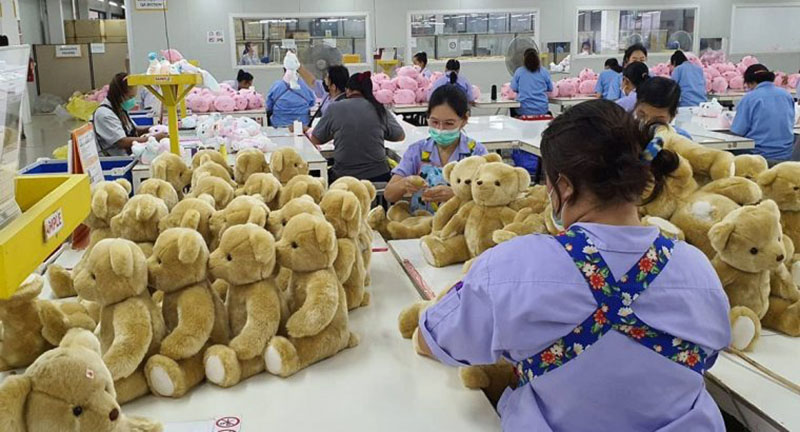
A risk control workflow in plush manufacturing is a documented, stage-by-stage process that identifies the quality, compliance, timeline, and commercial risks present at each production stage, applies specific control actions to prevent or mitigate each risk, and verifies that each control has been effective before the project advances to the next stage.
Structure matters because manufacturing risk is not uniform across the production timeline — different risks are most efficiently controlled at specific stages, and the cost of managing a risk escalates dramatically as the project advances past the stage where it was most controllable. A material compliance risk that costs $200 to prevent through certified material sourcing at the brief stage costs $15,000 to remediate as a batch failure at the post-production testing stage. A brief ambiguity that costs 30 minutes to resolve in a pre-sampling clarification conversation costs three weeks of revision rounds to discover as a first-sample error.
Without a structured workflow, these stage-specific risk opportunities are not systematically identified or addressed. Problems that could have been prevented at low cost in early stages are discovered at high cost in late stages — not because the factory was careless but because the process did not include the specific action at the specific stage that would have caught the problem earlier.
Here is the complete risk control workflow overview:
| Stage | Primary Risks | Control Mechanism | Verification Method |
|---|---|---|---|
| Project initiation | Scope ambiguity, compliance gap, timeline misalignment | Risk identification checklist, compliance mapping | Project brief confirmation |
| Design and brief | Interpretation error, design infeasibility, material unavailability | Brief review protocol, feasibility assessment | Pre-sampling clarification document |
| Material sourcing | Non-compliant materials, grade substitution, supply gap | Certified supplier network, swatch pre-approval | IQC documentation |
| Sampling | Pattern engineering error, construction inaccuracy, material deviation | Dedicated development team, deviation documentation | Sample approval with comparison checklist |
| Counter sample | Production environment quality gap | Production-condition prototype | Counter sample comparison report |
| Production start | Setup error, calibration failure, operator readiness | First-off inspection | First-off inspection report |
| Production run | Quality drift, material variation, pace shortfall | IPQC monitoring, pace tracking, communication protocol | IPQC logs, milestone updates |
| Pre-shipment | Batch quality failure, documentation gap, compliance failure | FQC, third-party inspection, documentation review | Inspection report, documentation checklist |
| Export | Shipping mark error, document error, logistics failure | Pre-shipment documentation review, logistics pre-booking | Documentation verification, booking confirmation |
How Is Risk Identified and Assessed Before a Project Begins?
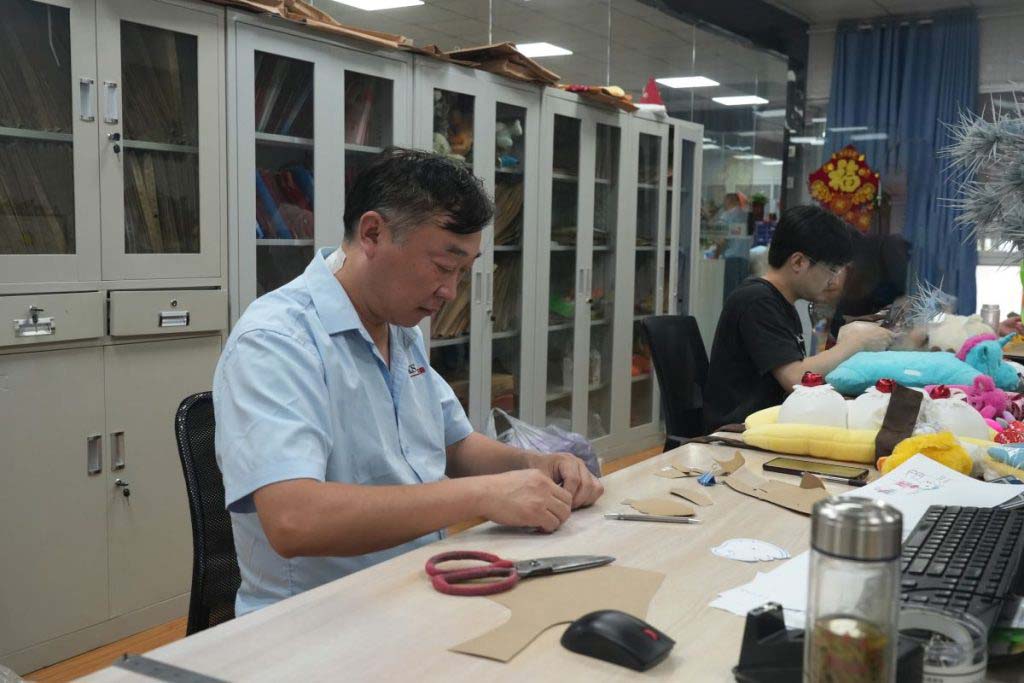
Risk identification before a project begins is the most commercially valuable risk management activity available — because risks identified at project initiation can be prevented at the lowest cost of any stage, and because some risks identified at this stage may affect the fundamental viability or design of the project in ways that are important to know before any development investment is made.
Our pre-project risk identification process covers four categories: product risk (risks related to the specific design and its producibility), compliance risk (risks related to the target market’s regulatory requirements and the materials and construction needed to meet them), timeline risk (risks that the intended timeline is not achievable given the project’s requirements), and commercial risk (risks that the expected cost, quality, or delivery outcomes will not be achievable at the intended economics).
Here is our pre-project risk identification framework:
Product Risk Assessment
| Risk Question | Risk Identified | Control Action |
|---|---|---|
| Does the design complexity exceed our standard development capability? | Development accuracy risk | Flag specific design elements requiring specialist approach |
| Are any design elements not producible as specified? | Design feasibility risk | Identify and propose alternatives before sampling begins |
| Does the design use construction approaches with known quality challenges? | Production quality risk | Specify enhanced QC measures for known challenge areas |
| Are the intended proportions achievable with the specified materials? | Material-design compatibility risk | Test material-proportion interaction in first sample |
Compliance Risk Assessment
| Risk Question | Risk Identified | Control Action |
|---|---|---|
| What markets will this product enter? | Market-specific compliance requirement | Map all applicable standards before material sourcing |
| Are the intended materials compliant with all target market requirements? | Chemical compliance risk | Source certified materials before sampling begins |
| Does the product category or design create additional compliance requirements? | Category-specific compliance risk | Identify and plan for full compliance scope |
| Is the age grade designation correct for the design’s safety characteristics? | Age grade compliance risk | Confirm age grade before specifying test scope |
| Are there electronic components requiring additional certification? | Electrical/radio compliance risk | Identify FCC, CE Radio, electrical safety requirements |
Timeline Risk Assessment
| Risk Question | Risk Identified | Control Action |
|---|---|---|
| Is the delivery timeline achievable given design complexity and sampling requirements? | Timeline compression risk | Identify minimum development time and flag conflicts |
| Are the required materials available within the lead time the timeline allows? | Material availability risk | Confirm material availability before committing to timeline |
| Does the compliance testing timeline fit within the overall project timeline? | Testing timeline risk | Initiate testing at sampling stage, not post-production |
| Is production capacity available at the required production start date? | Capacity availability risk | Reserve production capacity at project initiation |
Commercial Risk Assessment
| Risk Question | Risk Identified | Control Action |
|---|---|---|
| Is the target unit cost achievable with the specified design and materials? | Cost feasibility risk | Design review for cost optimization before sampling |
| Does the design have elements that will significantly exceed the budget? | Cost overrun risk | Identify high-cost elements and present alternatives |
| Are there elements that will require minimum order quantities above the planned volume? | MOQ feasibility risk | Confirm all component MOQs at brief review stage |
How Are Risks Controlled at the Design and Brief Stage?
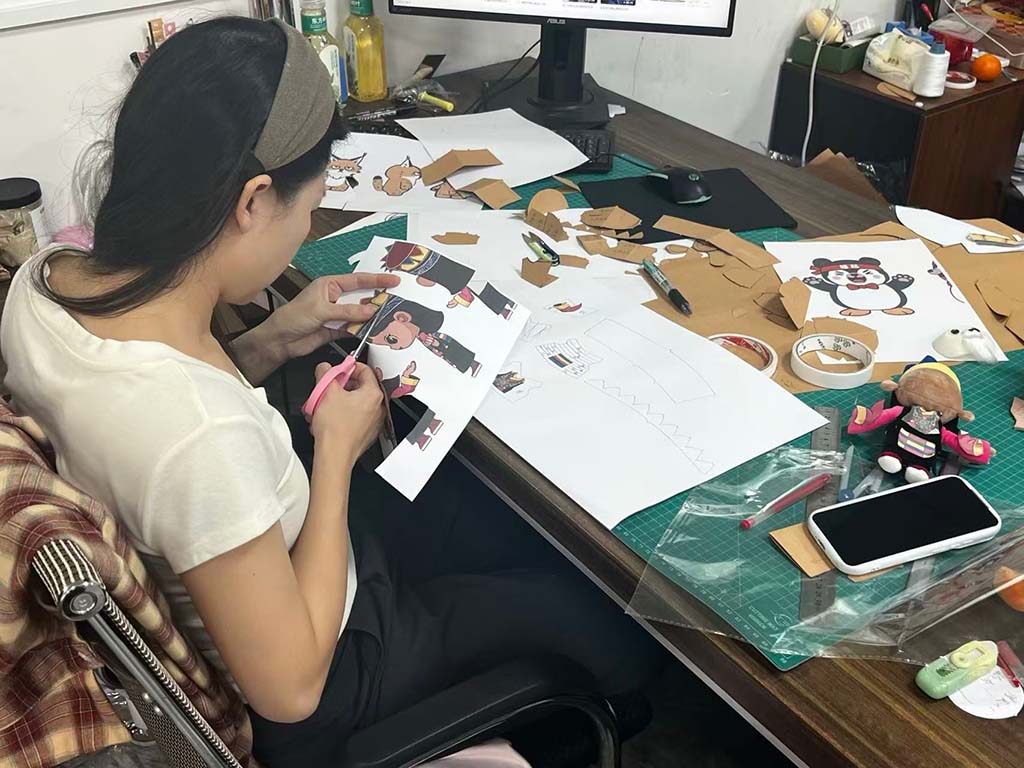
The design and brief stage is where the production project’s quality and cost outcomes are most powerfully determined — and where the highest concentration of preventable problems originate. Design ambiguities that are not resolved before sampling begins produce first-sample errors that require revision rounds. Design elements that are not feasibility-assessed before development begins produce mid-sampling discoveries that require redesign. Material specifications that are not confirmed before sampling begins produce material-related quality problems that require additional rounds.
Our design and brief stage risk control applies a structured protocol that systematically resolves each category of brief-stage risk before any sampling investment is made:
Brief Completeness Verification
| Brief Element | Risk if Missing | Verification Action | Output |
|---|---|---|---|
| Multi-view design reference | 3D form interpretation error | Request front, side, and back views | Complete reference set confirmed |
| Scale specification | Wrong-size product | Confirm specific dimensions in defined reference | Written dimension confirmation |
| Color references — Pantone | Color deviation requiring revision | Confirm Pantone TPX code for all colors | Color specification table |
| Material specification — grade and type | Material substitution, quality gap | Confirm pile height, grade, certification | Material specification confirmed |
| Accessory specification | Wrong accessories, character expression error | Confirm size, style, color, supplier code | Accessory specification confirmed |
| Compliance requirements | Non-compliant materials, testing gap | Map applicable standards for all target markets | Compliance requirement document |
| Construction notes | Default construction produces wrong result | Identify any specific construction requirements | Construction specification notes |
Design Feasibility Assessment
Our pattern making team reviews every design brief for feasibility before sampling begins — identifying elements that present specific production challenges and proposing solutions before the challenges produce sampling failures.
| Feasibility Assessment Area | What We Check | Risk Controlled |
|---|---|---|
| Proportion achievability | Whether intended proportions are achievable with specified materials at specified scale | Proportion engineering failure risk |
| Panel complexity | Whether the design requires specialist panel engineering and what approach | Complex design first-sample accuracy risk |
| Material-design interaction | Whether specified materials will produce the intended visual and tactile result | Material-design mismatch risk |
| Embroidery feasibility | Whether embroidery elements are achievable at the specified size and pile height | Embroidery quality failure risk |
| Accessory attachment points | Whether attachment points are structurally sound for safety test requirements | Safety test failure risk |
Pre-Sampling Clarification Document
Our pre-sampling clarification document is the output of the brief review process — a structured list of every element that requires buyer confirmation before pattern making begins. Every item in this document is a potential first-sample error if assumed rather than confirmed.
This document is shared with the buyer at the beginning of the development relationship, responses are confirmed in writing, and the confirmed responses become part of the project specification record that governs all subsequent development and production decisions.
How Are Risks Controlled at the Material Sourcing and IQC Stage?
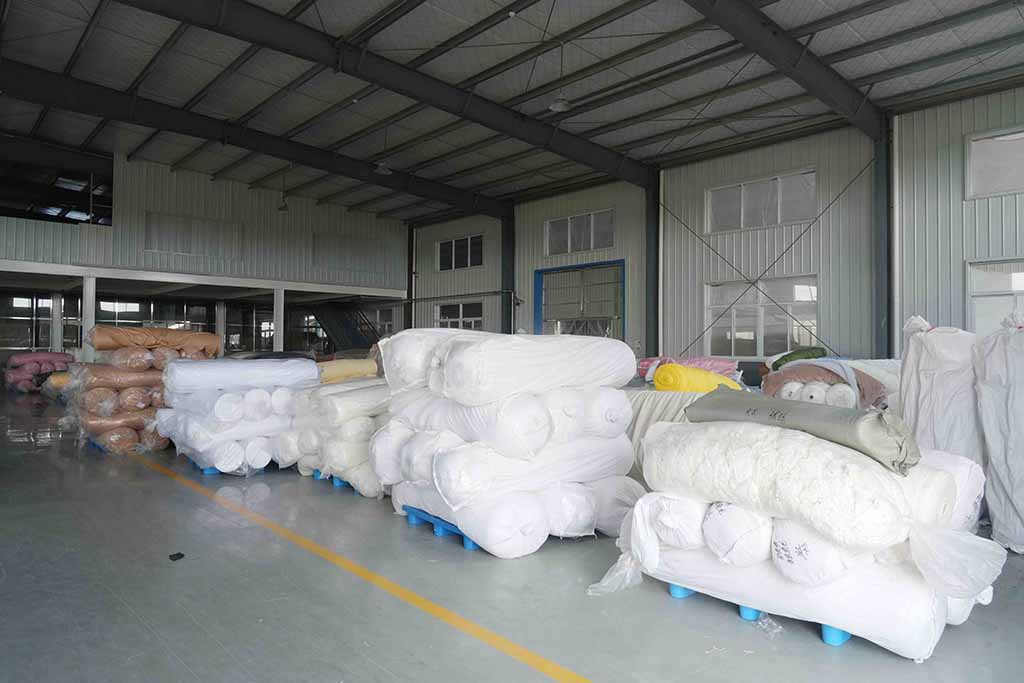
Material sourcing and IQC is the stage where the compliance and quality characteristics of the production materials are established — and where the most expensive downstream risks can be prevented most cost-efficiently. A material compliance failure that is caught at IQC prevents a batch-level compliance failure that would cost 50 to 100 times more to manage. A material quality deviation caught at IQC prevents the quality failure that would produce the same deviation in every unit of the production run.
Our material sourcing and IQC risk control operates through a certified supplier network, a mandatory swatch pre-approval process, and a per-roll incoming inspection protocol:
Certified Supplier Network Management
| Supplier Risk | Control Mechanism | Verification |
|---|---|---|
| Non-compliant fabric chemicals | Source only from suppliers with current OEKO-TEX, REACH documentation | Certificate verification at each delivery |
| Filling material contamination | Source from certified filling suppliers with quality documentation | IQC physical assessment |
| Accessory compliance failure | Source safety accessories with pull force test documentation | Documentation verification at IQC |
| Supplier substitution without notification | Approved supplier list with change authorization requirement | Delivery documentation verification |
Swatch Pre-Approval Protocol
Before any bulk fabric order is placed, we request swatches from the proposed fabric lot and compare them against the approved reference swatch under D65 standardized lighting. This pre-approval step catches color and quality deviations before the bulk order is placed — when sourcing alternatives is still possible without production delay.
| Pre-Approval Step | Risk Controlled | When Conducted |
|---|---|---|
| Swatch request from proposed fabric lot | Color deviation risk before bulk commitment | Before bulk fabric order placement |
| D65 comparison to approved reference | Lighting-independent color accuracy | At swatch receipt |
| Pile height spot measurement | Pile specification compliance | At swatch receipt |
| Compliance documentation request | Material compliance risk | Before order authorization |
| Bulk order placement authorization | Unauthorized fabric ordering | After all pre-approval criteria confirmed |
Per-Roll IQC Protocol
When bulk fabric arrives, every roll is individually assessed against the approved specification — not sampled at the delivery level and assumed to be uniform.
| IQC Check | Method | Pass/Fail Criterion | Risk if Skipped |
|---|---|---|---|
| Color comparison — D65 | Each roll compared to approved swatch | Within approved Pantone tolerance | Within-order color variation |
| Pile height measurement | Physical measurement in mm | Within ±1mm of specification | Surface quality inconsistency |
| Surface quality scan | Visual inspection of first 3 meters and roll end | Zero visible defects | Defects built into production |
| Width measurement | Physical measurement | Within ±0.5cm | Cutting yield and dimension impact |
| Pile direction check | Physical directional assessment | Consistent throughout | Pile direction inconsistency |
| Compliance documentation verification | Certificate review | Current and applicable | Compliance test failure risk |
Roll Tracking and Lot Management
Every incoming roll is assigned to its dye lot, documented in our roll tracking log, and allocated to the production sequence in a lot-consistent plan — ensuring that lot transitions occur at managed points with verification rather than as uncontrolled events within the production flow.
How Are Risks Controlled at the Sampling and Counter Sample Stage?

The sampling stage is the development phase that establishes the product standard — and the risk controls applied here determine whether that standard is correctly established and accurately documented before the production investment is committed. The two distinct sampling stage risks are development accuracy risk (the sample does not accurately represent the design intent) and production prediction risk (the approved sample does not accurately predict what bulk production will deliver).
Our sampling stage risk control addresses both:
Development Accuracy Risk Control
| Risk | Control Action | Verification |
|---|---|---|
| Pattern engineering error | Dedicated experienced pattern makers on every design | First sample proportion and form assessment |
| Material deviation from specification | Pre-confirmed material availability, correct material sourced before sampling | Material comparison to specification at sample receipt |
| Construction approach error | Pre-sampling clarification of construction requirements | Construction assessment at sample receipt |
| Revision item missed | Written action list confirmation before each revision | Checklist comparison at revision receipt |
| Revision circularity | Root cause analysis when same problem recurs | Structural problem identification |
Sample Deviation Documentation
Every sample is dispatched with a deviation documentation report — a written record of every element in the physical sample that differs from the design brief, accompanied by photographs and specific measurements where relevant.
This documentation serves three functions: it informs the buyer of any differences between the brief and the sample that require decision rather than assumption, it creates a record of each design decision as it is made, and it prevents the approval of samples that contain undisclosed deviations that will propagate into production as unintended product characteristics.
Counter Sample — Production Prediction Risk Control
The counter sample is the specific control mechanism for production prediction risk — the risk that the approved development sample does not accurately predict bulk production quality.
| Counter Sample Element | Risk Controlled | Method |
|---|---|---|
| Built with approved bulk materials | Material character gap between sample and bulk | Bulk material IQC cleared before counter sample construction |
| Built by production operators | Operator skill gap revealed before commitment | Production team constructs counter sample |
| Built on production equipment | Equipment calibration gap revealed | Production machines at production settings |
| Fill weight measured | Density achievability confirmed | Weight comparison to specification |
| Full comparison to approved sample | All quality dimensions verified | Systematic comparison checklist |
| Buyer approval required | Production authorized only after confirmed standard | Written approval before production start |
When the counter sample reveals a gap between the approved development sample and the production environment capability, we address the gap before authorizing production rather than proceeding and discovering the gap in the bulk goods:
| Gap Type | Resolution Approach |
|---|---|
| Material color deviation | Source alternative bulk fabric lot with closer match |
| Density achievability gap | Recalibrate production stuffing machine, adjust target weight |
| Operator skill gap in precision operation | Additional operator training before production authorization |
| Equipment limitation in specific operation | Process adjustment or manual operation substitution |
How Are Risks Controlled During the Production Run?

The production run is the stage of longest duration and highest quality drift risk — because quality is subject to gradual change across operator shifts, machine operating cycles, and material roll transitions that accumulate undetected without active monitoring. Our production run risk control combines pre-production setup verification, systematic in-process monitoring, pace tracking, and proactive communication to maintain quality and timeline performance across the full production duration.
Production Setup Risk Controls
Before the first production unit is built, our setup verification protocol confirms that every production parameter is correctly configured:
| Setup Element | Verification Method | Risk if Skipped |
|---|---|---|
| Stuffing machine calibration — post warm-up | Weight measurement of 5 test units after warm-up | Early-run density deviation affecting first units |
| Embroidery machine — position verification | First embroidery placement measured against coordinate specification | Position error propagating from first unit |
| Sewing machine tension — fabric-specific | Test seam on production fabric, assessed for tension and quality | Tension deviation producing seam quality problems |
| Counter sample at QC station | Physical presence confirmed | No reference for in-production comparison |
| Tech pack at all department supervisors | Distribution confirmed | Specification interpretation variation |
| Work instructions at all stations | Physical presence at each station confirmed | Technique variation producing quality inconsistency |
In-Process Quality Monitoring (IPQC)
Our IPQC monitoring protocol applies defined verification checks at defined production intervals for each quality dimension that is subject to drift:
| Quality Dimension | Monitoring Interval | Method | Corrective Action Trigger | Documentation |
|---|---|---|---|---|
| Fill weight | Every 150–200 units | Scale measurement of 3 units | Reading outside ±5% of target | Weight log entry |
| Embroidery position | Every 50 units | Coordinate measurement of 3 units | Reading outside ±3mm of specification | Position log entry |
| Fabric roll color | Every new roll | D65 comparison to approved swatch | Visual deviation outside tolerance | Transition log entry |
| Seam quality | Every 90 minutes | Visual and tension check on 5 units | Any visible tension or stitch issue | Inspection log entry |
| Accessory pull force | Every 2 hours | Pull force measurement on 5 units | Any failure below minimum force | Pull test log entry |
| Pre-closing distribution | Every 50–100 units | Visual and tactile before closing seam | Any visible distribution inconsistency | Inspection note |
| Surface finishing | Every 100 units | Visual inspection of 5 units | Any visible loose threads or pile issue | Inspection log entry |
Deviation Response Protocol
When an IPQC check identifies a deviation outside the acceptable range, our response protocol activates immediately:
| Response Step | What Occurs | Purpose |
|---|---|---|
| Production halt | Affected operation stopped immediately | Prevent additional affected units |
| Scope assessment | Units produced since last passing check identified | Establish rework scope |
| Root cause identification | Machine drift, material, operator, or other cause identified | Enables appropriate corrective action |
| Corrective action implementation | Recalibration, material assessment, operator technique, or other as appropriate | Resolves root cause |
| Correction verification | Five post-correction units produced and assessed | Confirms correction effectiveness |
| Affected units assessment | Units from affected interval individually assessed | Identifies which units require rework |
| Documentation | All steps documented in IPQC log | Creates auditable record of deviation management |
Production Pace Monitoring
Alongside quality monitoring, we track production pace daily — completed units versus planned daily production rate — and escalate timeline risks as they develop rather than at the point where they have already become unmanageable:
| Pace Shortfall Level | Internal Response | Buyer Communication |
|---|---|---|
| Within 5% of plan | Monitoring — no action | No immediate communication |
| 5–15% below plan | Investigation, minor adjustment | 25% milestone update with note |
| 15–25% below plan | Recovery planning, adjustment implementation | Specific timeline risk communication |
| 25%+ below plan | Escalation to management, buyer discussion | Immediate specific communication with options |
Proactive Milestone Communication
Our production communication protocol sends defined milestone updates to buyers throughout the production run without waiting for buyer requests:
| Communication Event | Timing | Content |
|---|---|---|
| Pre-production confirmation | Before production day 1 | Materials cleared, counter sample approved, schedule confirmed |
| First-off inspection report | Production day 1 | First units assessed, photos, any setup findings |
| IPQC initial summary | Day 2–3 | First density readings, embroidery checks, any early findings |
| 25% completion update | At 25% completion | Progress, quality findings, timeline status |
| 50% completion update | At 50% completion | IPQC summary to date, pace assessment, any issues |
| 75% completion update | At 75% completion | Production status, final timeline estimate |
| Production completion | At 100% completion | Completion confirmed, FQC scheduled |
| FQC report | After FQC | Complete inspection results with photos |
| Shipment notification | Day of shipment | Tracking and complete documentation |
How Are Risks Controlled at the Pre-Shipment and Export Stage?
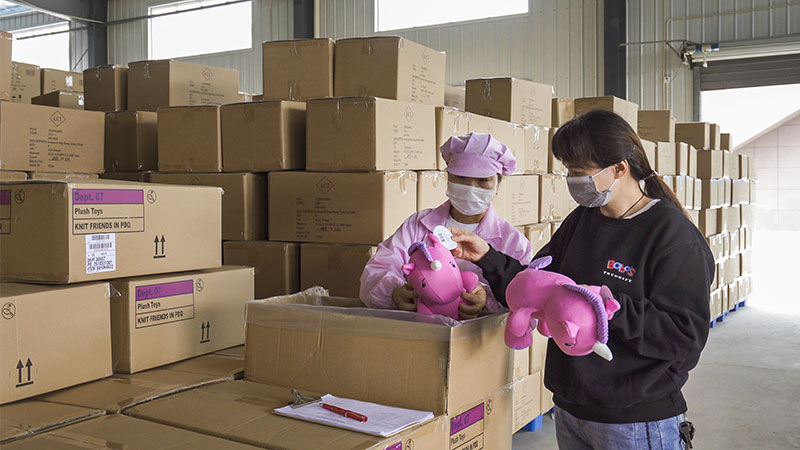
The pre-shipment and export stage is the final quality gate before goods leave the factory — and the last point at which problems can be resolved with the commercial leverage of the retained balance payment. Our pre-shipment risk control combines factory FQC, third-party inspection coordination, compliance documentation verification, and export documentation review to confirm that the batch meets quality and compliance standards before shipment is authorized.
Factory FQC
Our internal FQC applies AQL-based sampling to the completed batch, assessing all quality dimensions against the approved production standard:
| FQC Element | AQL Applied | What Is Assessed |
|---|---|---|
| Shape and proportion | AQL 2.5 (major) | Visual comparison to counter sample |
| Color accuracy | AQL 2.5 (major) | D65 comparison to approved swatch |
| Fill weight | AQL 2.5 (major) | Scale measurement against specification |
| Embroidery accuracy | AQL 2.5 (major) | Position measurement and quality |
| Seam integrity | AQL 1.5 (critical) | Visual and manual assessment |
| Accessory pull force | AQL 1.5 (critical) | Pull force measurement |
| Label content and placement | AQL 2.5 (major) | Content and position verification |
| Packaging compliance | AQL 4.0 (minor) | Packaging specification check |
Third-Party Inspection Coordination
For orders where third-party inspection has been specified — which we actively support and recommend for significant orders — we coordinate with SGS or Intertek to schedule the inspection for the correct production stage, prepare the required counter sample and approved specification references, and provide access to the complete batch for random sampling.
| Third-Party Coordination Element | What We Provide | Risk Controlled |
|---|---|---|
| Inspection brief preparation | Product specification, approved swatch, counter sample reference | Inspector reference accuracy |
| Batch availability confirmation | Complete batch present and accessible for sampling | Sample selection validity |
| Production documentation access | IPQC logs, FQC report, material compliance certificates | Inspection context |
| Defect classification guidance | Product-specific defect classification examples | Inspection scope accuracy |
Compliance Documentation Verification
Before shipment is authorized, we verify that every required compliance document is present, current, and correctly prepared:
| Document | Verification Check | Action if Gap Found |
|---|---|---|
| Material compliance certificates | Currency, coverage, specific lot | Source updated certificate before shipment |
| Third-party test reports | Currency, standard scope, product coverage | Commission retesting if reports are expired or insufficient |
| CPSIA CPC | Content accuracy, test report references | Revise before shipment |
| CE Declaration of Conformity | Product coverage, standard references, authorized signatory | Revise before shipment |
| Shipping marks verification | All required marks present on all cartons | Correct before shipment |
| Label content verification | Correct content, compliant placement | Correct before shipment |
Pre-Shipment Authorization Gate
Shipment is authorized only when all pre-shipment verification criteria are confirmed:
| Authorization Criterion | Confirmed By | Authorization If Not Met |
|---|---|---|
| FQC inspection passed | Factory FQC report | Rework required before re-assessment |
| Third-party inspection passed (if specified) | Independent inspection report | Rework required before re-assessment |
| All compliance documents complete | Documentation checklist | Missing documents obtained before authorization |
| Shipping marks correct | Photo verification | Correction before authorization |
| Balance payment cleared | Payment confirmation | Shipment on payment clearance |
How Is the Risk Control Workflow Maintained and Improved Across Successive Orders?

A risk control workflow is most commercially valuable when it improves over successive orders — when the knowledge and experience accumulated in each production project is captured in ways that make the next project more efficient, more accurate, and more reliably successful.
Our risk control workflow maintenance and improvement operates through three mechanisms: project closure documentation that captures the knowledge from each project, retrospective analysis that identifies where the workflow could have caught problems earlier, and workflow protocol updates that incorporate lessons learned.
Project Closure Documentation
At the completion of every production project, our project closure process creates a complete documentation archive that supports every future order of the same product:
| Archive Element | Content | Use in Future Orders |
|---|---|---|
| Approved tech pack | Complete, finalized specification | Production reference for all reorders |
| Approved counter sample | Physical sample retained in proper storage | Reorder quality comparison reference |
| Material specification with supplier codes | Specific material sources and grades | Consistent material sourcing for reorders |
| Reference swatch set | Approved swatches for all materials | IQC comparison reference for reorders |
| IQC records | Per-roll inspection results | Historical compliance verification |
| IPQC logs | Quality monitoring data throughout run | Reorder quality baseline reference |
| FQC report | Final inspection results | Reorder quality comparison |
| Deviation log | All deviations identified and resolved | Risk awareness for reorders |
| Risk control notes | Specific risk observations from the project | Enhanced risk focus for reorder |
Retrospective Analysis
After each production project, our quality team conducts a structured retrospective that asks:
| Retrospective Question | Purpose | Output |
|---|---|---|
| Which risks materialized that were anticipated? | Assess control effectiveness | Confirm controls, adjust if gaps found |
| Which risks materialized that were not anticipated? | Identify gaps in risk identification | Add to risk identification checklist |
| Which controls were most effective at preventing problems? | Identify high-value controls | Reinforce high-value controls |
| Which problems were caught later than they should have been? | Identify monitoring gaps | Tighten monitoring intervals or add checkpoints |
| Which rework was caused by factors in the risk control workflow? | Identify process failures | Revise workflow step to prevent recurrence |
Reorder Risk Efficiency
For reorders of established products, the risk control workflow becomes more efficient — not because controls are relaxed but because the baseline information is already established, reducing the time required for risk identification and specification confirmation:
| Risk Control Element | First Order | Reorder Efficiency |
|---|---|---|
| Product risk assessment | Full feasibility assessment required | Previously assessed — focus on any design changes |
| Brief review | Complete review required | Focus on changes from previous brief |
| Material sourcing | New sourcing and pre-approval required | Retained specification and supplier — swatch pre-approval only |
| Counter sample | Full counter sample required | Counter sample with reorder materials — more focused assessment |
| IPQC protocol | New protocol established | Previous protocol reviewed and confirmed or updated |
| Communication protocol | New milestone schedule established | Previous schedule confirmed |
At Kinwin, our risk control workflow is the operational expression of our commitment to consistent, reliable manufacturing outcomes — not a theoretical framework but a documented process that every project team follows and every project record demonstrates. Our IPQC logs, first-off inspection reports, pre-sampling clarification documents, and project closure archives are all outputs of this workflow — evidence that the controls were applied rather than claimed.
If you want to understand specifically how our risk control workflow would apply to your next plush project — what risk identification would occur at your project initiation, what controls would apply to your specific design complexity and target market requirements, and what documentation you would receive at each workflow stage — we would be glad to walk through it with you.
Reach out to our team at [email protected] or visit kinwintoys.com to start that conversation.
Conclusion
A risk control workflow in plush manufacturing is not a quality management system that activates when problems arise. It is a structured, stage-specific process that prevents the majority of problems from arising, catches the remainder at the earliest and lowest-cost stage of the production process, and documents every control action in ways that create transparency, accountability, and the institutional knowledge that makes each successive order more efficient and more reliable than the last.
The commercial value of this workflow is not primarily visible in any single order — it is visible in the pattern of outcomes across multiple orders: lower defect rates, fewer revision rounds, more reliable delivery timelines, consistent reorder quality, and the absence of the expensive surprises that characterize manufacturing relationships without structured risk management.
At Kinwin, this workflow is our standard operating process — applied to every project, for every buyer, at every order volume. The discipline of the workflow is what creates the predictability of the outcomes.
FAQ
Q1: How does the risk control workflow adapt when a buyer brings a design that has been partially developed elsewhere — for example, a design with an approved sample from another factory that needs to be re-sourced?
When a buyer brings a partially developed design — an approved sample from a previous factory, artwork from a design agency, or a reference product that needs to be replicated — our risk control workflow adapts at the risk identification stage to account for the specific risks that this scenario creates. The primary risks in this scenario are: the previous sample may have been produced with materials or construction approaches that we need to replicate but have not yet qualified; the proportions in the existing sample may require pattern re-engineering to achieve correctly in our production environment; and the quality standard the buyer has already approved may not be achievable at the unit cost they expect from our facility. Our workflow response addresses each: we conduct a physical assessment of the provided sample to identify its construction approach and material characteristics, we initiate material qualification in parallel with pattern development to confirm we can source equivalent materials, and we communicate any identified gap between the existing sample’s quality level and what our standard production achieves before any development investment is made. The counter sample stage becomes particularly important in this scenario — building our production-environment prototype from our materials and comparing it directly to the provided reference sample before production is authorized.
Q2: What is the most common point in the risk control workflow where buyers’ projects experience unexpected problems, and how can buyers reduce this vulnerability?
The most common point of unexpected problems is the gap between the approved development sample and the bulk production output — what is typically called the sample-to-bulk gap. This gap appears despite the counter sample stage when the counter sample is either skipped, conducted with different materials than the bulk production, or approved without rigorous comparison to the development sample. The vulnerability exists because the counter sample stage is the one most commonly pressured or eliminated when timeline is tight — it adds one to two weeks to the development process, and both factories and buyers are often eager to proceed to production once a good development sample is in hand. Buyers can reduce this vulnerability by making counter sample approval a contractual pre-condition for production authorization — specifically stating in the purchase agreement that production cannot begin before the buyer has approved the counter sample in writing. This contractual protection prevents the production start from occurring in the absence of counter sample approval, regardless of timeline pressure. Additionally, buyers who review counter samples against a specific comparison checklist — measuring fill weight, assessing proportions, measuring embroidery coordinates, and comparing color under D65 — rather than conducting a general visual impression assessment, catch counter sample deviations more reliably than those who rely on general impression.
Q3: How should the risk control workflow be communicated to a factory at the beginning of a new supplier relationship, and what is the most effective way to establish it as a mutual expectation?
Communicating the risk control workflow expectations at the beginning of a supplier relationship is most effectively done as part of the purchase agreement negotiation rather than as a separate quality management conversation. The purchase agreement is the appropriate place to specify the workflow requirements that the buyer expects as commercial obligations: the counter sample requirement before production authorization, the IPQC documentation the factory must produce, the milestone communication schedule, the compliance documentation package required before shipment, and the third-party inspection right. Framing these as purchase agreement terms rather than quality management preferences creates commercial accountability — they become obligations that the factory accepts as conditions of the order rather than optional enhancements. The most common mistake in communicating risk control workflow expectations is presenting them as requests after the order has been placed and the commercial terms have been agreed — at which point the factory has less incentive to accept requirements that add to their production overhead. Presenting the workflow requirements alongside the commercial terms — before the order is placed — creates the shared expectation that makes the workflow a genuine operational reality rather than an aspiration that the factory may or may not implement.
Q4: How does the risk control workflow handle a situation where the buyer’s design changes significantly between the approved sample and the planned production start — for example, when a licensor requires design modifications?
Significant design changes after sample approval are one of the highest-risk scenarios in plush manufacturing — because they invalidate the production standard that the entire preceding workflow established, while the production timeline pressure from a planned start date creates pressure to implement changes quickly and incompletely. Our workflow handles this through a mandatory design change assessment that evaluates the scope of each change and determines the appropriate re-development response. Changes that affect surface appearance only — color changes, embroidery modifications — can typically be addressed through a targeted counter sample that verifies the change before production proceeds. Changes that affect proportions, construction, or material specification require a targeted resample — producing a new physical prototype and repeating the counter sample stage before production authorization. Changes that affect compliance — age grade change, addition of accessory types with safety implications, or target market expansion — require compliance mapping re-assessment to identify whether new testing or material sourcing is needed. In all cases, the workflow requires that the change be fully incorporated into the tech pack before production begins — ensuring that the documented production standard reflects the final approved design rather than the superseded version.
Q5: Can the risk control workflow be applied retrospectively to an order where production has already begun and quality concerns have emerged — and what is the most effective workflow intervention when problems are discovered mid-production?
When production is already underway and quality concerns emerge, the risk control workflow can be applied retrospectively to diagnose the source of the problem and identify the most effective intervention point. The retrospective application begins with root cause analysis: is the concern a setup error that occurred at production start, a drift event that developed during the run, a material deviation that was not caught at IQC, or a specification ambiguity that produced variable interpretation across operators? Each root cause requires a different intervention. Setup errors require production halt, process reconfiguration, affected unit scope assessment, and post-correction first-off verification. Drift events require IPQC-informed scope assessment, machine recalibration or operator technique correction, and post-correction verification. Material deviations require material assessment, affected batch quarantine, and replacement material sourcing. Specification ambiguities require tech pack amendment, operator re-briefing, and potentially counter sample verification of the corrected interpretation. The most important principle in mid-production workflow application is that the intervention must address the root cause — not just the symptom. Correcting the visible defect in affected units while leaving the root cause in place allows the same defect to continue accumulating in subsequent units, producing an ongoing rework burden rather than a resolved problem.