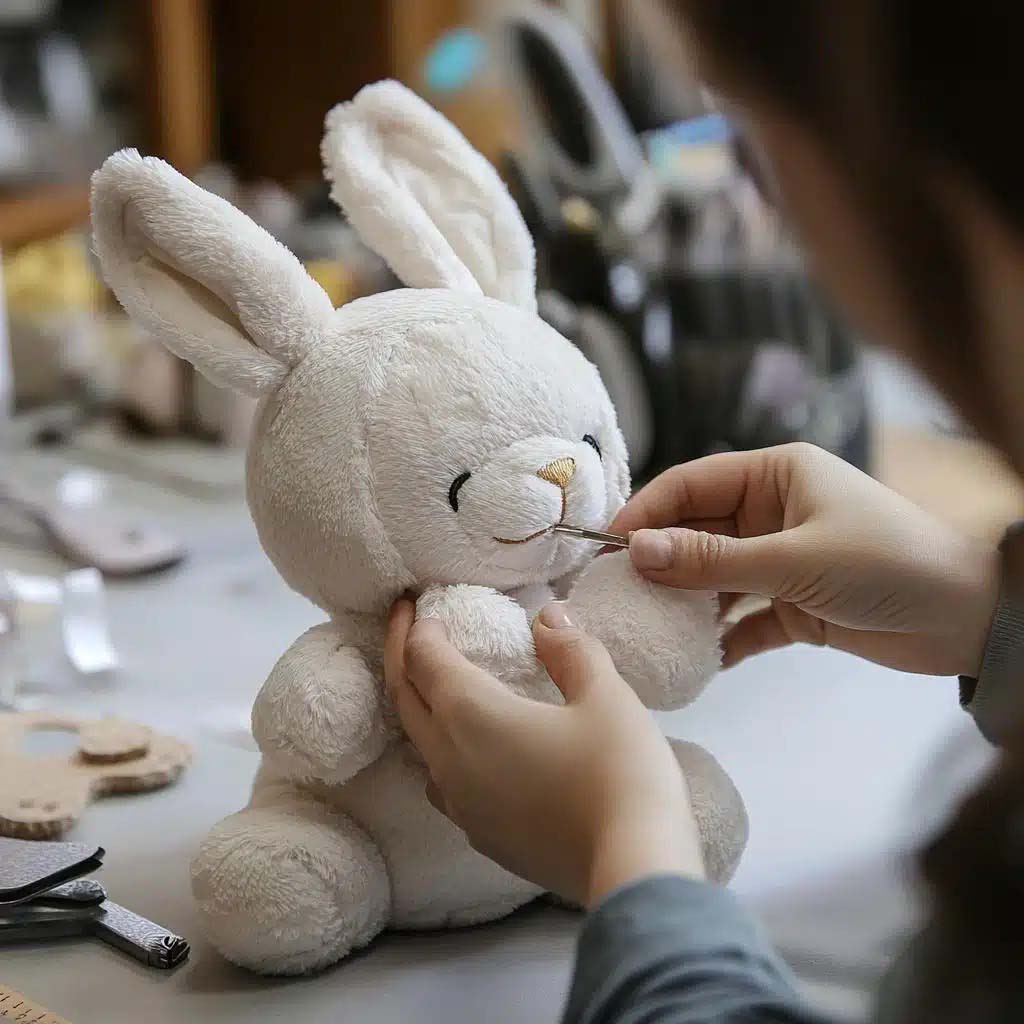
Quality control is one of the most talked-about topics in plush toy sourcing — and one of the least understood. Most buyers know that quality control exists and that factories claim to have it. Fewer understand what a professional QC system actually looks like in practice, which specific checks happen at which stages, what testing methods are used, and how to tell the difference between a factory with genuinely robust quality management and one that runs a minimal inspection process and calls it QC.
This gap in understanding has real commercial consequences. Buyers who cannot evaluate quality control effectively make factory selection decisions based on surface presentations rather than operational substance. They accept vague assurances that “quality is our priority” without knowing what questions to ask, what documents to request, or what a satisfactory answer actually looks like. And when quality problems appear in bulk orders — as they inevitably do in factories with inadequate QC — buyers are left managing the consequences of a system failure they had no framework to identify in advance.
This guide closes that gap. It explains how quality control actually works in a professional plush toy factory — the stages, the methods, the standards, the documentation, and the organizational structures that make QC effective or ineffective. It also explains how buyers can use this understanding to evaluate factories more accurately, set clearer expectations, and protect their orders more effectively throughout the production process.
What Is Quality Control in a Plush Toy Factory and Why Does It Matter?
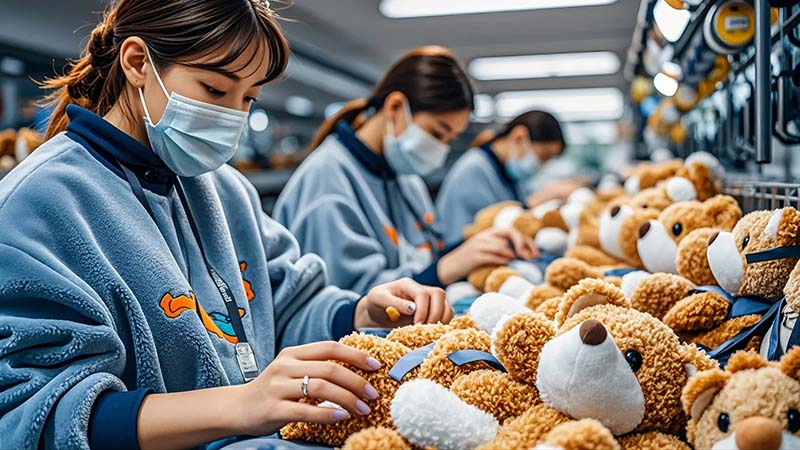
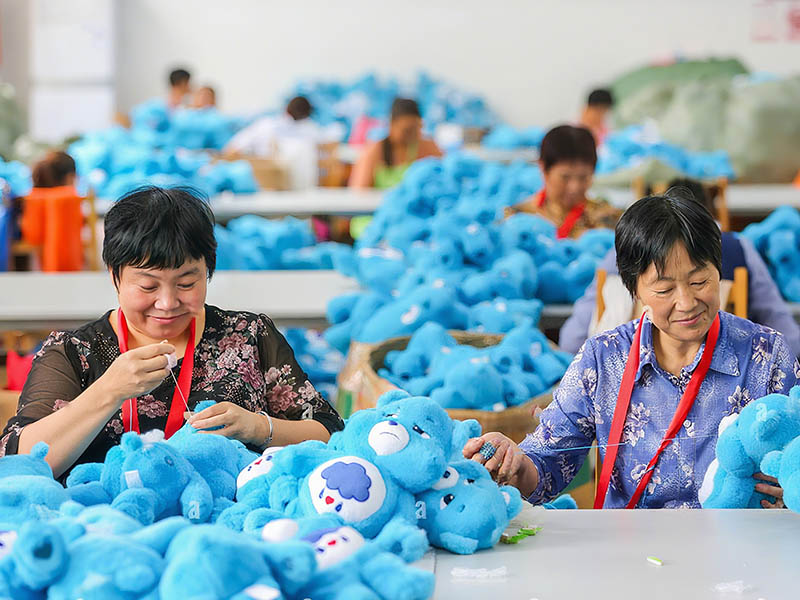
Quality control in a plush toy factory is the complete system of inspections, tests, checks, and corrective actions that are applied throughout the production process to ensure that finished products consistently meet defined quality and safety standards. It is not a single event — it is a continuous process that begins when raw materials arrive at the factory and ends when finished goods are confirmed ready for shipment.
Quality control in a plush toy factory matters because plush toys are complex, multi-component products produced in large volumes by human operators whose output varies. Without systematic quality management, this variability accumulates across the production process and produces finished goods that differ — sometimes subtly, sometimes significantly — from the approved standard. A professional QC system does not eliminate human variability. It monitors, catches, and corrects it at the earliest possible point in the process, before variation compounds into defects that reach the buyer.
Here is an overview of why quality control matters at each level of the plush toy supply chain:
| Stakeholder | Why QC Matters | Consequence of Inadequate QC |
|---|---|---|
| End consumer | Safety and product performance | Unsafe or disappointing products |
| Retail buyer | Consistent quality across units | Customer complaints, returns, brand damage |
| Brand owner | Compliance and market reputation | Recalls, platform delistings, legal liability |
| Sourcing buyer | Order reliability, supplier confidence | Wasted investment, supply chain disruption |
| Factory | Operational efficiency, client retention | Rework costs, client loss, compliance failures |
The Three Levels of Quality in Plush Production
Professional quality management in plush toy factories operates across three interconnected levels — each addressing a different aspect of product quality and requiring different tools, personnel, and processes.
The first level is material quality — ensuring that every input entering the production process meets defined standards before it is used. This is the domain of incoming quality control and is the foundation on which all subsequent quality depends. If materials do not meet standards, no amount of production-stage QC can fully compensate.
The second level is process quality — ensuring that the manufacturing operations that transform materials into finished products are executing correctly and consistently throughout the production run. This is the domain of in-process quality control and is where production drift, operator variation, and equipment setting changes are identified and corrected before they affect large quantities of finished goods.
The third level is product quality — verifying that finished goods meet all applicable standards before they are packed and shipped. This is the domain of final quality control and is the last gate before products reach the buyer. A factory that manages all three levels systematically and independently delivers a fundamentally different quality outcome from one that relies primarily on final inspection alone.
How Does Incoming Quality Control Protect Every Order Before Production Begins?

Incoming quality control — IQC — is the first stage of the factory’s quality management system and the most cost-effective point at which to prevent quality problems. The logic is straightforward: a defective or non-conforming material identified before it enters production costs nothing to address beyond the time of inspection and the delay of sourcing a replacement. The same material, incorporated into thousands of finished units, generates rework costs, rejection risks, compliance failures, and potentially complete batch losses.
IQC in a plush toy factory is the systematic inspection of all incoming raw materials and components against defined acceptance criteria before any production activity begins. It covers every material that will be incorporated into the finished product — fabric, filling, accessories, thread, labels, packaging components — and applies specific inspection methods appropriate to each material type to verify that quality, dimensions, color accuracy, and compliance documentation meet the required standard.
Here is a comprehensive overview of what IQC covers in a professional plush toy factory:
| Material Category | Inspection Criteria | Inspection Method | Pass/Fail Standard |
|---|---|---|---|
| Outer fabric | Color accuracy, pile height, surface consistency, density | Visual comparison under D65 lighting, physical measurement | Matches approved swatch within tolerance |
| Filling — PP cotton | Whiteness, loft recovery, cleanliness, fiber uniformity | Compression and release test, visual inspection | Meets density and loft specification |
| Filling — glass beads | Size uniformity, surface smoothness, weight accuracy | Sieve test, weight measurement | Meets size and weight specification |
| Safety accessories | Dimension accuracy, attachment compatibility, surface finish | Physical measurement, visual inspection | Matches approved component specification |
| Thread | Color accuracy, tensile strength consistency | Color comparison, tension test | Matches approved thread reference |
| Embroidery thread | Color accuracy, twist consistency | Color comparison under D65 lighting | Matches approved color reference |
| Labels | Content accuracy, print quality, material compliance | Visual inspection, content verification | Matches approved label specification |
| Packaging components | Dimension accuracy, print quality, material safety | Measurement, visual inspection | Matches approved packaging specification |
The AQL Framework in IQC
IQC inspections in professional factories are not conducted on 100 percent of incoming materials — this would be prohibitively time-consuming and expensive. Instead, IQC uses a statistical sampling framework — typically AQL (Acceptable Quality Level) sampling — to draw a representative sample from each incoming batch and use the sample’s defect rate to make a decision about the acceptability of the full batch.
The size of the sample drawn from each batch and the defect rate that triggers batch rejection are defined by the AQL level selected. For most plush toy material IQC, an AQL of 1.5 for critical defects — those affecting safety or producing severe quality failures — and 2.5 for major defects — those producing visible quality deviations — is the appropriate standard. If the inspected sample contains defects at a rate exceeding the threshold for the selected AQL level, the entire batch is quarantined and either returned to the supplier or subjected to 100 percent inspection before any material is released for production.
The Compliance Documentation Check
A critical component of IQC that goes beyond physical inspection is the compliance documentation check — verifying that incoming materials are accompanied by valid test reports and certification documents confirming their chemical safety compliance.
For plush toy production, this means verifying that fabric materials have current OEKO-TEX, REACH, or equivalent chemical test documentation. Filling materials must have chemical safety reports confirming the absence of restricted substances. Accessories such as safety eyes must have pull-force test documentation and chemical compliance certification.
This documentation check is not a formality — it is a substantive compliance safeguard. Materials that appear physically acceptable may still carry chemical compliance risks that are invisible to physical inspection. A factory that verifies compliance documentation as part of IQC is protecting its clients against the most costly type of compliance failure — a product that passes physical inspection but fails chemical testing, requiring the rework or destruction of a completed production run.
What Happens During In-Process Quality Control on a Plush Production Line?
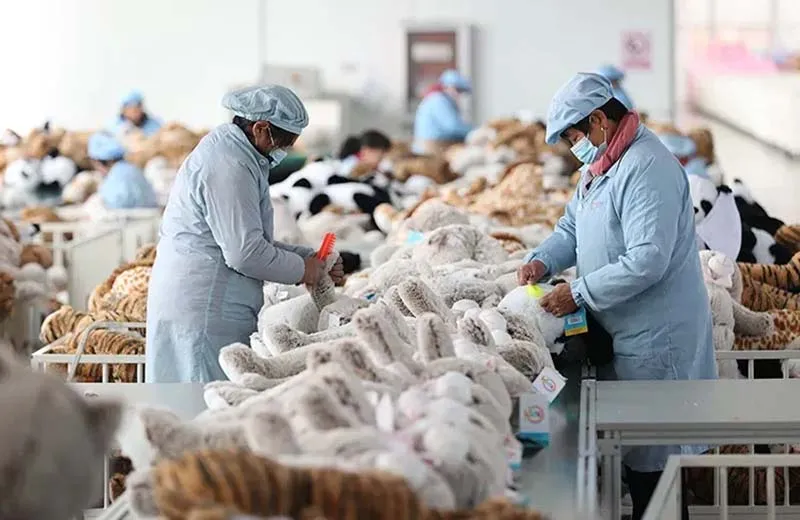
In-process quality control — IPQC — is the continuous monitoring system that operates throughout the production run, checking quality at defined intervals and at critical production milestones. If IQC is the gate that protects against material problems, IPQC is the monitoring system that protects against process problems — the operator errors, machine setting drifts, and execution variabilities that develop during production and can quietly accumulate into significant quality deviations if left unmonitored.
IPQC on a plush production line involves regular, structured inspections of work-in-progress units at critical production checkpoints, conducted by QC personnel who are independent of the production operators being monitored. The purpose is to detect any deviation from the production standard as early as possible — before it has been replicated across a large number of units — and to trigger corrective action before the deviation affects the broader production run.
Here is a detailed overview of IPQC checkpoints across the plush toy production sequence:
| Production Stage | IPQC Checkpoint | What Is Inspected | Trigger for Corrective Action |
|---|---|---|---|
| Pattern cutting | Cut piece dimension check | Panel dimensions against pattern specification | Deviation outside tolerance range |
| Pre-sewing | Panel alignment check | Correct panels matched, pile direction confirmed | Any misalignment or pile direction error |
| First-off inspection | First completed units | Full product against approved sample | Any deviation from approved standard |
| Sewing — early stage | Seam quality check | Stitch density, seam alignment, thread tension | Any visible seam quality deviation |
| Stuffing | Density consistency check | Firmness and weight of stuffed units | Weight or firmness outside target range |
| Accessory attachment | Pull force spot check | Security of eyes, buttons, other accessories | Any detachment under spot-check force |
| Embroidery | Position verification | Embroidery placement against coordinate standard | Any positional deviation outside tolerance |
| Finishing | Surface quality check | Thread trimming, surface cleanliness, marking | Any visible finishing defect |
| Mid-production random sample | Overall quality audit | Random units against approved sample | Cumulative deviation trend identified |
The First-Off Inspection — The Most Critical IPQC Checkpoint
Of all the IPQC checkpoints in plush toy production, the first-off inspection is the most critical — and the one that most directly determines whether the production run will be consistent from the beginning. The first-off inspection is conducted on the first two to five fully completed units from the production line, before the run continues beyond this initial output.
This inspection covers every quality dimension of the finished product — dimensions, color accuracy, fabric quality, stuffing density, embroidery positioning, accessory attachment, stitching quality, and finishing standard — and compares each against the approved counter sample or approved reference sample. Any deviation identified at this stage is addressed by halting production of the affected element, identifying the root cause, and implementing a correction before the run continues.
The commercial logic of the first-off inspection is straightforward. A problem identified in the first five units costs almost nothing to address — those units are adjusted or replaced, the cause is corrected, and production continues. The same problem, identified for the first time in final inspection after the full run is complete, may affect thousands of units and require either expensive rework or costly commercial negotiation with the buyer.
Managing Production Drift Through Regular IPQC
Even when the first-off inspection confirms that production has started correctly, conditions on the production line change continuously during the run. Machine settings drift subtly as equipment heats up. Operators fatigue as shifts progress. Fabric characteristics change subtly as production moves from one fabric roll to the next. Without regular IPQC monitoring throughout the run, these changes accumulate undetected.
Professional plush factories conduct IPQC random sampling at defined intervals — typically every one to two hours for complex products, every two to four hours for standard products. At each interval, a QC inspector draws a small number of units from the active production line and measures them against the approved standard. Any detected deviation triggers an investigation — is it an isolated operator error, a machine setting change, or a material characteristic shift? — followed by a targeted corrective action before production continues.
This regular monitoring rhythm is what prevents the production drift that produces visible quality differences between units produced at the beginning and end of the same production run — one of the most common quality complaints buyers receive from customers and retail partners.
How Does Final Quality Control Verify a Plush Order Before It Ships?
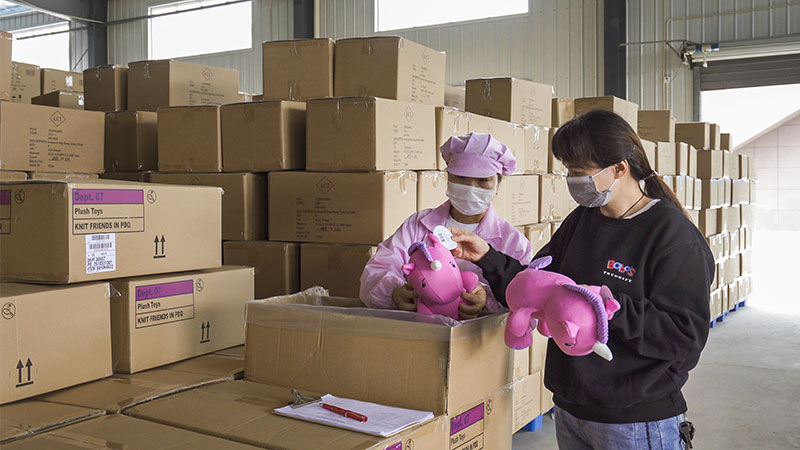
Final quality control — FQC — is the comprehensive inspection of finished, packed goods that occurs as the last quality gate before a production order is approved for shipment. It is the most visible component of the factory’s quality system from the buyer’s perspective and the one that most directly determines whether a shipment is released or held pending resolution of identified issues.
FQC in a plush toy factory is a systematic AQL-based inspection of a statistically defined sample drawn from the completed, packed production batch, conducted by QC personnel against the full set of applicable quality criteria. The inspection covers all dimensions of product quality — appearance, dimensions, construction, accessories, labeling, and packaging — and produces a documented report that either confirms the batch meets the required standard or identifies specific deviations that must be addressed before shipment is approved.
Here is a complete overview of what FQC covers in a professional plush toy factory:
| FQC Inspection Area | What Is Checked | Standard Applied | Defect Classification |
|---|---|---|---|
| Overall dimensions | Key measurements against tech pack specification | ±5% of approved dimension | Major |
| Color accuracy | All color areas against approved sample under D65 | Visual match within Pantone tolerance | Major |
| Fabric quality | Pile consistency, surface defects, color uniformity | Approved sample comparison | Major |
| Shape and proportion | Overall silhouette against approved sample | Visual comparison | Major |
| Stuffing density | Firmness and shape retention against standard | Compression reference | Major |
| Facial features | Embroidery position, thread quality, expression | Coordinate standard comparison | Major — Critical for character products |
| Seam integrity | Seam strength, alignment, stitch density | Tension inspection, visual check | Critical |
| Accessory attachment | Pull force test on eyes, buttons, other attached elements | EN71/ASTM pull force reference | Critical |
| Label accuracy | Care label, brand label, compliance label content | Regulatory and brand specification | Major |
| Finishing quality | Thread trimming, surface cleanliness, marking | Zero visible defect standard | Minor |
| Packaging accuracy | Box type, insert placement, labeling, barcode | Approved packaging specification | Major |
| Quantity verification | Actual unit count against purchase order | Purchase order | Major |
The Role of Third-Party FQC Inspection
For buyers who want independent verification of finished goods quality — rather than relying solely on the factory’s internal FQC — third-party pre-shipment inspection is the most effective available tool. Third-party inspection is conducted by an independent inspector from an accredited organization such as SGS, Bureau Veritas, or Intertek, who visits the factory, draws an AQL-based sample from the completed batch, and conducts a comprehensive inspection against the buyer’s specified criteria.
The third-party inspection report provides independent, documented evidence of the batch’s quality status before the balance payment is released and before the shipment is approved. For first orders with a new factory, for large-volume orders, and for orders where the buyer cannot visit the factory directly, third-party inspection is the most reliable way to verify that FQC results align with an independent assessment — and the most commercially powerful tool available for managing quality disputes, since the evidence it produces is objective and independently generated.
When FQC Results Trigger Production Holds
A professional quality system does not simply accept FQC results passively — it has a defined process for responding when FQC identifies deviations that exceed acceptable thresholds. This process typically involves three stages: documentation of the specific defects found, root cause analysis to understand how the defects occurred and how many units may be affected, and a resolution decision — either 100 percent re-inspection of the batch to segregate non-conforming units, rework of the affected defect category, replacement production for units that cannot be reworked, or in rare cases where the deviation is minor, a commercial adjustment negotiated with the buyer.
The existence and quality of this process is one of the most revealing indicators of a factory’s QC maturity. A factory with a well-defined FQC non-conformance process will be able to describe it specifically when asked — including who makes the hold decision, what documentation is produced, how the buyer is notified, and what resolution options are available. A factory without this process will respond to FQC non-conformance situations inconsistently, often minimizing the deviation rather than managing it systematically.
What Testing Equipment and Methods Are Used in Plush Toy QC?
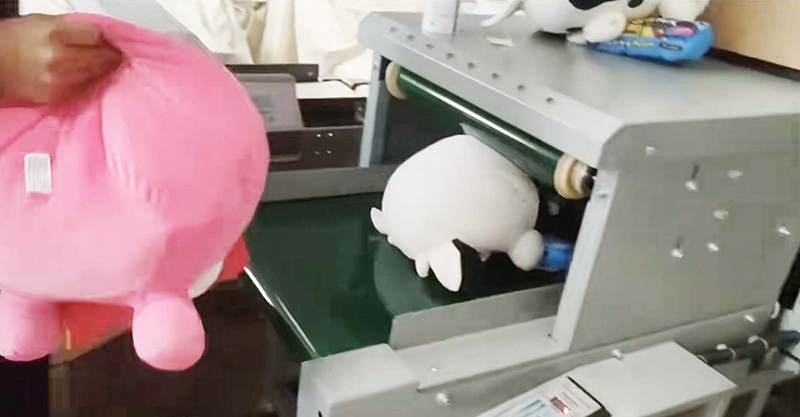
Quality control in a plush toy factory involves both physical inspection — using eyes, hands, and judgment against visual standards — and objective testing — using calibrated equipment to produce measurable results against defined thresholds. The balance between these two methods, and the quality of the equipment and standards used in each, directly affects how reliable and consistent the QC system’s outputs are.
Professional plush toy QC uses a combination of physical inspection methods and calibrated testing equipment to assess quality against both visual standards and objective thresholds. The specific equipment and methods used depend on the quality dimension being assessed — color accuracy, dimensional precision, structural integrity, and safety compliance each require different tools and approaches.
Here is an overview of the key testing equipment and methods used in professional plush QC:
| Quality Dimension | Testing Method | Equipment Used | What It Measures |
|---|---|---|---|
| Color accuracy | Visual comparison | D65 standardized light box | Color match to Pantone reference under standardized lighting |
| Dimensional accuracy | Physical measurement | Calibrated tape measure or digital calipers | Deviation from specified dimensions |
| Stuffing density | Compression testing | Compression scale or weight check | Filling weight or resistance to compression |
| Accessory attachment | Pull force test | Spring scale or pull force gauge | Force required to detach accessory |
| Seam strength | Tension test | Tension gauge or pull test rig | Force required to cause seam failure |
| Embroidery position | Coordinate measurement | Ruler with reference point system | Position of embroidery elements relative to fixed reference |
| Fabric pile height | Physical measurement | Pile height gauge | Deviation from specified pile height |
| AQL sampling | Statistical sampling | AQL table, counting | Sample size and defect rate assessment |
| Chemical compliance | Document review | N/A — laboratory test reports | Verification that materials have been tested to required standards |
The D65 Light Box — Essential for Color QC
The D65 light box is one of the most important pieces of equipment in a plush toy QC operation — and one of the most commonly absent in factories with underdeveloped QC systems. D65 is the international standard for daylight illumination used in color-critical assessment, representing the spectral characteristics of northern daylight at approximately 6500 Kelvin.
Color assessment conducted outside a D65 environment is inherently unreliable because color appearance changes significantly under different light sources. A fabric that appears to match the Pantone reference under warm incandescent lighting may show a visible deviation under cool fluorescent lighting or natural daylight — and vice versa. This lighting-dependent color variation is one of the most common sources of color quality disputes in international plush toy sourcing, and a D65 light box eliminates the ambiguity by establishing a standardized, reproducible assessment environment.
A professional QC facility will have a calibrated D65 light box available for color assessment and will use it consistently at both IQC and FQC stages. The presence of this equipment — visible during a factory tour or video audit — is a reliable indicator of investment in objective, standardized quality assessment.
Pull Force Testing — Critical for Safety Compliance
Pull force testing is one of the most safety-critical QC methods applied to plush toys, because it directly addresses the risk of small part detachment — the most common mechanism of toy-related injury and the most frequently cited cause of toy safety recalls.
The pull force test applies a defined tensile force to an attached accessory — an eye, a button, a nose, a ribbon — and assesses whether the accessory detaches under that force. The required force threshold depends on the applicable standard (ASTM F963 or EN71) and the age grade of the product — products for children under three years of age require higher pull force resistance than those for older age groups.
In a professional factory, pull force testing is conducted at multiple stages: during IQC to verify that accessory components are compatible with the attachment methods being used, during IPQC as a spot check on production line output, and during FQC on a sample from the completed batch. The results of all pull force tests should be documented with the applied force and the pass/fail result recorded for every test conducted.
How Do AQL Sampling Standards Apply to Plush Toy Factory Inspections?
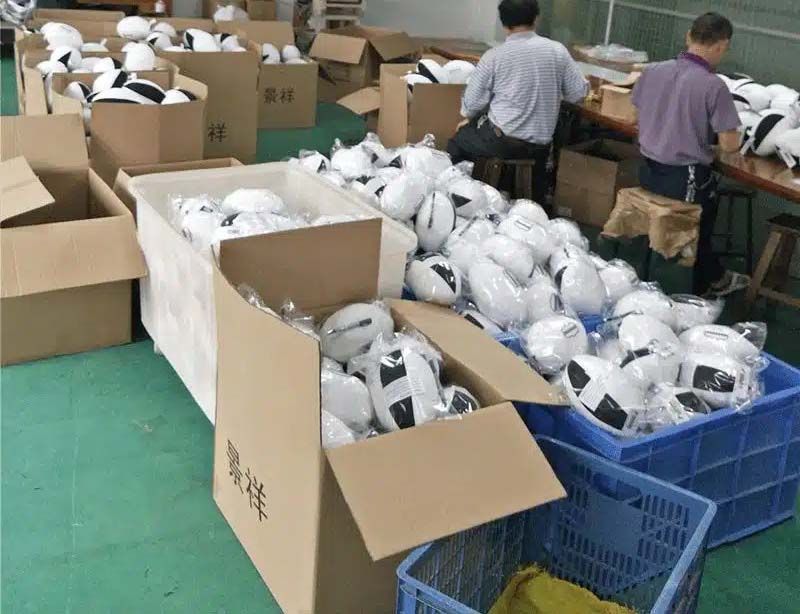
AQL — Acceptable Quality Level — is the statistical framework that governs how many units are inspected from a production batch and what defect rate constitutes an acceptable or unacceptable result. It is the foundation of systematic quality inspection in plush toy production and in manufacturing quality management more broadly, and understanding how it works is essential for buyers who want to set meaningful quality expectations and evaluate inspection results accurately.
AQL standards apply to plush toy factory inspections by providing a statistically validated method for drawing a representative sample from a production batch, classifying defects found in that sample, and using the defect rate in the sample to make a decision about the quality of the full batch. The AQL level selected defines the maximum proportion of defective units that is considered acceptable in the full batch — higher AQL levels accept more defects, lower AQL levels require higher quality.
Here is a practical overview of how AQL sampling works in plush toy QC:
| AQL Level | What It Means | Typical Application | Strictness |
|---|---|---|---|
| AQL 0.65 | Accepts max ~0.65% defects | Critical safety defects, medical applications | Very strict |
| AQL 1.0 | Accepts max ~1% defects | Critical defects in sensitive product categories | Strict |
| AQL 1.5 | Accepts max ~1.5% defects | Critical defects in standard toy categories | Standard for critical |
| AQL 2.5 | Accepts max ~2.5% defects | Major defects in standard consumer products | Standard for major |
| AQL 4.0 | Accepts max ~4% defects | Minor defects, cosmetic issues | Lenient |
| AQL 6.5 | Accepts max ~6.5% defects | Very minor cosmetic issues | Very lenient |
How AQL Sample Sizes Are Determined
The AQL sampling table — derived from ISO 2859 — determines the sample size to be inspected from a batch based on two inputs: the total batch quantity and the inspection level selected. For most plush toy FQC applications, Inspection Level II is used, which provides a balanced trade-off between sample size and statistical reliability.
For example, a batch of 3,200 units inspected at Inspection Level II falls into sample size code letter L, which specifies a sample size of 200 units. If the buyer has selected AQL 2.5 for major defects, the acceptance number — the maximum number of major defects permitted in the 200-unit sample for the batch to pass — is 10. If 11 or more major defects are found in the sample, the batch fails inspection and must be addressed before release.
Understanding this calculation helps buyers evaluate inspection results accurately. A report that identifies 8 major defects in a 200-unit sample from a 3,200-unit batch is a pass at AQL 2.5 — but it is approaching the acceptance threshold and suggests that the factory should investigate the root cause of the defects found, even though the batch technically passes.
Defect Classification in AQL Plush Toy Inspection
The AQL framework requires that defects be classified before the acceptance calculation is applied, because different AQL levels are applied to different defect classes. In plush toy inspection, three defect classes are typically used:
Critical defects are those that present a safety hazard to the user — a detached eye that presents a choking hazard, a torn seam that exposes filling, a label missing required safety warnings. Critical defects are assessed at a very strict AQL level — typically AQL 1.0 or lower — because even a small number of units with safety defects in a batch represents an unacceptable risk.
Major defects are those that significantly affect product quality, function, or appearance — incorrect dimensions, visible color deviation, embroidery positioning outside tolerance, stuffing density below specification. Major defects are assessed at AQL 2.5 in most standard plush toy applications.
Minor defects are those that affect appearance but not function or safety — a loose thread on a non-visible seam, a very slight surface mark on an area not typically visible in display, minor packaging scuff. Minor defects are assessed at AQL 4.0 in most applications, reflecting the lower commercial impact of these issues.
What Role Does Documentation Play in a Professional Plush QC System?
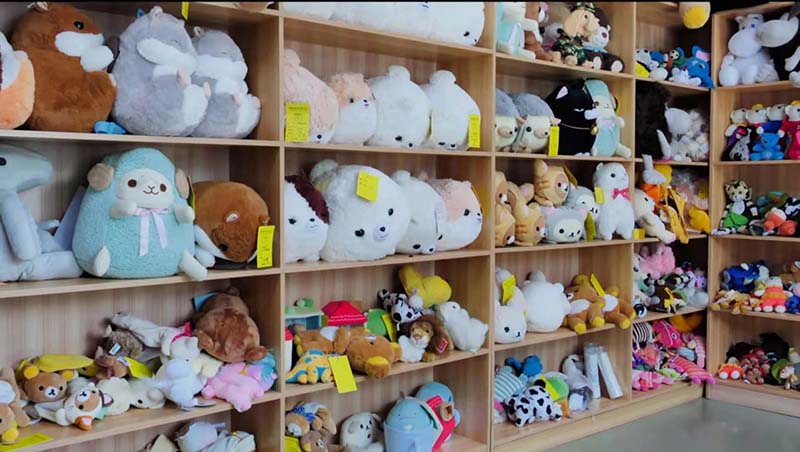
Documentation is the element of quality management that most clearly separates a genuine quality system from a performative one. A factory that conducts thorough inspections but records nothing — or records selectively and inconsistently — has created a quality system that cannot learn from its history, cannot demonstrate compliance to buyers or regulators, and cannot be held accountable to any objective standard when disputes arise.
Documentation plays three critical roles in a professional plush toy QC system. First, it creates a real-time management tool — giving factory management visibility into quality performance throughout the production process and enabling data-driven decisions about where to focus corrective action resources. Second, it creates a compliance record — providing documented evidence that specific tests were conducted, specific criteria were applied, and specific results were obtained for every production batch. Third, it creates an accountability framework — making it possible to objectively assess whether the quality system performed as designed and to identify specific failures when outcomes do not meet expectations.
Here is an overview of the key documentation outputs from a professional plush QC system:
| QC Document | When Produced | What It Records | Who Uses It |
|---|---|---|---|
| IQC incoming inspection report | At each material batch arrival | Material ID, inspection criteria, results, pass/fail, inspector | QC manager, production manager, buyer on request |
| Material compliance verification log | With each material batch | Supplier documentation received, compliance confirmation | Compliance manager, buyer on request |
| Cut piece verification record | After cutting, before sewing | Panel count, dimension check results, pile direction confirmation | Production supervisor, QC |
| First-off inspection report | At production start | Full product assessment against approved sample, photos | QC manager, production manager, buyer |
| IPQC in-process log | Throughout production | Time-stamped random sample results, any deviations and corrective actions | QC manager, production supervisor |
| Stuffing density log | Throughout production | Unit weight or compression measurements per interval | QC manager, stuffing team supervisor |
| Embroidery position log | Throughout embroidery stage | Position measurements per defined interval | QC manager, embroidery supervisor |
| Pre-pack inspection record | Before packaging | Appearance check results for each pre-pack sample | QC manager |
| FQC final inspection report | On completed packed goods | AQL sample results, defect classification, pass/fail, photos | QC manager, buyer, third-party inspector |
| Non-conformance report | When any QC stage fails | Description, root cause, corrective action, resolution status | QC manager, factory management, buyer |
How Documentation Enables Quality Improvement
Beyond its compliance and accountability functions, documentation enables the quality system to improve over time. When QC records are maintained consistently and analyzed regularly, patterns emerge that reveal where quality failures are most likely to occur, which production conditions correlate with higher defect rates, and which corrective actions are most effective at preventing specific types of deviation.
A factory that analyzes its IPQC logs and identifies, for example, that stuffing density deviations are most common in the last two hours of the afternoon shift, can implement targeted interventions — machine recalibration at the shift midpoint, additional supervisor attention in the identified period — that reduce the defect rate without changing the production system broadly. This kind of data-driven quality improvement is only possible in factories that maintain complete, consistent documentation.
What Buyers Should Request as Documentation Evidence
For buyers evaluating a plush toy manufacturer’s QC system, the most direct evidence of documentation quality is to request actual QC records from recent production runs — with client-identifying information appropriately redacted. Specifically, requesting an example IQC inspection report, a recent FQC final inspection report, and an example non-conformance report with resolution provides a direct view of the factory’s documentation standards, organizational systems, and transparency culture.
A factory that can produce clean, complete, well-organized examples of these documents quickly and without hesitation is demonstrating that documentation is a routine operational output — not a compliance performance created for external review. A factory that struggles to produce examples, produces inconsistent or partial records, or requests significant time to prepare documentation before sharing it is revealing that systematic documentation is not an operational reality.
How Can Buyers Evaluate and Strengthen QC When Sourcing Plush Toys Overseas?
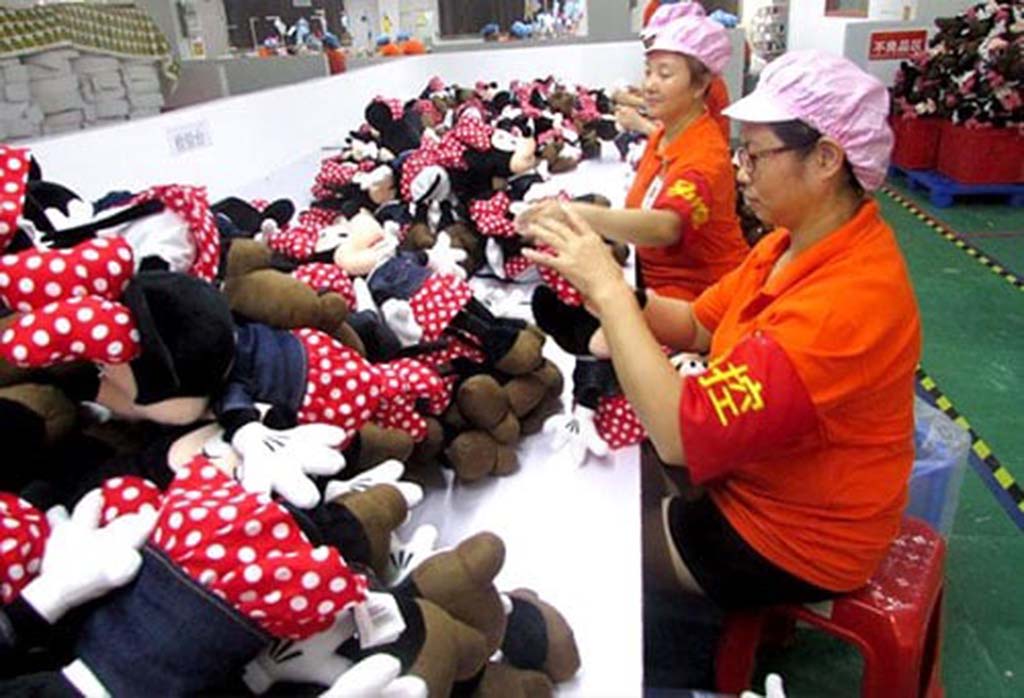
For buyers sourcing plush toys from overseas factories — the most common scenario for US and European brands and retailers — quality control evaluation and strengthening are active responsibilities, not passive outcomes. The distance between buyer and factory, the information asymmetry inherent in remote sourcing relationships, and the complexity of international logistics all create conditions where quality problems can develop, compound, and reach a buyer’s warehouse before being identified, unless buyers have actively implemented measures to monitor and protect quality throughout the production process.
Buyers can evaluate and strengthen QC when sourcing plush toys overseas through a combination of pre-order factory assessment, contractual quality standards, production milestone communication requirements, third-party inspection, and post-order quality performance review. Each of these measures addresses a specific vulnerability in the overseas sourcing quality management challenge.
Here is a structured framework for buyer QC management across the full sourcing lifecycle:
| Lifecycle Stage | Buyer QC Action | Purpose | Tools and Methods |
|---|---|---|---|
| Factory selection | QC system evaluation | Verify QC infrastructure before commitment | Video audit, documentation review, reference checks |
| Order placement | Quality standard agreement | Establish objective acceptance criteria | Written specification, AQL level, defect definitions |
| Pre-production | Material approval | Prevent material-related quality failures | Bulk material swatch approval, compliance documentation |
| Production start | First-off confirmation | Verify production setup before full run | Request first-off photos and inspection report |
| Mid-production | Progress monitoring | Detect and address drift before completion | Milestone update requests, IPQC report review |
| Pre-shipment | Independent inspection | Independent quality verification | Third-party SGS, Bureau Veritas, or Intertek inspection |
| Post-shipment | Quality performance review | Track trends, inform future requirements | Defect rate analysis, client feedback integration |
Setting Up Quality Standards Before Production Begins
The most important QC strengthening action buyers can take is establishing objective, written quality standards before production begins — not after a problem is discovered. This means specifying not just what the product should look like — covered by the approved sample — but defining measurable acceptance criteria for the dimensions, color tolerances, stuffing density, embroidery positioning, and accessory attachment strength that will be used to assess the bulk order.
These criteria should be agreed in writing with the factory before production begins and referenced in the purchase agreement. When FQC results — or a third-party inspection report — identify a deviation, having pre-agreed written criteria means the conversation is about whether an objective threshold was met, not about subjective interpretation of what “acceptable quality” means in a specific context. This objectivity makes disputes faster to resolve and easier to prevent in the first place.
Building QC Communication Into the Production Protocol
Beyond the formal QC system, buyers can strengthen quality management by establishing communication protocols that make QC outputs visible to them throughout the production process — not just at the end. Requesting production milestone updates that include QC results — first-off inspection report and photos, mid-production random sample update, pre-shipment FQC report — creates a communication framework where quality information flows proactively from the factory rather than being extracted reactively when problems are already advanced.
A factory that willingly shares these updates — providing photos, reports, and proactive notifications of any issues identified and actions taken — is demonstrating both a transparent QC culture and a client-oriented communication standard. This willingness to share quality information in real time is one of the most reliable indicators of a factory whose QC system is genuinely functional rather than primarily presentational.
At Kinwin, quality control documentation and communication are standard components of every client relationship. We share first-off inspection reports, mid-production updates, and FQC results as a matter of course — because we believe that buyers who can see quality being managed throughout the production process are better partners, make better decisions, and build the kind of long-term relationships where both parties can grow with confidence.
If you want to understand in detail how our three-stage QC system works, what documentation we produce at each stage, and how we communicate quality information throughout the production process, we would be glad to walk you through it directly.
Reach out to our team at [email protected] or visit kinwintoys.com to start that conversation.
Conclusion
Quality control in a professional plush toy factory is a comprehensive, multi-stage system that protects product quality from the moment materials arrive through the moment finished goods are confirmed ready for shipment. It is not a single inspection. It is not a formality conducted before payment is requested. It is an ongoing operational discipline that requires investment in trained personnel, calibrated equipment, documented processes, and organizational structures that allow the QC team to make objective decisions independent of production pressure.
For buyers, understanding how this system works transforms the quality conversation from a vague assurance exchange — “our quality is very good” — into a specific, verifiable assessment of whether a factory has built the infrastructure to deliver consistent quality reliably and repeatedly. Buyers who can evaluate QC systems objectively choose better factories, set clearer expectations, catch problems earlier, and build manufacturing relationships where quality is a predictable outcome rather than a pleasant surprise.
At Kinwin, our three-stage quality control system — covering IQC, IPQC, and FQC — is operated by an independent QC team using calibrated equipment, documented procedures, and complete production records for every order we produce. We build quality in at every stage of production rather than inspecting it at the end, and we share quality information proactively with our clients because transparency is how we build the trust that makes long-term partnerships genuinely valuable for both parties.
FAQ
Q1: What is the difference between a factory’s internal QC inspection and a third-party pre-shipment inspection, and do I need both?
A factory’s internal QC inspection — conducted by the factory’s own QC team — verifies quality against the factory’s internal standards and the agreed buyer specifications. It provides valuable quality management data throughout the production process and serves as the factory’s own assurance gate before shipment. A third-party pre-shipment inspection — conducted by an independent organization such as SGS, Bureau Veritas, or Intertek — provides independently verified quality assessment against the buyer’s specifications, conducted by inspectors who have no relationship with the factory and no incentive to pass marginal results. Both have value and serve different purposes. For established factory relationships with a consistent quality track record, internal QC documentation reviewed by the buyer may be sufficient for routine reorders. For first orders with any factory, for large-value orders, or where the buyer cannot visit the factory directly, both internal QC documentation and an independent third-party inspection provide the most complete quality assurance. The cost of a third-party inspection — typically $300 to $600 for a standard pre-shipment visit — is almost always justified by the protection it provides against the cost of receiving and managing a non-conforming shipment.
Q2: How can buyers monitor quality during production if they cannot visit the factory in person?
Remote quality monitoring during production is achievable through a combination of structured communication protocols and documentary evidence requests. Establishing at the order confirmation stage that the factory will share first-off inspection reports with photos, mid-production IPQC update reports, and pre-shipment FQC reports creates a documented quality trail that buyers can review remotely. Requesting video calls during critical production stages — particularly during first-off inspection — allows buyers to see physical product quality in real time and ask questions directly. WhatsApp or email photo updates from the production floor at defined milestones provide visual confirmation of production progress and quality status. None of these approaches replicates the direct observation available from an in-person factory visit, but together they create meaningful remote quality visibility that significantly reduces the risk of quality problems remaining undetected until shipment.
Q3: If a factory passes third-party inspection on a first order, can I rely on their internal QC for subsequent orders?
A passing third-party inspection result on a first order is valuable evidence that the factory can deliver acceptable quality under the conditions of that specific order — but it is not a permanent certification of quality management capability. Production conditions change between orders — personnel turn over, material suppliers change, production line equipment ages, factory capacity utilization fluctuates. For these reasons, most experienced buyers maintain some level of third-party verification on a risk-weighted basis — conducting third-party inspection on every large order regardless of history, and on a sampling basis for routine reorders from established factories with consistent track records. Completely eliminating third-party inspection for any factory, however strong the relationship, removes the independent verification that catches the gradual performance degradation that sometimes affects even reliable long-term suppliers.
Q4: What should buyers do if a factory refuses to share QC documentation or resists third-party inspection?
A factory that refuses to share QC documentation or resists third-party inspection is revealing something important about its quality management culture — and buyers should take this resistance seriously as a quality risk indicator, not dismiss it as a negotiation position. Professional factories with genuine quality systems welcome buyer engagement with their QC processes, because transparent quality management builds client confidence and supports long-term relationship development. Resistance to documentation sharing typically indicates one of three situations: the factory does not have the documented QC system it claims, it has QC records but they reveal performance issues it does not want buyers to see, or it has a cultural resistance to external scrutiny that will manifest in other transparency problems throughout the relationship. In all three cases, the appropriate response is to treat the resistance as a significant red flag and to factor it heavily into the factory selection decision — ideally by finding a factory that welcomes the scrutiny.
Q5: How does quality control differ for seasonal or time-sensitive plush toy orders where production timelines are compressed?
Compressed production timelines create specific quality management challenges that require heightened QC attention rather than reduced scrutiny. When production is accelerated to meet a seasonal deadline, the production line pressure that drives quality shortcuts — faster stuffing to meet daily targets, reduced finishing attention to maintain output rate, less careful fabric handling under time pressure — is at its highest. For seasonal orders, the most important quality protection measures are ones that work within the compressed timeline: ensuring that IQC is conducted immediately upon material arrival rather than queued, that first-off inspection happens on day one of production without delay, that IPQC interval frequency is increased to catch drift earlier, and that the factory understands clearly that the quality standard is non-negotiable regardless of timeline pressure. Third-party inspection should be scheduled in advance — with a confirmed inspection date built into the production plan — so that the inspection visit is not itself a timeline constraint. Accepting reduced QC rigor in exchange for timeline compliance consistently produces outcomes that are worse on both dimensions — the goods ship late and with quality problems — rather than achieving the intended trade-off.