Every buyer who has sourced plush toys for more than one production cycle has encountered the same decision: a manufacturer who quotes more, makes specific claims about quality systems and development capability, and represents a higher upfront cost — versus a supplier who quotes less, seems equally capable based on their presentation, and appears to offer the same product for a meaningfully lower price.
The instinct to choose the lower price is understandable. Business economics are real. Margin matters. And the performance gap between the two options is not always immediately obvious in a quotation comparison or even in the first sample.
The gap becomes obvious later — in the fourth revision round that a stronger factory would not have needed. In the bulk order that arrives with visible quality differences from the approved sample. In the compliance test failure that requires rework or destruction of the entire production batch. In the communication silence that follows a problem that should have been flagged three weeks earlier.
This guide explains specifically what separates a professional plush manufacturer from a low-cost supplier — not in marketing terms but in operational terms — and helps buyers make the comparison accurately before committing to a production relationship rather than discovering the difference through its consequences.
What Is the Real Difference Between a Professional Plush Manufacturer and a Low-Cost Supplier?
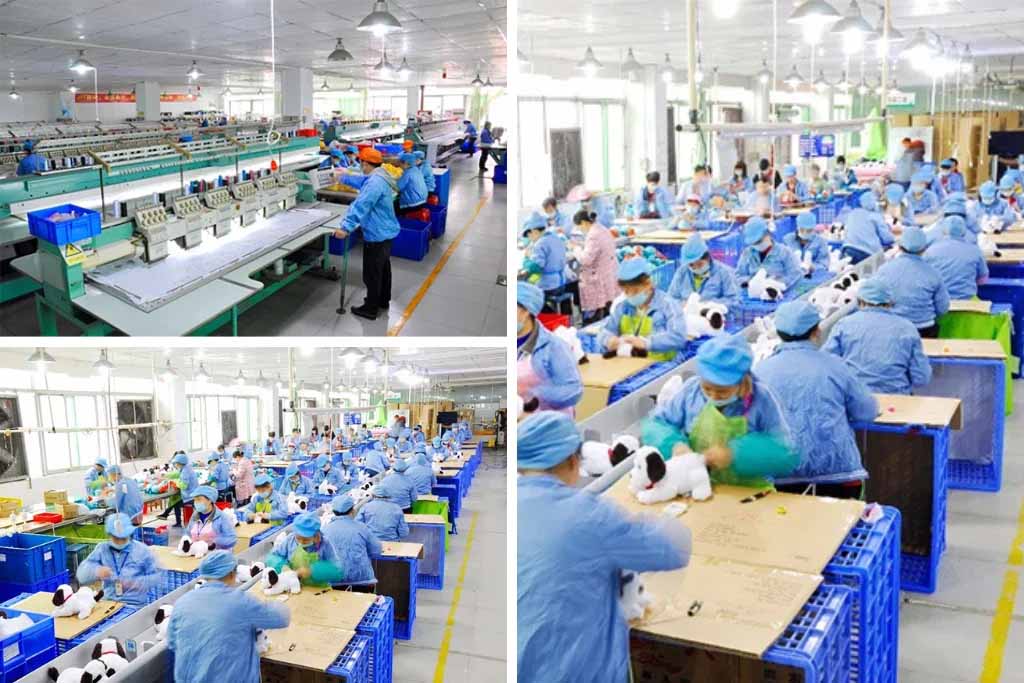
The difference between a professional plush manufacturer and a low-cost supplier is not primarily about price — it is about what the price reflects. Both types of supplier are profitable businesses operating in the same market. The difference is that the professional manufacturer’s price reflects genuine investment in the operational systems, skilled personnel, and compliance infrastructure that produce consistent, reliable quality — while the low-cost supplier’s price reflects the absence of some or all of those investments.
A professional plush manufacturer is one that has built and maintains the specific operational capabilities — pattern making expertise, documented quality control systems, compliance-certified material sourcing, structured development processes, and transparent communication infrastructure — that enable consistent, reliable production of custom plush products across multiple orders and product types. A low-cost supplier is one whose competitive positioning is based primarily on price, achieved through lower investment in one or more of these capability areas.
Here is a structured comparison across the primary operational dimensions:
| Operational Dimension | Professional Manufacturer | Low-Cost Supplier |
|---|---|---|
| Pattern making | Dedicated experienced team, high first-sample accuracy | Limited expertise, frequent proportion errors |
| Quality control | Three-stage documented IQC/IPQC/FQC, independent QC team | End-of-line spot check, minimal documentation |
| Material sourcing | Certified suppliers, compliance documentation, batch tracking | Price-driven sourcing, limited compliance documentation |
| Compliance infrastructure | Market-specific knowledge, laboratory relationships, current certifications | General awareness, limited operational capability |
| Communication | Proactive milestone updates, documented production record sharing | Reactive, limited visibility between order and delivery |
| Problem handling | Accountability culture, solution-first approach, documented corrective action | Avoidance, delayed disclosure, informal resolution |
| Development process | Structured brief review, counter sample, tech pack documentation | Informal, limited pre-production verification |
| Workforce stability | Experienced, stable workforce with specialized roles | Higher turnover, generalist operators |
Why the Distinction Is Not Visible in a Sales Presentation
The operational gap between professional manufacturers and low-cost suppliers is specifically designed to be invisible during the sales process. Low-cost suppliers use the same terminology — “strict quality control,” “experienced team,” “compliance certified” — and present similar materials — facility photos, product catalogs, client logos — as professional manufacturers. The gap is not in what they say about themselves but in what they have actually built and how they actually operate.
This invisibility is why buyers who evaluate suppliers primarily through their presentations and initial quotations consistently discover the real difference through production outcomes rather than through pre-order evaluation. The appropriate response is not to accept this invisibility as inevitable but to use the specific verification methods that make operational capability visible before the order is placed — factory audits, documentation reviews, reference conversations, and sample history evaluation.
How Do Development Capabilities Differ Between Professional and Low-Cost Plush Suppliers?
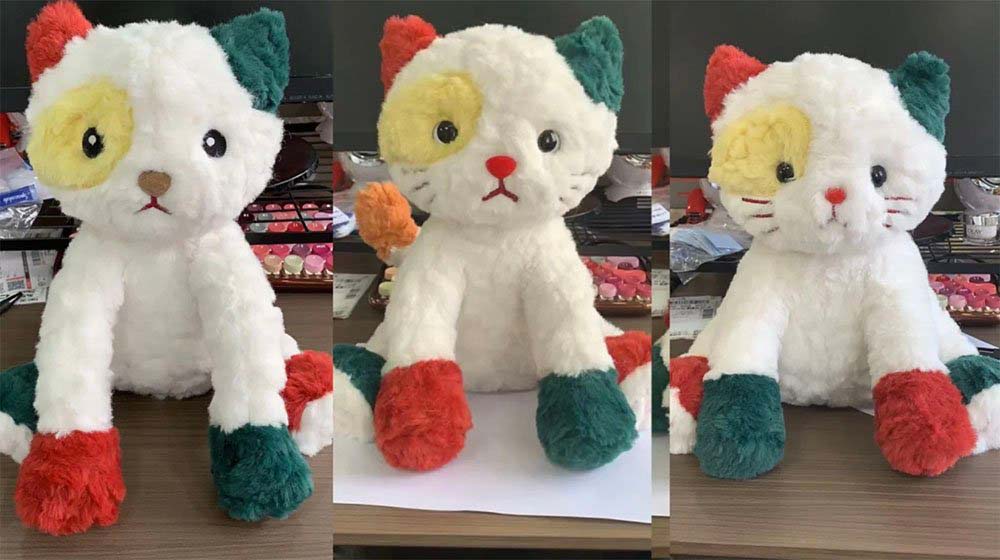
Development capability — the ability to accurately interpret design briefs, produce precise first samples, manage revision rounds efficiently, and translate approved samples into consistent bulk production — is the most commercially significant operational differentiator between professional manufacturers and low-cost suppliers for buyers who develop custom products.
Development capabilities differ between professional and low-cost suppliers because building genuine development capability requires sustained investment in experienced pattern makers, dedicated sampling infrastructure, structured development processes, and the institutional knowledge that comes from solving real design engineering problems across many product types over many years. Low-cost suppliers typically reduce or eliminate these investments as part of their cost management approach — using production workers to handle sampling, applying generic patterns to designs that require custom engineering, and managing revisions informally without documented change tracking.
Here is a detailed comparison of development capability across key dimensions:
| Development Dimension | Professional Manufacturer | Low-Cost Supplier | Buyer Impact |
|---|---|---|---|
| Pattern making team | Dedicated experienced pattern makers with plush-specific expertise | Production workers assigned to sampling as secondary duty | Accuracy of first sample, revision round count |
| Sampling infrastructure | Dedicated sampling area, specialist sewers, materials ready | Production line resources shared with sampling | Sample turnaround time, prototype quality |
| Brief interpretation | Proactive ambiguity identification, clarifying questions before sampling | Proceeds with assumptions, discovers problems in physical sample | First-sample accuracy, avoidable revision rounds |
| Revision management | Structured change tracking, action list confirmation before revision | Informal, some revision items missed or incorrectly addressed | Revision efficiency, circular revision patterns |
| Counter sample process | Standard step, builds with bulk materials before production authorization | Skipped or treated as optional | Sample-to-bulk consistency |
| Tech pack documentation | Complete specification document produced and distributed to all departments | Incomplete or absent, production relies on sample reference only | Production consistency across long runs |
| Design feasibility review | Honest cost and complexity assessment before sampling | Accepts brief as-is, problems discovered in sampling | Development cost surprises, unexpected complexity |
The First-Sample Accuracy Test
The most direct and most informative single test of development capability is first-sample accuracy — how closely the first physical prototype reflects the design brief without the benefit of revision feedback. A professional manufacturer with strong pattern making capability and dedicated sampling infrastructure consistently produces first samples that accurately capture the overall design intent — with remaining gaps concentrated in refinement areas rather than fundamental interpretation errors.
A low-cost supplier whose sampling is handled by production workers with limited pattern engineering expertise typically produces first samples with more fundamental deviations — proportion errors that require pattern rebuilding, material selections that are significantly different from what was specified, or construction approaches that differ meaningfully from the design intent.
The practical way for buyers to assess this without going through sampling is to request the development history of an existing product from the factory’s portfolio — asking to see the first sample, the revision samples, and the final approved sample of a comparable product, and evaluating how many rounds were required and whether the revisions were refinement or fundamental reconstruction.
How Do Quality Systems Separate Professional Manufacturers from Low-Cost Alternatives?

Quality systems are the operational infrastructure that determine whether a factory consistently delivers what it claims it can produce — or whether quality is a function of attention, good luck, and favorable production conditions rather than systematic management. The difference between a professional manufacturer’s quality system and a low-cost supplier’s approach is not primarily about the existence of a quality control function but about its scope, documentation quality, independence, and consistency of application.
Quality systems separate professional manufacturers from low-cost alternatives across five specific dimensions: the completeness of the quality control coverage (which stages are inspected), the depth of the inspection criteria (what is checked and against what standard), the independence of the QC function (who makes quality decisions and under what authority), the quality of the documentation (what is recorded and how accessibly), and the consistency of application (whether the system operates the same way on every order regardless of production pressure).
Here is a detailed quality system comparison:
| QC System Dimension | Professional Manufacturer | Low-Cost Supplier |
|---|---|---|
| Coverage | Full three-stage: IQC, IPQC, FQC with specific checkpoints at each | End-of-line FQC only, or informal spot checks during production |
| IQC depth | Per-batch inspection of all materials, compliance documentation verified, D65 color check | Delivery-level spot check or visual-only assessment |
| IPQC intervals | Defined intervals based on production rate and product complexity | Ad hoc checks when supervisors notice issues |
| First-off inspection | Standard procedure for every production run, documented and shared | Absent or conducted informally without documentation |
| QC team independence | Separate QC department reporting to management, not production | QC conducted by production supervisors with competing targets |
| AQL application | Correct AQL table applied to appropriate defect classes | No AQL framework, arbitrary sample sizes |
| Non-conformance process | Documented root cause analysis and corrective action | Informal apology and promise of improvement |
| Documentation quality | Complete, organized records available for buyer review | Incomplete, inconsistent records or no records |
How Documentation Quality Reveals System Maturity
The most efficient way to assess the real quality system maturity of a supplier during evaluation — without a physical factory visit — is to request actual quality control documentation from recent production runs. A specific request for an incoming inspection report, a first-off inspection report, and a final inspection report from a recent order provides direct evidence of whether the documented quality system described in sales conversations has operational substance.
A professional manufacturer can produce these documents quickly, in a consistent format, covering all inspection stages with specific measurements and findings. A low-cost supplier will typically respond to this request slowly, with inconsistent or incomplete documentation, or with documentation that appears to have been prepared specifically for the review rather than as routine operational output.
This documentation request is one of the most cost-effective due diligence steps available to any buyer evaluating a new supplier — because it requires no travel, no physical inspection, and no additional time investment beyond the request itself, while revealing the operational reality of the quality system more accurately than any self-description.
How Does Material Sourcing Practice Differ Between Professional and Low-Cost Suppliers?
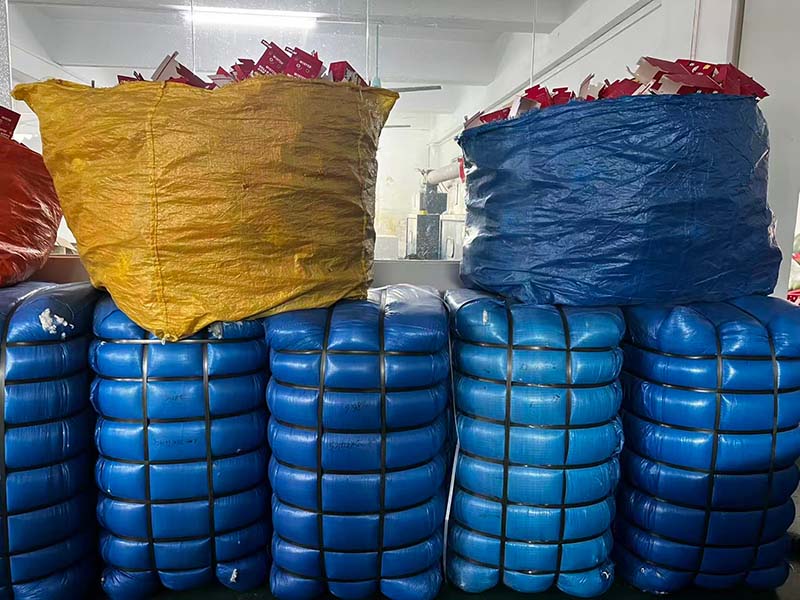
Material sourcing practice is one of the most commercially significant operational differences between professional manufacturers and low-cost suppliers — and one of the most effectively concealed during the sales process. Because materials represent 40 to 60 percent of a plush toy’s production cost, a supplier who sources cheaper materials gains an immediate cost advantage that directly translates into a lower quoted unit price. This advantage is only visible to the buyer when the quality or compliance consequences of the cheaper materials manifest in finished products.
Material sourcing practice differs between professional manufacturers and low-cost suppliers across four dimensions: the selection criteria used for material suppliers (quality and compliance vs primarily price), the verification processes applied to incoming materials (systematic IQC vs informal acceptance), the documentation maintained for material compliance (current certificates for all materials vs incomplete or absent documentation), and the transparency with which material specifications are disclosed to buyers (complete disclosure vs strategic omission).
Here is a comparison of material sourcing practice:
| Sourcing Practice Dimension | Professional Manufacturer | Low-Cost Supplier |
|---|---|---|
| Supplier selection criteria | Quality, compliance certification, consistency, reliability | Primarily price with minimum quality threshold |
| Fabric quality level | Certified fabrics meeting specification — OEKO-TEX, REACH documented | Standard or uncertified fabrics at lower cost |
| Compliance documentation | Current certificates for all materials, available on request | Incomplete documentation, certificates may be expired or absent |
| Incoming verification | Full IQC protocol for all materials including compliance review | Delivery acceptance without systematic inspection |
| Batch tracking | Roll-level tracking, lot management for fabric | No systematic batch tracking |
| Unauthorized substitution | Explicit contractual prohibition, buyer approval required for changes | Material changes made without buyer notification |
| Material specification disclosure | Complete specification disclosed on request | Generic material description, specific choices withheld |
The Unauthorized Substitution Risk
One of the most serious material sourcing risks with low-cost suppliers is unauthorized material substitution — where the factory uses a different fabric, filling, or accessory than specified without informing the buyer. This occurs when the specified material becomes more expensive, when the specified material is temporarily unavailable and a substitute is sourced without disclosure, or when the factory identifies a cheaper alternative that improves their margin without the buyer’s knowledge.
The buyer typically discovers unauthorized substitution when the bulk order arrives and the fabric feel, color, or overall quality is noticeably different from the approved sample — which was built with the correctly specified material. At this point, the cost of the problem is maximized: the full production investment has been made with the substituted material, and the options for correction are expensive and time-consuming.
Professional manufacturers prevent this through explicit contractual prohibition — a written agreement that any material change requires prior buyer approval — and through the internal culture and process discipline that makes compliance with this prohibition routine rather than exceptional.
How Do Compliance Capabilities Compare Between Professional and Low-Cost Plush Suppliers?
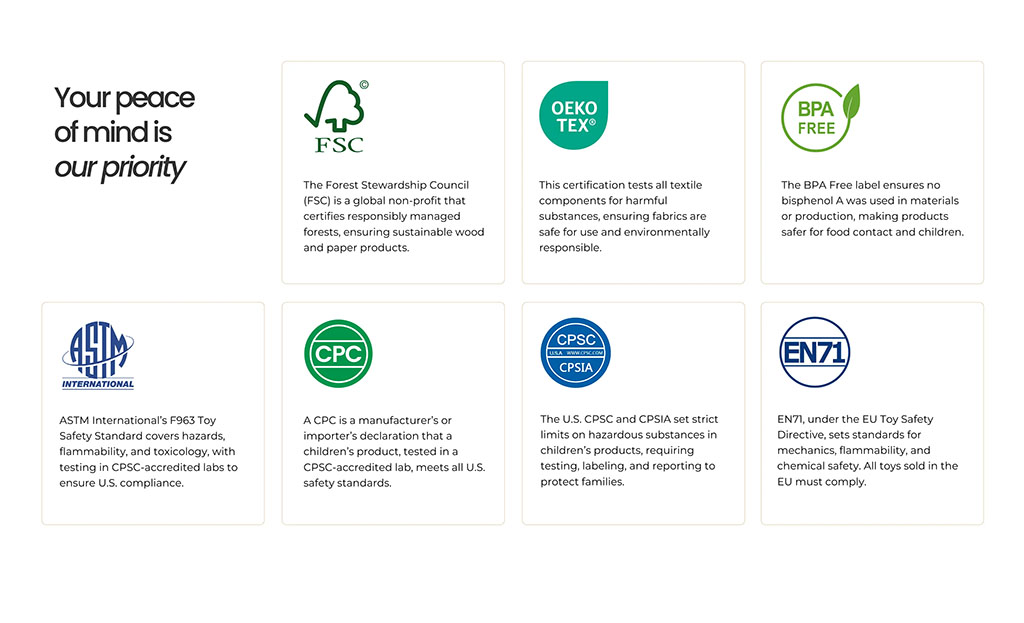
Compliance capability — the combination of regulatory knowledge, certified material sourcing, testing laboratory relationships, documentation management, and market-specific expertise that enables a factory to produce products that meet their clients’ target market safety requirements — is one of the most significant and most practically important differentiators between professional manufacturers and low-cost suppliers.
Compliance capabilities differ between professional manufacturers and low-cost suppliers because genuine compliance infrastructure requires sustained investment in regulatory knowledge development, certified supplier relationships, laboratory partnerships, and documentation systems that low-cost suppliers typically reduce or eliminate as part of their cost management approach. The result is a compliance capability gap that is invisible during the sales process but becomes commercially very visible when products fail safety testing, are rejected at customs, or are removed from retail or e-commerce platforms for non-compliance.
Here is a compliance capability comparison:
| Compliance Dimension | Professional Manufacturer | Low-Cost Supplier |
|---|---|---|
| Regulatory knowledge | Detailed, current knowledge of US and EU requirements by product type | General awareness without operational depth |
| Material certification | All materials carry current compliance certification | Partial or absent certification, expired documents common |
| Testing lab relationships | Established accounts with SGS, Intertek, Bureau Veritas | No established relationships, unfamiliar with testing process |
| CPSIA label application | Correct tracking label content and placement as standard | Inconsistent or incorrect label application |
| CE marking knowledge | Understands Declaration of Conformity requirements | Unclear on EU documentation requirements |
| Test report provision | Can provide current test reports on request | Unable to provide, provides expired reports, or cannot source |
| Compliance support | Guides buyers through requirements for their specific market | No proactive compliance guidance |
| Weighted product compliance | Specific knowledge of weighted-specific requirements | General toy safety awareness without weighted-specific depth |
The Compliance Failure Cost Calculation
The cost of a compliance failure — when a product fails safety testing because materials do not meet applicable standards — is one of the most significant hidden risks in low-cost supplier sourcing. When a product fails chemical testing under ASTM F963 or EN71, the consequences include identifying and replacing the non-compliant material, reworking or destroying affected units, retesting the corrected product, managing the timeline impact of this process, and absorbing the expedited shipping costs required to meet a delayed delivery window.
For a 2,000-unit order, the direct cost of a compliance failure scenario can range from $5,000 to $25,000 or more — eliminating the unit price saving achieved by choosing a low-cost supplier and often adding net cost beyond what a professional manufacturer would have charged.
This risk is entirely manageable through compliance-first material sourcing — using certified materials from verified suppliers for all products intended for regulated markets. Professional manufacturers build this into their standard sourcing practice. Low-cost suppliers often treat compliance as an afterthought or leave it entirely to the buyer — which means the buyer bears the full compliance failure risk without the operational infrastructure to manage it.
How Does Communication and Problem-Handling Culture Differ Between the Two?
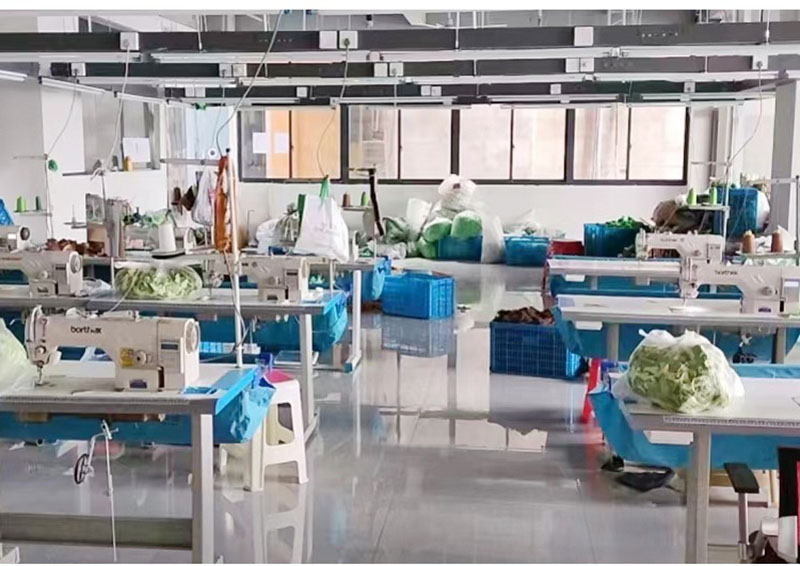
Communication quality and problem-handling culture are the operational dimensions that most directly determine a buyer’s day-to-day experience of working with a supplier — and the dimensions where professional manufacturers and low-cost suppliers diverge most consistently and most predictably.
Communication and problem-handling culture differ because they reflect the organizational priorities and values that a supplier has built into their operation — and those priorities either favor client transparency and accountability or favor self-protection and problem minimization. A professional manufacturer has built communication infrastructure — defined update protocols, production milestone reporting, proactive problem notification — that makes quality information visible to clients throughout the production process. A low-cost supplier typically communicates reactively — responding to buyer inquiries but not proactively sharing production status, quality information, or emerging problems.
Here is a detailed communication and problem-handling comparison:
| Communication Dimension | Professional Manufacturer | Low-Cost Supplier |
|---|---|---|
| Inquiry response | Within 24 hours, specific and technically informed | Variable — sometimes fast initially, less consistent over time |
| Production updates | Proactive milestone updates without being asked | Silent between order and delivery unless buyer asks |
| Problem notification | Proactive disclosure when identified, solution proposed simultaneously | Delayed disclosure, often after problem is unresolvable |
| QC result sharing | First-off report, mid-production update, FQC report shared as standard | Not shared unless specifically requested |
| Documentation provision | Production records available on request, provided promptly | Limited or no records, slow to provide when requested |
| Problem accountability | Clear acknowledgment when factory error, specific corrective action | Defensive response, external attribution, vague resolution |
| Post-problem follow-through | Corrective actions confirmed and documented | Promises made but rarely followed up systematically |
The Silence Problem
The most commercially damaging communication pattern in low-cost supplier relationships is not bad news communicated late — it is no news communicated at all. A buyer who places an order and then hears nothing for three weeks cannot know whether production is proceeding normally or whether a problem that will affect delivery and quality is developing unaddressed.
When the silence breaks — either with a shipment notification or with a problem disclosure — the buyer has no context for evaluating the news, no historical quality data to assess the shipment against, and no leverage to address problems that have been developing while they were kept in the dark.
Professional manufacturers address this through structured communication protocols that create a production visibility cadence — specific communications at specific production milestones that keep the buyer informed without requiring them to chase for information. This cadence transforms the production period from an anxious wait into a managed process that the buyer can track and respond to as it unfolds.
What Is the True Total Cost Comparison Between Professional and Low-Cost Plush Sourcing?

The unit price difference between a professional manufacturer and a low-cost supplier is real and visible in the initial quotation comparison. The total cost difference — which includes development costs, quality failure costs, compliance costs, management overhead costs, and the opportunity cost of quality problems that affect market success — is also real but largely invisible in the quotation comparison. Understanding the true total cost comparison is what transforms the sourcing decision from a unit price selection into a business value assessment.
The true total cost of a plush sourcing relationship is the sum of all costs incurred from brief submission through product delivery and market entry — including development investment, unit production cost, compliance and testing investment, quality remediation costs, management time costs, and the cost of any market performance impact from quality issues that reach customers.
Here is a total cost model comparing professional manufacturer and low-cost supplier sourcing at 1,000 units:
| Cost Category | Professional Manufacturer | Low-Cost Supplier | Notes |
|---|---|---|---|
| Unit price at 1,000 units | $5.50 | $4.20 | Low-cost saves $1,300 |
| Total production cost | $5,500 | $4,200 | |
| Sampling — estimated rounds | $250 (1 round) | $750 (3 rounds) | Low-cost costs $500 more |
| Sample shipping | $65 | $195 | Low-cost costs $130 more |
| Compliance testing | $0 (included) | $800 (excluded) | Low-cost costs $800 more |
| Quality rework — 12% defect rate | $0 | $504 | Low-cost costs $504 more |
| Third-party inspection | $0 (included) | $400 | Low-cost costs $400 more |
| Management time — 8 extra hours | $0 | $400 | Low-cost costs $400 more |
| Delay cost — 2-week late delivery | $0 | $800 | Low-cost costs $800 more |
| Total effective cost | $5,815 | $8,049 | Low-cost costs $2,234 more |
This model is illustrative — not universal. But the pattern it reflects is consistent: the unit price advantage of low-cost suppliers is regularly offset or exceeded by the additional costs generated by the capability gaps that produce the lower price. Buyers who compare suppliers on unit price alone systematically underestimate the total cost of low-cost sourcing and overestimate the premium paid for professional manufacturing.
When Low-Cost Sourcing Is Genuinely Appropriate
Low-cost sourcing is not always the wrong choice — there are specific situations where it delivers genuine value without exposing buyers to unmanageable risk. For very small test orders where the commercial exposure is limited and the primary goal is market testing rather than quality performance at scale, a low-cost supplier may be an appropriate lower-risk entry point. For simple, standardized products with minimal design complexity and non-critical compliance requirements — promotional items for markets without stringent toy safety regulation, for example — the capability premium of a professional manufacturer may not produce a quality benefit that justifies the price difference. For buyers who have sufficient quality management infrastructure of their own — internal QC teams, compliance expertise, production monitoring capability — the support services of a professional manufacturer may be partially redundant.
In all of these cases, the decision to use a low-cost supplier should be made with full awareness of the capability gaps and the specific risk management measures required to compensate for them — not as a default choice made because the lower price looks attractive without understanding what produces it.
How Should Buyers Decide Which Type of Supplier Fits Their Specific Sourcing Situation?
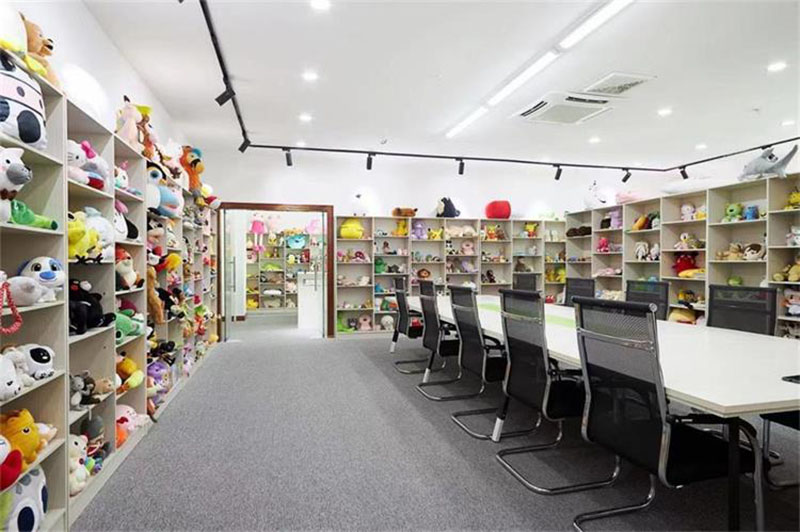
The decision between a professional manufacturer and a low-cost supplier is not universal — it is specific to each buyer’s product requirements, market obligations, business stage, and risk tolerance. The appropriate framework is not “which type is better” but “which type fits my specific situation and what does that fit require me to do to manage the remaining risk.”
Buyers should decide which supplier type fits their situation through a structured assessment of four factors: product complexity and the development capability required, market compliance obligations and the compliance infrastructure required to meet them, order volume and the quality economics that volume creates, and the buyer’s own quality management infrastructure and the degree to which it can compensate for supplier capability gaps.
Here is a decision framework organized by buyer situation:
| Buyer Situation | Recommended Supplier Type | Reasoning | Risk Management Required |
|---|---|---|---|
| Complex character design, US/EU market, 1,000+ units | Professional manufacturer | Development and compliance capability critical at this combination | Third-party inspection, documented specs |
| Simple design, promotional market, 500 units | Low-cost may be appropriate | Lower complexity and compliance criticality | Explicit spec, material verification |
| E-commerce brand, Amazon listing, 1,000+ units | Professional manufacturer | Platform compliance requirements, review exposure | Full compliance documentation essential |
| New product test, 200 units, non-regulated market | Low-cost may be appropriate | Limited exposure, learning objective | Third-party inspection recommended |
| Established brand, retail chain, seasonal reorder | Professional manufacturer | Consistency requirement, compliance accountability | Counter sample, IQC documentation |
| Weighted plush, adult wellness market | Professional manufacturer | Specialized capability, compliance criticality | Weighted-specific compliance testing |
| Licensed character, children’s market | Professional manufacturer | Character accuracy, compliance criticality | ASTM/EN71 testing essential |
| Promotional item, domestic market, 300 units | Low-cost may be appropriate | Lower compliance requirement, limited exposure | Basic spec documentation |
Building the Assessment Correctly
The most common error in this decision process is assessing only the product complexity dimension — choosing a professional manufacturer for complex products and a low-cost supplier for simple ones — without equally weighting the compliance obligation and exposure dimensions. A simple product that will be sold on Amazon, in US retail, or to a brand with ethical sourcing requirements carries compliance obligations that make professional manufacturer capability essential regardless of design complexity.
The exposure assessment is equally important. A 500-unit test order with a low-cost supplier carries limited financial exposure — the worst case is a failed order worth a few thousand dollars. A 5,000-unit order with a low-cost supplier carries five to ten times the financial exposure, and the compliance, quality, and delivery risks that were acceptable at small scale become commercially very significant at larger scale.
The appropriate approach is to make the decision at the intersection of all four assessment dimensions — not at any single dimension — and to build specific risk management measures for whichever capability gaps remain in the chosen supplier relationship.
At Kinwin, we understand that not every sourcing decision will favor a professional manufacturer — and we would rather help buyers make the right decision for their situation than win business that is not the right fit. When we engage with potential clients, we explain specifically what our capability provides and what problems it prevents — so buyers can assess whether the professional manufacturing capability we offer is worth the investment at their specific order size, market, and product complexity.
For buyers whose situation genuinely calls for a professional manufacturer — complex products, regulated markets, brand compliance obligations, or high-volume production where quality consistency directly affects customer experience and brand reputation — we would be glad to demonstrate specifically how Kinwin’s capabilities compare to the low-cost alternatives and what the total cost difference actually looks like across a full project.
Reach out to our team at [email protected] or visit kinwintoys.com to start that conversation.
Conclusion
The difference between a professional plush manufacturer and a low-cost supplier is real, operational, and commercially significant — but it is not visible in a quotation comparison. It becomes visible in the number of revision rounds required to reach an approved sample, in the consistency of bulk production relative to that sample, in the compliance documentation available when a retailer or platform requests it, in the communication quality throughout the production process, and in how problems are handled when production conditions are not ideal.
Buyers who evaluate suppliers on unit price alone systematically undervalue the operational capabilities that produce consistent, reliable quality outcomes — and systematically underestimate the total costs that capability gaps generate across the full development and production cycle. Those who evaluate suppliers on operational capability, compliance infrastructure, development process quality, and communication standards make sourcing decisions that hold up across multiple orders, multiple product types, and the inevitable challenges that any manufacturing relationship encounters.
The professional manufacturer’s price premium is not a profit extraction — it is a reflection of the investment in systems, personnel, and infrastructure that makes consistent, reliable, compliant production possible. Understanding what that investment produces, and whether it is worth the premium for a specific sourcing situation, is the analytical foundation for making the right supplier choice.
FAQ
Q1: How can buyers tell during the quotation stage whether a supplier is genuinely a professional manufacturer or a low-cost supplier presenting themselves as one?
The most effective differentiation approach at the quotation stage is to request specific operational evidence alongside the price — not as a trust challenge but as a standard evaluation requirement. Specifically requesting an itemized quotation that separates material cost, labor, and overhead; asking for the sampling fee structure with revision round policy; requesting compliance documentation for the specific target market; and asking for two reference contacts from clients who have placed multiple orders. Professional manufacturers respond to these requests promptly and completely — they have the operational systems and client relationships that make these responses routine. Low-cost suppliers typically respond slowly, partially, or with generic materials that do not specifically address the requests. The pattern of response is often more informative than its content.
Q2: Is it possible for a low-cost supplier to meet the same quality standards as a professional manufacturer with sufficient buyer oversight?
In principle, yes — but the buyer oversight required to compensate for a low-cost supplier’s capability gaps is substantially greater than buyers typically anticipate. Compensating for absent incoming material inspection requires the buyer to commission independent material verification. Compensating for weak in-process monitoring requires the buyer to commission multiple third-party inspections during production. Compensating for limited compliance capability requires the buyer to manage the entire testing process independently. Compensating for poor communication requires the buyer to actively chase for production updates. Each of these compensating activities has its own cost in time, management resources, and professional fees. When the total cost of the buyer oversight required to achieve professional manufacturer quality outcomes through a low-cost supplier is calculated, it frequently approaches or exceeds the premium that a professional manufacturer would have charged — without achieving the same level of reliability, because buyer oversight can catch problems but cannot replace the production-stage prevention that professional manufacturing systems provide.
Q3: At what order volume does the premium cost of a professional manufacturer become economically clearly justified?
The break-even calculation depends on the specific cost difference between the professional and low-cost options, the specific capability gaps in the low-cost option, and the probability and cost of quality or compliance failures. As a general framework, the premium of a professional manufacturer becomes clearly economically justified at volumes where the expected cost of quality and compliance failures at a low-cost supplier — calculated as the probability of failure multiplied by the cost of failure — exceeds the cost premium of the professional manufacturer. For most buyers operating in regulated markets (US, EU) with complex products, this break-even typically occurs at 500 to 1,000 units — below which the financial exposure is limited enough that risk acceptance may be appropriate, and above which the financial exposure from quality or compliance failures at a low-cost supplier meaningfully exceeds the professional manufacturer premium.
Q4: How should buyers approach an existing relationship with a low-cost supplier if they want to improve quality outcomes without switching manufacturers?
Improving quality outcomes within an existing low-cost supplier relationship requires a structured approach that addresses the specific capability gaps producing the quality issues, rather than simply requesting better quality without providing a clear operational framework for achieving it. The most effective approach begins with identifying the specific quality gaps through systematic analysis — what defect types appear consistently, at what production stage they originate, and which operational capability is absent that would prevent them. Then establishing specific process requirements for those gaps — written inspection protocols, material specification requirements, communication schedules — as formal additions to the commercial relationship rather than verbal requests. And backing those requirements with commercial leverage — tying future order placement to demonstrated compliance with the new requirements, and commissioning third-party inspection to verify implementation. This approach is more likely to produce lasting improvement than repeated requests for “better quality” without specifying what better quality requires operationally.
Q5: How should buyers evaluate a supplier that falls between a clear professional manufacturer and a clear low-cost supplier — showing some professional capabilities but not others?
Suppliers with partial professional capability — strong in some dimensions but weak in others — require a capability-specific evaluation rather than a categorical assessment. The relevant questions are: which specific capabilities are strong, which are weak, and which capabilities are most critical for my specific product and market? A supplier with strong pattern making and weak compliance infrastructure may be an appropriate choice for a product in a non-regulated market where development accuracy is the primary quality challenge. The same supplier may be an inappropriate choice for a compliance-critical market where the compliance gap poses unmanageable risk. The practical approach is to map the supplier’s specific capability strengths and weaknesses against the specific capability requirements of your product and market, and to build specific risk management measures for the capability gaps that remain. This targeted approach is more accurate than a binary professional/low-cost categorization and more practically useful for making the specific sourcing decision.