Skip to content
Defects in plush toy production are not random events. They have causes — specific, identifiable causes that operate at predictable points in the manufacturing process. A fabric color deviation originates in the incoming material inspection stage, when a batch that does not match the approved standard is accepted into production. A stuffing density inconsistency originates in the in-process stage, when stuffing machine calibration drifts and goes unmonitored. A loose eye attachment originates in the assembly stage, when an operator uses insufficient force or incorrect technique during accessory attachment.
When defects are understood as having specific causes rather than being random occurrences, the appropriate response shifts from detection to prevention. Detection — finding defects in finished goods before shipment — is necessary, but it is both expensive and incomplete as a quality strategy. By the time a defect is detected in final inspection, it has already been produced across hundreds or thousands of units. Rework is expensive, rejection is more expensive, and some defects — particularly those that affect compliance — cannot be reworked at all.
Prevention addresses defects at their source — the specific point in the production process where the condition that causes the defect originates. A defect prevented in incoming inspection costs almost nothing. The same defect prevented in process monitoring costs marginally more. Caught in final inspection, it costs significantly. Discovered after shipment, it costs substantially more — and in some cases, it costs the entire commercial relationship.
This guide walks through every stage of the defect prevention system in plush toy production — from the materials that enter the factory to the finished goods that leave it — and explains what specific controls at each stage most effectively prevent the most commercially significant defect categories.
Why Defect Prevention Matters More Than Defect Detection in Plush Manufacturing?
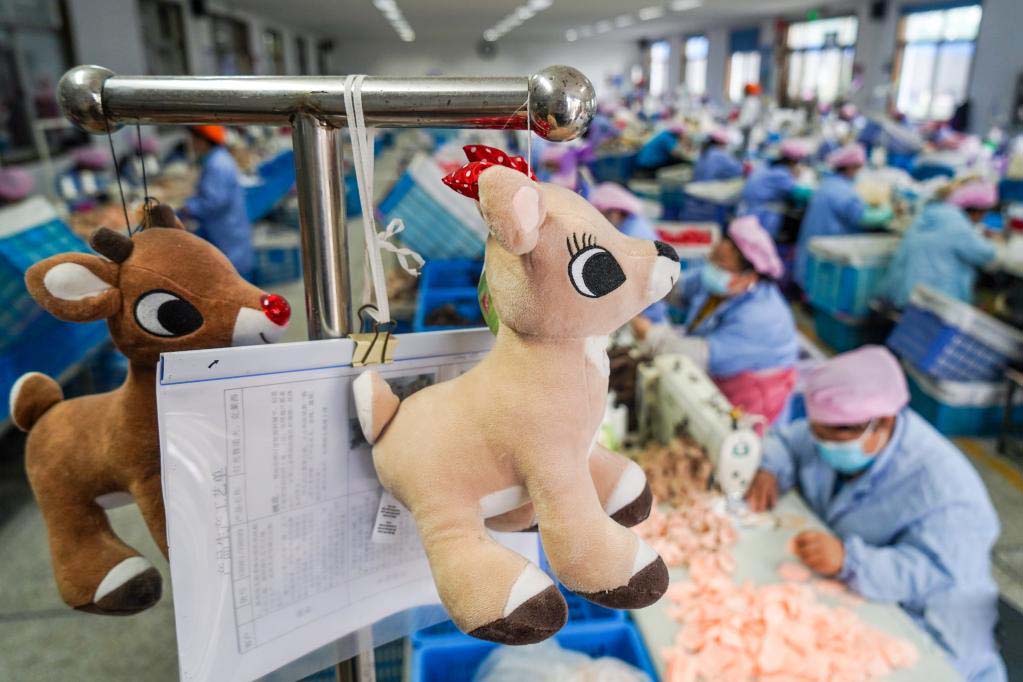
The conventional understanding of quality control focuses on detection — inspecting finished goods, identifying defects, and sorting or reworking affected units before shipment. Detection-based quality management has a role in any manufacturing system, but as a primary quality strategy, it is fundamentally limited in both effectiveness and economics.
Defect prevention matters more than defect detection in plush manufacturing because the cost of a defect — in materials, labor, time, and commercial impact — increases exponentially with how late in the production process it is discovered. A defect prevented at the incoming material stage costs a material rejection and sourcing delay. The same defect discovered in final inspection costs the rework or replacement of thousands of units. Discovered after shipment, it costs returns, recalls, platform delistings, and brand damage that no amount of rework can fully repair.
Here is a cost comparison of defect discovery at different production stages:
| Discovery Stage | Typical Remediation | Direct Cost | Timeline Impact | Commercial Impact |
|---|---|---|---|---|
| Incoming inspection | Reject and replace material | Very Low | 3–5 day delay | Minimal |
| Pre-production check | Adjust pattern or material before production | Low | 1–3 day delay | Minimal |
| First-off inspection | Halt and recalibrate — 5 units affected | Low-Medium | 1 day delay | Minimal |
| Mid-production IPQC | Correct and rework recent output | Medium | 1–3 day delay | Minor |
| Final inspection | Rework or reject batch — full run affected | High | 1–2 week delay | Significant |
| Post-shipment | Returns, replacements, recalls | Very High | Weeks to months | Severe |
The Detection Trap
Factories that rely primarily on final inspection as their quality strategy are operating in what might be called the detection trap — a quality management approach that consistently produces higher costs and worse outcomes than prevention-based alternatives. The detection trap works as follows: because defects are only identified at the end of production, the full cost of producing defective units is incurred before any quality action is taken. Rework of those units adds cost on top of the original production cost. And the defects that cannot be reworked — compliance failures, irreparable fabric damage, structural defects that compromise safety — result in the entire production investment being written off or rejected.
Prevention-based quality management breaks this cycle by addressing defects at their source, before production cost is incurred. The investment in prevention — incoming inspection, pre-production controls, in-process monitoring — is consistently lower than the cost of the defects those investments prevent.
Why Plush Toys Are Particularly Defect-Sensitive
Plush toys have specific characteristics that make defect prevention particularly important relative to other product categories. The multi-component nature of plush construction — combining fabric, filling, accessories, embroidery, and labels — means there are many potential defect sources at many stages of the production process. The tactile and visual expectations of end customers are high — customers immediately notice and respond negatively to stuffing inconsistency, color deviation, or embroidery variation that might be acceptable in less scrutinized product categories. And the safety requirements for plush toys — particularly for children’s products — mean that structural or chemical defects can have consequences that go beyond commercial disputes into regulatory and legal territory.
How Do Material Standards and Incoming Inspection Prevent the Root Causes of Defects?
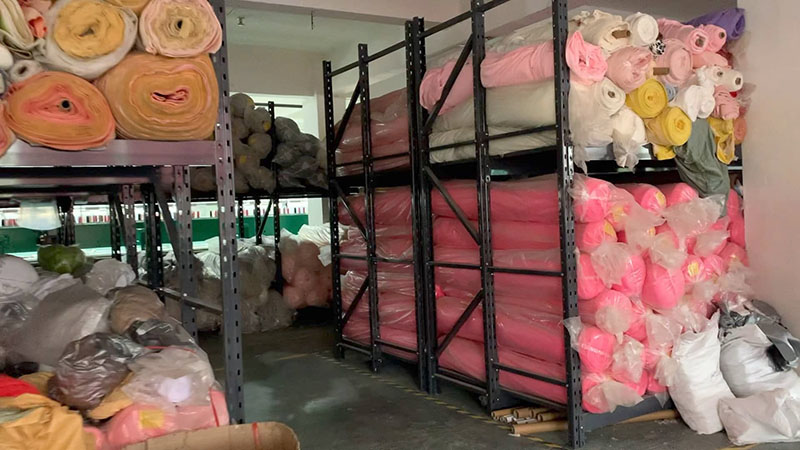
Materials are the foundation of every plush toy quality outcome. The quality, consistency, and compliance status of the materials that enter the production process directly determine the baseline quality characteristics of every unit produced. No amount of production-stage quality management can consistently compensate for materials that do not meet the required standard — because production processes that work correctly with specified materials may produce defective output when those materials vary from specification.
Material standards and incoming inspection prevent the root causes of defects by ensuring that only materials meeting defined quality, dimensional, and compliance specifications enter the production process. Every material deviation that is caught at the incoming stage is a potential defect category eliminated from the production run before a single unit is produced with it.
Here is a comprehensive overview of incoming inspection protocols for the main material categories in plush toy production:
| Material Category | Primary Defect Risk | Incoming Inspection Method | Acceptance Standard |
|---|---|---|---|
| Outer fabric | Color deviation, pile height inconsistency, surface defects | D65 visual comparison, pile height measurement, surface inspection | Within approved swatch tolerance |
| PP cotton filling | Density inconsistency, contamination, low loft | Compression and loft recovery test, visual cleanliness check | Meets density and loft specification |
| Glass beads (weighted) | Size non-uniformity, surface roughness, weight deviation | Sieve test, surface inspection, weight measurement | Within specified size and weight range |
| Safety eyes and accessories | Size deviation, attachment incompatibility, surface defects | Dimensional measurement, fit test with attachment point | Matches approved component specification |
| Thread | Tensile strength inconsistency, color deviation | Tension test, color comparison under D65 | Meets strength and color specification |
| Embroidery thread | Color deviation, twist inconsistency | Color comparison under D65 standard | Matches approved color reference |
| Labels — care and brand | Content accuracy, print quality, dimensional accuracy | Visual content verification, dimensional check | Matches approved label specification |
| Packaging components | Dimensional accuracy, print quality, material safety | Measurement, visual inspection, material documentation | Matches approved packaging specification |
The Batch Consistency Problem
One of the most important defect risks in incoming material inspection is batch-to-batch variation — the subtle differences in color, pile height, or density that occur between different production batches of the same material from the same supplier. This variation is normal in textile manufacturing but becomes a defect source in plush production when it is not identified and managed before the variable material enters production.
Effective incoming inspection manages batch variation through a specific protocol: every new material batch — not just the first batch for a new product but every subsequent batch for every reorder — is compared against the approved reference standard before being accepted for production. For fabric, this means comparing a swatch from every new roll against the approved color reference under D65 lighting. For filling, it means measuring the density of each new bale against the approved compression standard. For accessories, it means verifying dimensions against the approved component specification.
Factories that apply incoming inspection only to new products but not to reorders are leaving a significant defect risk unmanaged — because the most common source of reorder quality complaints is batch variation in materials that was not caught before production.
Compliance Documentation as a Defect Prevention Tool
Beyond physical quality inspection, compliance documentation review at the incoming stage prevents the most serious category of plush toy defect — chemical non-compliance. Fabrics dyed with restricted azo compounds, fillings containing excessive heavy metals, accessories with phthalate concentrations above regulatory limits — all of these produce products that cannot legally enter their target markets, regardless of their physical appearance.
Requiring and verifying current compliance documentation from all material suppliers — OEKO-TEX certification for fabrics, REACH compliance documentation for all materials entering EU-bound products, chemical test reports for filling materials — before any material is accepted into production creates a compliance barrier at the earliest possible stage. Materials without current, valid compliance documentation should not enter production regardless of their physical appearance — because the physical inspection cannot identify the chemical compliance risks that only laboratory testing can detect.
What Pre-Production Controls Stop Defects Before the First Unit Is Produced?

Pre-production controls are the quality management activities that occur between material acceptance and the start of production. They address a category of defect risk — process setup errors, specification ambiguities, and production system misalignments — that incoming inspection cannot detect because these risks originate in how the production process is configured rather than in the materials it uses.
Pre-production controls stop defects before the first unit is produced by ensuring that the production system — patterns, equipment settings, material preparation, and operator instructions — is correctly configured to produce the approved standard before any production volume is committed to that configuration. A process setup error caught in a pre-production check costs essentially nothing to correct. The same error discovered after the full production run is complete may cost the entire batch.
Here is an overview of the essential pre-production controls in plush toy manufacturing:
| Pre-Production Control | What It Addresses | When It Occurs | Defect Category Prevented |
|---|---|---|---|
| Tech pack distribution review | Operator understanding of production standard | Before production day 1 | Specification interpretation errors |
| Counter sample comparison | Bulk material match to approved standard | After bulk materials confirmed | Material batch deviation defects |
| Pattern verification | Cutting template accuracy for production run | Before cutting begins | Dimensional and shape defects |
| Stuffing machine calibration | Density setting accuracy for target standard | Before stuffing begins | Stuffing density defects |
| Embroidery machine setup | Position programming accuracy for design | Before embroidery begins | Embroidery position defects |
| Accessory attachment method confirmation | Correct technique verification | Before assembly begins | Attachment security defects |
| Work instruction distribution | Operator-specific production technique guidance | Before each production stage | Technique variation defects |
| Material sorting and organization | Panel and material management protocol | Before cutting begins | Within-unit material variation defects |
The Counter Sample as a Pre-Production Defect Prevention Tool
The counter sample occupies a unique position in the defect prevention system — it is both the final stage of the sample approval workflow and the first stage of pre-production quality management. As a pre-production control, the counter sample’s specific function is to verify that the combination of bulk production materials, production patterns, and production processes produces a finished product that matches the approved development sample before the full production run commits to that combination.
This verification catches several defect categories that cannot be identified by any earlier control. The color deviation that occurs when bulk fabric comes from a different dye lot than the development sample fabric is only visible in a finished product — not in a swatch comparison. The stuffing density difference between hand-stuffed development samples and machine-stuffed production units is only measurable in a complete stuffed product. The embroidery position change that results from transferring embroidery patterns between the sampling embroidery machine and the production embroidery machine is only visible in a complete embroidered product.
Each of these is a real and common defect source that the counter sample specifically addresses — making it one of the highest-value pre-production investments available to any production run.
Work Instructions as Defect Prevention
Work instructions are the documented, operator-specific guidance that specifies exactly how each production operation should be performed to achieve the quality standard defined in the tech pack. They translate the quality specifications that QC inspectors use to assess output into the operational techniques that production operators use to produce it.
Effective work instructions for plush toy production cover specific technique guidance for the operations where operator variation most commonly produces defects: panel alignment technique for complex multi-panel designs, stuffing sequence and distribution method for products with complex shapes, accessory attachment force and angle for safety-critical components, embroidery hoop positioning method and reference point procedure, and thread trimming technique and acceptable finishing standard.
Factories that produce work instructions for every new design — rather than relying on operator experience and verbal communication — consistently produce lower defect rates on first production runs than those that do not. The investment in work instruction preparation is small. The reduction in first-run defect rates from having them is significant.
How Does In-Process Quality Monitoring Catch Defects While They Can Still Be Corrected?
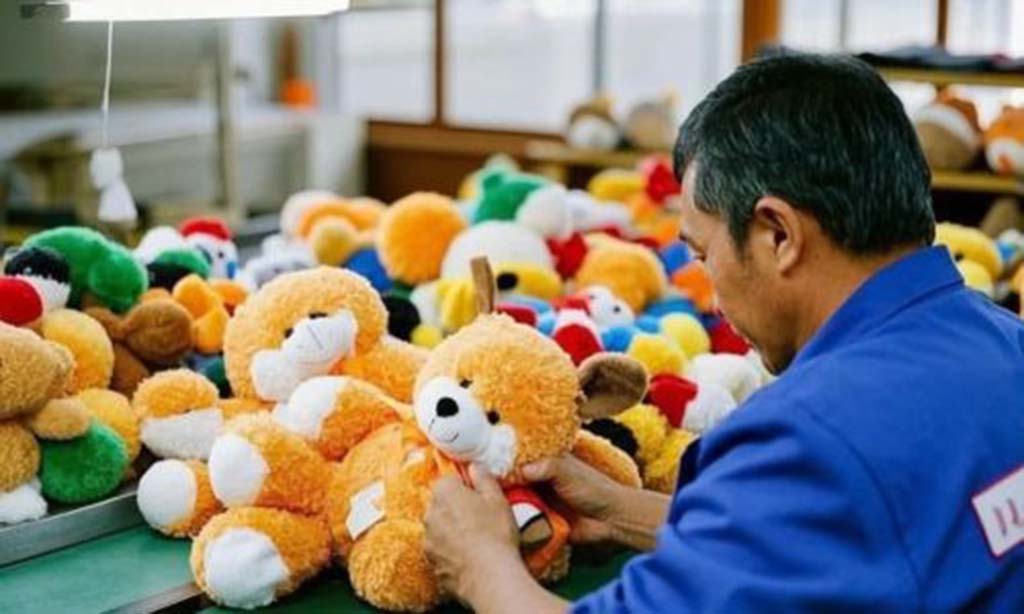
In-process quality monitoring — IPQC — is the continuous quality management system that operates throughout the production run, checking output at defined intervals and at critical production milestones. Its purpose is to catch defects while production is still ongoing — when the number of affected units is small and correction is still possible — rather than after the full run is complete and the defect has been replicated thousands of times.
In-process quality monitoring catches defects while they can still be corrected by detecting production drift — the gradual change in output quality that occurs as machines develop subtle setting changes, operators fatigue, and material characteristics vary from roll to roll — at an early enough stage to limit the number of units affected before correction is applied. A defect detected by IPQC after 300 units have been produced affects at most 300 units. The same defect, first detected in final inspection, affects the entire production run.
Here is a complete IPQC protocol framework for plush toy production:
| IPQC Checkpoint | Timing | Sample Size | What Is Checked | Trigger for Corrective Action |
|---|---|---|---|---|
| Post-cutting panel check | After every 200 cut sets | 5 sets | Panel dimensions, grain line direction | Any deviation outside tolerance |
| First-off inspection | First 3–5 complete units | 100% of first-off | Full product against counter sample | Any deviation from approved standard |
| Sewing quality check | Every 60–90 minutes | 3–5 units | Seam alignment, stitch density, tension | Any visible seam quality deviation |
| Stuffing density check | Every 150–200 units | 3 units | Weight measurement, compression test | Reading outside target density range |
| Embroidery position check | Every 50 embroidered units | 3 units | Coordinate measurement against standard | Any positional deviation outside tolerance |
| Accessory attachment check | Every 2 hours | 5 units | Manual pull force on all accessories | Any detachment under spot-check force |
| Surface finishing check | Every 60–90 minutes | 5 units | Thread trimming, surface cleanliness | Any visible finishing defect |
| Fabric roll transition check | At every new fabric roll | 2 units from new roll | Color and texture consistency | Any visible variation from previous roll |
The First-Off Inspection — Highest Return IPQC Investment
Of all the IPQC checkpoints in the plush toy production process, the first-off inspection delivers the highest return on quality investment. By conducting a comprehensive quality check on the first three to five fully completed units from the production run — before any additional units are produced — the first-off inspection catches process setup errors at the point where they affect the fewest possible units.
The specific defects the first-off inspection is most valuable for catching are process configuration errors — the stuffing machine was calibrated to a slightly different density than specified, the embroidery machine hoop positioning produces a systematic offset from the approved coordinate, the panel cutting shows a consistent size deviation that indicates a pattern calibration issue. These errors, if not caught, replicate identically across every unit produced until they are identified and corrected. The first-off inspection identifies them when five units have been affected rather than five thousand.
Managing Production Drift with Interval IPQC
Between the first-off inspection and the final inspection, production drift is the primary defect source that interval IPQC is designed to manage. Production drift is the gradual change in output quality that occurs as machines warm up and develop subtle setting changes, operators fatigue across a shift and apply slightly less force or attention to precision operations, and material characteristics vary subtly as production moves through different fabric rolls or filling bales.
Managing production drift effectively requires that IPQC intervals are short enough to catch drift before it accumulates into a visible quality deviation. For high-precision operations — embroidery positioning, stuffing density, complex panel alignment — shorter intervals of 50 to 100 units are appropriate. For lower-precision operations — basic sewing, simple finishing — longer intervals of 200 to 300 units are acceptable.
Factories that conduct IPQC at intervals that are too long — checking once every shift rather than every hour or every 200 units — allow production drift to accumulate across hundreds or thousands of units before correction. The practical difference in defect rate between a factory with hourly IPQC and one with shift-level IPQC is consistently visible in the proportion of units in final inspection that require rework.
What Are the Most Common Defect Types in Plush Toy Production and How Are They Prevented?
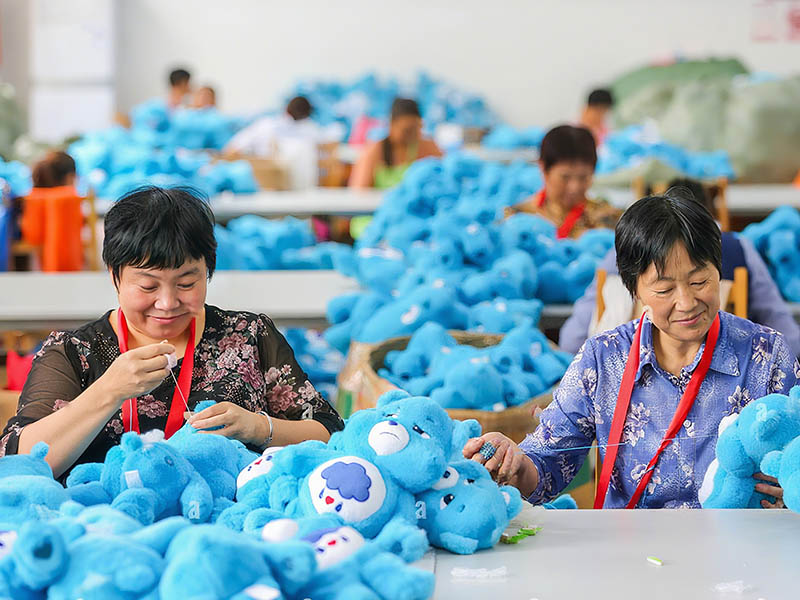
Understanding the specific defect types most commonly found in plush toy production — and which control in the prevention system addresses each one — enables both factories and buyers to target their quality management investment where it produces the most defect reduction per unit of effort.
The most common defect types in plush toy production fall into six categories: material defects, dimensional defects, stuffing defects, surface and finishing defects, accessory and attachment defects, and compliance defects. Each category has specific prevention controls that are most effective at its root cause stage.
Here is a comprehensive defect type analysis with prevention controls:
| Defect Type | Specific Examples | Root Cause Stage | Primary Prevention Control |
|---|---|---|---|
| Material defects | Color deviation, pile height variation, fabric contamination | Incoming material | IQC with D65 color check, pile measurement |
| Dimensional defects | Product too large or small, proportion imbalance | Pattern making, cutting | Pattern verification, cut piece check |
| Stuffing defects | Under-stuffed areas, over-stuffing, uneven density | Production — stuffing stage | Machine calibration, density IPQC |
| Embroidery defects | Position drift, thread tension, color variation | Production — embroidery | Coordinate IPQC, tension calibration |
| Surface defects | Loose threads, fabric marks, pile damage | Production — all stages | First-off check, pre-pack inspection |
| Accessory defects | Loose eyes, mispositioned accessories, detachment | Production — assembly | Technique work instructions, pull force IPQC |
| Seam defects | Weak seams, misaligned panels, puckering | Production — sewing | Sewing IPQC, seam tension monitoring |
| Compliance defects | Chemical non-compliance, labeling errors | Material sourcing, pre-production | IQC compliance documentation, label verification |
| Shape defects | Incorrect silhouette, asymmetry, collapsed areas | Pattern making, stuffing | Pattern verification, stuffing technique guidance |
| Finishing defects | Exposed thread, rough edges, surface stains | End-of-line finishing | Pre-pack visual inspection protocol |
Preventing Stuffing Density Defects — The Most Visible Category
Stuffing density defects are among the most commercially visible defect categories in plush toy production because they directly affect the product’s three-dimensional appearance — its shape, proportions, and the visual expression of any character features. A product that is under-stuffed appears flat and deflated. A product that is over-stuffed has distorted proportions and stressed seams. A product with inconsistent stuffing has areas of different firmness that are immediately apparent when the product is handled.
The three-stage prevention system for stuffing density defects operates as follows. Pre-production calibration establishes the target density setting on the stuffing machine — verified by producing test units at the calibrated setting and measuring their weight against the target weight range specified in the tech pack. First-off inspection confirms that the calibrated setting produces the correct density in actual finished units. Interval IPQC checks unit weight at defined intervals throughout the production run to catch density drift before it accumulates across a significant portion of the run.
Preventing Embroidery Position Defects — The Most Emotionally Impactful Category
Embroidery position defects — where facial features shift from their approved coordinates across units in the production run — are particularly commercially impactful for character-based plush toys because the position of eyes, nose, and mouth elements determines the character’s emotional expression. A shift of even 3 to 5 millimeters in eye positioning changes the perceived emotional character of the product — from warm and friendly to distant or unsettling — in ways that customers immediately register even if they cannot articulate the specific change.
Preventing embroidery position defects requires a coordinate-based positioning standard — specific measurements that define where each embroidery element should sit relative to fixed reference points on the product — and interval monitoring that checks actual positions against this standard at regular intervals throughout the embroidery production run. Factories that rely on visual comparison to the previous unit for embroidery position assessment allow drift to accumulate across the run. Factories that use coordinate measurement against an absolute standard catch drift at the point where it exceeds the acceptable tolerance.
How Do Operator Training and Workforce Management Reduce Defect Rates at Scale?
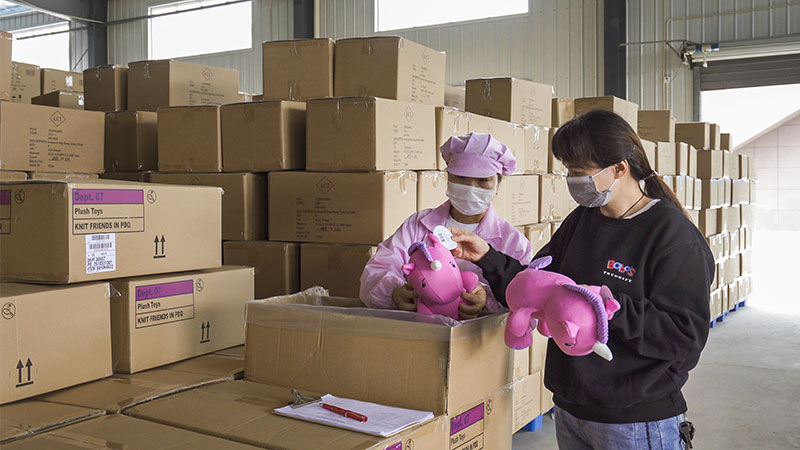
Production quality in plush toy manufacturing is, to a significant degree, a human performance question. Unlike industries where automated machinery handles most critical production steps, plush toy manufacturing relies on skilled human operators at every stage — cutting, sewing, stuffing, assembly, finishing. The skill level, training depth, and working conditions of these operators directly affect the defect rate of the production output.
Operator training and workforce management reduce defect rates at scale by building and maintaining the human capabilities that prevent the operator-controlled defect categories — technique variation, attention lapses, skill-dependent precision operations — that quality monitoring systems can catch but cannot independently prevent. A well-trained, well-managed workforce prevents defects from being produced. A monitoring system catches the ones that are produced despite training. Both are necessary, but prevention through training is cheaper per defect prevented than detection through monitoring.
Here is a framework for operator training and workforce management as defect prevention:
| Training and Management Element | Defect Category Addressed | How It Prevents Defects |
|---|---|---|
| Task specialization | Consistency defects from role rotation | Operators develop deep expertise in specific operations |
| New product training | First-run defects on new designs | Operators understand product-specific requirements before production |
| Technique standardization | Variation defects between operators | All operators use the same documented technique for each operation |
| Quality standard orientation | Detection failures from unclear standards | Operators understand what acceptable and unacceptable output looks like |
| Fatigue management | End-of-shift quality decline | Production scheduling limits defect-generating fatigue effects |
| Supervisor quality monitoring | Drift from operator shortcuts | Supervisors catch technique deviations before they become defect patterns |
| Performance feedback | Persistent individual error patterns | Operators receive specific feedback on their quality output |
Task Specialization as a Defect Reduction Strategy
Task specialization — the practice of assigning operators to specific production stages rather than rotating them through all tasks — is one of the most effective structural defect reduction strategies available to plush toy manufacturers. It works because plush toy production involves multiple operations that require different skills, and operators who focus on a single operation develop the muscle memory, judgment, and technique precision that multi-task operators cannot achieve.
An operator who spends every working day sewing the face panels of plush toys develops an intuitive sense of panel alignment that significantly reduces misalignment defects. An operator who specializes in accessory attachment develops the consistent force application that produces secure attachment results. An operator who focuses exclusively on finishing and thread trimming achieves standards that operators handling finishing as one task among many cannot consistently replicate.
Factories that invest in task specialization typically see lower defect rates on complex or precision-demanding operations compared to those that use generalist production workforces. The management complexity of specialization — more rigid production line organization, dependency on specific skilled operators — is consistently offset by the defect rate reduction it produces.
Workforce Stability as a Quality Investment
High workforce turnover is one of the most corrosive influences on production quality in plush toy manufacturing. When experienced operators leave and are replaced by new workers, the institutional knowledge embedded in those operators — the accumulated muscle memory, judgment, and technique precision built over months or years of daily practice — leaves with them. New operators produce at lower quality and higher defect rates during their learning period, which may last weeks to months depending on the complexity of their assigned operations.
Factories that invest in workforce stability — through competitive wages, good working conditions, and career development opportunities — maintain experienced workforces whose quality output improves over time. The cost of this investment is reflected in unit pricing but produces consistent returns in lower defect rates, higher first-pass yield, and reduced rework costs. For buyers evaluating factory quality systems, workforce stability indicators — average operator tenure, annual turnover rate — are among the most informative capability indicators available.
How Does Final Inspection Serve as the Last Line of Defense Against Defects?
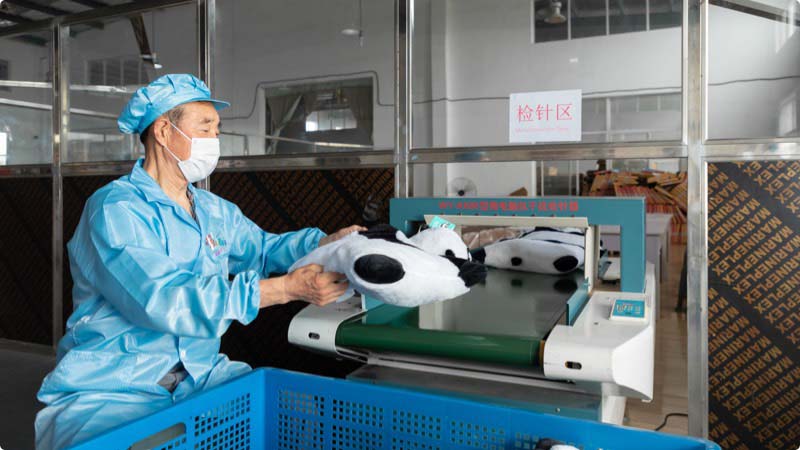
Final inspection — FQC — is the comprehensive quality check conducted on completed, packed goods as the last verification step before shipment is approved. It is not the primary defect prevention mechanism — that role belongs to the upstream controls described throughout this guide — but it is the essential safety net that catches defects that slipped through earlier controls and confirms that the production run as a whole meets the required quality standard.
Final inspection serves as the last line of defense against defects by applying AQL-based statistical sampling to the completed batch — inspecting a statistically defined sample of finished units against all applicable quality criteria and using the sample’s defect rate to determine whether the overall batch meets the acceptance threshold. If the sample defect rate exceeds the AQL threshold, the batch is held pending root cause investigation and remediation rather than being released for shipment.
Here is a complete final inspection protocol for plush toy production:
| FQC Inspection Area | Inspection Criteria | Defect Class | AQL Level Applied |
|---|---|---|---|
| Overall dimensions | Key measurements within tech pack tolerance | Major | 2.5 |
| Color accuracy | All color areas within approved Pantone tolerance under D65 | Major | 2.5 |
| Shape and proportion | Silhouette matches counter sample | Major | 2.5 |
| Fabric surface quality | No pilling, marks, contamination, or pile damage | Major | 2.5 |
| Stuffing density | Compression within target range | Major | 2.5 |
| Embroidery quality | Position within coordinate tolerance, tension correct | Major | 2.5 |
| Seam integrity | No visible weakness, misalignment, or thread exposure | Critical | 1.5 |
| Accessory attachment | All accessories pass pull force test | Critical | 1.5 |
| Safety eye security | No movement or detachment under test force | Critical | 1.0 |
| Label content | All required content present and accurate | Major | 2.5 |
| Finishing standard | No loose threads, surface marks, packaging damage | Minor | 4.0 |
| Packaging accuracy | Correct packaging type, insert, barcode, labeling | Major | 2.5 |
The Relationship Between Upstream Prevention and FQC Efficiency
The effectiveness of final inspection as a defect control is directly related to the effectiveness of the upstream prevention controls. A production run that has been managed through rigorous incoming inspection, pre-production control, and interval IPQC will present a low defect rate in final inspection — making the AQL sampling process quick, straightforward, and almost certain to produce a pass result.
A production run that has not been managed through upstream controls will present a higher defect rate in final inspection — requiring either acceptance of a substandard batch, expensive rework of defective units, or rejection of the batch and replacement production. In all three cases, the cost is significantly higher than the cost of the upstream prevention controls that would have prevented the defects from being produced.
This relationship is why final inspection should be understood as confirming that the prevention system worked rather than as the primary mechanism for ensuring quality. When final inspection reveals significant defect rates, it is the signal that the upstream prevention system failed — not that the final inspection process is working correctly.
Third-Party Final Inspection as Additional Assurance
For buyers who want independent verification of final inspection results — particularly for first orders with new factories, large-volume orders, or orders with complex compliance requirements — third-party pre-shipment inspection conducted by accredited organizations such as SGS, Bureau Veritas, or Intertek provides an independently verified FQC result that supplements the factory’s internal inspection.
Third-party inspection is particularly valuable for confirming that the factory’s internal FQC results accurately reflect the batch quality — since there is always a potential conflict of interest when a factory’s own QC team makes the final determination on whether the factory’s own production is acceptable. An independent inspector has no relationship with the factory and no incentive to pass results that do not meet the agreed standard, making their assessment the most objective quality verification available to buyers who cannot conduct the inspection themselves.
How Can Buyers Build Defect Prevention Into Their Supplier Relationships?
Defect prevention is not solely a factory responsibility. Buyers who actively participate in building defect prevention into their supplier relationships consistently experience lower defect rates than those who treat quality management as entirely the factory’s problem. This active participation takes several specific forms — setting clear standards, requiring documentation, structuring purchasing terms around quality performance, and maintaining the communication protocols that make prevention effective.
Buyers can build defect prevention into their supplier relationships by establishing clear, documented quality standards before production begins, requiring pre-production material approval, mandating first-off inspection reporting, structuring payment terms that retain leverage until quality is confirmed, and maintaining proactive communication protocols that make quality information visible throughout production rather than only after completion.
Here is a practical framework for buyer-led defect prevention in supplier relationships:
| Buyer Action | When It Occurs | Defect Category Addressed | How to Implement |
|---|---|---|---|
| Specify measurable quality standards | Before production | All defect categories | Complete tech pack with tolerances, AQL specification |
| Require material swatch approval | Before cutting begins | Material batch defects | Written approval protocol in purchase agreement |
| Mandate first-off inspection report | Production day 1 | Process setup defects | Request with photos as standard communication |
| Request IPQC milestone updates | During production | Drift and process defects | Mid-production update at 50% completion |
| Commission third-party inspection | Pre-shipment | All defect categories at batch level | Schedule with SGS, Bureau Veritas, or Intertek |
| Retain balance payment until QC passed | Pre-shipment | All defect categories | Payment structure in purchase agreement |
| Conduct post-delivery quality review | After receipt | Systematic defect pattern identification | Defect rate reporting to factory |
| Establish corrective action requirements | After any defect event | Recurrence prevention | Written CAPA requirement with root cause |
The Contractual Foundation for Defect Prevention
Defect prevention in a supplier relationship requires a contractual foundation that establishes the quality standard before production begins rather than negotiating it after a defect is discovered. The most important contractual elements for defect prevention are a product specification document that defines the quality standard in measurable terms, an AQL agreement that specifies the inspection level and acceptance threshold for the batch, a right-to-inspect clause that authorizes third-party inspection at any production stage, and a payment structure that retains the majority of payment until inspection results confirm batch quality.
These contractual elements do not guarantee defect-free production — but they create the framework within which defect prevention is enforceable rather than aspirational. When the quality standard is defined in measurable terms before production begins, defect disputes become objective assessments against agreed criteria rather than subjective disagreements about expectations that were never clearly established.
Building a Corrective Action Culture with Suppliers
The most mature form of buyer-led defect prevention is the establishment of a corrective action culture in the supplier relationship — a systematic approach to defect events that treats them as opportunities to identify and eliminate root causes rather than as one-time problems to be resolved and forgotten.
When a defect is identified — whether in IPQC, FQC, or post-delivery review — a genuine corrective action process involves three steps. Root cause identification: what specific condition in the production process produced this defect? Corrective action implementation: what specific change to the process, material, or control eliminates that condition? Verification: has the corrective action actually eliminated the defect — confirmed through production data after the change is implemented?
Suppliers who engage in this corrective action cycle genuinely improve their defect rates over time. Suppliers who treat each defect event as an isolated incident requiring apology rather than systematic correction produce similar defect rates across every production run.
At Kinwin, defect prevention is built into our operational culture rather than treated as a quality compliance exercise. Our three-stage IQC, IPQC, and FQC system, our material compliance documentation requirements, our first-off inspection protocol, and our corrective action process are all designed to prevent defects at their source rather than detect them at shipment. When defects do occur — as they occasionally do in any manufacturing environment — we treat them as process improvement opportunities with root cause investigation, corrective action implementation, and verification as the standard response.
If you are sourcing plush toys and want to understand specifically how our defect prevention system works in practice — what controls are applied at each stage, what documentation those controls produce, and how we communicate quality information throughout the production process — we would be glad to walk through it with you.
Reach out to our team at [email protected] or visit kinwintoys.com to start that conversation.
Conclusion
Defect prevention in plush toy production is a system, not a single action. It operates across every stage of the production process — from the materials that enter the factory to the finished goods that leave it — with specific controls at each stage targeting the specific defect categories most likely to originate there.
The economics of defect prevention are clear: preventing defects at their source is consistently cheaper, faster, and more commercially effective than detecting and correcting them after they have been produced. Buyers who understand this economics — and who choose manufacturing partners who have built genuinely prevention-oriented quality systems — consistently experience lower defect rates, fewer quality disputes, and more reliable production outcomes than those who treat quality management as a final inspection exercise.
The framework in this guide — incoming inspection, pre-production control, in-process monitoring, targeted defect prevention by category, workforce management, final inspection, and buyer relationship practices — represents the complete prevention system that the best plush toy factories implement and that the most sophisticated buyers require. Building this framework into every sourcing relationship is the most direct path to the consistent production quality that successful plush toy brands depend on.
FAQ
Q1: What is the most cost-effective single investment a plush toy factory can make to reduce its overall defect rate?
Based on the defect economics described in this guide, the most cost-effective single investment is a rigorous incoming quality control system with documented acceptance criteria and compliance documentation verification for all materials. IQC operates at the point in the production process where defects cost the least to prevent — before any production labor or overhead is invested in the affected materials. A comprehensive IQC system that catches material deviations, batch variations, and compliance issues before production begins eliminates entire defect categories at their root cause, preventing the cascading costs that occur when the same defects are discovered later. For buyers evaluating factory quality investments, asking specifically about the depth and documentation quality of the factory’s incoming inspection process is the single most revealing quality management question available.
Q2: How should buyers handle it when a factory’s FQC report shows a passing result but buyers discover defects in the delivered goods?
When delivered goods show defects not identified in the factory’s own FQC report, the first step is to document the defects systematically — photographs, measurements, and defect count across a statistically meaningful sample of the delivered units. This documentation should then be compared against the factory’s FQC report to determine whether the defects found in the delivery fall within or outside the AQL threshold that the factory’s inspection declared acceptable. If the delivery defect rate exceeds the agreed AQL threshold, the factory’s inspection results are inaccurate — either because of sampling error, inspector error, or deliberate misreporting. This is exactly the scenario that third-party pre-shipment inspection prevents — and for buyers who have experienced this pattern with a supplier, commissioning third-party inspection on all subsequent orders from that supplier is a justified and proportionate response.
Q3: Are there specific plush toy product types that are inherently more defect-prone than others, and how should buyers account for this in their quality requirements?
Yes — product complexity is strongly correlated with defect risk. Weighted plush toys — with their compartmentalized filling systems and reinforced seam requirements — present higher defect risk than standard PP cotton-filled products, particularly in the filling containment and seam strength categories. Complex character designs with many fabric panels present higher dimensional and alignment defect risk than simple standard shapes. Products with electronic components present additional assembly and functional defect risks beyond standard plush construction. For these product types, buyers should specify more stringent AQL levels for the highest-risk defect categories, require more frequent IPQC intervals during production, commission third-party inspection more consistently, and invest in more detailed work instructions that specifically address the higher-risk production operations. The additional quality management investment for complex products is always justified by the higher per-unit cost and higher customer expectation associated with premium product categories.
Q4: How does defect prevention in plush toy production change when producing very large orders — say, 20,000 units or more?
Very large production orders introduce specific defect prevention challenges that smaller orders do not present at the same severity. Material batch variation risk is higher because the order volume requires multiple fabric lots or filling batches — each of which may show subtle characteristics differences. The IPQC management challenge is more demanding because the longer production timeline creates more opportunity for drift accumulation between inspection intervals. The incoming inspection challenge is greater because the volume of material to be received and inspected is much larger. And the statistical significance of defect rates is higher — a 1 percent defect rate on a 500-unit order is 5 units, but the same rate on a 20,000-unit order is 200 units. For large orders, buyers should require more frequent IPQC reports — at least at 25%, 50%, and 75% production completion rather than just mid-production — commission multiple pre-shipment inspection visits rather than a single final inspection, and require material lot tracking documentation that identifies which material batch was used for which units so that any batch-specific defect can be identified and segregated efficiently.
Q5: What is the appropriate buyer response when a factory consistently produces acceptable FQC results but customers report higher-than-expected defect rates after purchase?
A pattern of post-delivery customer defect rates that exceed the FQC-reported defect rate is a serious quality management signal that warrants systematic investigation. The most common explanations are: the FQC sampling was not representative of the production batch — either the sample was too small or drawn from a non-random portion of the batch; the FQC inspection criteria were not aligned with the defect types customers are experiencing — meaning the inspection was passing products that do not meet actual use requirements; or defects are developing in use rather than being present at inspection — which points to durability or structural issues rather than cosmetic or dimensional ones. The appropriate response is first to document the customer defect types specifically — what defects are being reported, in what proportion, after what period of use — and then to compare these with the FQC inspection criteria to identify whether the inspection was testing for the right things at the right standards. This analysis typically reveals either an inspection criteria gap — requiring updated FQC criteria — or a structural quality issue — requiring process investigation and corrective action — that the existing inspection protocol was not designed to catch.