Price variation is one of the first things buyers notice when they start comparing plush toy suppliers. Send the same product brief to five different factories and you will receive five different quotes — sometimes varying by 30, 50, or even 100 percent between the lowest and highest. The instinct is to wonder which supplier is overcharging. The more productive question is to understand what is actually driving the difference.
Price variation between plush toy suppliers is not random, and it is not primarily a negotiation phenomenon. It reflects real differences in what different suppliers are actually providing — differences in materials, in production processes, in workforce quality, in quality control infrastructure, in compliance capability, and in the type of entity the buyer is actually dealing with. Understanding these differences is what allows buyers to evaluate quotes accurately rather than simply selecting the lowest number and hoping the product delivers what was promised.
The buyers who source most successfully are not necessarily the ones who find the cheapest supplier. They are the ones who understand what drives the price they are paying, verify that the value behind the price is genuine, and make sourcing decisions based on total cost — including the cost of quality failures, compliance problems, and relationship management — not just the unit price on the quotation.
This guide explains every major driver of price variation between plush toy suppliers so that buyers can approach the next quotation comparison with the analytical framework to make a genuinely informed decision.
Why Do Plush Toy Prices Vary So Much Between Different Suppliers?
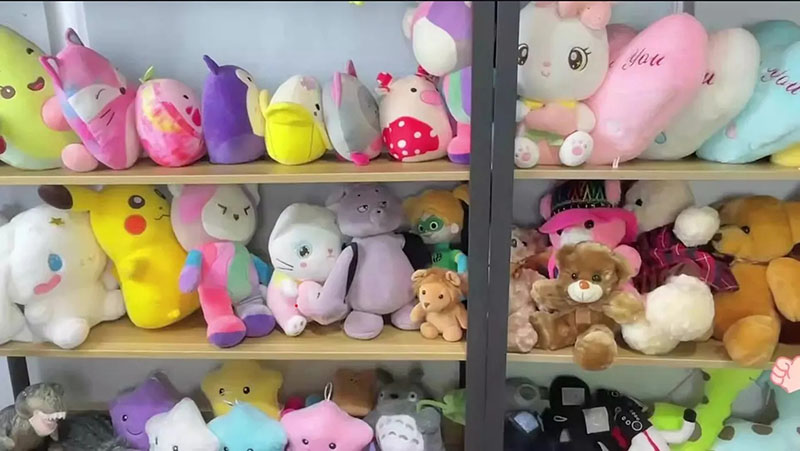
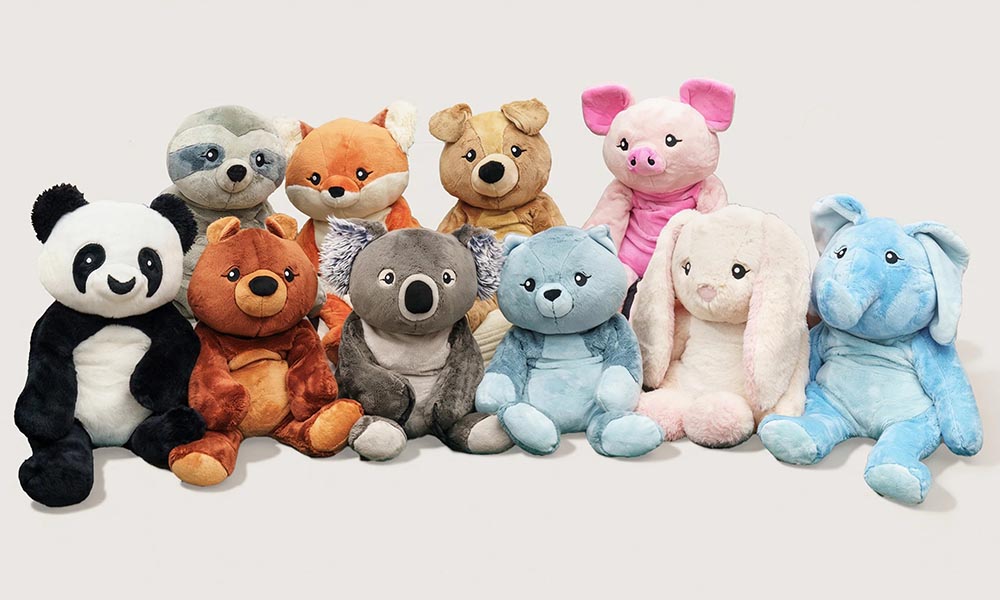
The range of prices buyers encounter when sourcing custom plush toys from different suppliers reflects the full spectrum of manufacturing capability, business model, material standard, and quality investment that exists in the plush toy supply market. At one end are highly capable OEM manufacturers with advanced production infrastructure, certified materials, rigorous quality systems, and experienced development teams. At the other end are simple assemblers using uncertified materials, minimal QC, and limited technical capability. Between these extremes lies a broad range of supplier types with different capability and cost profiles.
Plush toy prices vary significantly between suppliers because the cost of producing a plush toy is determined by a combination of factors — materials, labor, quality systems, compliance infrastructure, development capability, and business model — that differ fundamentally across different supplier types and production approaches. A price that appears low reflects lower costs in one or more of these areas. Understanding which costs are lower, and what the buyer is giving up as a result, is the essential analytical question behind every price comparison.
Here is a framework for understanding the major sources of price variation:
| Price Driver | High-Cost Scenario | Low-Cost Scenario | Price Impact |
|---|---|---|---|
| Supplier type | Direct factory with full capability | Trading company or limited-capability factory | 15–30% |
| Material quality | Certified premium fabrics and filling | Uncertified standard materials | 20–40% |
| Quality control | Three-stage documented QC system | Minimal end-of-line spot check | 10–20% |
| Compliance infrastructure | Full certification and testing support | No compliance capability | 10–25% |
| Labor standards | Experienced, fairly compensated workforce | Minimum wage, high-turnover labor | 10–20% |
| Development capability | Dedicated sampling team, experienced pattern makers | Production workers handle sampling | 5–15% |
| Order volume | Low MOQ, small batch production | High MOQ, optimized production | 15–35% |
| Geographic location | Higher labor cost regions | Lower labor cost regions | 10–25% |
Why the Lowest Price Is Rarely the Best Value
The temptation to select the lowest quote is understandable — plush toys are often sourced in competitive, margin-sensitive commercial environments where input cost reduction directly improves profitability. But the relationship between quoted price and total sourcing cost is more complex than a simple unit price comparison captures.
A lower-priced supplier that generates quality problems requiring rework, uses non-compliant materials that fail safety testing, delivers orders late due to production management failures, or communicates poorly enough that problems go undetected until goods arrive at the buyer’s warehouse creates total costs that frequently exceed the premium charged by a more expensive, more capable supplier. The price differential between suppliers is only a genuine saving if the lower-priced supplier delivers the same total value — and this is rarely the case when the price difference is large.
How Does Supplier Type — Factory vs Trading Company — Affect the Price You Pay?
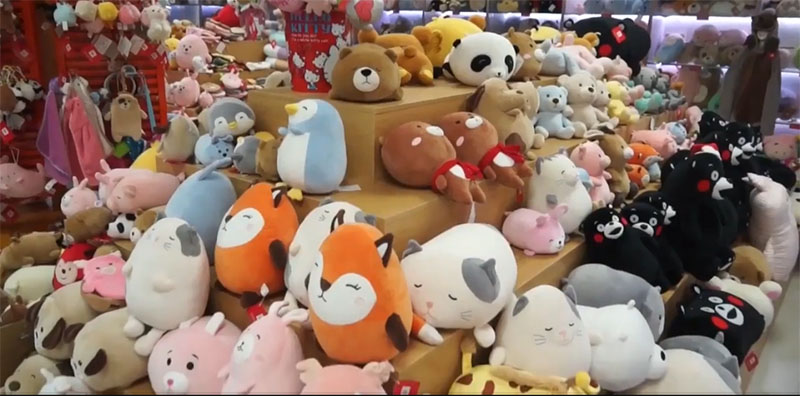
One of the most fundamental sources of price variation in plush toy sourcing is the type of entity the buyer is actually dealing with. The distinction between a direct factory and a trading company — or sourcing agent — is one of the most commercially significant in international manufacturing sourcing, and one of the most frequently obscured by suppliers who prefer buyers not to know which category they fall into.
The supplier type — whether the buyer is dealing directly with a manufacturing factory or with a trading company that subcontracts production — has a direct and significant impact on the price paid, the level of quality control available, the communication accuracy, and the buyer’s ability to manage production effectively. Trading companies add a margin layer to the factory’s price, reducing the buyer’s cost visibility and creating a communication intermediary between the buyer and the actual production environment.
Here is a comparison of the cost and capability implications of factory-direct versus trading company sourcing:
| Dimension | Factory Direct | Trading Company |
|---|---|---|
| Price | Factory cost only | Factory cost plus trading margin (typically 10–25%) |
| Price transparency | Direct visibility into cost structure | Cost structure obscured by intermediary |
| QC control | Direct access to factory QC systems | Dependent on trading company’s oversight of factory |
| Communication accuracy | Direct communication with production team | Filtered through intermediary, potential information loss |
| Problem resolution speed | Direct access to decision-makers | Dependent on trading company’s urgency and leverage |
| Customization capability | Direct development collaboration | Dependent on factory’s relationship with trading company |
| Audit capability | Direct factory audit possible | Factory may not be disclosed for audit |
How to Identify Whether a Supplier Is a Factory or a Trading Company
Many suppliers presenting as factories on Alibaba and similar platforms are in fact trading companies — intermediaries who source production from factories they may or may not disclose to buyers. Identifying the supplier type before engaging deeply is one of the most commercially important due diligence steps available to buyers.
Several practical approaches help identify supplier type. Requesting a factory audit — either in person or via video call — and observing whether the supplier can show actual production facilities with the product category being discussed is the most direct approach. Asking for the factory’s business license and noting whether the registered business scope includes manufacturing or trading activity provides documentary evidence. Asking to speak directly with the factory’s production or technical team — not a sales representative — and assessing whether the person reached has genuine manufacturing knowledge is a revealing communication test.
Factories that are genuinely direct manufacturers will welcome these approaches because they have nothing to hide and understand that buyers who verify direct factory status trust them more and order more confidently. Suppliers who resist audits, cannot provide manufacturing business licenses, or cannot connect buyers with technical production personnel are typically revealing that their presentation as a factory is not accurate.
When a Trading Company Might Be Appropriate
Trading companies are not always the wrong choice — but buyers who use them should do so with clear awareness of the cost and capability implications. For buyers who are placing very small orders that fall below the MOQ threshold of direct factories, trading companies can provide access to production that would otherwise be unavailable. For buyers who are sourcing across many categories simultaneously and want consolidated sourcing management, a trading company with strong factory relationships may provide genuine efficiency value.
In these situations, the trading company’s margin should be understood as payment for a specific service — access or consolidation — rather than a hidden cost. The buyer accepts the higher price in exchange for a defined benefit, with full awareness of the trade-off.
How Do Material Quality Differences Drive Price Variation Between Suppliers?
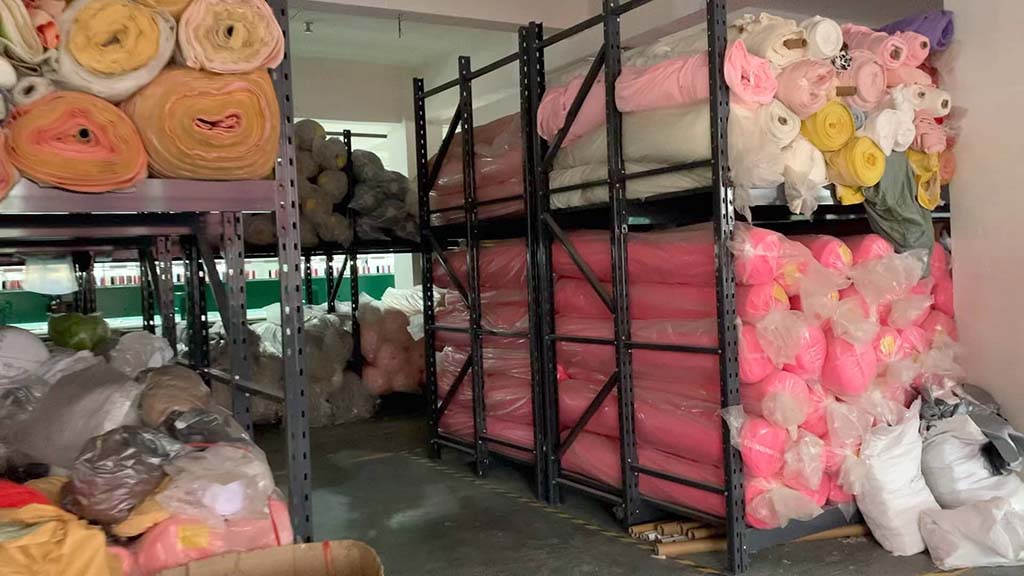
Material costs typically represent 40 to 60 percent of a plush toy’s total production cost. This makes material quality the single most significant determinant of unit price variation between suppliers offering apparently similar products. When two suppliers quote significantly different prices for the same design brief, material differences are almost always a primary driver of that gap — whether the buyer knows it or not.
Material quality differences drive price variation between plush toy suppliers because higher-quality materials — premium fabrics, certified fillings, safe accessories — cost more to source than standard or uncertified alternatives, and this cost difference flows directly into the unit price. A supplier who quotes a lower price for the same product has almost certainly made different — and typically lower — material choices, whether those choices are disclosed in the quotation or not.
Here is a comparison of material quality tiers and their cost implications:
| Material Category | Standard Quality | Premium Quality | Price Difference | Quality Impact |
|---|---|---|---|---|
| Outer fabric | Basic plush, no certification | Minky or high-density plush, OEKO-TEX certified | 20–40% higher | Feel, durability, compliance |
| Filling — PP cotton | Ungraded, uncertified | High-loft, certified, consistent density | 15–25% higher | Shape retention, consistency |
| Filling — glass beads | Variable size, uncertified | Uniform size, chemical test certified | 20–35% higher | Weight consistency, compliance |
| Safety eyes and accessories | Basic plastic, no pull test documentation | Safety-certified with pull force documentation | 15–30% higher | Safety compliance |
| Thread | Standard polyester thread | High-tenacity, colorfast thread | 10–20% higher | Seam strength, durability |
| Labels | Basic printed label | Woven or high-resolution printed, compliant content | 10–25% higher | Quality presentation, compliance |
The Invisible Material Substitution
One of the most common ways low-price suppliers maintain their price advantage is through material substitution — using lower-quality materials than specified in the buyer’s brief or than implied by the quoted price. This substitution may be explicit — the supplier quotes knowing they will use a different material — or opportunistic — the supplier quotes a price based on the specified material and then substitutes when it affects their margin.
Either way, the buyer receives a product built with materials different from what they specified and possibly from what they expected. The product may look acceptable in photos or in a first sample built with attention during the sales process, but bulk production reveals the material difference through lower texture quality, faster degradation, inconsistent color, or in the most serious cases, compliance failures when the product is tested.
Preventing material substitution requires specifying materials precisely in the brief and purchase agreement, requiring material test reports and compliance documentation for all key materials before production begins, approving bulk material swatches against the approved standard before cutting starts, and including an explicit contractual prohibition on unauthorized material changes. Suppliers who resist these requirements — particularly the contractual prohibition on unauthorized substitution — are typically revealing that material flexibility is part of how they manage their quoted price.
Compliance Certification and Its Cost
Materials that carry compliance certification — OEKO-TEX Standard 100, REACH compliance documentation, CPSIA-compatible chemical test reports — cost more than uncertified alternatives. This premium reflects the cost of the certification process itself, the more rigorous manufacturing controls required to produce certified materials, and the ongoing audit and testing costs that certified suppliers bear to maintain their certification status.
A supplier who quotes significantly below the market rate for a product intended for the US or EU market is often using uncertified materials that have not been tested for the restricted substances that compliance standards prohibit. The buyer accepts a lower unit price and receives a product that may fail safety testing — generating costs that dwarf the original price saving when rework, retesting, or batch replacement is required.
How Do Production Scale and Order Volume Create Price Differences Across Suppliers?
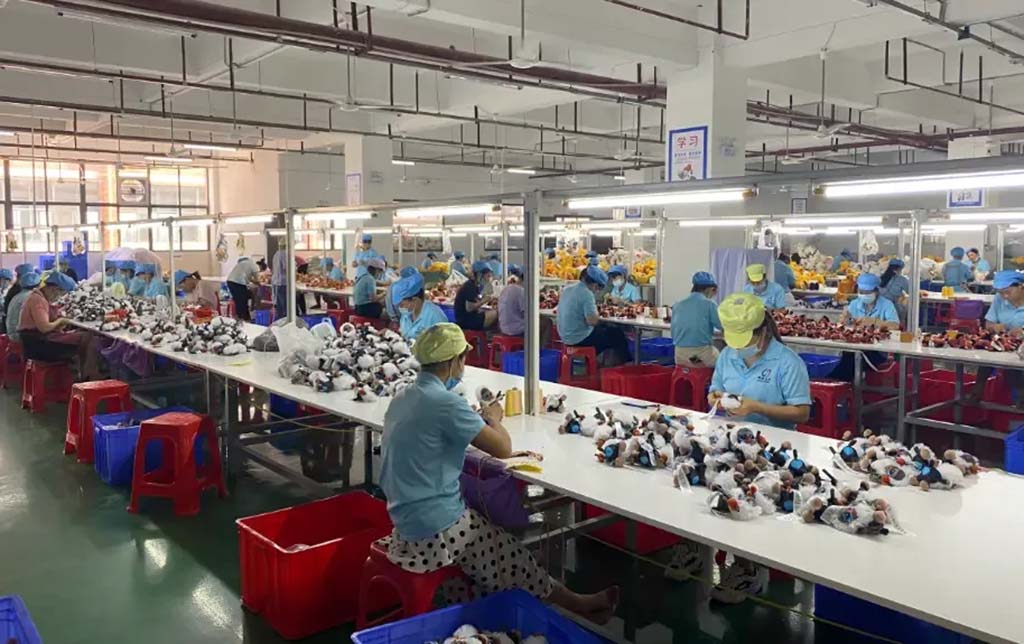
Order volume is one of the most direct and predictable drivers of unit price variation — both between different suppliers and across different order quantities with the same supplier. The relationship between volume and unit cost is a fundamental economic reality of manufacturing: fixed costs — tooling, sampling, setup, overhead — are spread across more units as volume increases, reducing the per-unit fixed cost burden and lowering the total unit price.
Production scale and order volume create price differences between suppliers because factories optimized for different production volumes have different cost structures, different MOQ requirements, and different pricing models. A factory whose minimum order is 5,000 units per design can offer a significantly lower unit price than one whose minimum is 300 units — not because of lower quality but because its production economics are structured around higher volume efficiency.
Here is a practical illustration of how order volume affects unit pricing across different supplier types:
| Supplier Type | Typical MOQ | Unit Price at MOQ | Unit Price at 5x MOQ | Best For |
|---|---|---|---|---|
| Small workshop | 100–300 units | Highest | High | Very small runs, test orders |
| Mid-size factory | 300–1,000 units | High | Medium | Growing brands, moderate volume |
| Large OEM factory | 1,000–5,000 units | Medium | Lower | Established brands, high volume |
| Major manufacturer | 5,000+ units | Lower | Lowest | Large brands, mass market |
The Fixed Cost Distribution Effect
Every production order carries fixed costs that do not change with volume — pattern making, sampling, machine setup, quality system overhead, and compliance documentation preparation. At low volumes, these fixed costs are distributed across fewer units, adding significantly to the per-unit cost. At high volumes, the same fixed costs become a negligible fraction of the total, and the unit price approaches the variable cost — the direct cost of materials and labor per unit.
This is why a factory that quotes $8 per unit at 500 units might quote $5.50 per unit at 3,000 units — not because the materials are cheaper or the labor is lower, but because the fixed cost distribution is more favorable at higher volume. Understanding this dynamic helps buyers evaluate whether a price difference between suppliers reflects a genuine cost structure difference or simply a volume difference.
Comparing Quotes Across Different Volume Levels
When comparing quotes from different suppliers, it is important to ensure that volume levels are consistent across all quotes. A supplier quoting $6 per unit at a 2,000-unit MOQ is not necessarily more expensive than one quoting $5.50 per unit at a 5,000-unit MOQ — the total investment and inventory risk implications of these two quotes are very different, and the cost comparison only becomes meaningful when both quotes are assessed at the same volume level.
Requesting quotes from all suppliers at the same specific volume — and at a volume that reflects the buyer’s actual intended order quantity rather than the supplier’s preferred MOQ — produces a comparison that is genuinely apples-to-apples and reveals price differences that reflect genuine cost structure differences rather than volume-driven distortions.
How Do Labor Standards and Workforce Investment Affect Supplier Pricing?

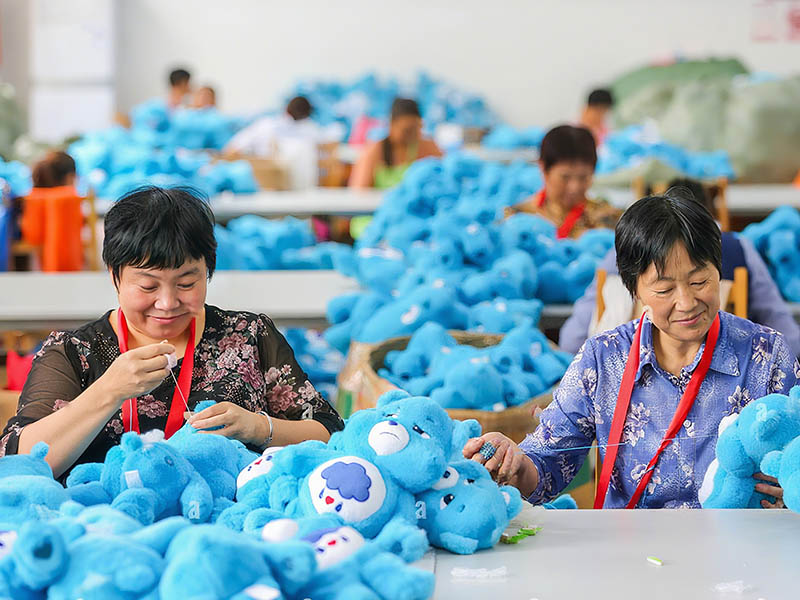
Labor is one of the most significant cost inputs in plush toy manufacturing — a category that, by the nature of its construction complexity, relies heavily on skilled human operators at every stage of production. The way a factory manages, compensates, and develops its workforce directly affects both its cost structure and its production quality — and these two effects run in the same direction, which is why labor quality is one of the most commercially important dimensions of supplier price variation.
Labor standards and workforce investment affect supplier pricing because factories that pay higher wages, invest in worker training, maintain stable workforces with low turnover, and structure working conditions that support skilled performance have higher labor cost structures than those that minimize labor investment. These higher costs produce more experienced, more skilled, and more consistently performing workforces — which generate better production quality, lower defect rates, and more reliable delivery — but they are reflected in higher unit prices.
Here is a comparison of the cost and quality implications of different labor investment approaches:
| Labor Dimension | High Investment Approach | Low Investment Approach | Cost Impact | Quality Impact |
|---|---|---|---|---|
| Wage levels | Above-market wages | Minimum wage | Higher unit cost | Lower turnover, higher skill retention |
| Worker tenure | Long-term workforce retention | High turnover, constant onboarding | Lower recruitment cost but quality variability | Higher skill consistency |
| Skill training | Ongoing technical training programs | Minimal — learn on the job | Training investment in unit cost | Higher operator skill, lower defect rate |
| Task specialization | Workers specialize by production stage | Workers rotate across all tasks | Efficiency investment | Higher expertise per task, better quality |
| Working conditions | Good conditions, reasonable hours | Minimum compliance | Higher overhead | Lower fatigue-related quality issues |
The Turnover-Quality Connection
High workforce turnover is one of the most damaging — and most underappreciated — quality risks in plush toy manufacturing. When experienced operators leave and are replaced by new workers who lack the muscle memory and judgment that experienced sewers develop over months and years of production, the quality of work at every affected production step declines. Seam alignment becomes less consistent. Stuffing density control becomes more variable. Finishing quality deteriorates.
Factories with high turnover — which is common when wages are low and working conditions are poor — are in a constant state of quality regression, where the experience level of the workforce is perpetually below the level required for fully consistent output. The cost savings from lower wages are partially or fully offset by higher defect rates, more frequent QC failures, and higher rework costs.
Factories that invest in workforce retention — through competitive wages, stable working conditions, and genuine career development — build workforces whose skill level increases over time rather than cycling perpetually through early-stage operator learning. This investment is visible in the unit price — but it is also visible in the consistency and reliability of the production output.
Social Compliance Audits as a Labor Standard Indicator
Social compliance audits — conducted by organizations such as BSCI, SEDEX, or Fair Labor Association — assess whether a factory’s labor practices meet defined standards for wages, working hours, workplace safety, and worker rights. A factory that has passed a recent social compliance audit from a credible organization has been independently verified to meet these standards — which correlates with the stable, experienced, fairly compensated workforce that produces more consistent quality.
For buyers who source for brands with ethical sourcing commitments — which includes an increasing proportion of US and European buyers — social compliance certification is a purchasing requirement as well as a quality indicator. The cost of meeting social compliance standards is reflected in the unit price, but so is the quality benefit of the workforce it creates.
How Do Quality Control Infrastructure and Compliance Costs Contribute to Price Differences?
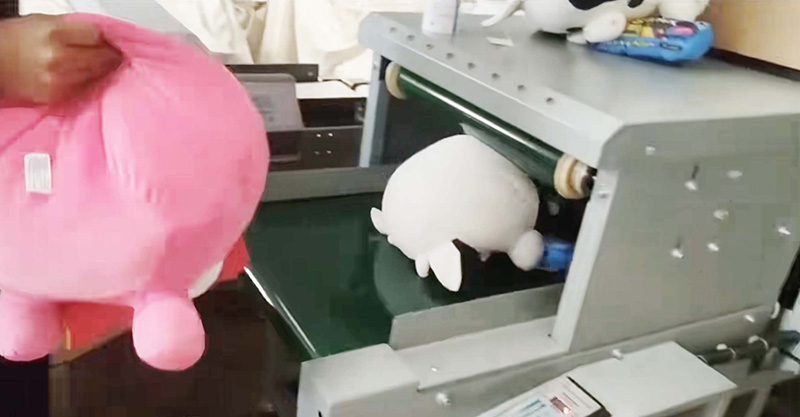
Quality control infrastructure and compliance capability are not free. They require investment in trained QC personnel, calibrated testing equipment, documented processes, compliance documentation systems, and the organizational structure that allows QC to operate independently from production. This investment is not recoverable through revenue other than the prices charged for production — which means it is reflected in unit pricing. Suppliers who quote lower prices have typically made lower investments in these areas.
Quality control infrastructure and compliance costs contribute to price differences between suppliers because maintaining a professional, three-stage QC system with independent QC personnel, calibrated equipment, and complete documentation is more expensive than conducting minimal spot checks. Similarly, sourcing certified materials, supporting compliance testing, and maintaining the expertise to navigate regulatory requirements in multiple markets adds costs that are reflected in unit prices — and absent from the prices of suppliers who do not invest in these capabilities.
Here is an overview of the specific QC and compliance costs that contribute to price differences:
| Cost Category | What It Covers | Approximate Cost Impact | Present in Low-Price Quotes? |
|---|---|---|---|
| QC personnel | Dedicated QC team salaries, independent of production | Significant overhead per unit | Rarely in full |
| Testing equipment | D65 light boxes, pull force gauges, calibrated tools | Fixed investment amortized per unit | Sometimes partially |
| Compliance documentation | Material test reports, certification maintenance | Per-batch variable cost | Often absent |
| Third-party testing support | Laboratory relationships, sample preparation | Per-product variable cost | Rarely |
| Regulatory monitoring | Staying current with standard changes | Ongoing overhead | Rarely |
| Certification maintenance | ISO, BSCI, OEKO-TEX audit costs | Annual fixed cost | Sometimes |
Why QC Cost Differences Are Invisible in Quotations
One of the challenges of evaluating QC infrastructure through price comparison is that QC costs are rarely itemized in a standard unit price quotation. The quotation shows a materials line, a labor line, and a factory overhead line — but QC costs are typically embedded in overhead without separate visibility. This makes it impossible to tell from a quotation alone whether the overhead includes genuine QC investment or whether it represents a minimal overhead structure with correspondingly minimal quality management.
The only way to understand what a supplier’s price includes in terms of QC investment is to ask directly — and to verify the answers through documentation requests, factory audits, and reference checks. A factory with genuine QC infrastructure will be able to describe their system in detail, show their equipment and processes, and provide QC documentation from recent production runs without hesitation.
The Compliance Cost That Low-Price Quotes Often Exclude
Compliance testing — submitting products to accredited laboratories for ASTM F963, EN71, CPSIA, or REACH testing — is a cost that many low-price suppliers have simply not included in their pricing model. They quote a production cost without accounting for the testing investment required to bring the product to market in the buyer’s target geography.
When buyers receive these low quotes and then discover the compliance testing cost separately — typically when the product is ready to ship and the buyer realizes testing has not been done — the total cost of the order rises significantly. For a product requiring comprehensive ASTM and EN71 testing, the testing investment alone can be $600 to $1,200 or more. At 500 units, this adds $1.20 to $2.40 per unit to the effective cost — which can eliminate the apparent price advantage of a lower-quoted supplier.
What Hidden Costs Can Make a Low-Price Quote More Expensive Than It Appears?
The unit price in a supplier quotation is the most visible number in any price comparison — but it is rarely the complete picture of what the buyer will ultimately spend. Hidden costs — costs that are not reflected in the quoted unit price but that inevitably arise as a result of supplier or product characteristics — can add substantially to the total cost of an order, sometimes transforming the cheapest-quoted option into the most expensive one when all costs are accounted for.
Hidden costs in plush toy sourcing include quality failure remediation, compliance testing and failure costs, extended development timelines from excessive revision rounds, communication management overhead, rework and replacement costs for non-conforming goods, platform-related compliance costs, and the long-term brand damage costs of quality issues that reach end customers. These costs do not appear in any quotation but are predictable consequences of specific supplier characteristics that buyers can identify — and avoid — with the right evaluation framework.
Here is a practical guide to the most significant hidden costs in low-price plush toy sourcing:
| Hidden Cost Category | How It Arises | Typical Cost Impact | Prevention |
|---|---|---|---|
| Excessive revision rounds | Weak brief interpretation, limited sampling capability | $150–$400 per extra round per design | Choose factory with strong sampling capability |
| Compliance testing failure | Non-compliant materials, requiring rework or replacement | $2,000–$20,000+ per failed batch | Use certified materials, pre-production material testing |
| Bulk quality rework | Non-conforming goods requiring manual correction | $0.50–$2.00 per unit for affected units | Rigorous QC system verification before order |
| Replacement production | Non-conforming batch requiring full re-run | Full production cost repeated | Third-party inspection before balance payment |
| Platform listing removal | Compliance failure on live listing | Revenue loss during relisting period | Ensure compliance before listing |
| Shipping cost for replacement samples | Multiple revision rounds requiring shipment | $50–$150 per sample round | Strong brief preparation |
| Management time | Managing problems with unreliable suppliers | 5–15 hours per problem event | Supplier reliability verification upfront |
| Brand damage costs | Quality issues reaching end customers | Difficult to quantify, potentially large | Material and QC standard verification |
The Revision Round Cost Accumulation
For buyers developing multiple custom designs, the cost difference between a factory that interprets briefs accurately — achieving approval in one to two revision rounds — and one that requires four to six rounds per design accumulates quickly. At $200 per revision round and $80 in shipping costs per round, the difference between two and five revision rounds across ten designs is $7,200. This cost is not reflected in any unit price comparison but is a predictable consequence of choosing a supplier with weaker sampling capability — which is often a characteristic of lower-priced suppliers.
The Compliance Failure Cost Calculation
The cost of a compliance testing failure is one of the most significant hidden costs in plush toy sourcing — and one that buyers with no previous experience of it are most likely to underestimate. When a product fails chemical safety testing under ASTM F963 or EN71, the typical sequence of events involves identifying the non-compliant material, replacing it with a certified alternative, rebuilding affected units, retesting the corrected product, and managing the timeline impact of this process — which typically adds four to eight weeks to the project timeline.
For a 2,000-unit order with a unit cost of $6, the direct production cost of the original run is $12,000. If 30 percent of units require rework at $1.50 per unit, the rework cost is $900. If the corrected product requires retesting at $800 for the test, and the delay costs $2,000 in expedited shipping to meet the original delivery window, the total compliance failure cost added to the order is $3,700 — a 31 percent increase in effective order cost that does not appear anywhere in the original quotation comparison.
How Should Buyers Evaluate Supplier Pricing to Make the Right Sourcing Decision?

Evaluating supplier pricing effectively requires moving beyond the unit price comparison to a total cost assessment that accounts for what each supplier’s price actually includes, what it excludes, and what additional costs can be predicted based on the supplier’s characteristics and capability profile. This total cost assessment is more complex than a unit price comparison — but it is far more accurate as a basis for sourcing decisions.
Buyers should evaluate supplier pricing by assessing the full cost of the sourcing relationship — including unit price, development costs, quality management costs, compliance costs, and the predicted cost of problems based on the supplier’s capability profile — rather than comparing unit prices in isolation. The supplier offering the best total cost value is not always the one with the lowest unit price, and identifying the right supplier requires understanding what is driving the price differences observed in quotation comparisons.
Here is a structured framework for total cost supplier evaluation:
| Cost Component | How to Assess | Information Source | Included in Unit Price? |
|---|---|---|---|
| Materials quality and cost | Request material specifications and test reports | Supplier documentation | Partially — quality level affects unit price |
| Development and sampling | Ask for itemized sampling fee structure | Supplier quotation | No — separate line item |
| Quality system investment | Evaluate QC infrastructure through audit and documentation | Factory audit, documentation | Embedded in overhead |
| Compliance capability | Request compliance documentation and testing history | Supplier documentation, lab reports | Partially — capability affects overhead |
| Revision round history | Request reference feedback on sampling accuracy | Reference clients | Not directly — affects total development cost |
| Problem handling history | Assess through reference checks and communication tests | Reference clients, evaluation interactions | Not directly — affects total management cost |
| Hidden cost prediction | Score supplier characteristics against hidden cost risk factors | Evaluation framework | Not included |
Requesting Itemized Quotations
One of the most practical steps buyers can take to improve quotation comparison accuracy is to request itemized quotations rather than single unit prices. An itemized quotation that separately states material cost, labor cost, QC and overhead cost, compliance cost, and profit margin gives the buyer visibility into where the price comes from — and makes material substitution, QC shortcuts, and compliance omissions visible rather than hidden in an opaque total.
Not all suppliers will provide full cost breakdowns — factories typically protect margin detail as commercially sensitive. But even a partial breakdown — separating material cost from labor and overhead — provides meaningful information about whether the quoted price is built on material standards comparable to what the buyer specified.
Building a Supplier Price Evaluation Scorecard
A practical tool for evaluating supplier pricing holistically is a simple scorecard that scores each supplier across the key total cost dimensions — unit price, material quality, sampling capability, QC infrastructure, compliance capability, and predicted hidden cost risk — and produces a weighted total cost score that reflects the complete sourcing value of each supplier rather than just their headline unit price.
This scorecard approach makes it explicit when a cheaper supplier scores lower on quality and compliance dimensions — and allows buyers to calculate, at least approximately, how much higher actual total cost the lower unit price is likely to produce when quality failures, revision rounds, and compliance costs are factored in.
At Kinwin, we actively support buyers through this kind of total cost evaluation process — providing detailed material specifications and test documentation, transparent sampling fee structures, factory audit availability, and reference contacts from clients in comparable product categories. We are confident that when buyers evaluate the complete cost picture — not just the unit price — our pricing reflects genuine value that consistently justifies the comparison.
If you are comparing plush toy supplier quotations and want support understanding what is driving the price differences you are seeing, we would be glad to walk through it with you directly.
Reach out to our team at [email protected] or visit kinwintoys.com to start that conversation.
Conclusion
Price variation between plush toy suppliers is not random and it is not primarily a negotiation phenomenon. It reflects real differences in what different suppliers are providing — in materials, production quality, workforce investment, quality control infrastructure, compliance capability, and business model. Understanding these differences is what transforms a price comparison from a race to the lowest number into a genuine assessment of which supplier offers the best total value for the specific product, market, and business relationship the buyer needs.
The most expensive supplier is not automatically the best choice — and the cheapest is not automatically the wrong one. The right choice is the supplier whose price reflects a genuine capability and quality investment that matches what the buyer actually needs, and whose total cost — including the predictable costs of quality management, compliance, and relationship maintenance — is lower than alternatives that appear cheaper on the quotation page but deliver more expensively in practice.
Buyers who develop this analytical framework for price evaluation source more consistently, build better supplier relationships, and make fewer costly mistakes than those who treat price comparison as a simple exercise in finding the lowest number.
At Kinwin, our pricing reflects the investment we have made in certified materials, documented quality systems, compliance infrastructure, experienced development teams, and the communication standards that make supplier relationships genuinely productive. We welcome the kind of detailed evaluation that reveals what our pricing includes — because we are confident that buyers who look closely at the full picture will find that the value behind our prices is exactly what they are looking for.
FAQ
Q1: When a supplier claims their materials are the same quality as a more expensive competitor, how can I verify this?
The most direct verification method is to request material test reports and certification documentation for the specific materials the supplier plans to use in your product — not generic documentation but reports for the actual fabric, filling, and accessories referenced in your quotation. Comparing these reports against those provided by the more expensive supplier reveals whether the materials are genuinely equivalent in certification status and tested substance compliance. Additionally, requesting physical material swatches from both suppliers and comparing them side by side — in terms of pile height, pile density, surface consistency, and overall feel — provides a direct sensory assessment that written documentation alone cannot deliver. A supplier confident in their material quality will provide both the documentation and the physical samples without hesitation.
Q2: How much price variation between suppliers is normal, and at what point should a significant price difference be investigated?
For comparable products at comparable volumes from direct factories in the same manufacturing region, price variation of 10 to 20 percent is normal and reflects legitimate differences in overhead, workflow efficiency, and margin positioning. Price differences of 30 percent or more should prompt investigation into what is driving the gap — specifically whether the lower-priced supplier is using different materials, has a different supplier type (trading company vs factory), is operating at a different quality and compliance standard, or is quoting for a significantly different volume or specification. The investigation does not mean the lower price is wrong — it means the buyer needs to understand what is different before accepting that the lower-priced option represents equivalent value.
Q3: Is it worth paying a premium for a supplier with ISO 9001 certification compared to one without?
ISO 9001 certification indicates that a factory has been independently assessed to have a functioning quality management system that meets defined organizational standards. It does not certify specific product quality outcomes, but it does provide meaningful evidence of quality management maturity — including documented processes, systematic non-conformance management, and regular internal auditing — that correlates with more consistent production performance. For buyers who are placing large orders, sourcing for compliance-sensitive markets, or building long-term supplier relationships, the additional confidence provided by ISO 9001 certification generally justifies a modest price premium. For very small test orders or single-occasion sourcing, the benefit may not justify a large price differential — though the certification itself indicates a supplier worth returning to for larger future orders.
Q4: How should buyers handle a situation where their preferred supplier quotes a higher price than a competitor for the same brief?
The first step is to understand specifically what is driving the price difference through the framework described in this guide — material specifications, supplier type, QC infrastructure, compliance capability, and volume assumptions. If the preferred supplier’s higher price reflects genuine quality and capability advantages that are relevant to the buyer’s product and market requirements, the appropriate response is either to accept the higher price in recognition of the total value difference, or to have a direct conversation with the preferred supplier about whether any cost optimization is available without compromising the quality dimensions that make them the preferred choice. Volume commitment, simplified packaging, or adjusted delivery terms sometimes allow a preferred supplier to offer improved pricing without material or quality trade-offs. If the preferred supplier’s price advantage cannot be explained by genuine quality differences, it may simply reflect a higher margin target — in which case direct negotiation is appropriate and reasonable.
Q5: Do plush toy prices from Chinese manufacturers typically include shipping costs, and how should buyers account for shipping in total cost comparisons?
Standard quotations from Chinese plush toy manufacturers are almost always quoted on FOB (Free on Board) terms — meaning the price covers production and delivery of goods to the port of export, but does not include ocean freight, destination port charges, customs duties, or inland delivery costs. These additional logistics costs can add 10 to 30 percent to the total landed cost depending on the shipment volume, destination, and freight market conditions at the time of shipment. When comparing supplier quotations, ensuring that all quotes are on equivalent terms — all FOB, or all CIF (Cost, Insurance, and Freight) to the same destination — is essential for an accurate comparison. A supplier who quotes CIF when others quote FOB appears more expensive at first glance but may be comparable or even cheaper when all logistics costs are correctly accounted for. Including estimated logistics costs in the total cost comparison, not just the production price, produces a landed cost comparison that reflects the actual investment required for each option.