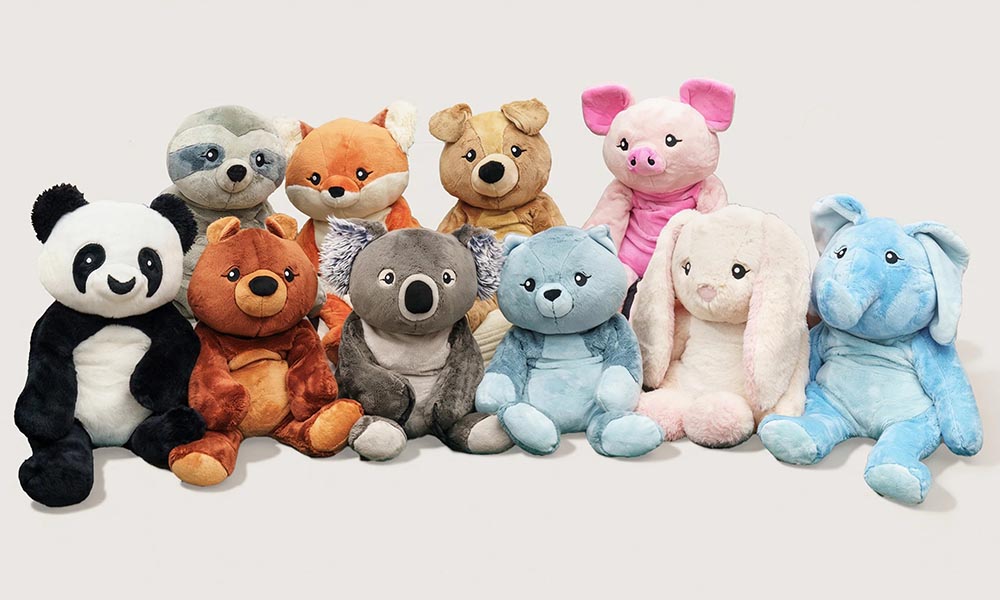
It is one of the most frustrating experiences in plush toy sourcing. You spend weeks — sometimes months — going through the sampling process. You refine the design, adjust the colors, confirm the materials, and finally approve a sample you are genuinely happy with. Then the bulk order arrives, and something is off.
The color looks slightly different. The face has a different expression. Some units are firmer than others. A few have embroidery that sits at a slightly different angle. None of these issues are dramatic on their own — but across 3,000 units sitting on a pallet, they are impossible to ignore.
This experience is more common than most buyers realize — and more preventable than most manufacturers admit. The gap between an approved sample and a bulk production run is not random. It has specific, identifiable causes that operate at predictable points in the manufacturing process. Understanding those causes is the first step toward preventing them — and toward having the right conversations with your manufacturer before the problem occurs rather than after the shipment has already arrived.
This guide breaks down every major reason why plush toys look different in bulk orders, explains the mechanisms behind each cause, and walks through the controls that separate factories that deliver consistent results from those that do not.
Why Do Plush Toys Look Different in Bulk Compared to the Approved Sample?
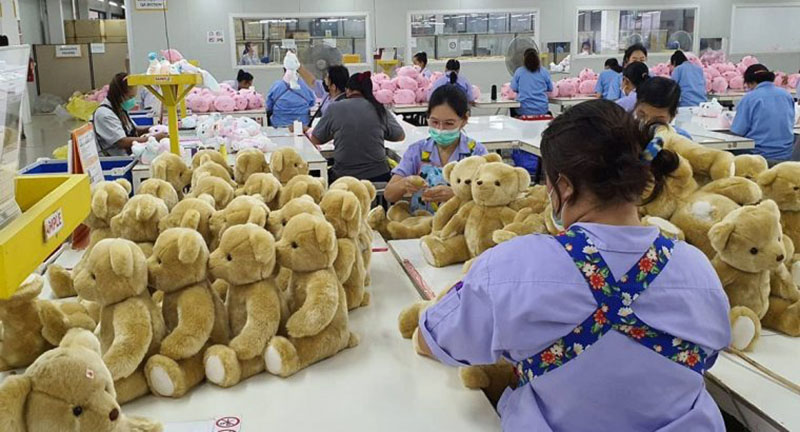
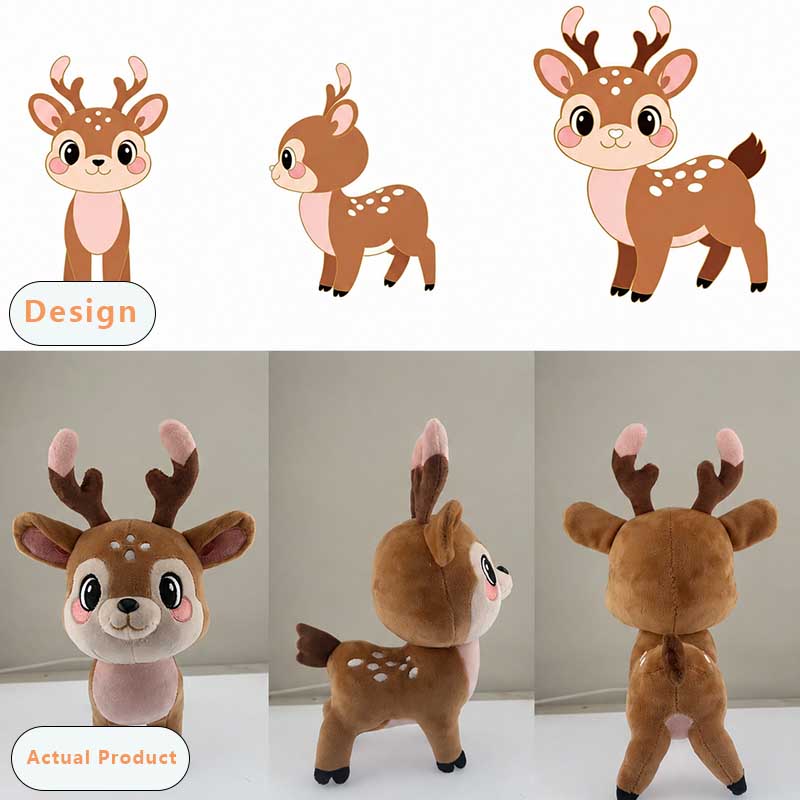
The approved sample and the bulk production run are produced under fundamentally different conditions. This difference is the root cause of almost every visual inconsistency buyers encounter — and understanding it changes how buyers approach the entire quality assurance process.
Plush toys look different in bulk compared to the approved sample because samples are produced under controlled, high-attention conditions by skilled development workers using carefully selected materials, while bulk production operates at scale with general production line workers, batch-sourced materials, automated or semi-automated processes, and the inevitable variability that comes from producing thousands of units over days or weeks. The gap is not a sign of bad faith — it is a structural reality of manufacturing that must be actively managed rather than assumed away.
Here is an overview of the most common causes of sample-to-bulk visual difference:
| Cause of Visual Difference | Where It Originates | Visibility to End Customer | Preventability |
|---|---|---|---|
| Fabric batch color variation | Material sourcing | High — immediately visible | High with proper IQC |
| Stuffing density inconsistency | Production process | Medium — affects shape | High with calibrated equipment |
| Embroidery position drift | Embroidery process | High — changes expression | High with coordinate control |
| Panel alignment variation | Cutting and sewing | Medium-High — affects silhouette | Medium with experienced operators |
| Pile direction inconsistency | Cutting process | High — creates shading patches | High with pattern control |
| Accessory placement variation | Assembly process | Medium — affects overall look | Medium with placement guides |
| Finishing inconsistency | End-of-line process | Low-Medium — thread, surface | High with dedicated finishing step |
| Material substitution | Sourcing decision | High — can affect texture and color | High with approval protocols |
The Skilled Worker Gap
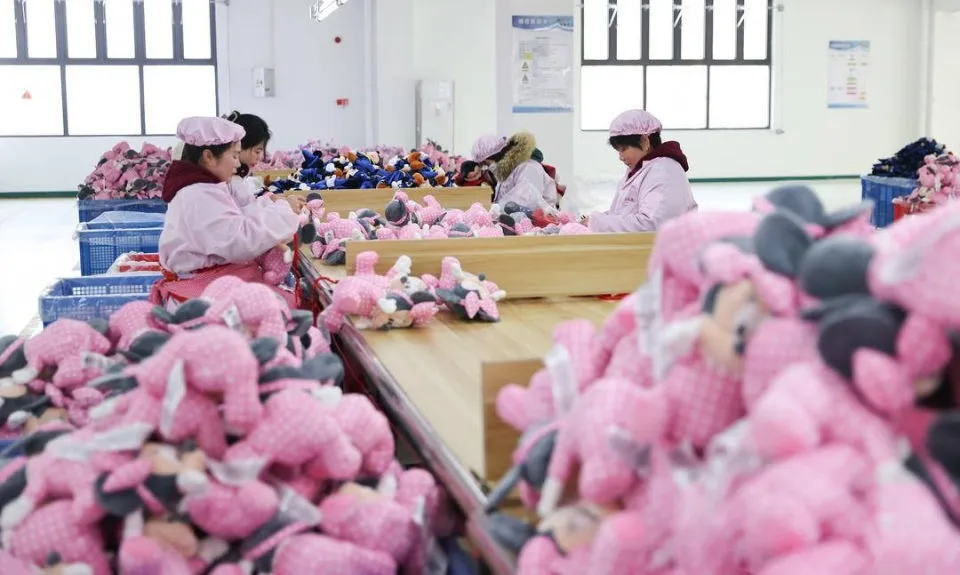
During sampling, a factory’s most experienced pattern makers and prototype sewers build the product with careful attention to every detail. These individuals have the skill and judgment to interpret the design accurately, make real-time adjustments to achieve the intended result, and produce a sample that represents the product at its best.
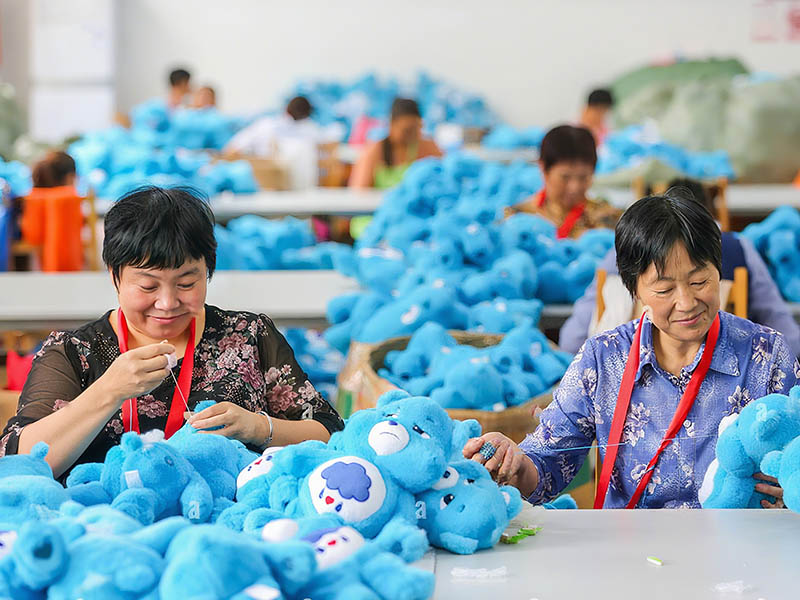
During bulk production, the same product is handled by general production line workers whose performance is measured primarily by output speed. The judgment calls that an experienced sample sewer makes intuitively — how much pressure to apply at a specific seam, how to distribute stuffing to achieve the correct shape, how to align a panel to maintain pile direction — are not being made with the same care and skill on the production line.
Without compensating controls — detailed work instructions, in-process monitoring, supervisor oversight, and regular QC checks against the approved standard — this skill gap translates directly into visual inconsistency between the sample and the bulk units.
Why the Problem Compounds Across a Production Run
Visual inconsistency in bulk plush production is not always uniform — it often develops and worsens over the course of the production run. A unit produced on the first day of production may look closer to the approved sample than a unit produced on the fourth day. This happens because of a phenomenon known as production drift — the gradual degradation of precision as the run progresses, machines develop subtle setting shifts, workers tire, and supervisory attention disperses.
Without regular in-process quality checks that compare production output against the approved standard at defined intervals, drift accumulates invisibly until the full batch is complete. By that point, the earliest and latest units in the run may differ from each other meaningfully — and both may differ from the approved sample.
How Do Fabric Batch Variations Cause Visual Differences in Bulk Plush Orders?
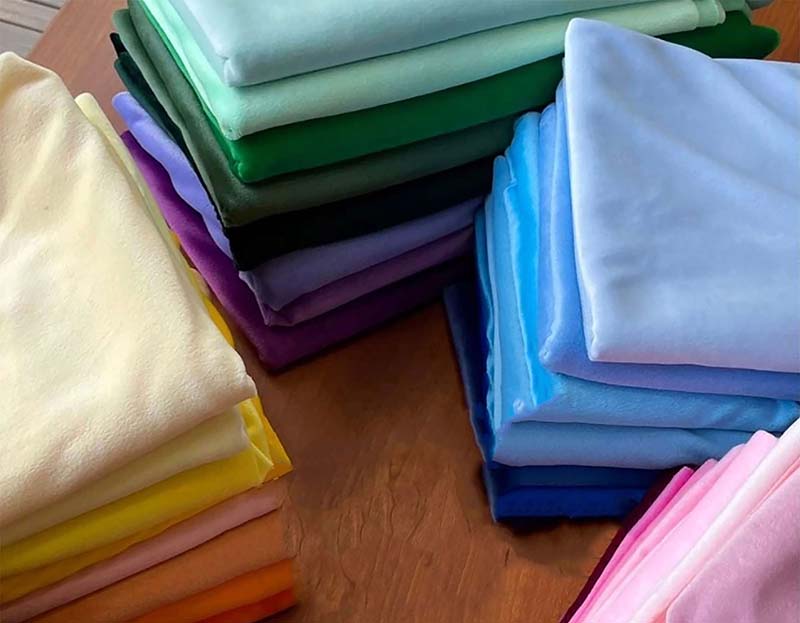
Fabric is the most visually dominant material in any plush toy. It is the first thing a customer sees and the first thing they touch. And it is also one of the most variable inputs in the manufacturing process — because even when the same fabric from the same supplier is ordered for a bulk production run, the characteristics of that fabric can differ subtly but visibly from the fabric used in the approved sample.
Fabric batch variations cause visual differences in bulk plush orders because textile manufacturing involves inherent dye lot variation, pile height inconsistency between production batches, and density differences between fabric rolls — all of which affect the finished product’s color, texture, and surface appearance. These variations are not defects in the fabric itself — they are normal characteristics of textile production — but they become quality problems in plush toys when they are not identified and managed before production begins.
Here is a breakdown of the main fabric variation types and their visual impact:
| Fabric Variation Type | What Causes It | Visual Impact on Finished Product | Detection Method |
|---|---|---|---|
| Dye lot color variation | Different dye batches produce different shades | Product color differs from sample | Swatch comparison under D65 lighting |
| Pile height variation | Production setting differences between batches | Different texture feel and light reflection | Physical comparison and measurement |
| Pile density variation | Fiber count differences between rolls | Different surface fullness and visual weight | Compression test and visual comparison |
| Surface sheen variation | Finishing treatment differences | Different visual finish under light | Visual comparison under consistent lighting |
| Fabric width variation | Loom setting differences | Affects cutting efficiency and panel dimensions | Width measurement at IQC |
The Dye Lot Problem
Dye lot variation is the most common fabric-related cause of visual inconsistency in bulk plush orders — and one of the most preventable. When the approved sample is produced using fabric from one production batch, and the bulk order is produced using fabric from a new batch ordered weeks or months later, there is a genuine risk that the two batches will have subtly different color characteristics.
This risk exists even when the exact same fabric style is ordered from the exact same supplier. Textile dyeing processes involve natural variation that makes perfect color replication across batches difficult to guarantee without active management.
The solution is straightforward but requires discipline to implement consistently. Before any bulk fabric is cut, a swatch from the actual bulk production roll should be compared against a swatch from the approved sample fabric under standardized D65 lighting conditions. If a color deviation is visible, the batch should be flagged for discussion before production proceeds — not discovered after thousands of units have been cut.
When Fabric Variation Occurs Across Multiple Rolls
In large bulk orders, fabric may be sourced from multiple rolls within the same production batch — and even rolls from the same batch can show subtle variation. A factory managing this risk correctly will check multiple rolls from the same batch rather than assuming uniformity, and will sort rolls to ensure that any detected variation is distributed across the production run rather than concentrated in one area.
A factory that does not manage multi-roll variation may produce an order where units from the beginning of the run — cut from the first rolls — differ visibly from units produced at the end — cut from the last rolls. The resulting inconsistency within the same order is often more visible and more problematic than the difference from the approved sample.
How Does Stuffing Density Inconsistency Change the Way a Plush Toy Looks?
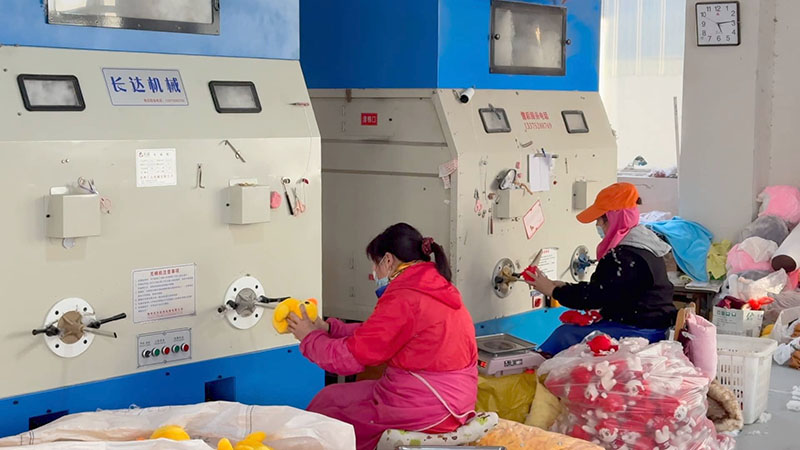
Stuffing density is one of the most direct determinants of a plush toy’s visual appearance. A well-stuffed product holds its shape, maintains the proportions established in the design, and presents a consistent silhouette that matches the approved sample. A product that is under-stuffed collapses in unexpected places, loses its intended proportions, and looks visibly different from the sample even when all other elements are correct.
Stuffing density inconsistency changes the way a plush toy looks by altering the product’s three-dimensional form — causing some units to appear fuller, rounder, and more symmetrical than others, while under-stuffed units look deflated, misshapen, or asymmetric. Because stuffing density directly determines the product’s silhouette and proportions, inconsistency in this element is among the most visually impactful quality deviations in plush production.
Here is how stuffing density variation affects visual appearance across different product areas:
| Product Area | Effect of Under-Stuffing | Effect of Over-Stuffing | Visual Impact Level |
|---|---|---|---|
| Head | Flattened, loses round shape | Distorted, seams under stress | Very High |
| Body | Collapses, loses proportions | Stiff, unnatural shape | High |
| Limbs | Flat, floppy appearance | Rigid, incorrect angle | High |
| Facial features | Features sink, expression changes | Features pushed out of position | Very High |
| Ears | Collapse, lose intended shape | Stick out at wrong angle | Medium |
| Overall silhouette | Smaller than approved sample | Larger than approved sample | High |
The Stuffing Machine Calibration Problem
Most plush factories use mechanical stuffing machines that blow PP cotton filling into the product under controlled air pressure. The density of the fill — how much cotton is delivered per unit — is controlled by settings on the machine. When these settings are correct and the machine is properly calibrated, stuffing density is consistent across units. When machine settings drift — as they naturally do over a long production run as the machine warms up, as cotton feed characteristics change, or as the operator adjusts settings without formal authorization — density becomes inconsistent.
A factory managing stuffing density correctly will establish a target density specification, calibrate stuffing machines to that specification before production begins, and check actual density on finished units at regular intervals during the production run. Density checks can be performed through weight measurement — comparing the finished unit weight against a target that includes both the outer fabric weight and the target filling weight — or through compression testing that measures the firmness of the finished product.
Hand Stuffing and Its Specific Risks
Some complex designs, particularly those with small or intricately shaped areas that stuffing machines cannot reach effectively, are hand-stuffed in specific sections. Hand stuffing introduces a different type of density inconsistency — one driven by operator judgment rather than machine calibration.
When different operators hand-stuff the same product section with different force or different filling quantities, the resulting density variation can be significant. Managing this risk requires clear, measurable density standards for every hand-stuffed area, regular training on the target feel and firmness for those areas, and in-process checking by a supervisor or QC inspector who can identify when an operator’s output is drifting from the standard.
How Do Embroidery and Facial Feature Variations Affect Plush Toy Appearance at Scale?

Embroidery is one of the most emotionally significant design elements in a plush toy — because embroidery defines the facial expression, and the facial expression is the primary driver of the emotional connection between the product and the customer. A slight shift in eye positioning, a minor change in the angle of an embroidered smile, or a variation in thread tension that makes the nose appear slightly different from the sample — these are the changes that make customers say a product “looks different” or “doesn’t have the right expression.”
Embroidery and facial feature variations affect plush toy appearance at scale because positional drift, thread tension inconsistency, and embroidery machine setting changes can cause subtle but emotionally significant differences in facial expression across units in the same production run. Even small positional deviations — as little as 3 to 5 millimeters in eye placement — can change the perceived emotional character of the product from warm and friendly to distant or unsettling.
Here is a breakdown of embroidery variation types and their visual and emotional impact:
| Embroidery Variation | How It Occurs | Visual Impact | Emotional Impact on Customer |
|---|---|---|---|
| Eye position drift | Machine hoop repositioning error | Eyes appear uneven or misplaced | Product looks “wrong,” less appealing |
| Thread tension variation | Machine tension setting drift | Embroidery appears raised or flat | Different texture feel and visual weight |
| Color density variation | Thread lot differences or tension | Embroidery color appears different | Inconsistency in perceived quality |
| Nose position variation | Hoop placement inconsistency | Facial proportions appear different | Expression changes significantly |
| Smile angle variation | Pattern file positioning error | Expression appears different | Emotional connection weakened |
| Overall embroidery size | Machine scaling error | Features appear larger or smaller | Proportions of face change |
Position Drift Across a Production Run
Embroidery position drift is one of the most insidious consistency problems in plush production because it develops gradually and may not be obvious when looking at individual units. When a unit from the beginning of the production run is placed beside a unit from the end, the accumulated drift in eye or nose positioning can be quite visible — but no single unit in the run looks dramatically wrong in isolation.
The mechanism behind position drift is the process of repositioning the embroidery hoop between units. Each time the hoop is repositioned, a tiny error in placement is possible. These errors accumulate across hundreds of hoop repositionings until the cumulative drift becomes visible.
Managing this risk requires regular position verification — checking embroidery placement on units at defined production intervals against a coordinate-based standard that specifies where key embroidery elements should sit relative to fixed reference points on the product. Factories that rely on visual judgment for embroidery positioning, comparing each unit to the previous one rather than to an absolute standard, allow drift to accumulate unchecked.
Thread Lot Variation and Color Consistency
Embroidery thread, like fabric, is subject to dye lot variation. Thread from the same color code but different production batches may show subtle color differences that become visible when comparing units produced at different points in the run.
For products where embroidery color is a significant element of the overall visual design — a brightly colored logo, a distinctive facial color — using thread from a single lot for the entire production run is the most reliable way to prevent color variation. For very large orders where a single thread lot cannot cover the full production volume, maintaining consistent tension settings and verifying color under standardized lighting throughout the run is the practical alternative.
What Role Does Operator Skill and Production Line Pressure Play in Visual Inconsistency?
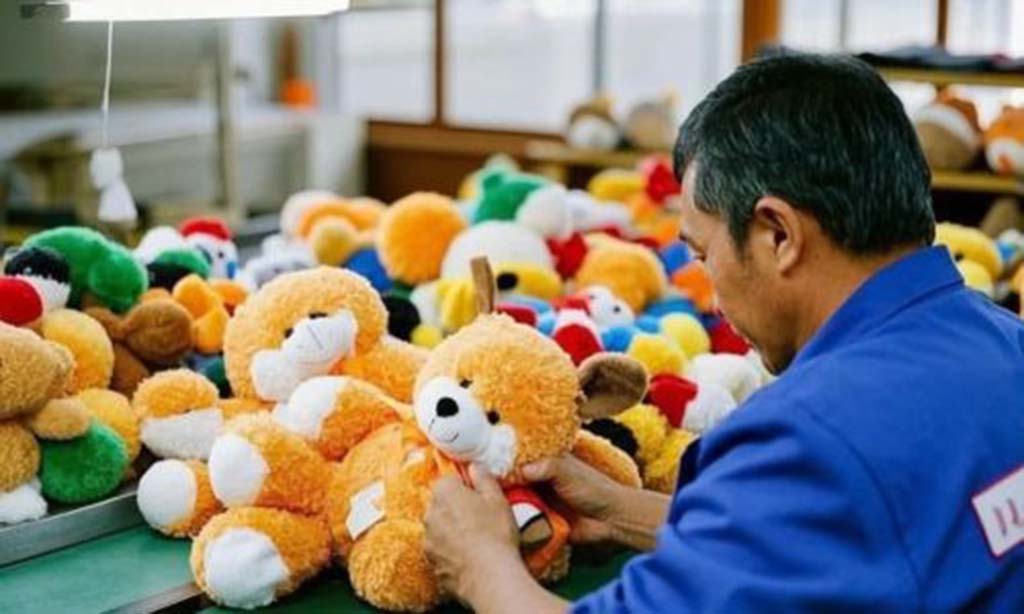
Manufacturing quality in plush toy production is, to a significant degree, a human performance question. Unlike industries where automated machinery handles all critical production steps, plush toy manufacturing involves substantial skilled handwork at every stage — cutting, sewing, stuffing, assembly, finishing. The skill level, training, and working conditions of the operators handling each of these steps directly affect the visual consistency of the finished product.
Operator skill variation and production line pressure are two of the most significant human factors contributing to visual inconsistency in bulk plush orders. Operators with different skill levels produce outputs of different quality. Operators under time pressure — from production targets that prioritize speed over precision — make more errors and exercise less care at critical detail steps. Both factors introduce variation that quality control systems can catch but cannot fully eliminate if they are operating at a severity level that exceeds the system’s correction capacity.
Here is how human factors affect different aspects of visual consistency:
| Human Factor | Visual Consistency Impact | How It Manifests | Management Approach |
|---|---|---|---|
| Operator skill variation | Inconsistent seam quality, panel alignment | Some units cleaner than others | Skill-based task assignment, training |
| Production target pressure | Reduced attention to detail steps | More finishing issues, rushed alignment | Balanced targets that include quality metrics |
| Worker fatigue | Declining precision over shift | End-of-shift units more variable | Production scheduling, break management |
| New operator onboarding | Below-standard output during learning period | Inconsistent early output | Probationary QC monitoring |
| Supervisor attention variation | Less correction of drifting quality | Gradual deterioration over time | Regular supervisor quality reviews |
The Production Target Conflict
One of the most persistent structural sources of quality inconsistency in manufacturing is the conflict between production volume targets and quality standards. When operators are measured primarily on how many units they complete per hour or per shift, the rational response to production pressure is to reduce time spent on steps that are not directly measured — careful panel alignment, precise embroidery positioning, thorough finishing.
This behavior is not a sign of carelessness or bad faith — it is a rational response to the incentive structure the production system has created. The solution is not to push operators harder but to structure production targets and quality metrics in a way that makes quality performance an equally visible and rewarded dimension of operator performance.
Factories that build quality metrics — defect rate, first-pass yield, QC check results — into their production performance measurement systems create an environment where operators are incentivized to maintain quality standards under production pressure, not to trade them against speed.
Managing Skill Variation Through Task Assignment
In factories producing complex plush designs, one of the most effective approaches to managing operator skill variation is to assign the most skill-demanding production steps to the most experienced operators. Panel alignment on complex multi-fabric designs, facial feature positioning, and detailed finishing work are performed better by experienced operators — and the visual quality difference is significant enough to justify the scheduling complexity this requires.
Factories that assign tasks randomly across the operator pool without regard to skill level introduce unnecessary visual inconsistency that could be reduced through more deliberate task allocation. Identifying this practice — or its absence — during factory evaluation is a useful indicator of how seriously the factory takes quality consistency as an operational priority.
How Do Cutting and Panel Alignment Errors Create Visible Differences Across Units?

The cutting stage is where fabric becomes components — and where dimensional errors introduced into individual panels propagate through every subsequent stage of production. A panel cut 3mm wider than the pattern specifies will create a seam alignment issue when joined to adjacent panels, which will create a silhouette distortion in the finished product. Multiplied across thousands of units, cutting inconsistency is one of the most significant structural sources of visual variation in bulk plush production.
Cutting and panel alignment errors create visible differences across plush toy units by introducing dimensional variation into fabric panels that propagates through sewing and assembly to produce finished products with different silhouettes, different surface alignment at seam boundaries, and different pile direction consistency. These differences are often subtle in individual units but become visible and commercially problematic when units are compared side by side or displayed together.
Here is how specific cutting and alignment errors translate into visible product differences:
| Error Type | How It Occurs | Visible Impact on Finished Product | Detection Point |
|---|---|---|---|
| Panel dimension variation | Cutting line drift, blade wear | Different product size across units | IQC cut piece check |
| Grain line deviation | Panel placed off-grain on fabric | Pile direction inconsistency across panels | Visual check at cutting |
| Pile direction error | Panel cut in wrong fabric direction | Shading inconsistency on finished surface | Visual check at cutting |
| Notch misalignment | Alignment marks cut in wrong position | Panel seams do not align correctly | Sewing check |
| Asymmetric panel error | Left and right panels reversed or confused | Product appears twisted or unbalanced | Pre-sewing check |
The Grain Line Problem at Scale
Grain line — the alignment of the fabric panel relative to the fabric’s structural direction — is one of the most important and most commonly mismanaged cutting variables in plush production. Each fabric panel must be cut with the pile lying in the correct direction relative to the design, and each type of fabric has specific grain line requirements.
When panels are cut with incorrect grain alignment — even by a few degrees — the finished product shows visible shading differences between adjacent panels, because light reflects differently off pile that is lying in different directions. This is the “patchy” appearance that buyers sometimes notice in bulk orders where the sample looked uniform and consistent.
Managing grain line consistency at scale requires that cutting patterns clearly indicate the correct grain alignment for each panel, that operators are trained to follow these indicators precisely, and that cut panels are inspected for grain consistency before being passed to sewing. Factories that cut fabric efficiently but without strict grain line control will consistently produce panels with pile direction variation — a problem that cannot be corrected at any subsequent production stage.
Panel Sorting and Management Between Cutting and Sewing
One often-overlooked source of panel-related visual inconsistency is the handling of cut panels between the cutting and sewing stages. When cut panels from multiple fabric rolls are mixed together — and different rolls have subtle fabric characteristic differences — the resulting variation within individual finished units creates an appearance inconsistency that is difficult to diagnose.
Factories that manage panels carefully — keeping panels from the same fabric roll together, clearly labeling panels by roll origin, and ensuring that left and right panels for each unit come from the same roll — significantly reduce the risk of within-unit variation from fabric batch differences. This level of panel management discipline is more common in factories with mature quality systems and less common in those where cutting and sewing are managed as separate, uncommunicating departments.
What Pre-Production and In-Process Controls Prevent Visual Inconsistency in Bulk?
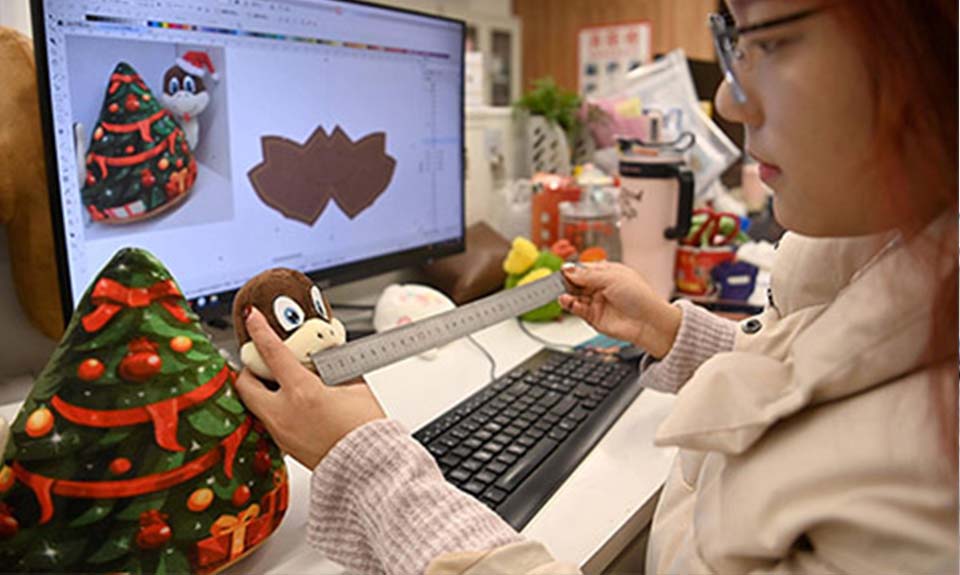
Preventing visual inconsistency in bulk plush production requires controls applied at every stage of the process — before production begins, during production, and as a final confirmation before shipment. A factory that relies only on final inspection to catch visual inconsistency is managing the outcome rather than preventing the cause. By the time a visual inconsistency is identified in final inspection, it has already been built into every unit in the production run.
Pre-production and in-process controls prevent visual inconsistency by addressing the root causes of variation at the point in the production process where they are least expensive to correct. These controls include bulk material approval, counter sample confirmation, first-off inspection, calibrated equipment setup, production-specific work instructions, regular in-process quality checks, and systematic embroidery position verification.
Here is a comprehensive framework of controls organized by production stage:
| Control Stage | Specific Control | What It Prevents | Implementation Standard |
|---|---|---|---|
| Pre-production | Bulk fabric swatch approval | Color and texture deviation from sample | D65 lighting comparison against approved swatch |
| Pre-production | Counter sample production | Sample-to-bulk material and process deviation | Full product built with bulk materials |
| Pre-production | Work instruction distribution | Operator interpretation variation | Documented instructions per production step |
| Pre-production | Equipment calibration | Stuffing density and machine setting drift | Calibration record before production start |
| Production start | First-off inspection | Process setup errors | Full comparison against approved sample |
| In-process | Stuffing density checks | Density drift during run | Weight or compression check every 200–300 units |
| In-process | Embroidery position verification | Positional drift across run | Coordinate check at defined intervals |
| In-process | Panel alignment spot check | Sewing quality drift | Random seam inspection every 1–2 hours |
| In-process | Fabric roll transition check | Between-roll variation | Swatch comparison at each new roll |
| Pre-packing | Appearance and finishing check | Surface defects, thread issues | Per-unit visual check before packing |
The Counter Sample as a Visual Benchmark
The counter sample is one of the most underutilized and most valuable pre-production controls available for preventing visual inconsistency. Built using the actual bulk production materials, processes, and production line — rather than the carefully managed conditions of the sampling stage — the counter sample reveals whether the production environment can reproduce the approved visual standard before any bulk units are produced.
If the counter sample shows a color difference from the approved sample, this is discovered before 3,000 units have been produced with that color difference. If the counter sample shows a stuffing density that is slightly below the approved standard, this is corrected before the entire production run is completed at the wrong density. The cost of identifying and correcting a visual deviation in one unit — the counter sample — is always dramatically lower than the cost of the same deviation multiplied across the entire production run.
Building a Visual Reference Set for Production
One practical control that the best factories implement is a visual reference set — a small set of physically marked units that define the acceptable range of visual variation for a specific product. This reference set typically includes the approved sample, the approved counter sample, and one or two limit samples that show the boundary between acceptable and unacceptable variation in the most critical visual dimensions.
The visual reference set is displayed at the quality control station on the production floor. QC inspectors compare random production units against this reference set rather than against their own memory of what the product should look like. This objectifies what would otherwise be a subjective judgment and ensures that QC decisions are consistent across inspectors, across shifts, and across the full duration of the production run.
How Should Buyers Respond When Bulk Plush Orders Do Not Match the Approved Sample?
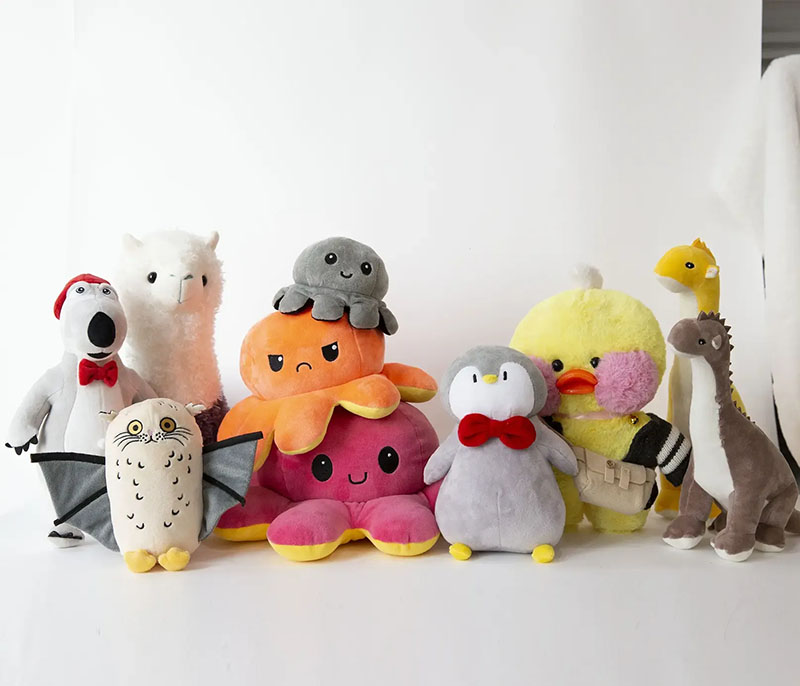
Even with the best pre-production controls and the most rigorous in-process monitoring, visual inconsistencies in bulk plush orders do occasionally occur. Knowing how to respond when they do — quickly, objectively, and with clear documentation — is one of the most important practical skills in plush toy sourcing.
When bulk plush orders do not match the approved sample, buyers should document deviations systematically with photographs and measurements, assess the severity and scope of the inconsistency using the approved sample as the reference standard, communicate findings to the factory in a structured, objective format, and negotiate a resolution based on the specific deviation type and its commercial impact. The resolution process is most effective when the buyer has clear contractual standards to reference, documented quality evidence to present, and a commercial relationship with enough history to support collaborative problem-solving.
Here is a structured response framework for handling visual inconsistency in bulk orders:
| Response Step | What to Do | Why It Matters |
|---|---|---|
| Documentation | Photograph affected units alongside approved sample | Creates objective visual evidence |
| Scope assessment | Estimate what percentage of units are affected | Determines severity and resolution options |
| Deviation classification | Categorize as critical, major, or minor | Guides appropriate resolution demand |
| Factory communication | Send structured deviation report with photos | Establishes shared understanding of the issue |
| Root cause discussion | Ask factory to identify and explain the cause | Informs prevention on future orders |
| Resolution negotiation | Agree on rework, replacement, or financial adjustment | Recovers commercial value |
| Future prevention | Document agreed preventive measures | Reduces recurrence risk |
How to Classify the Severity of Visual Deviations
Not all visual deviations carry the same commercial impact. A minor color variation that is visible only under direct comparison with the approved sample is a different category of problem from a stuffing density issue that makes 20% of units visibly misshapen, or an embroidery position error that changes the facial expression of a character design.
Classifying deviations by severity helps structure the resolution discussion proportionally. Critical deviations — those that prevent the product from being sold — require full replacement or rejection. Major deviations — those that visibly affect product quality and customer experience — require rework, replacement of affected units, or financial compensation. Minor deviations — those visible only under controlled comparison — may be acceptable with a documented acknowledgment and preventive measures confirmed for future orders.
Documenting the Approval Standard to Support Resolution
The effectiveness of any post-shipment quality resolution is directly proportional to the quality of the documentation that existed before production began. A buyer who has a signed-off approved sample, a complete tech pack with measurable specifications, and a written agreement on AQL inspection standards has a clear, objective basis for any deviation claim. A buyer who approved the product informally — via email or photo without a formal sign-off process — has a much weaker basis for demanding resolution.
At Kinwin, we invest in pre-production documentation precisely because it protects both parties. A clear, agreed standard established before production begins means that any deviation from that standard can be identified objectively, discussed constructively, and resolved efficiently — without the subjective disagreements that arise when standards were never precisely defined.
If you are experiencing visual inconsistency issues with a current plush supplier and want to understand how a more structured quality management approach could prevent these problems on future orders, we would be glad to walk you through our process. Reach out to our team at [email protected] or visit kinwintoys.com.
Conclusion
Plush toys look different in bulk orders for specific, identifiable reasons — fabric batch variation, stuffing density inconsistency, embroidery position drift, operator skill variation, cutting errors, and production line pressure. None of these causes is mysterious, and none is inevitable. They are all manageable through the right combination of pre-production controls, in-process monitoring, and quality documentation.
The buyers who consistently receive bulk orders that match their approved samples are not lucky — they are working with factories that have built and maintained the quality management systems required to control these variables systematically. The buyers who regularly experience visual inconsistency are typically working with factories where these systems are incomplete, poorly documented, or inconsistently applied.
Understanding the causes of visual inconsistency changes how buyers approach every stage of the sourcing process — from the questions they ask during factory evaluation, to the controls they insist on before production begins, to the documentation they maintain throughout the development process. This understanding is not just useful for resolving problems — it is the foundation of a sourcing approach that prevents them.
At Kinwin, preventing visual inconsistency is built into every stage of how we work — from the bulk material approval process that catches color and texture deviations before cutting begins, to the first-off inspection that identifies process setup errors on day one of production, to the regular in-process checks that monitor embroidery position, stuffing density, and panel alignment throughout every production run. Our goal is to deliver bulk orders that our clients do not need to worry about — because the systems that protect consistency are already in place before the first unit is produced.
FAQ
Q1: How can buyers tell from a factory visit or video audit whether a factory has strong visual consistency controls?
During a factory visit or video audit, there are specific indicators that reveal the strength of a factory’s visual consistency controls. Look for a visual reference set displayed at the QC station — this shows that QC inspectors have an objective standard to compare against. Ask to see the work instructions used on the production floor — factories with strong controls will have documented, product-specific instructions at each workstation rather than relying on operator memory. Ask to see the embroidery position verification log — a factory that checks and records embroidery positioning at regular intervals will have this available. And observe whether the QC team operates physically independently from the production line — the separation of QC from production is one of the clearest structural indicators of quality management maturity.
Q2: Is it possible to specify acceptable variation tolerances in a purchase agreement, and would a factory accept this?
Yes — and specifying measurable variation tolerances in a purchase agreement or quality annex is one of the most effective ways to protect against visual inconsistency disputes. Tolerances can cover key dimensions (±5% of approved measurements), color variation (within one Pantone shade under D65 lighting), embroidery positioning (±3mm from approved coordinates), and stuffing density (±10% of approved compression value). Most professional factories will accept these specifications if they are reasonable — reflecting the natural variation range of a well-managed production process rather than demanding perfection. Factories that resist agreeing to any measurable tolerances are typically those who lack confidence in their ability to maintain consistency, which is itself a useful signal during supplier evaluation.
Q3: How does the number of units in an order affect the likelihood of visual inconsistency?
Larger orders introduce more sources of visual inconsistency than smaller ones, for several structural reasons. A large order typically requires fabric from multiple rolls or multiple batches, increasing the risk of material variation. It requires more operator hours, increasing the impact of fatigue and skill variation. It extends the production timeline, increasing the opportunity for machine setting drift and embroidery position accumulation. And it involves more production line changeovers and setup events, each of which introduces a potential reset point for consistency controls. This means that the QC intensity required to maintain visual consistency should scale with order size — more frequent in-process checks, more thorough material approval, and ideally a third-party inspection for large orders that is not required for smaller ones.
Q4: What is the most cost-effective single change a buyer can make to reduce visual inconsistency in future orders?
The single most cost-effective change most buyers can make is implementing a formal bulk material approval step before production begins. This means requesting actual bulk production fabric swatches before any cutting starts, comparing them against the approved sample material under D65 standardized lighting, and formally approving or rejecting each material batch before it enters production. This step costs nothing beyond the time of the comparison, but it eliminates the most common and most visible cause of bulk-to-sample visual difference — fabric batch color and texture variation — before it affects a single production unit. Buyers who implement this step consistently report a significant reduction in color-related inconsistency complaints without any other change to their sourcing process.
Q5: When a factory claims that a visual difference is “within normal manufacturing tolerance,” how should a buyer evaluate whether this claim is valid?
The validity of a factory’s tolerance claim can only be assessed objectively if a defined tolerance standard was agreed upon before production began. If measurable tolerances were specified in the purchase agreement or quality annex — covering dimensions, color, stuffing density, and embroidery positioning — then the factory’s claim can be evaluated against those documented standards. If no tolerances were specified, the factory’s claim is essentially asking the buyer to accept a standard of variation that was never discussed or agreed. In this situation, the buyer’s most effective response is to use the approved sample as the reference standard and document specific, measurable deviations from that standard — providing objective evidence that the deviation is visible and commercially significant rather than engaging in a subjective argument about what is “normal.” This is one of the strongest practical arguments for establishing measurable tolerance standards in writing before production begins rather than after a problem has occurred.