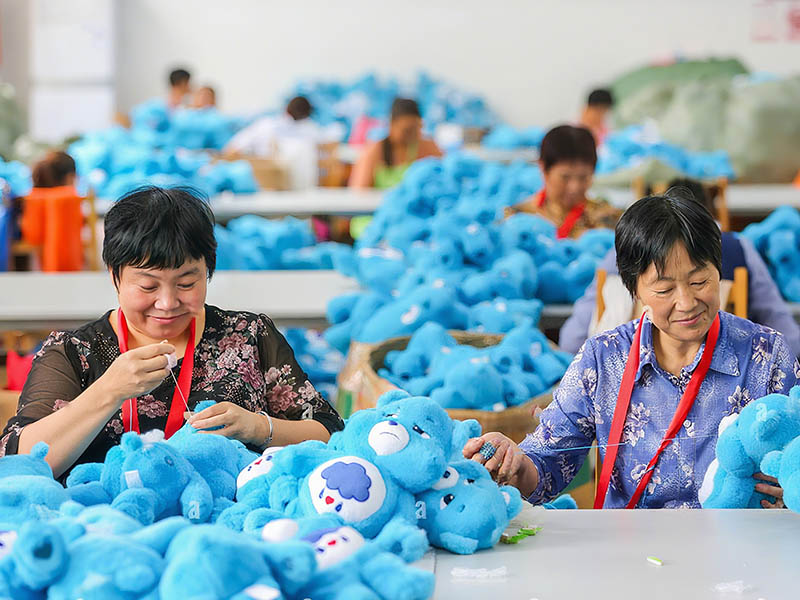
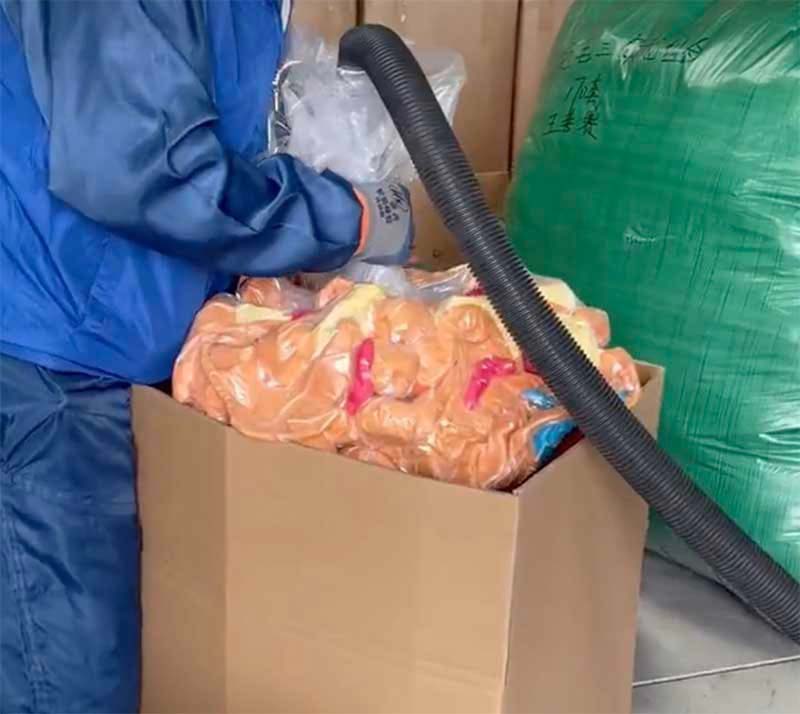
Most buyers think of plush toy sourcing as a series of transactions — a sample order, a production order, a shipment. Each interaction with the factory feels separate: a brief submitted here, a sample reviewed there, a payment made before shipping. The factory manages the production. The buyer waits for results.
This transactional model is one of the primary reasons plush toy sourcing so frequently produces outcomes that disappoint — not because the factory is necessarily incapable but because the production relationship lacks the structure that makes complex, multi-stage manufacturing reliably successful.
A project-based plush manufacturing process treats each product launch as what it actually is: a structured project with defined stages, clear deliverables at each stage, specific responsibilities for both buyer and factory, quality gates that must be passed before the next stage begins, and systematic documentation that captures the decisions and standards established across the project for use in future orders.
This approach does not require more effort from buyers — it redirects effort from reactive problem management to proactive project governance, which consistently produces better outcomes with less total management burden. This guide explains what a project-based plush manufacturing process looks like stage by stage, what each stage requires from both parties, and how the structure of the process produces the quality and reliability outcomes that the transactional model consistently fails to deliver.
What Is a Project-Based Plush Manufacturing Process and Why Does It Matter?

A project-based plush manufacturing process is a structured framework that organizes the development and production of a plush toy product into defined sequential stages — each with specific inputs, defined activities, quality-verified outputs, and formal handoff criteria that must be met before the next stage begins. It treats a product launch not as a loosely connected series of factory interactions but as a managed project with clear scope, defined standards, documented decisions, and accountable execution.
A project-based approach matters because the complexity of custom plush toy manufacturing — combining design development, pattern engineering, material compliance, sampling, quality management, and production execution across a multi-week timeline — exceeds the reliability of informal, transaction-by-transaction management. Informal management works when everything goes smoothly. The project framework is what makes recovery from inevitable complications systematic rather than reactive, and what prevents complications from escalating into crises.
Here is a comparison of the transactional and project-based approaches across key manufacturing outcomes:
| Manufacturing Outcome | Transactional Approach | Project-Based Approach |
|---|---|---|
| Design accuracy | Depends on factory interpretation | Established through structured brief and feasibility review |
| Revision round count | Determined by brief quality and luck | Managed through defined brief standards and revision protocols |
| Sample-to-bulk consistency | Variable — no systematic verification | Assured through counter sample and pre-production authorization |
| Material compliance | Discovered in testing | Established through specification and sourcing requirements |
| Production quality | Discovered in final inspection | Managed through IPQC protocols across production |
| Problem detection timing | At delivery or after | At production stage through monitoring and communication |
| Documentation completeness | Fragmentary | Systematic — organized by project stage |
| Reorder efficiency | Rebuilds from scratch | Accelerated through project archive |
The Stage-Gate Principle
The core operating principle of a project-based plush manufacturing process is the stage-gate — a defined quality verification point at the end of each project stage that must be passed before the next stage begins. Stage-gates prevent the compounding of unresolved issues across multiple stages, which is the primary driver of the large, expensive problems that characterize poorly managed manufacturing relationships.
When every stage must be formally closed before the next opens, problems are addressed at the stage where they originate — where they are least expensive and most efficiently resolved — rather than at the end of the project where they have compounded through multiple subsequent stages. The cost of implementing stage-gates is the time and attention required to formally verify each stage’s completion. The return is the prevention of the cascading problem scenarios that most commonly produce the largest sourcing costs.
How Does the Project Initiation Stage Define Scope, Standards, and Success Criteria?

Project initiation is the stage that most directly determines whether everything that follows proceeds efficiently or struggles from a foundation of unclear expectations and misaligned assumptions. It is the stage most commonly compressed or skipped entirely in transactional sourcing relationships — and the stage whose absence most consistently produces the problems that make subsequent stages more difficult and expensive.
The project initiation stage defines the scope, standards, and success criteria for the entire manufacturing project — establishing what the product is, what quality standard it must achieve, what markets it will enter, what compliance requirements it must meet, what production volume it will require, and what timeline it must satisfy. These definitions, established at initiation, govern every decision made across every subsequent stage.
Here is a complete project initiation checklist:
| Initiation Element | What Is Established | Who Is Responsible | Output Document |
|---|---|---|---|
| Product scope | Exact product type, character concept, size range, functional features | Buyer | Product scope statement |
| Target market | Geographic markets, retail channels, age grade | Buyer | Market and compliance specification |
| Compliance requirements | Applicable standards for each target market | Buyer with factory input | Compliance requirements document |
| Quality standard | Material quality level, finish standard, construction standard | Buyer | Quality specification statement |
| Production volume | Initial order quantity and anticipated reorder pattern | Buyer | Volume and timeline plan |
| Budget parameters | Unit cost target, total development investment, compliance budget | Buyer | Project budget |
| Timeline requirements | Target delivery date, key milestone dates | Buyer | Project timeline |
| Success criteria | Specific, measurable criteria for project success | Both parties | Success criteria document |
| Supplier capabilities confirmation | Factory confirms capability to meet all scope requirements | Factory | Capability confirmation |
| Communication protocol | Update frequency, format, contact points | Both parties | Communication protocol |
Establishing Success Criteria Before Development Begins
One of the most important — and most frequently omitted — initiation activities is establishing specific, measurable success criteria before any development work begins. Success criteria define what “done correctly” looks like for each stage of the project — not as a general aspiration toward quality but as specific, objective standards against which each stage’s output will be assessed.
Sample stage success criteria specify what first-sample accuracy level is expected, how many revision rounds are budgeted, and what specific quality attributes must be confirmed before the sample is approved. Production stage success criteria specify the AQL level for final inspection, the defect classification system, and what inspection results must be achieved before shipment is authorized. Compliance criteria specify which test reports must be in place before goods can ship.
Without established success criteria, every stage assessment becomes a subjective judgment — “is this good enough?” — rather than an objective evaluation against a defined standard. Subjective assessments produce disputes. Objective assessments against established criteria produce resolutions.
How Is the Design Development Stage Structured from Concept to Production-Ready Brief?
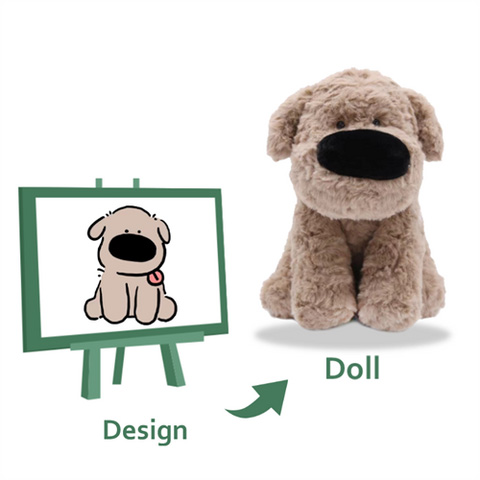
The design development stage is where the product concept established in initiation is translated into a production-ready design brief — a comprehensive technical document that the factory can use to build an accurate first sample without making assumptions that undermine the brief’s intent. It is the stage where design decisions that determine the majority of the product’s production cost, quality characteristics, and compliance status are made — and where the investment in getting those decisions right pays the largest return across all subsequent stages.
The design development stage is structured from concept to production-ready brief through four sequential activities: concept definition, design optimization review, specification development, and brief completion verification. Each activity has a specific output that feeds into the next, and the stage is complete only when a brief that meets the completeness standard has been produced and reviewed by both parties.
Here is a structured design development workflow:
| Development Activity | Primary Output | Quality Standard | Responsible Party |
|---|---|---|---|
| Concept definition | Character concept with multi-view reference artwork | Front, back, side views; clear character direction | Buyer |
| Design feasibility review | Feasibility assessment with optimization opportunities | Factory confirms producibility, flags complexity risks | Factory |
| Material direction | Fabric, filling, and accessory direction with samples | Physical swatches and specifications | Both |
| Color specification | Pantone references for all color areas | TPX or TPG codes for all colors | Buyer |
| Specification development | Complete dimension table, placement coordinates, construction notes | All measurable elements specified with tolerances | Both |
| Compliance integration | Certification requirements stated in brief | Applicable standards specified | Buyer with factory input |
| Brief completion verification | Complete brief reviewed against checklist | All elements present, no specification gaps | Both |
| Factory brief confirmation | Factory confirms understanding and capability | Written confirmation with any clarifying questions | Factory |
The Design Optimization Review as a Project Investment
The design optimization review — where the factory reviews the initial design concept and identifies specific opportunities to achieve the same visual and quality outcome at lower production cost or with fewer production risks — is one of the highest-return activities in the design development stage, but it requires a specific type of buyer-factory relationship to be effective.
In a transactional relationship, buyers submit designs and factories execute them. There is no mechanism for the factory’s manufacturing expertise to inform the design before it is fixed. In a project-based relationship, the design review is a structured collaboration where the factory’s pattern making and production expertise is brought to bear on the design before sampling begins — identifying opportunities to reduce panel count without visual impact, to substitute standard accessories for equivalent custom components, or to simplify construction approaches that would otherwise create consistency challenges at scale.
The design optimization review is not about reducing quality — it is about achieving the required quality through the most production-efficient approach. The cost saving from design optimization compounds across every unit in every production run of the product — making it one of the highest-return investments in the entire project.
How Does the Sampling Stage Operate as a Project Phase with Defined Milestones?
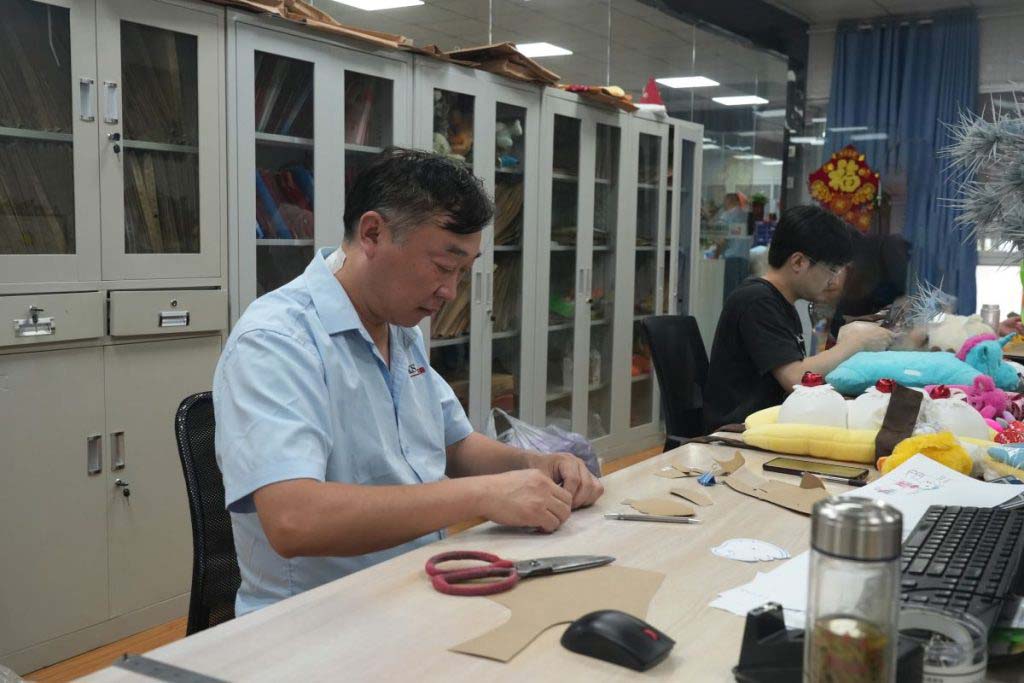
The sampling stage — the most development-intensive phase of a plush manufacturing project — operates most effectively when managed as a project phase with defined milestones, documented decision points, and formal stage completion criteria rather than as an open-ended iterative cycle without defined endpoints.
The sampling stage operates as a project phase through a defined sequence of milestone events: factory brief review confirmation, pattern making and material sourcing completion, first sample dispatch, buyer evaluation and feedback, revision rounds with action list confirmation, sample approval decision, and counter sample authorization. Each milestone has a specific input, a defined output, and a clear completion criterion — making the stage’s progress visible and its completion definitive rather than open to indefinite continuation.
Here is the sampling stage milestone framework:
| Milestone | Input | Activity | Output | Completion Criterion |
|---|---|---|---|---|
| Brief confirmation | Complete design brief | Factory reviews and confirms understanding | Written confirmation with any clarifying questions | Factory confirms all elements understood |
| Pattern and material completion | Confirmed brief | Pattern making and material sourcing | Patterns ready, materials sourced | Factory confirms production ready |
| First sample dispatch | Complete patterns and materials | Sample construction by dedicated team | First physical sample | Sample dispatched with deviation documentation |
| Buyer first evaluation | Received sample | Systematic evaluation against all criteria | Structured feedback document | All elements evaluated, feedback consolidated |
| Revision action confirmation | Buyer feedback | Factory confirms understanding of all changes | Written revision action list | Buyer confirms list is complete and accurate |
| Revision sample dispatch | Confirmed action list | Revised sample construction | Revised physical sample | Sample dispatched with change notes |
| Sample approval decision | Revised sample | Buyer evaluation against approval criteria | Approval or further revision decision | All criteria within tolerance — approved |
| Counter sample authorization | Approved development sample | Bulk materials sourced, counter sample built | Counter sample for review | Counter sample matches development sample within tolerance |
| Production authorization | Approved counter sample | Both parties confirm production can begin | Signed production authorization | All stage-gate criteria met |
Managing Revision Rounds as Defined Project Events
In the transactional model, revision rounds are open-ended — they continue until the buyer approves or runs out of budget. In the project-based model, revision rounds are defined project events with specific inputs, specific activities, and specific outputs — each governed by a revision action list that specifies exactly what is being changed and confirmed before work begins.
This revision governance structure prevents the most common revision inefficiencies: factory addressing some feedback items and missing others, buyer raising new feedback items that should have been identified in the previous round, and the circular revision pattern where the same issues appear across multiple rounds without definitive resolution.
Managing revision rounds as defined project events also makes the revision budget visible and manageable. When each revision round is a defined project event with a specific scope, cost, and timeline, the total sampling investment is predictable rather than open-ended. When the budget threshold for revision rounds approaches, the buyer has clear information for deciding whether to continue refining or to approve and manage remaining minor gaps through production monitoring.
How Is Production Authorized and Prepared as a Distinct Project Stage?
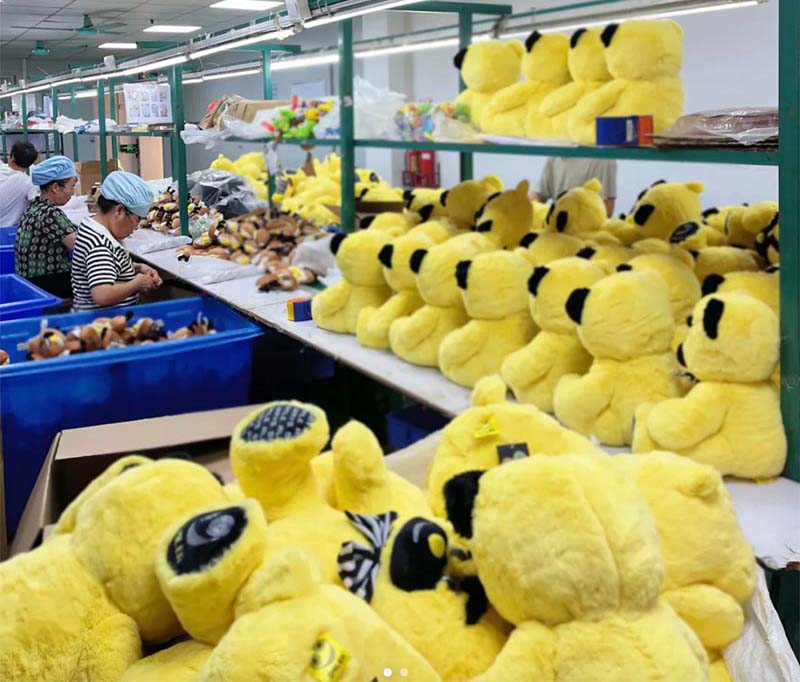
Production authorization and preparation is the stage that sits between a fully approved sample and the start of mass manufacturing — and it is one of the most commonly compressed or eliminated stages in transactional sourcing relationships. In the project-based model, production authorization is a distinct stage with specific verification activities that must be completed before a single production unit is cut, sewn, or stuffed.
Production authorization and preparation as a distinct project stage involves five parallel verification and preparation activities: bulk material approval, counter sample verification, production planning and scheduling, work instruction preparation and distribution, and quality checkpoint scheduling. All five must be completed before production authorization is granted — because each addresses a specific quality risk that, if not managed at this stage, will manifest as a problem in the production run.
Here is the complete production authorization and preparation checklist:
| Authorization Activity | What Is Verified or Prepared | Stage-Gate Criterion | Responsible Party |
|---|---|---|---|
| Bulk material swatch approval | Proposed bulk fabric compared to approved reference under D65 | All materials within approved color tolerance | Both — factory provides, buyer approves |
| Material compliance verification | Compliance certificates for all bulk materials | Current certificates available for all materials | Factory |
| Counter sample approval | Counter sample compared to approved development sample | Counter sample within defined tolerances | Buyer |
| Production patterns verification | Production patterns confirmed accurate from counter sample | Patterns produce correct dimensions and form | Factory QC |
| Equipment calibration verification | Stuffing, embroidery, sewing equipment at correct settings | Calibration confirmed and documented | Factory |
| Work instruction preparation | Station-specific technique guidance prepared | Instructions available at all relevant workstations | Factory |
| Tech pack distribution | Current tech pack distributed to all production departments | Confirmed distributed and acknowledged | Factory |
| QC checkpoint scheduling | IPQC intervals and assignments defined and scheduled | Schedule confirmed with QC team | Factory |
| Production timeline confirmation | Production schedule with buffer confirmed | Schedule satisfies delivery requirement with buffer | Both |
| Third-party inspection scheduling | Inspection booked in advance | Inspection date confirmed for appropriate production stage | Buyer with factory coordination |
The Production Authorization Gate
The production authorization gate — the formal confirmation that all preparation activities are complete and production is cleared to begin — is the most important single quality governance decision in the entire project. It is the last point at which problems can be resolved at minimal cost before the full production investment is committed.
A production authorization gate that is passed without completing all preparation activities — because of timeline pressure, budget constraints, or the simple desire to move forward quickly — creates exactly the risks that the preparation activities were designed to prevent. Bulk material that was not formally approved before cutting becomes an undisclosed deviation that may only be identified in final inspection. Equipment that was not calibrated before production begins produces output whose density or position characteristics differ from the approved standard. Work instructions not distributed before operators begin result in technique variation that IPQC monitoring must catch after the fact rather than preventing from the start.
In the project-based model, the production authorization gate is non-negotiable — it either passes or the specific unmet criteria are addressed before authorization is granted. This non-negotiability is what makes the gate effective as a quality control mechanism rather than a nominal formality.
How Is the Mass Production Stage Managed as an Active Project with Monitoring and Control?
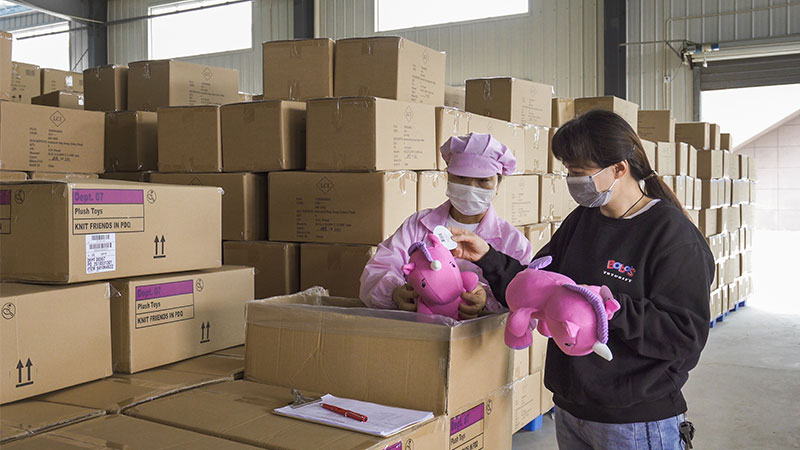
The mass production stage — in a transactional sourcing relationship — is a waiting period during which the buyer has no meaningful visibility into what is happening and no mechanism for influencing outcomes until the production is complete and the shipment is ready. The factory produces, the buyer waits, and any problems that develop during production are discovered at delivery rather than during production.
In the project-based model, the mass production stage is an actively managed phase — with defined monitoring activities, scheduled reporting milestones, documented IPQC data, and a buyer-factory communication structure that provides meaningful production visibility without requiring the buyer to be physically present. This active management does not add to the factory’s production burden — it formalizes and makes visible the quality management activities that a professional factory conducts routinely.
Here is a complete mass production project management framework:
| Management Activity | Timing | Information Provided | By Whom | Action Trigger |
|---|---|---|---|---|
| Production start confirmation | Day 1 | Production begun, all preparation confirmed | Factory | — |
| First-off inspection report | Day 1 of production | First-off photos and assessment against counter sample | Factory | Deviation outside tolerance triggers correction |
| Stuffing density log — initial | Day 2–3 | First density readings confirming machine calibration | Factory | Any reading outside range triggers recalibration |
| Embroidery position log — initial | When embroidery begins | First position measurements against coordinate standard | Factory | Any deviation triggers hoop adjustment |
| 25% completion update | At 25% of production | Progress confirmation, any quality findings | Factory | Issues trigger buyer notification and discussion |
| IPQC summary — fabric | At each lot transition | Roll transition verification results | Factory | Any failed transition triggers immediate hold |
| 50% completion update | At 50% of production | Production status, accumulated IPQC summary | Factory | Systematic issues trigger corrective discussion |
| 75% completion update | At 75% of production | Production status, timeline confirmation | Factory | Timeline risk triggers contingency discussion |
| Production completion confirmation | At 100% of production | Production complete, FQC scheduled | Factory | — |
The Buyer’s Role in Active Production Management
Active production management in the project-based model requires specific buyer actions — not just passive receipt of factory-provided updates. The buyer must review each update received, assess whether the information indicates any emerging quality or timeline risk, and respond to issues with specific direction rather than general concern.
When a mid-production update reveals that stuffing density readings are trending toward the lower boundary of the acceptable range, the appropriate buyer response is not “please ensure quality is maintained” — it is “please recalibrate stuffing equipment and share the post-recalibration weight readings in your next update.” Specific, informed responses to production information require the buyer to understand what the IPQC data means and what correction it should trigger — which is one of the reasons this guide provides the technical foundation for interpreting production monitoring information rather than simply describing the communication structure.
Buyers who develop this informed engagement capability become better project managers of their manufacturing relationships — extracting more quality assurance value from factory communication and providing more useful direction that helps factories maintain quality standards throughout the production run.
How Does the Quality Verification and Pre-Shipment Stage Complete the Production Project?

The quality verification and pre-shipment stage is the final quality gate before the production project transitions from manufacturing to logistics — the stage where the quality of the completed production batch is formally verified against the established project standards and either confirmed as meeting those standards or identified as requiring remediation before shipment is authorized.
In the project-based model, this stage has a defined scope, a defined sequence of verification activities, and a specific shipment authorization criterion that must be met before any goods leave the factory. It is not a formality to be completed as quickly as possible before the shipping window closes — it is the quality accountability moment that the entire project’s quality governance has been designed to support.
Here is the complete quality verification and pre-shipment stage framework:
| Verification Activity | What Is Assessed | Standard Applied | Output | Shipment Impact |
|---|---|---|---|---|
| Factory FQC inspection | AQL sample from completed batch against all quality criteria | AQL 2.5 major / 1.5 critical | FQC report | Required for internal quality confirmation |
| Third-party pre-shipment inspection | Independent AQL inspection against buyer’s specified criteria | Buyer’s specified AQL and criteria | Independent inspection report | Required for shipment authorization on high-value orders |
| Compliance documentation review | All required certificates, test reports, labels confirmed complete | Market-specific documentation requirements | Compliance documentation file | Required for market entry |
| Packaging and labeling verification | Correct packaging, labels, and markings confirmed | Approved packaging specification | Physical confirmation | Required for retail or customs compliance |
| Quantity verification | Actual count versus purchase order | Purchase order quantity | Packing list | Required for logistics and customs |
| Shipment authorization | All verification activities completed with passing results | All stage-gate criteria met | Signed shipment authorization | Production project closes |
The Shipment Authorization Gate
The shipment authorization gate — the formal confirmation that all pre-shipment verification activities have been completed with passing results and that the shipment is cleared to proceed — is the project-based model’s final quality governance mechanism. It is the commercial mechanism that makes the entire quality framework enforceable — because the buyer’s balance payment is retained until after this gate is passed.
The shipment authorization gate passes when the factory FQC report shows a passing AQL result, the third-party inspection report (where required) confirms the independent quality assessment, all compliance documentation is confirmed complete and current, packaging and labeling have been verified, and the quantity is confirmed. When all of these conditions are met simultaneously, the shipment authorization is granted, the balance payment is released, and the production project formally closes.
When any condition is not met — an FQC deviation exceeds the AQL threshold, a compliance document is missing, a packaging labeling error is identified — the shipment authorization is withheld until the specific issue is resolved. This withholding is not a punitive measure — it is the quality governance mechanism that ensures the project’s quality standards are met before the buyer’s commercial leverage is released.
How Is the Project Closed and What Institutional Knowledge Is Preserved for Future Orders?
Project closure in the transactional sourcing model is implicit — the goods are shipped, the invoice is settled, and the interaction ends until the next order is placed. In the project-based model, project closure is a deliberate stage that serves two functions: formally completing the current project with documented lessons and outcomes, and creating the institutional knowledge archive that makes future orders faster, more efficient, and more reliable.
Project closure involves three activities: quality performance review, documentation archiving, and production standard preservation. Each activity produces a specific output that serves a specific purpose in future project efficiency.
Here is the complete project closure framework:
| Closure Activity | Output Produced | Purpose | Future Benefit |
|---|---|---|---|
| Quality performance review | Documented assessment of actual vs expected quality across all stages | Identifies process improvements and risk factors for future projects | Better planning for subsequent orders |
| Defect analysis | Root cause documentation for any quality issues identified in the project | Informs corrective action for future production | Lower defect rates on reorders |
| Sampling efficiency review | Assessment of brief quality, revision count, and development timeline | Identifies brief preparation improvements | Fewer revision rounds on future designs |
| Tech pack finalization | Complete, distribution-ready specification for the approved product | Production reference for all future orders | Faster, more accurate reorder production |
| Material specification archive | Specific fabric lots, supplier codes, and compliance certificates used | Enables like-for-like material sourcing on reorders | More consistent reorder fabric quality |
| Approved sample archiving | Physical approved sample stored under appropriate conditions | Visual and tactile reference for reorder comparison | Reliable reorder quality standard |
| IQC and IPQC record archiving | Complete quality monitoring records from the production run | Traceability and comparative reference | Reorder quality baseline |
| Supplier performance record | Documented assessment of factory performance across all project dimensions | Input for future sourcing decisions | Better-informed supplier relationships |
The Reorder Efficiency Dividend
The institutional knowledge archived at project closure produces its most tangible commercial value on the first reorder — when all of the project’s foundational work has already been done and the reorder can proceed directly to the stages that require fresh execution rather than rebuilding from scratch.
A reorder of a product whose original project has been formally closed and documented follows a compressed project framework: brief is already complete, materials are already specified and sourced from known lots, patterns are already verified, tech pack is already finalized, compliance is already established. The reorder project begins at the material verification and counter sample stage rather than at concept and requires a fraction of the management investment that the original project required.
This reorder efficiency dividend compounds across every subsequent order of the same product — making the institutional knowledge investment in project closure one of the highest-return activities in the entire manufacturing relationship. Brands that consistently formalize project closure build manufacturing relationships that become progressively more efficient with each successive order, reducing both cost and management burden as the product matures in their catalog.
Range Extension Efficiency
For brands that develop product ranges — multiple characters, colorways, or variants within a consistent design family — the project closure archive also accelerates range extension development. The construction standards, material specifications, and quality criteria established for the first character in a family provide a verified foundation for subsequent character development — reducing the pattern engineering uncertainty, material sourcing ambiguity, and quality standard establishment effort that the first project required.
A second character in the same design family begins development with a pre-verified construction approach, pre-qualified materials, and pre-established quality criteria — reducing the development stage from the full concept-to-brief workflow to a targeted brief for the character-specific elements. This efficiency benefit is only available when the first project’s institutional knowledge has been systematically captured and made accessible — which is what the project closure stage is designed to ensure.
At Kinwin, we approach every client project with the project-based structure described in this guide — because we have found that structured project management consistently produces better quality outcomes, more efficient development cycles, and more successful long-term relationships than the transactional alternative. Our project management approach is built into our client onboarding, our production communication protocols, and our documentation archiving systems — so that every project we complete becomes a foundation for the next one rather than a standalone transaction that has to be rebuilt from scratch.
If you are interested in understanding specifically how the project-based process we use would apply to your next plush product development, we would be glad to walk through it with you in detail.
Reach out to our team at [email protected] or visit kinwintoys.com to start that conversation.
Conclusion
The project-based plush manufacturing process is not a more complicated version of transactional sourcing — it is a more structured version of the same activities that happen in every manufacturing relationship, organized in a way that makes those activities more effective, more efficient, and more reliably productive.
The stage-gate structure prevents problems from compounding across stages. The defined milestones make progress visible and decision points explicit. The documentation requirements create the institutional knowledge that makes each successive order more efficient than the last. And the shared governance framework aligns the buyer and factory around clear, measurable standards rather than leaving quality assessment to subjective judgment after the fact.
Buyers who adopt the project-based approach consistently experience fewer quality surprises, more efficient development cycles, and better production outcomes than those who manage the same manufacturing relationships transactionally — because the project structure makes the right quality management activities happen at the right stages rather than leaving them to be improvised when problems force them.
At Kinwin, the project-based manufacturing process is how we work with every client — because we believe that structured, transparent, mutually governed project management is the foundation of the manufacturing partnerships that produce the best outcomes for both parties.
FAQ
Q1: How does the project-based approach affect the timeline compared to the transactional approach for the same product?
The project-based approach adds structured time at specific stages — project initiation, design optimization review, and production authorization preparation — that the transactional approach compresses or skips. In the short term, these additions appear to slow the process. In practice, the time invested in these structured stages is consistently recovered — and exceeded — by the time saved through reduced revision rounds, fewer production problems requiring mid-run correction, and the absence of post-shipment remediation cycles. A product developed through a well-executed project-based process typically reaches market faster than the same product managed transactionally — because the time invested in preventing problems at earlier, cheaper stages is consistently less than the time consumed by managing those problems when they emerge at later, more expensive stages.
Q2: Is the project-based approach practical for smaller orders, or does it only make sense for large production volumes?
The project-based approach scales with order size — the investment in each stage-gate is proportional to the stakes of the production it governs. For a 300-unit first order, the project framework is simplified: initiation is lighter, the production authorization stage is less complex, and the active production monitoring is less intensive. But the core structure — defined brief before sampling, formal sample approval before production authorization, bulk material approval before cutting, and quality verification before payment — applies at any order size and produces proportional value. The institutional knowledge captured at project closure is particularly valuable for small first orders because it makes the second order — often larger — significantly more efficient to manage.
Q3: How should buyers handle a factory that is willing to adopt the communication and documentation standards of the project-based approach but does not currently have the systems to support them?
A factory that is willing but not currently capable of supporting project-based documentation and communication standards should be assessed for the specific gaps and the timeline for closing them. If the gaps are primarily in documentation organization and communication protocol — rather than in the underlying quality management systems — they are often bridgeable through the introduction of specific report formats and communication schedules that the factory can begin implementing immediately. If the gaps indicate missing quality management infrastructure — no IPQC monitoring system, no compliance documentation process, no first-off inspection protocol — these are more fundamental capability gaps that cannot be bridged through reporting format changes alone. In the latter case, the buyer must decide whether to work with the factory while these systems are developed (accepting higher risk during the development period), to structure the relationship with compensating buyer-side quality management investments (third-party inspection at multiple production stages), or to source with a factory that already has the systems in place.
Q4: What is the most important single element of the project-based approach for buyers who cannot implement the full framework immediately?
If only one element of the project-based approach can be implemented immediately, the production authorization gate — specifically the requirement that bulk material swatches are approved and a counter sample is built and approved before production is authorized — provides the highest single-element return. This gate addresses the two most common and most expensive sources of sample-to-bulk quality failure: material batch variation that produces color or quality differences between the approved sample and the bulk goods, and production environment differences that produce dimensional or density differences when the approved standard is not verified under actual production conditions. Both of these failure modes are prevented by the production authorization gate at a cost — counter sample fee and material swatch review time — that is consistently less than the remediation cost of the failures they prevent.
Q5: How does the project-based approach change the relationship dynamic between buyer and factory — does it create more conflict or less?
The project-based approach consistently reduces conflict in manufacturing relationships — not because it eliminates problems but because it resolves disagreements through objective assessment against pre-established standards rather than through subjective judgment after the fact. When both parties have agreed in advance that the FQC must pass at AQL 2.5 before shipment is authorized, a failing inspection result is not a dispute — it is a clear finding that triggers a defined response. When both parties have agreed that bulk material swatches must be approved before cutting, a color deviation identified in that swatch review is not a supplier failure — it is a project system working as designed. The clarity of stage-gate criteria replaces the ambiguity that generates most manufacturing relationship conflicts, and the shared governance of the project framework makes both parties invested in the same outcome rather than positioned as adversaries managing competing interests.