Skip to content
Your custom plush sample may be approved, your bulk order may be packed, and your freight booking may be ready—but that does not mean the shipment is documentation-ready for the United States. Since CPSC eFiling took effect on July 8, 2026, importers of covered products must connect product, testing, manufacturing, and certificate data before entry. This guide explains how to build that information during product development instead of chasing it after the goods leave the factory.
Direct answer: CPSC eFiling for plush toys is the electronic submission of required certificate data for imported plush products subject to CPSC rules. For a children’s plush toy, the U.S. importer generally needs a valid Children’s Product Certificate supported by applicable testing, accurate product identification, manufacture and test details, laboratory information, and a record contact. The manufacturer can supply critical production data, but the importer remains responsible for determining requirements and coordinating the filing with its customs broker.
Important: This article provides manufacturing and sourcing guidance, not legal advice. Product classification and applicable requirements depend on the actual design, intended age, marketing, materials, functions, and distribution model. Confirm your program with qualified compliance professionals, a CPSC-accepted laboratory, and your licensed customs broker.
What Changed for Plush Toy Imports on July 8, 2026?
The U.S. Consumer Product Safety Commission announced that mandatory eFiling took effect on July 8, 2026 for most imported regulated consumer products. Importers must transmit certificate information electronically to U.S. Customs and Border Protection through a Partner Government Agency message set before the products enter U.S. commerce.
Products entered from a Foreign Trade Zone for consumption or warehousing have a later effective date of January 8, 2027. CPSC implementation announcement
The most important point is what did not change: eFiling did not create a new toy test or safety certificate. CPSC states that the program changes how existing certificate information is transmitted. Children’s products subject to CPSC rules already required appropriate testing and certification; eFiling makes that information available electronically during import.
| Area | What remains the same | What eFiling changes |
|---|---|---|
| Product safety | The finished product must comply with applicable CPSC rules | Certificate data is submitted electronically for covered imports |
| Testing | Required children’s-product testing must support certification | Test and laboratory data must be organized for filing |
| CPC | A valid Children’s Product Certificate still needs accurate required elements | Importers transmit certificate data through a Full or Reference PGA Message Set |
| Factory records | Manufacture location, date, product identity, and batch information must be reliable | These records must reach the importer and broker in a filing-ready form |
| Customs entry | Importer and broker still coordinate entry | CPSC data becomes part of the electronic import workflow |
A filing is not a substitute for compliance. Uploading incomplete or inaccurate data does not correct an untested product, an incorrect age classification, or a label that cannot be traced to the production batch.
Does CPSC eFiling Apply to Your Custom Plush Product?

CPSC says eFiling applies to imported consumer products subject to a consumer product safety rule, ban, standard, or regulation enforced by the Commission and requiring certification. A conventional plush designed or marketed as a plaything for children will often fall within toy requirements, but every product should be assessed on its actual characteristics.
Children’s toy, adult collectible, promotional item, or functional product?
Plush products are not all identical from a regulatory perspective. A baby comfort toy, licensed character plush for children, adult collectible, promotional mascot, weighted plush, and interactive plush with a sound module can present different questions.
CPSC toy guidance defines a toy as an object designed, manufactured, or marketed as a plaything for children under 14. It also explains that U.S. third-party testing and Children’s Product Certificate requirements apply to products designed or intended primarily for children 12 or younger. CPSC Toy Safety Business Guidance
That age distinction is easy to misunderstand. A “13+” statement on a package should not be used as a shortcut if the product’s design, marketing, play value, or distribution indicates a younger intended audience.
| Product characteristic | Question the buyer should resolve early |
|---|---|
| Sold in a children’s toy aisle or marketed for play | Is it a children’s toy, and which CPSC rules apply? |
| Intended for babies or toddlers | Are small-parts, seam strength, accessible components, and age-specific hazards addressed? |
| Sound, light, battery, heat, or electronic features | Do additional toy sections or other rules apply? |
| Magnets, rigid accessories, pellets, or weighted inserts | What mechanical, material, containment, and labeling assessments are needed? |
| Adult collectible positioning | Does the complete product presentation support that classification? |
| Imported only as a prototype for evaluation or testing | Can the importer document that it will never be sold or distributed to consumers? |
Do not wait until laboratory booking to decide the target age and use case. Those decisions influence construction, material selection, warning strategy, test scope, packaging, and certificate citations.
What about samples and prototypes?
CPSC’s current eFiling FAQ distinguishes true sample-only products from goods entering commerce. A product imported only for development, testing, product evaluation, or quality control—and never sold, distributed, or used by consumers—may be handled differently.
The importer must be able to demonstrate the sample’s ultimate disposition. CPSC suggests documentation or marking that makes the product unsuitable for sale or distribution. CPSC eFiling FAQ
That does not mean every courier shipment labeled “sample” is automatically exempt. A marketing sample sent to a retailer, influencer unit, preorder reward, or product later sold to a consumer may not fit the same facts. Before shipping a prototype, tell your factory and broker exactly how it will be used and follow current CPSC and CBP guidance.
CPSC eFiling, the CPC, Testing, and Tracking Labels Are Different Controls
First-time importers often treat four separate controls as if they were one document. Separating them makes the project easier to manage.
1. Product design and compliance planning
The product must be designed for its intended market. For plush, this may affect seam construction, attached accessories, embroidery, plastic eyes, fasteners, filling, surface coatings, electronics, magnets, packaging, warnings, and age grading.
Testing cannot make a fundamentally unsuitable design safe. It can only evaluate the submitted product against the selected requirements.
2. Third-party testing
Children’s products subject to applicable CPSC safety rules generally require testing by a CPSC-accepted third-party laboratory. The exact scope depends on the product.
ASTM F963 is incorporated into U.S. toy requirements through 16 C.F.R. part 1250, but not every ASTM F963 section applies to every plush toy. Other requirements may apply based on accessible materials, coatings, small parts, sound, batteries, or additional features.
The test sample should represent the product you will manufacture. If you change an accessible accessory, coating, printed area, filling system, sound module, or other relevant component after testing, ask your laboratory or compliance adviser whether the change affects the evidence supporting certification.
3. Children’s Product Certificate
A CPC is the importer’s or domestic manufacturer’s written certification that a children’s product complies with applicable safety rules. CPSC says the CPC and supporting test reports must be in English.
A generic laboratory report is not automatically a finished CPC. A certificate should not describe the product so vaguely that it could refer to multiple unrelated SKUs. CPSC CPC guidance
4. CPSC eFiling
eFiling transmits required certificate data electronically. An importer can provide the data for a Full PGA Message Set or store certificate data in the CPSC Product Registry and file a Reference PGA Message Set using certificate identifiers.
The Product Registry does not automatically send information to CBP’s ACE system. The importer must still coordinate the applicable identifiers with its broker.
5. Tracking labels
Children’s products must carry permanent, distinguishing tracking information on the product and its packaging to the extent practicable.
CPSC guidance identifies information such as the manufacturer or importer/private labeler, production location and date, batch or run information, and details that help identify the product’s source. Tracking-label requirements support traceability, but CPSC notes that tracking labels are not themselves a rule cited on the CPC. CPSC Tracking Label Business Guidance
In a plush project, this becomes a practical label-engineering task: choosing a sewn-in label large enough for legible codes, confirming its seam location, ensuring it survives expected use, and aligning its batch code with carton, production, inspection, and certificate records.
Who Is Responsible: Importer, Factory, Laboratory, or Customs Broker?

Compliance is a shared information chain, but the roles are not interchangeable.
| Party | Main role | What it should not be assumed to do |
|---|---|---|
| U.S. importer or responsible certifier | Determine applicable requirements, ensure supporting evidence exists, issue accurate certification, control product IDs and records, and coordinate filing | Transfer legal responsibility by asking a factory or broker to “handle everything” |
| Plush manufacturer | Produce to the approved specification and provide accurate factory, production, material, batch, label, and product information | Decide the importer’s complete U.S. legal position without intended-use and distribution information |
| CPSC-accepted laboratory | Test the submitted product to the agreed scope and issue reports | Guarantee that later production changes or untested variants remain covered |
| Licensed customs broker | Transmit entry and PGA data based on importer instructions and records | Invent missing product, test, factory, or citation data at the port |
| Compliance adviser or legal counsel | Help interpret classification, applicable rules, exceptions, and documentation | Replace accurate production and testing records |
CPSC explains that the importer is typically the party creating business accounts in the Product Registry. If an Importer of Record such as an authorized broker lacks sufficient product knowledge to be responsible for testing and certification, the broker may identify the owner, purchaser, or consignee that authorized entry as the responsible party. CPSC importer resources
The correct arrangement should be established before shipment—not discovered after a broker requests data.
From a manufacturing perspective, the importer should nominate one document owner. That person controls the SKU list, approved sample version, test-report mapping, CPC draft, tracking-label code, shipment documents, and broker handoff.
When responsibility is spread across product development, logistics, a sourcing agent, and an external laboratory with no single owner, mismatches become likely.
What Information Must Be Ready for CPSC eFiling?
CPSC identifies seven required product-certificate data elements for a Full PGA Message Set:
- Product ID
- Citation codes for applicable rules
- Manufacture date
- Manufacture place
- Product test date
- Testing laboratory
- Point of contact
For a Reference PGA Message Set, the importer first enters and certifies product information in the CPSC Product Registry, then provides three certificate identifiers to the broker: Certifier ID, Product ID, and Version ID. CPSC eFiling FAQ
The list can create a false sense of simplicity. Each field depends on earlier product decisions.
Product identification
CPSC accepts identifier types including GTIN, SKU, UPC, model number, serial number, registered number, or an alternate ID. It strongly recommends using an identifier that can also be found on the packaging, packing list, or invoice.
For custom plush, use a stable identifier that distinguishes material or construction differences that matter.
A blue character and red character may share a pattern but use different fabric. A standard plush and sound-enabled version may look almost identical but have different applicable requirements. If both are called “Character Plush,” the document set can become ambiguous.
Create a product-variant matrix before testing:
| Identifier | Size | Colorway | Construction | Functional parts | Packaging | Test/report mapping |
|---|---|---|---|---|---|---|
| SKU-01 | Confirmed | Blue | Standard fill | None | Polybag + hangtag | Report set A |
| SKU-02 | Confirmed | Red | Standard fill | None | Retail box | Confirm applicability |
| SKU-03 | Confirmed | Blue | Internal module pocket | Sound module | Retail box | Report set B |
This is not a suggested certificate template. It is an internal control that helps the importer, factory, laboratory, and broker discuss the same product.
Applicable citations and test mapping
Do not copy a competitor’s citation list. The correct rules depend on the product.
CPSC’s toy guidance states that certificates for children’s toys should cite 16 C.F.R. part 1250 and list applicable ASTM F963 sections. Other federal citations may also be needed for requirements such as small parts or lead, depending on the product.
Your record should show which laboratory tested which applicable requirement and when. CPSC’s eFiling FAQ states that certificates must associate laboratories with the rules for which they performed testing, including component testing relied on to certify the finished product. Testing exclusions relied upon must also be identified under the revised rule.
Manufacturing data
The factory should provide its accurate legal name and the address of the actual finished-product assembly location—not only a sales office, export company, or marketplace profile.
CPC guidance requires the date and place of manufacture, with at least the month and year and sufficient location detail. If one supplier operates more than one production site, confirm which site made the certified product.
Production codes should connect:
- Purchase order and SKU
- Approved sample or specification version
- Material and accessory list
- Production month and factory location
- Batch or run number
- Sewn-in tracking label
- Carton marks and packing list
- Inspection record
- Applicable test and certificate file
The goal is traceability. If a question arises about one shipment, you should be able to identify what was produced, where, when, to which approved standard, and under which certificate data.
Build eFiling Readiness Into the Custom Plush Development Process
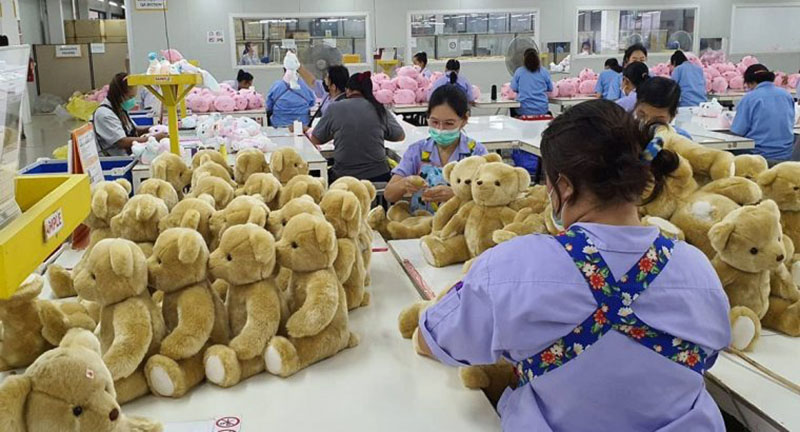
The most reliable approach is to create compliance data alongside the product rather than after production.
Step 1: Define the product, user, and destination market
State the product’s intended age, use, sales channel, U.S. distribution plan, and functional features. Provide this information to the factory, laboratory, and compliance adviser.
“Custom mascot” is not enough. A preschool retail toy and an adult corporate display item can require different decisions.
Step 2: Freeze a controlled specification
Convert the approved concept into a version-controlled specification covering dimensions, pattern, fabric, pile direction, embroidery, printing, filling, hard components, accessories, labels, packaging, and functions.
Identify which details are aesthetic and which affect compliance or product identity.
Step 3: Create the SKU and variant matrix
Decide whether colors, sizes, outfits, modules, packaging formats, or market versions require separate identifiers.
Ask the laboratory and compliance adviser how variants can be grouped or whether separate evaluation is needed. Do this before requesting one test report to cover an assortment.
Step 4: Review foreseeable plush-specific risks
The development team should examine construction before the final sample. Typical questions include:
- Can a seam open and expose filling, pellets, a module, or rigid component?
- Are eyes and decorations embroidered, printed, or attached as separate parts?
- Could a zipper pull, charm, clothing piece, battery door, magnet, or accessory detach?
- Does fabric pile interfere with embroidery clarity or label legibility?
- Are coated, painted, printed, or plastic parts accessible?
- Does a sound, heat, scented, weighted, or interactive function change the assessment?
- Is the product washable, and could washing affect seams, labels, electronics, or filling containment?
This is where an experienced custom plush manufacturer adds value. Pattern design, seam allowance, attachment method, filling density, fabric stretch direction, and accessory construction are production choices with consequences beyond appearance.
Step 5: Approve a representative sample
The test sample and production standard should be aligned. Confirm its materials, colorways, accessories, labels, and packaging. Record every approved revision.
A visually approved prototype built with temporary fabric or substitute accessories may be useful for shape review, but it may not be the right sample for final compliance testing.
Step 6: Confirm the test plan with qualified parties
Use current CPSC guidance, a CPSC-accepted laboratory, and professional advice to identify applicable rules and samples.
Avoid asking the factory for a generic “ASTM certificate” without defining the SKU, age, construction, and destination.
Step 7: Lock production and traceability details
After testing and final approval, control changes. Confirm the factory location, expected production period, batch coding, sewn-in label, packaging marks, and record-retention process.
If a necessary substitution occurs, pause and review whether it affects testing or certification before mass production continues.
Step 8: Prepare and review the CPC information
The responsible domestic manufacturer or importer creates the CPC.
CPSC lists seven required CPC elements: product identification; each applicable safety rule; certifier identity; test-record contact; manufacture date and place; test date and place; and identification of each CPSC-accepted third-party laboratory.
Review the certificate against the product, test reports, invoice, labels, and production records.
Step 9: Choose the filing route and brief the broker
Use a Full PGA Message Set when the broker will transmit the required certificate data directly.
Consider the Product Registry and Reference PGA Message Set when the same product certificate will support repeated imports. Confirm the data format and cut-off with the broker before the shipment departs.
Step 10: Run a pre-shipment document-to-product check
Before loading, compare the finished goods and paperwork:
- Correct SKU and product description
- Correct approved specification version
- Correct factory and production date
- Correct tracking information on product and packaging
- Correct laboratory and test dates
- Correct rule citations and exclusions, if any
- Correct certificate identifiers for the broker
- Correct invoice, packing list, and carton identification
A quality inspection and document review solve different problems. The inspection confirms what was made; the document review confirms that the shipment’s identity and supporting records agree.
Full PGA Message Set or Reference PGA Message Set?
Both routes can transmit the required data, but they fit different operating models.
| Filing route | How it works | Often better suited to | Main control point |
|---|---|---|---|
| Full PGA Message Set | Importer provides seven required data elements and the broker transmits them with entry | Infrequent imports or record-by-record workflows | Accurate broker handoff for every entry |
| Reference PGA Message Set | Importer stores certified data in the Product Registry; broker transmits Certifier ID, Product ID, and Version ID | Repeated imports covered by identical certificate data | Registry version control and correct identifiers |
CPSC says identical certificate details stored in the Product Registry can be referenced for repeated shipments.
However, “same character” or “same product name” does not necessarily mean identical certificate details. A changed factory, material, applicable rule, test basis, manufacturing period, or product version may require a record review or update.
Brands with many plush characters should treat the Product Registry as part of product-data governance, not as a one-time form. Assign owners for creating records, approving changes, providing identifiers to brokers, and retiring obsolete versions.
Common eFiling Mistakes in Custom Plush Programs

Treating eFiling as a last-mile logistics task
The data begins with product design and testing. A broker cannot reconstruct an approved material list or determine whether a sound module changed the test scope while a shipment is waiting for entry.
Assuming the factory’s test report transfers responsibility
A report may provide important evidence, but the importer must ensure it applies to the finished SKU and supports the rules cited on the CPC.
A report for a similar generic plush is not automatically evidence for a custom character with different accessories or materials.
Using inconsistent product names and IDs
If the CPC says “Model KP-101,” the invoice says “Blue Bear,” the carton says “Character A,” and the broker receives “Plush Toy,” reviewers may struggle to connect the shipment to the certificate.
Establish one controlled identity map.
Testing before materials and accessories are final
Early testing can be wasted if the product later changes to a different fabric treatment, print, coating, plastic component, filling system, electronic module, or attachment method.
Separate appearance-only prototypes from final representative samples.
Ignoring the actual production location
The seller’s address is not necessarily the finished-product assembly location.
Confirm whether production occurs in the quoted factory or is subcontracted elsewhere, and keep manufacturer data current.
Treating a tracking label as packaging artwork only
For children’s products, required tracking information generally needs to be permanently affixed to both the product and packaging to the extent practicable.
Plan the sewn-in label during sampling so its size and seam location do not become a rushed bulk-production change.
Reusing old records after a product change
New colorways, accessories, age claims, modules, materials, suppliers, or factories may affect the product identity or compliance basis.
Establish a change-control trigger that sends modified SKUs back to the compliance owner for review.
Believing an initial warning-only posture removes the obligation
CPSC’s current FAQ says it does not initially intend to request CBP denial solely because Full or Reference PGA data is missing and expects warning messages rather than reject messages in that circumstance.
The same guidance says CPSC continues to enforce certificate requirements and may seek seizure of non-compliant products. Treat this as an implementation detail, not permission to ship without required records.
A Buyer’s Pre-Order CPSC eFiling Readiness Checklist
Use this checklist before confirming bulk production:
- Intended age, use, U.S. sales channel, and importer role are documented.
- Product classification and applicable rules have been reviewed by qualified parties.
- Each SKU or relevant variant has a stable product identifier.
- The approved specification and sample represent planned production.
- Test scope was agreed with a CPSC-accepted laboratory.
- Test reports map clearly to the finished product and applicable rules.
- Any testing exclusions relied upon are identified correctly.
- CPC information is complete, accurate, and in English.
- Actual assembly-factory name, address, manufacture date, and batch are recorded.
- Product and packaging tracking information is approved.
- Product IDs agree across certificate data, labels, invoice, packing list, and cartons.
- Full or Reference PGA filing route is confirmed.
- Broker has the required data or certificate identifiers before entry.
- Changes after testing trigger documented compliance review.
- Records are organized for reorders, inspections, and CPSC requests.
Make Compliance Data Part of the Product, Not an Afterthought
CPSC eFiling for plush toys is easiest when the product has been developed with traceable decisions. The importer needs more than a passing sample: it needs a stable SKU, representative testing, accurate factory and production data, a valid CPC, workable tracking labels, and a clean handoff to the customs broker.
An experienced manufacturer cannot replace the importer’s compliance counsel or filing responsibility. It can, however, make upstream work more reliable by controlling the approved specification, production location, material and accessory records, sample versions, batch information, labels, and packaging details.
If you are developing a custom plush product for the U.S. market, Kinwin can review your artwork, target age, materials, functions, labels, sampling route, and production-information needs before bulk manufacturing. Bring your character art, tech pack, existing sample, or current documentation problem; the goal is to identify manufacturing gaps early enough to correct them.