Skip to content
Minimum order quantity is one of the first practical constraints buyers encounter when sourcing custom plush toys — and one of the most commonly misunderstood. Some buyers are surprised that MOQs exist at all, expecting factories to produce any quantity of any product on demand. Others accept whatever MOQ is quoted without understanding whether it is genuinely the factory’s production minimum or a commercially inflated number designed to maximize order value.
Between these extremes lies the more productive question: what is a reasonable MOQ for your specific product, your specific supplier, and your specific business situation — and what does that number reflect about the economics of custom plush manufacturing?
Understanding MOQ in its full context — what drives it, how it varies across different product types and factory types, how it relates to unit cost, and how it can be managed strategically at different stages of a brand’s development — transforms MOQ from an obstacle to be negotiated past into a production variable to be planned around intelligently.
What Does MOQ Mean in Custom Plush Toy Manufacturing and Why Does It Exist?
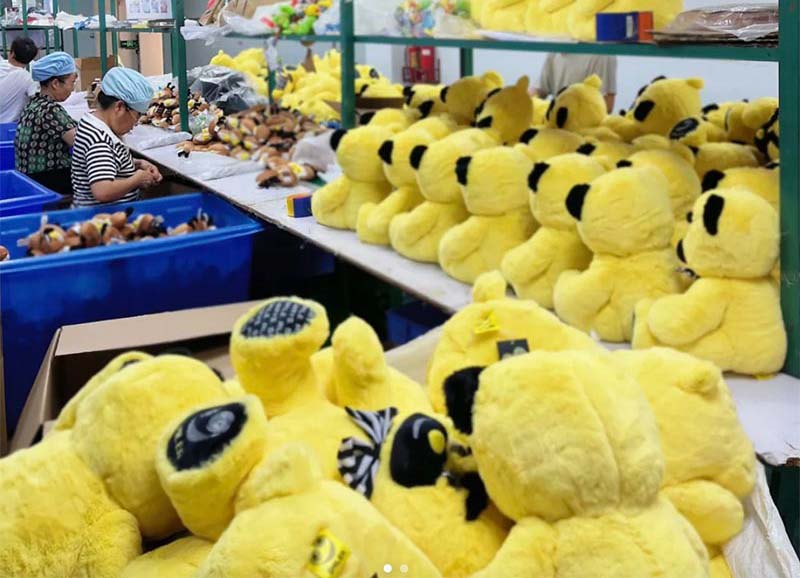
MOQ — minimum order quantity — is the smallest number of units of a specific product that a factory is willing to produce in a single production run. In custom plush toy manufacturing, the MOQ is set at the product level — for a specific design in a specific colorway — rather than at the total order level, because each product variant requires its own pattern, material allocation, and production setup regardless of how many other variants are ordered simultaneously.
MOQ exists in custom plush manufacturing because producing a custom product requires fixed investments in pattern making, sampling, material procurement, equipment setup, and quality system configuration that occur once regardless of how many units are produced. These fixed costs must be recovered across the production run — and the minimum viable production run is the quantity at which the fixed cost per unit is economically sustainable for both the factory and the buyer.
Here is a breakdown of the fixed cost components that MOQ is designed to cover:
| Fixed Cost Component | Approximate Cost Range | Recovered Across MOQ | Per-Unit Impact at 300 Units | Per-Unit Impact at 1,000 Units |
|---|---|---|---|---|
| Pattern making | $50–$200 | Yes — one-time | $0.17–$0.67 | $0.05–$0.20 |
| Production setup | $100–$300 | Yes — per run | $0.33–$1.00 | $0.10–$0.30 |
| Machine calibration | $50–$150 | Yes — per run | $0.17–$0.50 | $0.05–$0.15 |
| Material minimum purchase | $200–$800 | Partial — excess material | $0.67–$2.67 | $0.20–$0.80 |
| Quality system overhead | $100–$400 | Yes — per run | $0.33–$1.33 | $0.10–$0.40 |
| Total fixed cost range | $500–$1,850 | $1.67–$6.17 | $0.50–$1.85 |
Why MOQ Is Not Arbitrary
The MOQ that a factory sets is not an arbitrary commercial preference — it is the quantity at which the fixed cost per unit reaches a level that makes production economically viable within the unit price the buyer is willing to pay. If a factory’s fixed production costs for a custom product are $1,200 and the buyer’s target unit price allows for $1.50 of fixed cost contribution per unit, the economic MOQ is 800 units. Producing 200 units at the same price means the factory recovers only $300 of $1,200 in fixed costs — and either loses money or charges a significantly higher unit price to compensate.
Understanding this cost structure helps buyers have more productive conversations with factories about MOQ — because the conversation can focus on the specific fixed cost components and how they might be managed, rather than on the MOQ number as an abstract commercial position.
What Factors Determine the MOQ a Factory Sets for Custom Plush Orders?
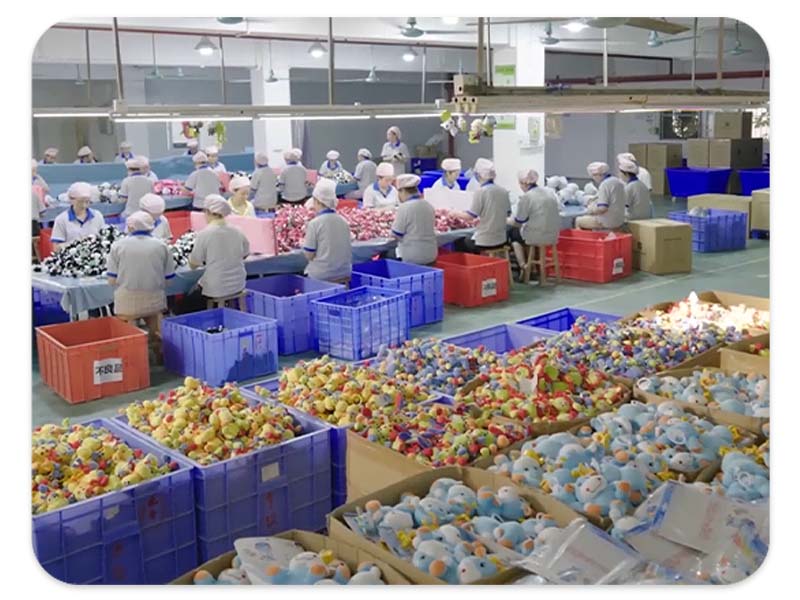
The MOQ a factory sets for a specific custom plush order is determined by a combination of the product’s design complexity, the material procurement requirements, the factory’s production scale and overhead structure, and the commercial dynamics of the buyer-supplier relationship at the time of the order. Understanding each factor helps buyers assess whether a quoted MOQ reflects genuine production economics or includes a commercial margin that may be negotiable.
Here is a comprehensive framework for understanding the factors that determine MOQ:
| Determining Factor | How It Affects MOQ | Lower MOQ Scenario | Higher MOQ Scenario |
|---|---|---|---|
| Design complexity | More complex designs have higher setup costs requiring more units to amortize | Simple standard shape | Complex original character with many panels |
| Material procurement minimums | Fabric suppliers have minimum order quantities that the buyer’s order must justify | Standard fabric in catalog colors | Custom-dyed or specialty fabric |
| Pattern making investment | More complex patterns cost more and require more units to recover | Reusing existing similar pattern | New complex pattern required |
| Production line efficiency | More efficient products reach economic throughput at lower quantities | Standard construction, high throughput | Complex construction, lower throughput |
| Factory scale and overhead | Larger factories have higher overhead requiring larger minimum orders | Small to medium factory | Large-scale factory with high overhead |
| Tooling requirements | Custom accessories or molds require cost recovery over minimum run | Standard accessories | Custom-molded accessories |
| Relationship stage | Established clients may access lower MOQ as commercial accommodation | Repeat client, growth relationship | First-time, unproven buyer |
| Market seasonality | Peak-season capacity pressure may increase effective MOQ | Off-peak ordering | Peak-season ordering |
The Material Minimum Procurement Factor
One of the most significant and least visible MOQ drivers in custom plush production is the material minimum purchase requirement from fabric and filling suppliers. Professional factories source fabric from textile suppliers who have their own minimum order quantities — often 300 to 500 meters per colorway for custom-dyed fabrics, or 100 to 200 meters for catalog colors.
When a buyer’s production order requires less fabric than the fabric supplier’s minimum, the factory must either order more fabric than the production requires — creating unused inventory that they bear the cost of — or source from a more expensive supplier that offers smaller minimums. Both scenarios increase the factory’s cost per unit, which translates into either a higher unit price or a higher MOQ requirement to justify the purchase.
This material minimum factor is why custom-colored or specialty fabric products typically have higher MOQs than products using standard catalog fabrics — the custom fabric requires a purchase commitment that only makes economic sense when a sufficient number of units are produced.
What Is a Reasonable MOQ Range for Different Types of Custom Plush Products?
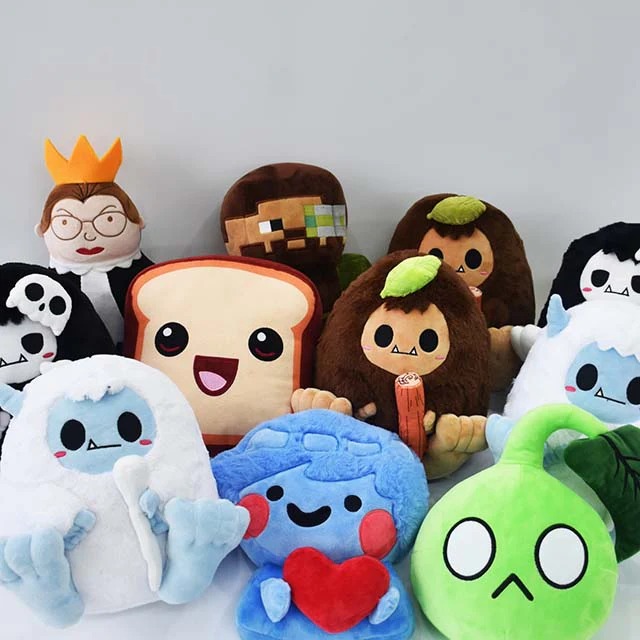
MOQ ranges vary significantly across different custom plush product types because the production economics, material requirements, and setup complexity differ meaningfully between product categories. Understanding what a reasonable MOQ looks like for each type helps buyers assess whether the quotes they receive fall within normal parameters or require further investigation.
Here is a practical MOQ reference guide across different custom plush product categories:
| Product Category | Typical MOQ Range | Key MOQ Driver | Notes |
|---|---|---|---|
| Simple standard shapes (bears, bunnies) | 200–500 units | Pattern reuse possible | Lower end when factory has similar existing patterns |
| Original character designs — moderate complexity | 300–600 units | New pattern investment | Increases with panel count |
| Complex character designs (15+ panels) | 500–1,000 units | High setup and skill cost | Specialist operators needed |
| Weighted plush toys | 500–1,000 units | Specialized materials and construction | Glass bead minimum purchases apply |
| Plush with electronic components | 500–1,500 units | Component MOQ and setup | Electronic sourcing minimums significant |
| Custom colorway of existing design | 200–400 units | Limited new setup required | Pattern already exists |
| Custom-dyed fabric required | 500–1,000 units | Fabric dye minimum | Fabric supplier minimums drive this |
| Large plush (60cm+) | 300–600 units | Higher material cost per unit | Material cost makes lower MOQ unviable |
| Promotional plush — simple design | 100–300 units | Simplified construction | Lower setup investment |
| Licensed character production | 500–2,000 units | Complexity and IP verification | Licensor requirements may apply |
Why These Ranges Have Floors and Ceilings
Each MOQ range has both a floor — the minimum below which production is genuinely not economically viable at a commercially reasonable unit price — and a ceiling — the maximum above which the factory is adding commercial margin to the economic requirement.
The floor is determined by the specific cost structure described earlier — fixed costs, material minimums, and the minimum viable unit price. The ceiling is determined by market competition — if every comparable factory in the market offers a product at 300 units, a factory quoting 1,000 units for the same product is either significantly less efficient than its competitors or is using MOQ as a commercial leverage tool.
Buyers who research the MOQ landscape across multiple comparable suppliers for the same product type are in the strongest position to assess whether a specific factory’s MOQ reflects genuine production economics or commercial inflation.
How Does MOQ Affect Unit Cost, Development Investment, and Total Project Economics?
MOQ does not exist in isolation from unit cost — the two are directly linked through the fixed cost distribution mechanism described earlier. Understanding this linkage helps buyers make more informed decisions about the real economics of different MOQ and unit price combinations rather than evaluating either in isolation.
MOQ affects unit cost through its role in distributing fixed production costs across the production run. The same product at half the MOQ typically requires either a significantly higher unit price to maintain factory economics or a significant reduction in fixed cost investment that affects development quality. The product at higher MOQ carries more favorable unit economics but requires more capital investment and more inventory risk.
Here is a practical illustration of MOQ’s impact on unit cost and total project economics:
| Scenario | MOQ | Unit Price | Total Production Cost | Fixed Development Cost | Total Project Cost | Per-Unit Total Cost |
|---|---|---|---|---|---|---|
| Low MOQ, standard quality | 200 | $7.50 | $1,500 | $500 | $2,000 | $10.00 |
| Medium MOQ, standard quality | 500 | $5.80 | $2,900 | $500 | $3,400 | $6.80 |
| Higher MOQ, standard quality | 1,000 | $4.90 | $4,900 | $500 | $5,400 | $5.40 |
| Low MOQ, complex design | 300 | $9.20 | $2,760 | $800 | $3,560 | $11.87 |
| Medium MOQ, complex design | 600 | $7.10 | $4,260 | $800 | $5,060 | $8.43 |
This table reveals several important relationships. First, the per-unit total cost decreases significantly as MOQ increases — but the rate of decrease diminishes at higher volumes. The jump from 200 to 500 units produces a much larger per-unit cost reduction than the jump from 500 to 1,000 units. Second, the fixed development cost — sampling fees, tooling, tech pack — is the same regardless of MOQ. This means that increasing MOQ is a more efficient way to reduce per-unit cost than reducing development investment, since development investment directly affects product quality.
The Inventory Risk-Cost Efficiency Trade-off
The economic logic of higher MOQ is clear — more units means lower per-unit cost. But the inventory risk logic runs in the opposite direction — more units means more capital tied up in inventory, more storage requirement, and more risk exposure if the product does not perform at the expected sales velocity.
The appropriate MOQ for any buyer is not simply the quantity that minimizes per-unit cost but the quantity that optimizes across three dimensions simultaneously: unit economics (favor higher MOQ), capital requirement and inventory risk (favor lower MOQ), and market validation opportunity (favor lower MOQ for new products, higher for proven products). Finding the right balance across these three dimensions is the strategic MOQ decision — not simply accepting whatever number the factory quotes.
How Can Buyers Negotiate or Reduce MOQ Without Damaging the Supplier Relationship?
MOQ negotiation is one of the most delicate commercial conversations in plush toy sourcing because the factory’s MOQ is not pure commercial preference — it reflects real production economics that the factory needs to manage. Negotiating MOQ in a way that dismisses this economic reality damages the relationship and often produces a grudging accommodation that costs more in other ways than it saves in quantity reduction.
Buyers can negotiate or reduce MOQ effectively by addressing the specific economic factors that drive the MOQ rather than simply asking for a lower number. Each approach to MOQ reduction works by changing one of the underlying economic variables — sharing fixed costs differently, adjusting material procurement strategies, or aligning commercial incentives through relationship commitments.
Here is a structured guide to MOQ reduction approaches:
| MOQ Reduction Approach | How It Works | MOQ Reduction Potential | Trade-off or Commitment Required |
|---|---|---|---|
| Consolidate multiple designs in one order | Shared setup and production scheduling efficiency | 20–40% per individual design | Commitment to minimum total order value |
| Commit to second order within defined timeframe | Reduces factory risk of single-run economics | 20–30% | Binding commitment to follow-on order |
| Accept higher unit price for lower MOQ | Buyer compensates factory for lower run efficiency | 30–50% | Higher per-unit cost — must assess viability |
| Use factory’s existing similar patterns | Reduces pattern making investment | 15–25% | Design adaptation to existing pattern |
| Accept standard fabric colors | Eliminates fabric supplier MOQ pressure | 20–30% | Design constrained to catalog colors |
| Provide longer production timeline | Allows factory to batch your order with others | 15–25% | Extended delivery timeline accepted |
| Establish exclusive supplier relationship | Long-term volume commitment reduces per-run risk | 20–35% | Exclusivity and volume commitment required |
| Phase into higher-MOQ follow-on order | First order at higher unit price, subsequent at standard | 30–40% on first order | Commitment to and delivery on follow-on order |
The Relationship Commitment Approach
The most effective MOQ reduction strategy for buyers who are serious about building long-term supplier relationships is the relationship commitment approach — demonstrating to the factory through specific, binding commitments that the initial lower-MOQ order is part of a growing business relationship rather than a one-time purchase.
A factory that understands it is beginning a long-term relationship with a buyer whose volume will grow over successive orders has a fundamentally different commercial perspective on a low-MOQ first order than one that views each order as a standalone transaction. For the former, the lower-MOQ first order is an investment in a growing client relationship. For the latter, it is a non-economic transaction that sets an undesirable precedent.
The binding nature of the commitment matters significantly. A buyer who says “we plan to reorder much larger quantities in the future” is making a statement that creates no commercial accountability. A buyer who says “we commit to a follow-on order of at least X units within Y months, and we are happy to put this in writing” is making a commitment that changes the factory’s commercial calculation on the current order.
What Are the Risks of Ordering Below a Factory’s True Production MOQ?
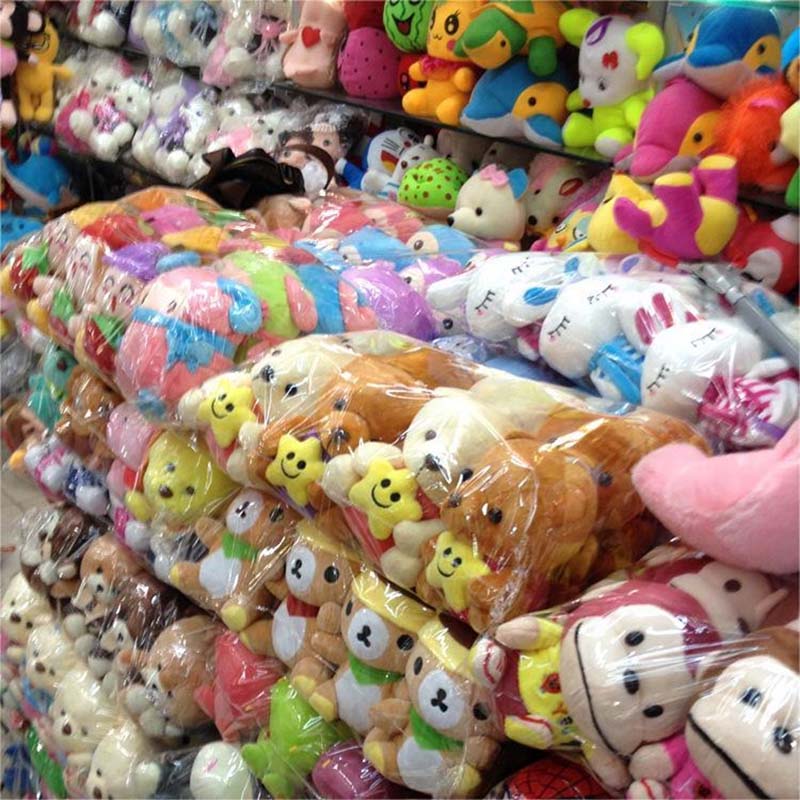
Some buyers, when faced with a factory’s MOQ, simply find a supplier willing to produce at lower quantities — often a trading company or a smaller workshop that does not have the true MOQ requirements of a professional manufacturer. This approach reduces the quantity commitment but introduces specific quality and reliability risks that are worth understanding before this trade-off is made.
Ordering below a factory’s true production MOQ — or finding a supplier who accepts very low MOQs on complex products — carries risks that are directly related to why those MOQs are difficult to justify economically. When the economics of a production run do not support the fixed cost investment of a professional manufacturing process, corners are cut to make the economics work — and those cuts typically happen in the areas least visible to the buyer: pattern quality, material sourcing, quality control depth, and development investment.
Here is a risk assessment for below-MOQ ordering scenarios:
| Risk Category | How It Manifests | Severity | Mitigation Difficulty |
|---|---|---|---|
| Simplified pattern making | Less experienced pattern maker, fewer revisions possible | Medium-High | Hard — not visible until sample received |
| Material quality compromise | Lower-cost materials sourced to maintain margin | Medium-High | Moderate — requires explicit specification |
| Quality control simplification | Reduced or absent IPQC, limited FQC | High | Hard — not visible without audit |
| Compliance gaps | Uncertified materials used to manage cost | Very High | Moderate — requires compliance verification |
| Production consistency | Less predictable output at very small runs | Medium | Hard — requires production monitoring |
| Supplier stability | Small workshops have higher failure rates | Medium | Moderate — requires background check |
| Reorder availability | Small suppliers may not be able to maintain consistency | Medium | Hard — only discovered at reorder |
When Below-MOQ Sourcing Is Appropriate
Below-MOQ sourcing through smaller workshops or trading companies is most appropriate in two specific situations: market testing with genuinely small quantities where the primary objective is validating market response rather than establishing a production standard, and promotional product use cases where unit cost is the primary criterion and quality consistency is a secondary concern.
In both situations, the appropriate approach is to enter the below-MOQ relationship with clear awareness of its limitations — not expecting the quality consistency and compliance rigor of a professional manufacturer, and planning to transition to a professional manufacturer for the main production once the initial objective is achieved.
The risk is in treating below-MOQ sourcing as a permanent solution rather than a transitional approach — continuing with small-workshop or trading company sourcing as the product scales, and discovering that the quality consistency and compliance infrastructure required for larger retail and e-commerce channels is not available from the original supplier.
How Should Buyers Align MOQ with Their Business Stage and Market Strategy?
The appropriate MOQ for a buyer is not determined solely by production economics — it is determined by the intersection of production economics, business stage, market strategy, and risk tolerance. Different business stages require different approaches to MOQ, and a strategy that is appropriate for a brand’s first product launch may be entirely inappropriate for its fifth.
Here is a framework for aligning MOQ decisions with business stage:
| Business Stage | MOQ Approach | Rationale | Transition Trigger |
|---|---|---|---|
| First product launch | Minimum viable MOQ — typically 200–400 units | Limit inventory risk while validating market | Evidence of consistent sales velocity |
| Proven concept, second order | Increase to 500–800 units | Better economics, validated demand | Consistent first-order sell-through |
| Established product, third+ order | Standard production MOQ — 800–1,500 units | Optimize economics, build inventory confidence | Predictable demand, channel establishment |
| Range expansion — new design | Return to lower MOQ for new designs | New product carries uncertainty regardless of brand | Validated each new design before scaling |
| Core product, maturity stage | Higher MOQ orders — 2,000+ units | Maximum cost efficiency, planned seasonal inventory | Strong demand history, reliable forecast |
| Licensed character launch | Match MOQ to license commitment volume | License commitments typically require volume | License agreement requirements |
The Market Testing Logic
For first product launches, the primary strategic objective is not unit cost optimization — it is market validation. A brand that launches its first plush product at 200 units and pays $10 per unit has a total production investment of $2,000. If the product does not sell as expected, the loss is $2,000 plus unsold inventory cost. A brand that launches at 1,000 units to achieve $6 per unit pricing has a $6,000 investment — and a much larger exposure if market response disappoints.
The appropriate MOQ for a first product launch is the smallest quantity that provides meaningful market data — enough units to test multiple channels, generate customer feedback, and build review velocity — not the quantity that optimizes unit cost. Unit cost optimization becomes the priority once market validation has occurred and the product’s commercial potential is confirmed.
The Range Strategy MOQ Consideration
For brands developing product ranges — multiple characters, colorways, or product types under a consistent brand identity — MOQ strategy must be managed at the range level rather than just the individual product level. A brand developing five characters simultaneously faces a total MOQ exposure that may exceed its budget even if each individual product’s MOQ is at the lower end of the reasonable range.
Managing range MOQ strategically involves sequencing launches — introducing new characters at different points in the annual calendar rather than simultaneously — consolidating orders where possible to reach favorable economics across multiple designs, and using lower-MOQ early launches to build market knowledge that informs which products deserve larger subsequent investment.
How Does Kinwin Approach MOQ for Different Types of Custom Plush Projects?
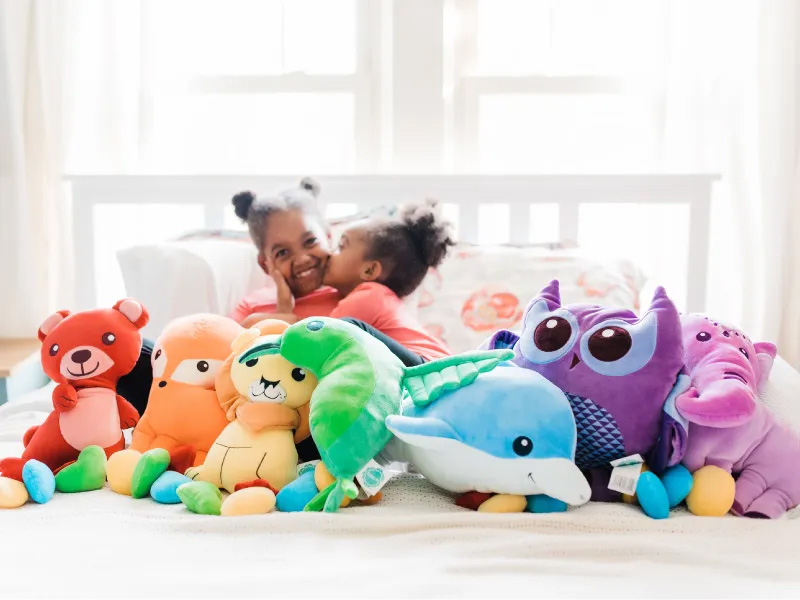
At Kinwin, our MOQ approach reflects both the genuine production economics of custom plush manufacturing and our commitment to supporting brands at different stages of their development — from first-time buyers testing the market to established brands scaling established product lines.
Our MOQ framework is not a single number applied uniformly across all products and relationships — it is a structure that varies based on product complexity, material requirements, relationship stage, and the specific commercial context of each project.
Here is how our MOQ approach varies across different project types:
| Project Type | Our Typical MOQ Range | Key Factors | Flexibility Available |
|---|---|---|---|
| Simple standard designs — catalog colors | 200–300 units | Pattern reuse possible, standard materials | Some flexibility for established relationships |
| Original character — moderate complexity | 300–500 units | New pattern investment, standard materials | Negotiable with relationship commitment |
| Complex original character — high complexity | 500–800 units | High pattern and skill investment | Limited flexibility on first orders |
| Weighted plush products | 500–800 units | Specialized materials and construction | Flexible based on design complexity |
| Custom colorway of existing design | 200–300 units | Pattern exists, different material sourcing | Good flexibility |
| Large-scale promotional orders | 300–500 units | Setup amortized across higher volume | Price-competitive at MOQ threshold |
| Established client reorders | Lower than standard | Production knowledge reduces setup | Available for consistent relationships |
Our Philosophy on First-Order MOQ
For buyers who are launching their first custom plush product with Kinwin, we understand that the first order carries inherent market uncertainty regardless of how strong the product concept is. Our philosophy is to structure first-order MOQs at a level that allows meaningful market testing without requiring a capital commitment that the buyer cannot comfortably absorb if the product performs below expectations.
This does not mean we accept any quantity regardless of production economics — but it does mean we are genuinely open to discussing the specific factors driving our MOQ for a particular product and whether there are approaches — design simplification, material choices, relationship commitments — that can make a lower-MOQ first order viable within the economics of both parties.
For buyers who are committed to building a long-term product line with Kinwin, we are particularly willing to be flexible on first-order MOQ as an investment in the relationship — because the growing order history that follows a successful first order creates the economics that justify the accommodation.
Transparency as Our MOQ Standard
Our commitment on MOQ is transparency rather than the lowest possible number. When we quote an MOQ, we are able to explain specifically what is driving it — which fixed costs need recovery, which material minimums apply, which production factors make the specific quantity the economic threshold. This transparency means that MOQ discussions with Kinwin are grounded in production reality rather than commercial positioning — and that buyers who understand the drivers can work with us to find approaches that achieve their quantity requirements within the genuine economics of the production.
If you are planning a custom plush product and want to understand what MOQ would apply to your specific design — and what factors are driving it — we would be glad to provide a specific, explained assessment as part of our pre-development consultation.
Reach out to our team at [email protected] or visit kinwintoys.com to start that conversation.
Conclusion
A reasonable MOQ for custom plush toys is not a single number — it is a range that varies based on product complexity, material requirements, factory type, and the commercial context of the specific sourcing relationship. Understanding what drives MOQ — fixed cost recovery, material procurement minimums, production efficiency thresholds — transforms MOQ from an opaque commercial barrier into a production variable that can be managed strategically.
Buyers who understand MOQ economics can have more productive conversations with factories, make better decisions about when to negotiate and when to accept, align their MOQ commitments with their actual business stage and risk tolerance, and build the kinds of supplier relationships that provide genuine flexibility as their business grows.
The most important insight about MOQ is that it is not the right place to optimize at the expense of everything else. A lower MOQ achieved by accepting lower-quality production, less rigorous quality management, or reduced compliance investment may cost more in total project economics than the higher-MOQ, professionally managed alternative. The right MOQ is the one that serves the buyer’s actual business objectives — not simply the lowest number that any supplier will accept.
FAQ
Q1: Can a buyer split an MOQ across multiple colorways of the same design to reach the factory’s minimum?
Yes — and this is one of the most practical approaches for buyers who want design variety without committing to full MOQ on each individual colorway. When multiple colorways use the same pattern and construction approach, the factory’s fixed cost investment — pattern making, equipment setup, tech pack development — is shared across all colorways. This means the total MOQ requirement for the full range may be similar to or only slightly higher than the MOQ for a single colorway. The practical approach is to discuss a shared-pattern colorway range with the factory at the beginning of the development conversation — proposing, for example, three colorways at 200 units each rather than one colorway at 600 units. Many factories are receptive to this structure because the total order value is similar while the buyer’s inventory risk per colorway is lower.
Q2: Is it better to meet a factory’s full MOQ on one design or to spread a limited budget across more designs at lower individual quantities?
This depends on the buyer’s primary objective. If the objective is building a multi-product range and testing market response across several designs simultaneously, spreading budget across more designs at lower individual quantities may be appropriate — provided that each individual design’s quantity is within the range that a professional factory can execute at acceptable quality. If the objective is establishing a strong initial product with robust market presence — adequate inventory for multiple channels, sufficient units for review generation and velocity building — concentrating budget on a single design at full or above-MOQ is typically more effective. The split-across-designs approach carries the risk that each individual design is produced at a quantity that is below the economic threshold for proper quality management — leading to lower quality across all products rather than strong quality on fewer products.
Q3: How does MOQ change for repeat orders of the same design, and should buyers expect lower minimums on reorders?
Reorders of the same design typically carry lower effective MOQs than first orders — because the fixed cost investments that drove the original MOQ have already been made and do not need to be recovered again. Pattern making, tooling, tech pack development, and initial material supplier qualification are all sunk costs from the original project. The reorder’s fixed cost structure is limited primarily to production setup, material procurement for the new run, and quality system configuration — a lower total that can be recovered across a smaller minimum run quantity. In practice, many factories will discuss a lower reorder MOQ with established clients — typically 20 to 40 percent below the original first-order MOQ — particularly when the reorder relationship is consistent and the product’s production knowledge is mature.
Q4: Are there product categories in custom plush where low MOQ is genuinely achievable at professional manufacturing quality?
Yes — there are specific product categories where lower MOQs are achievable without compromising professional manufacturing quality. Products using existing standard patterns with catalog-color fabrics can often be produced at 150 to 250 units because the fixed cost investment is minimal — the pattern exists, the material is available without minimum purchase constraints, and the production setup is straightforward. Products for promotional use that do not require the highest quality finish standards can be produced at lower quantities because the reduced quality management investment changes the economics. Custom-embroidered versions of existing catalog designs — where only the embroidery artwork is new — can often be produced at 200 to 300 units because the base product pattern already exists. Buyers who work with factories that have well-organized pattern libraries and material catalogs can access these lower-MOQ opportunities most effectively.
Q5: What should buyers do if they receive significantly different MOQ quotes from different factories for the same product?
Significantly different MOQ quotes for the same product should be investigated rather than simply accepting the lowest. The relevant questions are: what is driving the lower MOQ factory’s ability to accept fewer units — do they have a similar existing pattern that reduces their setup investment, are they using lower-grade materials to make the economics work at lower volume, or are they genuinely more efficient in a way that legitimately reduces their minimum? And what is driving the higher MOQ factory’s requirement — is it genuine fixed cost structure, commercial inflation, or a mismatch between their factory scale and the buyer’s order size? The most reliable way to answer these questions is through the production economics discussion described in this guide — asking each factory specifically what is driving their MOQ and what the unit price would be at different quantity levels. The pattern of answers reveals whether the MOQ reflects production reality or commercial positioning, and enables the buyer to make a total-cost comparison rather than simply a MOQ comparison.