 Skip to content
Stuffed Animal Sourcing from China — The Complete Buyer’s Guide
Stuffed Animal Sourcing from China — The Complete Buyer's Guide
Supplier Discovery · Vetting Criteria · Negotiation · Contracts · Compliance · Quality Control · Logistics · Risk Management
Sourcing stuffed animals from China is the most commercially viable path for brands, retailers, and distributors who require custom manufacturing at competitive prices with access to the world’s deepest specialist workforce, most complete material supply chain, and most developed compliance infrastructure. But sourcing from China — like any international manufacturing relationship — requires knowledge, process, and ongoing management to deliver the results your brand needs.
This guide covers the complete stuffed animal sourcing process for buyers approaching China for the first time — and for experienced buyers looking to improve their sourcing outcomes. It addresses every stage: supplier discovery, vetting and qualification, sampling and development, contract and commercial terms, quality control, compliance documentation, logistics, and ongoing supply management.
Before You Start Sourcing — What to Define First
Before You Start Sourcing — What to Define First
The quality of your sourcing outcome is determined before you contact a single supplier. Brands who approach suppliers with clear, detailed specifications consistently achieve better results, faster timelines, and more accurate quotations than brands who approach with vague requirements.
Character Design (any format)
Why: Determines sampling accuracy and development speed
If not defined: Multiple revision rounds; delayed first sample
Target Size
Why: Affects pricing, safety classification, production methods
If not defined: Incorrect quotation; wrong sample size
Target Markets
Why: Determines safety certification requirements
If not defined: Wrong certifications; products cannot be sold
MOQ You Can Commit
Why: Affects supplier selection and pricing tier
If not defined: Mismatch with supplier minimums
Target Unit Cost
Why: Sets realistic expectations for design complexity
If not defined: Over-specified design at budget not supporting it
Launch Date
Why: Determines whether timeline is achievable
If not defined: Missed launch; rushed production with quality risk
Compliance Requirements
Why: Determines certification scope and cost
If not defined: Non-compliant product; marketplace removal
Supplier Discovery — How to Find Stuffed Animal Manufacturers in China
Supplier Discovery and Early Filtering
Discovery Channels
- B2B platforms (Alibaba, Global Sources, Made-in-China): largest supplier databases; free to search but require careful vetting — many listings are trading companies, not factories
- Canton Fair : the largest trade fair in China — held twice yearly in Guangzhou; attended by thousands of manufacturers; the most comprehensive in-person supplier discovery channel available
- Industry trade shows: Toy Fair Nuremberg, Hong Kong Toys & Games Fair, Toy Fair New York — Chinese manufacturers attend and exhibit
- Industry referrals: other brands who source plush toys — not direct competitors — who can share qualified supplier contacts
- Sourcing agents: professionals with on-the-ground knowledge of the Chinese manufacturing landscape — useful for buyers without direct market knowledge
- Direct web search: searching for specific capability terms (‘OEM plush toy manufacturer Dongguan’, ‘CE certified stuffed animal factory China’) sometimes surfaces qualified manufacturers directly
Discovery Efficiency — 5 Early Filters
- Filter 1: Do they claim to be a direct manufacturer? (Ask directly — ‘Do you own the production facility?’)
- Filter 2: Do they have ISO 9001 certification? (Request the certificate number and verify with the certifying body)
- Filter 3: Can they provide CE/ASTM test reports for a recent order? (Sample compliance evidence of existing capability)
- Filter 4: Will they sign an NDA before receiving your design files? (A refusal is a disqualifying red flag)
- Filter 5: What is their sampling turnaround? (7-14 days for standard designs is professional; vague or very long answers suggest poor planning)
Supplier Vetting — Documentation Verification
Supplier Vetting — Documentation to Request and Verify
Business License
Verify: Manufacturing in business scope; legally registered
How: Request copy; check scope wording
ISO 9001 Certificate
Verify: Current, valid, manufacturing scope
How: Verify certificate number with certifying body
BSCI / SMETA Audit Report
Verify: Recent report (within 12 months); passing score
How: Request full report; check audit date
CE Declaration Sample
Verify: Product-specific; correct format
How: Check directive references; confirm test report exists
EN71 Test Reports
Verify: Recent; from accredited lab; all parts
How: Check lab accreditation; test date; product description
OEKO-TEX Certificates
Verify: Product Class I; valid (annual renewal)
How: Verify at oeko-tex.com using certificate number
Disney FAMA (if claimed)
Verify: Authorization letter; factory name matches
How: Request authorization letter; verify details
Capability Vetting & Factory Visit Assessment
Capability Vetting & Factory Visit Assessment
Capability Questions to Ask
- Request a sample of an existing production character — not a specially prepared showcase sample. Evaluate construction quality, embroidery precision, filling density, and seam integrity
- Ask about in-house vs subcontracted production: ‘What percentage of production is done in your own facility?’
- Ask about pattern maker count and experience: ‘How many full-time pattern makers do you employ and what is their average experience?’
- Request production line count and annual output: meaningful for assessing capacity for your program size
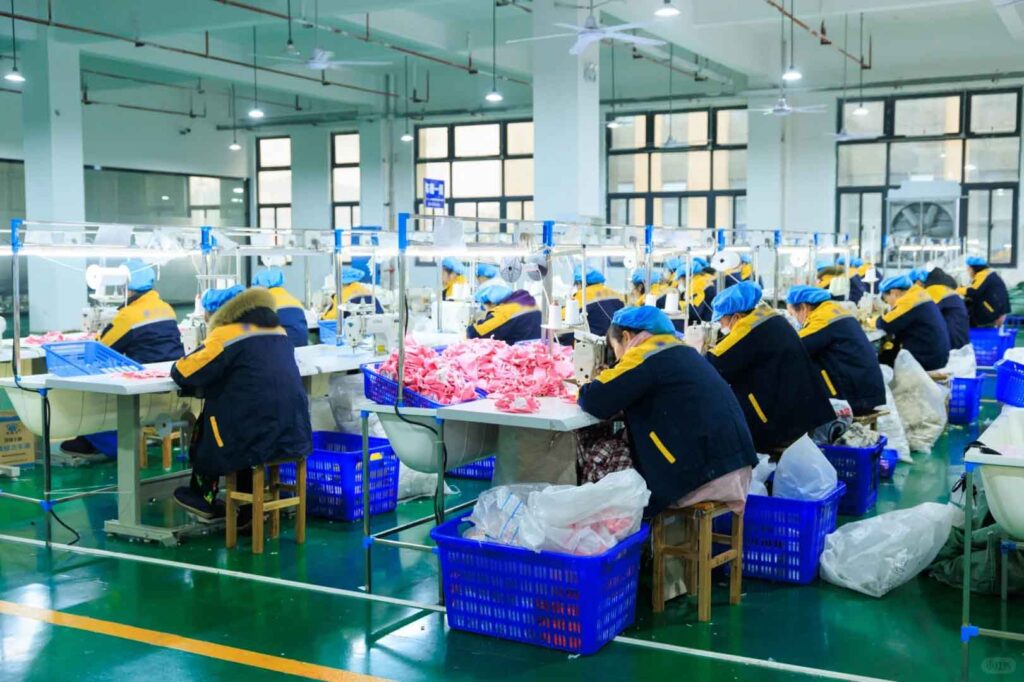
Factory Visit — What to Observe
- Golden samples visible on production floor — physically present at workstations, not stored away
- In-process QC happening at workstations — not just a final inspection room
- Embroidery placement templates in use — physical jigs, not freehand
- Filling station: scales or weighing equipment visible for density control
- Material storage: organized, labeled, protected from contamination
- Production volume evidence: clearly active production lines with meaningful output
Contracts and Commercial Terms
Key Contractual Protections and Payment Structure
6 Key Contractual Protections
- NDA (Non-Disclosure Agreement): signed before any design sharing — covers non-disclosure, non-compete for the specific character, and IP ownership
- IP ownership clause: explicitly states that all character designs, patterns, and specifications created for your order remain your property
- Quality specification reference: purchase order references the approved golden sample as the production quality benchmark
- AQL inspection clause: specifies the AQL level for pre-shipment inspection and the buyer’s right to conduct third-party inspection
- Compliance documentation clause: specifies which certifications must be provided and what happens if a product fails testing
- Defect and return policy: clear process for handling quality failures discovered before or after shipment
Standard Payment Structure
Sampling Fee
Amount: Quoted at cost
Trigger: Before sampling begins
Purpose: Covers development cost; deductible from production
Production Deposit (30%)
Amount: 30% of production value
Trigger: After golden sample approval
Purpose: Initiates material procurement and scheduling
Balance Payment (70%)
Amount: 70% of production value
Trigger: After QC pass, before shipping
Purpose: Protects buyer quality leverage
Never agree to 100% upfront payment — this removes all quality leverage before the goods are produced. The 30/70 split protects both parties appropriately.
Quality Control Management in China Sourcing
Quality Control Management — Active Oversight at Every Stage
The Four QC Moments
The Four QC Moments
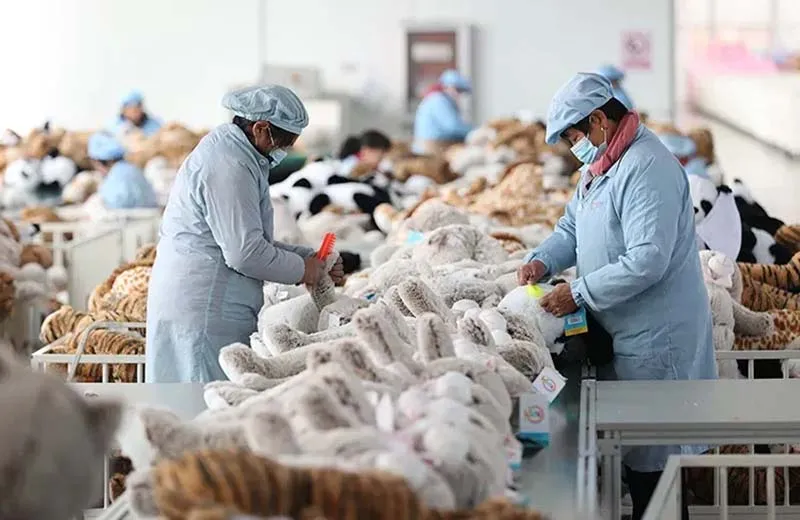
Quality control in a China manufacturing relationship requires active management by the buyer — it is not a passive expectation.
- 1. Pre-production: confirm golden sample is approved; materials confirmed; design alignment documented
- 2. During production (DUPRO): inspection at 30-40% completion — catches systemic defects before full run is affected
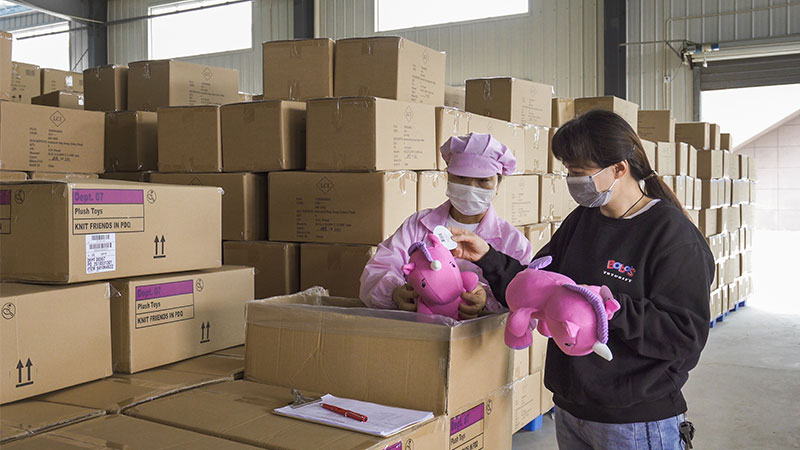
- 3. Pre-shipment: inspection of finished, packed goods — the most critical quality gate
- 4. Container loading: verification of correct product loaded and carton integrity
Third-Party Pre-Shipment Inspection
Third-Party Pre-Shipment Inspection
For first-time orders with a new supplier, a third-party pre-shipment inspection by SGS, Intertek, Bureau Veritas, or QIMA is the most reliable quality assurance tool available. It provides independent verification of product quality against your specifications before you authorize final payment and shipment.
- Cost: approximately $250-$450 USD per inspection day — typically one inspection covers a standard order
- What to provide the inspector: your approved golden sample, the agreed specifications (dimensions, color references, fill density), and the AQL level to apply
- What you get: a formal inspection report with photographs, defect classification, and pass/fail determination
- When to act on a failure: do not authorize shipment until the failure is resolved — returning goods after arrival is significantly more expensive
Managing Compliance Documentation
Compliance Documentation — Retention Requirements and Usage
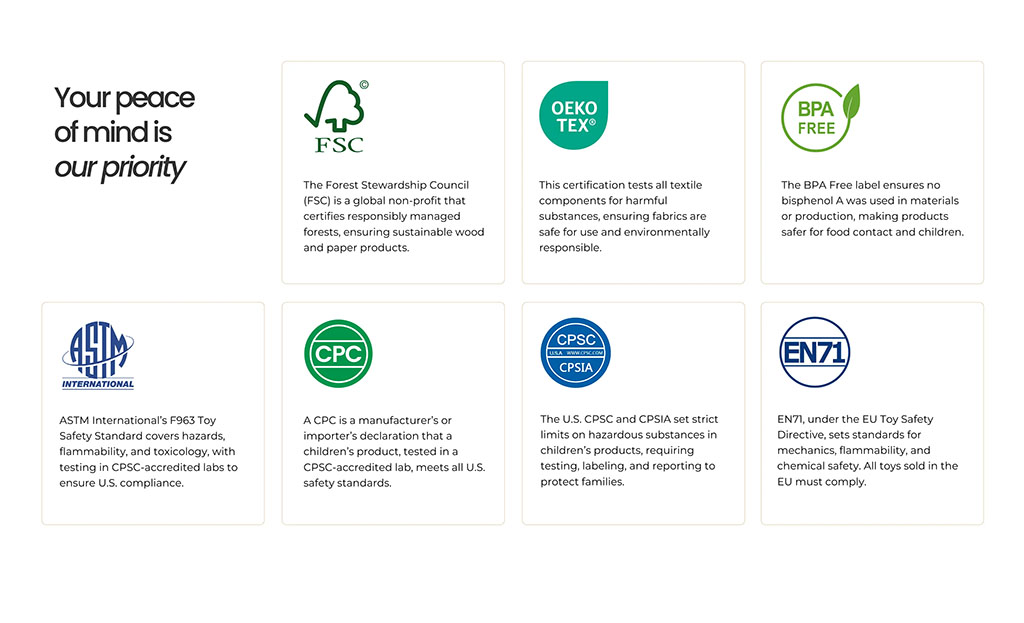
Compliance documentation is both a legal requirement and a commercial asset. Properly maintained compliance records protect your brand from market surveillance action, support retail buyer qualification, and enable Amazon marketplace listing approvals.
CE Declaration of Conformity
Retention: 10 years (EU Toy Safety Directive)
Use for: Customs clearance, retail buyer, Amazon EU
EN71 Test Reports
Retention: 10 years
Use for: Supports CE Declaration; retail buyer; customs
CPSC Children's Product Certificate
Retention: 5 years (CPSIA)
Use for: Required for Amazon US toy listing
ASTM F963 Test Reports
Retention: 5 years
Use for: Supports CPC; retail buyer; customs
BSCI / SMETA Audit Report
Retention: Until next audit (typically 12 months)
Use for: Retail supplier qualification; ESG reporting
OEKO-TEX Certificates
Retention: Duration of product active period
Use for: Material safety evidence; buyer confidence
Pre-Shipment Inspection Report
Retention: Duration of product active period
Use for: Quality documentation; dispute resolution
Logistics Fundamentals for Stuffed Animal Sourcing
Logistics — Shipping Methods and Planning
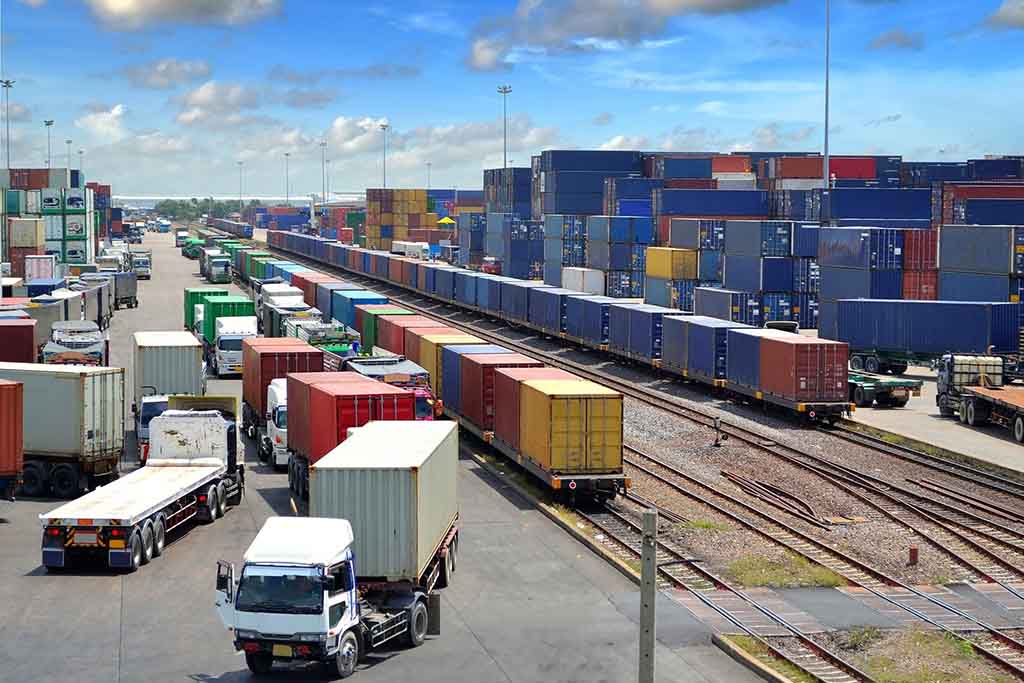
Stuffed animals are volumetric cargo — their dimensional weight (calculated from package dimensions) typically exceeds their actual weight, which means shipping costs are driven by volume, not weight. This has important implications for freight cost planning.
Sea FCL (Full Container)
Transit: US West Coast: 18-22 days · EU: 28-35 days
Cost: Lowest per-CBM cost
Best for: 5,000+ pcs
Sea LCL (Shared Container)
Transit: US: 25-32 days · EU: 30-38 days
Cost: Per-CBM + handling
Best for: 500–5,000 pcs
Air Freight
Transit: 3–6 days
Cost: 5–8x sea freight cost
Best for: Urgent orders; high-value small shipments
Express Courier (DHL/FedEx)
Transit: 3–5 days
Cost: Highest per-kg cost
Best for: Samples; very small quantities
DDP (Delivered Duty Paid)
Transit: Same as sea/air transit
Cost: All-in cost; no import management
Best for: Buyers without import capability
Critical planning point: stuffed animals shipped by sea to Amazon FBA require an additional 1-2 weeks for FBA check-in processing after arrival. Plan your order placement to ensure inventory arrives at FBA at least 3-4 weeks before your planned launch date.
Ongoing Supply Relationship Management
Ongoing Supply Relationship Management
A successful first order is the beginning of a supply relationship, not its conclusion. The brands with the most reliable supply outcomes are those who invest in managing the relationship continuously — not just at order time.
- Annual production planning: map your full year of seasonal and reorder needs in Q1 — gives your manufacturer advance notice to secure capacity and materials
- Inventory reorder triggers: define the stock level at which you automatically initiate a reorder — based on weekly sell rate plus 10-week production and transit buffer
- Golden sample retention confirmation: annually confirm that your golden samples and production documentation remain on file with your manufacturer
- Compliance renewal tracking: track expiry of CE declarations, ASTM test reports, and OEKO-TEX certificates — refresh before expiry to avoid marketplace listing issues
- Annual factory relationship contact: maintain the personal relationship with your account contact — visit, video call, or in-person at trade shows
- Competitive benchmarking: periodically assess whether pricing and quality remain competitive — not to switch suppliers but to ensure the relationship remains mutually beneficial
Why Brands Source Stuffed Animals from KINWIN
Why Brands Source Stuffed Animals from KINWIN
✓ Direct manufacturer in Dongguan — no trading company between your brand and the factory
✓ Complete certification portfolio: Disney FAMA, ISO 9001, BSCI, SMETA, CE, EN71, ASTM, OEKO-TEX
✓ 30+ senior pattern makers — the specialist skill that determines character accuracy
✓ 7-day standard sampling turnaround — industry-leading development speed
✓ MOQ 500 pieces — accessible for brands at every stage
✓ NDA from first contact; full IP protection protocols
✓ Third-party inspection welcome and facilitated at no charge
✓ Factory visits welcome with advance scheduling
✓ 17+ years, 1,000+ brands, 30+ countries — proven sourcing reliability
✓ Respond to all inquiries within 24 hours with development plan and quotation
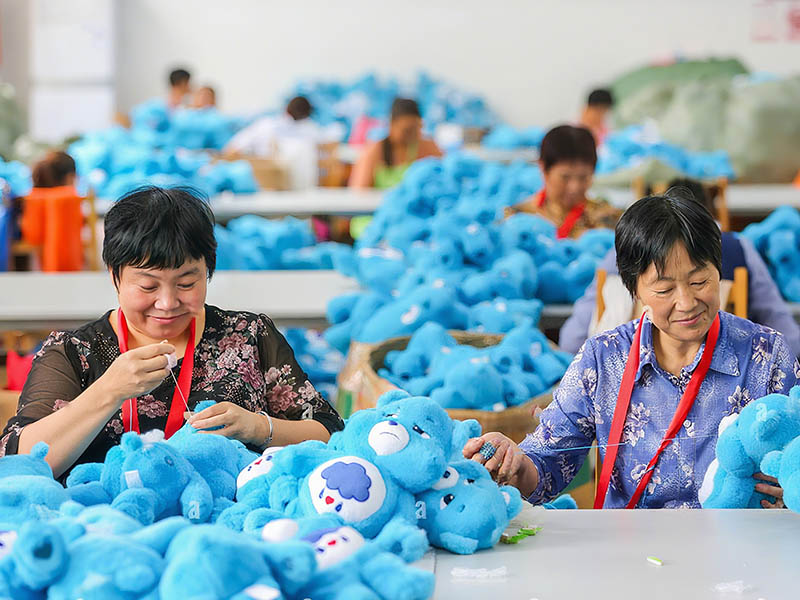
Sourcing stuffed animals from China is a process, not a transaction. KINWIN is the manufacturing partner who makes that process work.
Frequently Asked Questions — Stuffed Animal Sourcing from China
Frequently Asked Questions — Stuffed Animal Sourcing from China
Q1. How do I protect myself if the stuffed animals I receive don't match the approved sample?
The most effective protections are established before production begins, not after delivery. Key protections: (1) Golden sample clause in your PO — specify that production must match the approved golden sample; (2) Third-party pre-shipment inspection — arrange this before authorizing balance payment; inspection results that fall below AQL give you grounds to withhold payment and require rework; (3) Balance payment leverage — never pay the full balance until quality is confirmed through pre-shipment inspection; the 70% balance payment gives you significant leverage to require resolution before shipment; (4) Defect remediation clause — specify in writing what happens if quality fails: rework, replacement, or refund. If quality failure is discovered after arrival: document everything photographically, notify the manufacturer in writing immediately with specific defect descriptions referencing the golden sample, and negotiate resolution from that documented position. Working with certified manufacturers like KINWIN who provide 100% in-process and final inspection reduces the likelihood of a quality failure reaching delivery in the first place.
Q2. What Incoterms should I use when buying stuffed animals from China?
The most common Incoterms for stuffed animal sourcing from China are: FOB (Free On Board): the manufacturer is responsible for getting goods to the named Chinese port; you arrange and pay for international freight, insurance, and import at destination. This gives you control over freight choice and cost but requires you to manage import logistics. CIF (Cost, Insurance and Freight): manufacturer arranges and pays for ocean freight and insurance to destination port; you handle import customs and last-mile delivery. Simpler than FOB but you have less control over freight. DDP (Delivered Duty Paid): manufacturer arranges door-to-door delivery including all freight, insurance, and import duties. Simplest for buyers without import experience — everything is handled — but typically most expensive total cost. For most established importers with a freight forwarder relationship, FOB is the most efficient terms. For first-time importers or buyers focused on simplicity, DDP removes import complexity at a cost premium. KINWIN supports all three Incoterms structures.
Q3. How long does it take to receive stuffed animals from China from the time I place an order?
For a first OEM order (new character requiring development): 12-16 weeks total — development and sampling 3-4 weeks, safety testing 2 weeks (parallel with production prep), mass production 4-5 weeks, sea freight to US/EU 3-5 weeks. For an ODM order (existing design with branding): 8-12 weeks total. For a reorder of an existing approved design: 8-10 weeks total (production 4-5 weeks + sea freight). Air freight reduces transit by 3-4 weeks but at 5-8x the cost. The most common timeline extension causes: revision rounds during sampling (brands with vague design briefs average 2-3 rounds; brands with detailed briefs average under 1), and peak season production queue delays (June-September). Starting development earlier — before your launch date pressure is acute — is the single most effective way to ensure on-time delivery.
Q4. Should I use a sourcing agent for stuffed animal sourcing from China?
A sourcing agent adds a cost layer (typically 5-15% of FOB value) and an accountability gap between you and the factory. Whether the value justifies the cost depends on your specific situation. Sourcing agents add value when: you have no existing supplier relationships and need help with discovery; you are sourcing multiple unrelated product categories simultaneously (a plush specialist agent handles plush better than a generalist importer); you do not have bandwidth to manage supplier communication directly; or you need someone with physical presence in China for factory visits and QC oversight. Sourcing agents reduce value when: they do not have deep stuffed animal category expertise; they represent many factories and cannot provide objective comparison; or they take a commission from both you and the factory (a conflict of interest). The alternative to a sourcing agent for stuffed animals specifically is working directly with an established manufacturer like KINWIN who provides design support, sampling, QC, compliance, and shipping coordination as part of the standard manufacturing service.
Q5. How do I handle import duties and customs for stuffed animals from China?
Import duties for stuffed animals from China vary by destination market and HS code classification. Stuffed animals are classified under HS code 9503 (toys), specifically 9503.00 for stuffed animal toys. Key duty rates to plan for: US: stuffed animals from China are currently subject to Section 301 tariffs in addition to standard MFN duty rates — the combined rate has varied; verify current rates with your customs broker before ordering. EU: standard MFN duty rate for stuffed toys is typically 4.7% of customs value. UK post-Brexit: UK-specific tariff schedule applies. Australia: 0% duty under the China-Australia Free Trade Agreement (ChAFTA). KINWIN provides commercial invoices with the correct HS code and accurate declared value for all shipments. For first-time importers, working with an experienced customs broker at destination is strongly recommended — they navigate the import process, calculate duties, and manage compliance documentation on your behalf.
If You Can lmagine lt,We Will Create lt!
1.Tell Us What You Need
Tell us as specific as possible of your needs and share your idea.
2.Get Solution & Quote
We will work on the best solution according to yourrequirements,the specific quote will be provided within 24 hours.
3.Approve for Mass Production
We will start mass production after getting your approval.
