
Small Order Plush Toys — Custom Plush from 500 Pieces with Full Quality and Compliance
Small Order Plush Toys — Custom Plush from 500 Pieces with Full Quality and Compliance
500 pcs MOQ · OEM & ODM · Full Custom Quality · CE/ASTM Certified · Private Label · 7-Day Sampling · No Compromise
The most common barrier brands encounter when trying to launch a custom plush toy is the minimum order quantity. Many factories set MOQs of 3,000, 5,000, or even 10,000 pieces — quantities that require significant capital commitment before a single sale has been made. KINWIN’s 500-piece minimum order quantity is a deliberate commercial decision: we believe professional custom plush manufacturing should be accessible to brands at launch stage, not just to established brands with purchasing power.
At 500 pieces, KINWIN provides exactly the same service, quality, and compliance as a 50,000-piece order. The same design alignment process. The same senior pattern makers. The same 100% production inspection. The same safety certifications. The same golden sample retention. The 500-piece order receives everything a major brand receives — because the only difference between a 500-piece order and a 50,000-piece order is volume, and volume does not determine quality.
Why 500 Pieces Is a Viable Launch Quantity
500 Pieces by Sales Channel — Viability and Revenue Reference
Five hundred pieces sounds small in manufacturing terms. In commercial terms, it is a meaningful first order for most plush toy brands at launch stage — large enough to validate the market, generate real sales data, build initial inventory, and establish the production baseline for future scaling.
DTC Website (Shopify)
Viability: Strong — 500 pcs is a reasonable first run
Sell-through: 3–12 months depending on marketing
Revenue: 500 × $35 = $17,500 gross revenue
Amazon FBA
Viability: Strong — FBA handles fulfillment at any volume
Sell-through: 2–8 months with optimized listing
Revenue: 500 × $28 = $14,000 gross revenue
Gift Shop / Boutique Retail
Viability: Viable — 1-3 accounts at 50-150 pcs each
Sell-through: 1–3 peak seasons
Revenue: 500 × $22 wholesale = $11,000
Etsy / Handmade Platform
Viability: Very strong — unique design has natural fit
Sell-through: 1–6 months
Revenue: 500 × $32 = $16,000 gross revenue
Convention / Event Sales
Viability: Strong — 500 pcs suits 2-4 convention seasons
Sell-through: Seasonal events
Revenue: 500 × $30 = $15,000 gross revenue
Kickstarter / Crowdfunding
Viability: Ideal — 500 pcs minimum aligns with campaign scale
Sell-through: Campaign duration + fulfillment
Revenue: Variable — campaign dependent
The economics of a 500-piece first order depend on the channel, price point, and sell-through rate — but the principle holds across all of them: 500 pieces generates enough revenue and sales data to make an informed decision about reordering and scaling. It is a test, not a permanent commitment, and the design, patterns, and golden sample are retained at KINWIN for reorders whenever the data supports scaling.
What a 500-Piece Order at KINWIN Actually Includes
What a 500-Piece Order Includes — Everything, No Exceptions
Some factories offer low MOQs as a category — but at reduced service levels, simplified quality control, or without full certification. KINWIN’s 500-piece order includes everything a large-volume order includes, because quality is not a function of quantity.
- Full OEM character development: design alignment document, senior pattern maker, unlimited sampling revisions until approved
- Material sourcing: Pantone TPX color-matched fabric, OEKO-TEX Standard 100 certified, physical swatch confirmation
- Production on dedicated lines: same 15 production lines used for all orders, no separate ‘small order’ production
- 100% in-process and final inspection: every unit inspected against golden sample — not AQL sampling
- Safety certification: CE Declaration and EN71 test reports (EU/UK), ASTM F963 and CPSC CPC (US) — product-specific, in your brand’s name
- Private label: custom woven label, hang tag, packaging — no KINWIN branding on the product
- Golden sample retention: indefinitely archived for consistent reorders
- Pre-shipment documentation: QC inspection report, packing list, commercial invoice, compliance certificate set
The Unit Cost Reality at 500 Pieces
Unit Cost at 500 Pieces — Honest Analysis of the Premium
The honest answer to the cost question: unit cost at 500 pieces is higher than at 5,000 pieces — typically 25-40% higher, depending on the design and specification. This is the setup cost amortization reality of manufacturing: the costs of pattern making, machine setup, material minimum purchases, and sampling development are spread across fewer units at lower quantities.
Materials
Behavior: Minimum purchase quantities apply; slightly less favorable supplier pricing
Unit cost impact: Moderate — 10-20% higher per unit
Setup / Machine Preparation
Behavior: Fixed cost spread over fewer units
Unit cost impact: Moderate — 5-15% higher per unit
Pattern Making
Behavior: One-time cost — same at any quantity
Unit cost impact: Significant at 500 pcs; minimal at 5,000 pcs
QC Inspection
Behavior: Per-unit cost similar at all volumes (100% inspection)
Unit cost impact: Minimal difference
Safety Testing
Behavior: Fixed per product — same cost at any quantity
Unit cost impact: Significant at 500 pcs; minimal at 5,000 pcs
Freight
Behavior: LCL (shared container) at 500 pcs vs FCL at higher volumes
Unit cost impact: Moderate — per-unit sea freight slightly higher
The higher unit cost at 500 pieces is not waste — it is the investment in all the infrastructure (patterns, golden samples, compliance documentation) that makes reorders faster, cheaper, and consistent. When the same design is reordered at 2,000 pieces, the setup costs are already paid, and the unit cost drops significantly. The 500-piece first order is the foundation investment; subsequent orders are where the economics improve.
The ODM Path — Faster and Lower-Cost for Small First Orders
OEM vs ODM — 7 Dimensions Compared for 500-Piece Programs
For brands where character exclusivity is less important than speed to market and lower initial investment, KINWIN’s ODM library offers an alternative to full OEM development. ODM means applying your brand identity to an existing KINWIN character design — eliminating the character development phase and its associated cost and timeline.
First Order Timeline
OEM: 12-16 weeks
ODM: 6-10 weeks
Character Development Cost
OEM: Yes — pattern making, design alignment, sampling
ODM: No — character already developed
Character Exclusivity
OEM: Complete — character is yours exclusively
ODM: Partial — base shape may be used by other brands
Brand Differentiation
OEM: Maximum — completely unique product
ODM: Moderate — unique branding on shared character base
Unit Cost at 500 pcs
OEM: Higher — development amortized
ODM: Lower — no development amortization
IP Ownership
OEM: Full — character design is your IP
ODM: Branding only — base character shape is KINWIN’s
Best For
OEM: Character brand builders, long-term programs
ODM: Fast launch, seasonal, promotional, test programs
Many successful brands start with ODM private label at 500 pieces to validate the market, then graduate to full OEM character development once sales confirm the demand. KINWIN supports both paths and advises on when the OEM investment is commercially justified based on sales performance and brand development stage.
Who Places 500-Piece Plush Orders at KINWIN
6 Buyer Profiles That Are Right for 500-Piece Orders
The 500-piece tier is not a stepping stone for hesitant buyers — it is the right order size for a specific and large category of buyers whose programs are genuinely at this scale.
Independent DTC Founders
Brand founders launching a character-based plush brand without external funding need a manufacturer who can deliver professional quality at a quantity that matches their initial inventory budget. Five hundred pieces at a $25-40 retail price point generates $12,500-$20,000 in potential revenue — a meaningful first-order commercial test for a bootstrapped brand.
Why 500 pieces: Establishes production baseline, compliance documentation, and customer feedback loop that informs whether and how much to scale
Shopify and E-Commerce Brands
E-commerce brands typically launch with conservative inventory to validate conversion rates before committing to higher stock levels. A 500-piece initial order allows the brand to launch, run advertising, collect real conversion data, and make an evidence-based decision about reorder quantity before the first order sells through.
Why 500 pieces: With KINWIN’s 8-10 week reorder lead time, a brand can initiate reorder when 60-70% sold and receive replenishment before stockout
Kickstarter and Crowdfunding Creators
Crowdfunding campaigns for plush toys work at 500-piece scale: a campaign targeting 300-500 backers at $35-55 per tier generates the funding and pre-orders that justify a 500-piece production run. KINWIN’s development timeline fits the crowdfunding model.
Why 500 pieces: Campaign 30 days + post-campaign 30 days + KINWIN’s 12-14 week production = reasonable backer delivery expectations
Convention and Event Merchandise Creators
Artists, illustrators, and content creators selling merchandise at conventions typically order 200-500 pieces per character for each convention season — with 500 pieces representing a two to four convention run for most creators.
Why 500 pieces: Enough to supply multiple events without overcommitting; small enough to test new characters before ordering larger quantities of proven sellers
Gift Shop and Boutique Buyers
Independent gift shops and boutique retailers sourcing exclusive or locally-relevant characters operate at 50-150 unit reorders per character. A 500-piece first production run supplies three to five such retailers or gives a single retailer buffer stock for a full season.
Why 500 pieces: Makes character development investment commercially rational; 3-5 retail accounts at first order
Charity and Non-Profit Programs
Fundraising plush programs at small charities, local hospitals, and cause organizations operate at 500-2,000 pieces — enough to supply a fundraising season, a donor recognition program, or a regional event.
Why 500 pieces: Makes professional custom character plush accessible for organizations that could not justify a 3,000-piece commitment
Development and Production Timeline at 500 Pieces
Full Development Timeline — Identical to Any Order Size
The development timeline at 500 pieces is identical to any other order size — the same stages, the same quality milestones, the same development rigor. Small orders do not get a compressed or simplified process.
Brief Review and Quotation
Timeline: 24 hours
Output: Development plan + pricing
NDA Signing
Timeline: 1-2 days
Output: Signed NDA
Design Alignment Document
Timeline: 3-5 days
Output: Confirmed 3D interpretation for approval
Material Sourcing and Swatch Confirmation
Timeline: 5-10 days (parallel)
Output: Color-confirmed material set
Pattern Making
Timeline: 3-5 days
Output: Complete pattern set
First Prototype Sample
Timeline: 7 working days
Output: Physical sample + HD photography
Revision Rounds (if needed)
Timeline: 7-10 days per round
Output: Revised sample
Golden Sample Approval
Timeline: Client approval
Output: Production locked
Safety Testing (parallel with production prep)
Timeline: 10-14 days
Output: Test reports + certifications
Mass Production (500 pcs)
Timeline: 20-28 days
Output: Finished goods
Pre-Shipment Inspection
Timeline: 2-3 days
Output: QC report
Sea Freight Delivery
Timeline: 18-35 days depending on destination
Output: Goods at destination
Total First Order (OEM, 1 revision round)
Timeline: Approximately 14-16 weeks
Output: Complete
Making the Most of a 500-Piece First Order
Making the Most of a 500-Piece First Order
A 500-piece first order is a significant investment for a small brand — managing it well determines whether it becomes the foundation of a growing business or an expensive lesson.
- Invest in photography before launch: use 3-5 units from the production run for professional product photography before inventory goes live — the main product image is the single highest-impact investment in online sales performance
- Set up reorder triggers before selling starts: define the stock level at which you will initiate a reorder (typically when 60-70% is sold), calculate the reorder date based on KINWIN’s 8-10 week lead time, and set a calendar reminder
- Collect customer feedback systematically: a 500-piece first order is a market test — every review, return, and customer comment is data that informs whether to reorder the same design or adjust for the next run
- Build the brand story alongside the product: the hang tag, the product page, and the social media launch content should tell the character’s story — the emotional connection that makes customers return and refer others
- Plan the next character before the first sells out: character series build faster than single-character brands — having character 2 in development by the time character 1 is 50% sold creates momentum
Why Small-Order Brands Choose KINWIN
Why Small-Order Brands Choose KINWIN
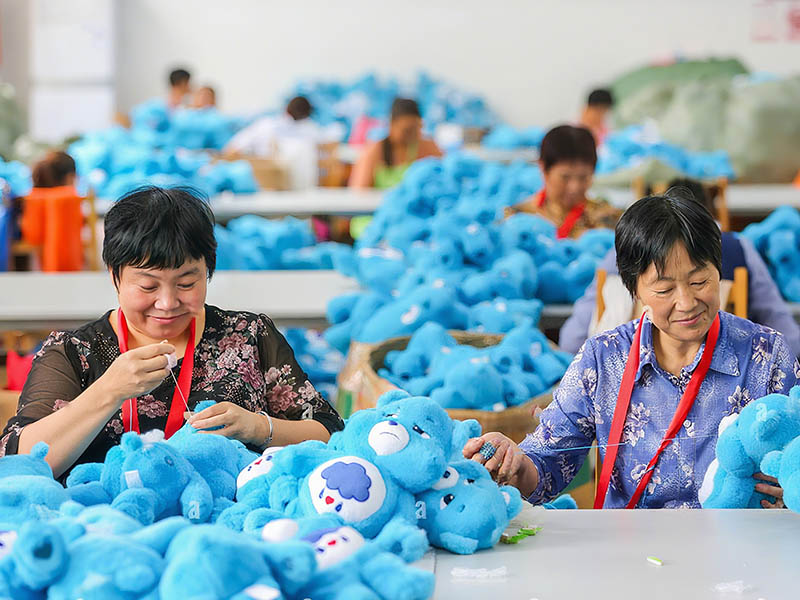
Every large plush brand started with a small order. KINWIN makes that first order as good as any that follows.
✓ 500-piece MOQ with no compromise on quality, service, or compliance
✓ Same senior pattern makers, same 100% QC inspection, same safety certification as large-volume orders
✓ Full OEM character development from any design input at 500 pieces
✓ ODM library for faster, lower-cost 500-piece private label programs
✓ 7-day standard sampling after design alignment approval
✓ Unlimited free revisions — small-order brands are not pressured to approve substandard samples
✓ CE, EN71, ASTM F963 full certification — compliant for all major markets from the first order
✓ Private label: custom woven label, hang tag, packaging — your brand on every unit
✓ Golden sample and production documentation retained indefinitely — reorders are consistent and fast
✓ NDA from first contact — IP protection from day one
✓ No KINWIN branding on any element the customer sees
✓ Factory visits welcome — transparency regardless of order size
Frequently Asked Questions — Small Order Plush Toys
Frequently Asked Questions — Small Order Plush Toys
Q1. Is 500 pieces truly the minimum, or are there hidden conditions that push the real minimum higher?
Five hundred pieces per design is KINWIN’s genuine minimum — there are no hidden conditions that routinely push it higher. The 500-piece minimum applies equally to simple ODM programs and complex multi-accessory OEM characters. The only scenario where the effective minimum may differ is if your design requires a specific fabric that has a supplier minimum purchase exceeding what 500 pieces would normally use — in which case KINWIN will advise upfront and propose alternatives (a different fabric with standard minimums, or a slightly higher quantity to meet the supplier minimum). This is an edge case for unusual material specifications, not a standard condition. If you submit a brief and KINWIN cannot fulfill it at 500 pieces for any reason, we will tell you immediately and explain why — not discover the issue after you have committed.
Q2. How much more expensive per unit is a 500-piece order compared to larger quantities?
At 500 pieces, unit cost is typically 25-40% higher than at 5,000 pieces for the same design. The premium varies by product: simpler designs with fewer components are closer to 25%; complex designs with multiple accessories or special materials are closer to 40%. The premium is driven by setup cost amortization (pattern making, machine setup, material minimums) spread across fewer units — not by KINWIN charging more per unit for small orders as a policy. To put this in context: if a 5,000-piece design costs $8.00/unit, the same design at 500 pieces typically costs $10.00-$11.20/unit. At a $30 retail price, both represent healthy margins. The relevant question is not ‘how much cheaper would 5,000 pieces be’ but ‘does the business case support 5,000 pieces before market validation’ — and for most new brands, the answer is no.
Q3. Can I order a sample before committing to a 500-piece production run?
Yes — KINWIN’s development process produces a physical prototype sample (golden sample) before production is committed. You review and approve the physical sample before authorizing the production order. The sampling process involves a sampling fee that covers the cost of development, material sourcing, and prototype production — this fee is typically deductible from the subsequent production order. You are never required to place a production order if the sample does not meet your expectations — though KINWIN’s unlimited revision policy means the sample is refined until you approve it. The sampling stage is exactly the right place to confirm the product meets your vision before committing to production. For ODM programs (existing character with your branding), the sampling stage is faster and less expensive than full OEM character development sampling.
Q4. If my 500-piece first order sells well, how quickly can I reorder?
Reorder lead time for an existing approved design at KINWIN is 8-10 weeks from deposit receipt to delivery — significantly faster than the 14-16 weeks for a first OEM order, because there is no development phase. The golden sample, pattern files, tech pack, and material specifications are all on file and production begins almost immediately after deposit is received and materials are confirmed. To avoid stockouts: monitor your weekly sell-through rate and set a reorder trigger at 60-70% sold — if you are selling 50 units per week and have 300 units remaining, you have approximately 6 weeks of stock left, and a reorder placed now will arrive in 8-10 weeks, meaning a brief stockout is possible. For brands with strong early sell-through, KINWIN advises placing the reorder when 50% sold to build in a safety buffer. Communicate your reorder intentions to KINWIN early — even a non-binding heads-up about likely timing allows us to plan production scheduling.
Q5. Do I need a registered business to place a 500-piece order with KINWIN?
No — KINWIN works with individual creators, sole traders, and unregistered small businesses as well as incorporated companies. What matters is that the party placing the order can receive the goods, make payments, and take legal responsibility for the product in their market. For compliance purposes, the EU Declaration of Conformity and CPSC Children’s Product Certificate require a named responsible party with an address in the relevant market — this can be an individual’s trading name and address rather than a corporate entity in most cases. If you are an individual creator with no registered business, KINWIN will advise on how to correctly format compliance documentation for your situation. For brands planning to sell through retail chains or Amazon, you will eventually need a business entity for platform registration — but this does not need to be in place before placing your first manufacturing order with KINWIN.
If You Can lmagine lt,We Will Create lt!
1.Tell Us What You Need
Tell us as specific as possible of your needs and share your idea.
2.Get Solution & Quote
We will work on the best solution according to yourrequirements,the specific quote will be provided within 24 hours.
3.Approve for Mass Production
We will start mass production after getting your approval.