
Plush Toys with LED Lights — Custom Illuminated Plush Design and Manufacturing
Plush Toys with LED Lights — Custom Illuminated Plush Design and Manufacturing
Single-Color LED · RGB Color-Changing · Pulsing & Breathing Modes · Touch Activation · IEC 62115 · CE/ASTM · MOQ 500 pcs
LED-integrated plush toys occupy a commercially distinct position in the soft toy market — they are both comfort objects and light sources, both tactile products and visual spectacles. A plush toy that glows, pulses, or shifts through colors in response to touch or automatically creates a product experience that a standard plush cannot replicate: it works in the dark, it creates atmosphere, and it provides a multisensory experience that photographs and videos dramatically.
KINWIN manufactures custom LED plush toys as an in-house capability — from single-color glow plush to RGB color-changing characters with multiple light modes. LED integration requires engineering expertise beyond standard plush manufacturing: the electronic module must be correctly specified, safely enclosed, battery-accessible, and tested to IEC 62115 electronic toy safety standards alongside standard EN71 and ASTM requirements.
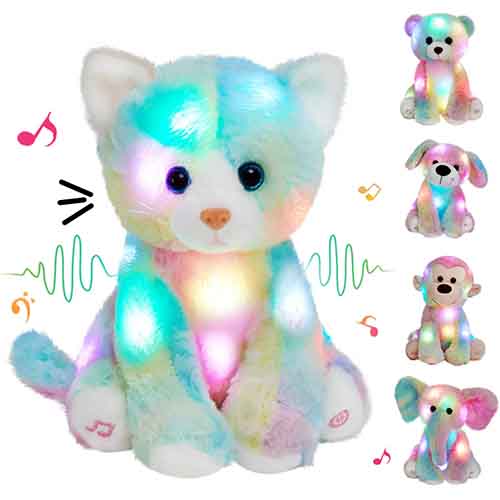
LED Plush Formats — What Different Light Effects Achieve
7 LED Formats — Visual Effect, Application and Technical Complexity
Not all LED plush is the same — different LED configurations produce fundamentally different visual effects and serve different commercial purposes. Choosing the right LED format is a product design decision with direct commercial and emotional impact.
Single-Color Static Glow
Visual effect: Constant soft glow in one color — warm white, cool white, or character color
Best for: Night light plush, sleep companion, ambient comfort
Complexity: Low — simple LED array, basic switch
Single-Color Pulse / Breathing
Visual effect: Gentle pulsing fade in and out — simulates breathing rhythm
Best for: Sleep support, calming plush, therapeutic formats
Complexity: Low-Medium — controller with breathing pattern
Dual-Color Toggle
Visual effect: Two colors selectable by user — e.g. warm white and blue
Best for: Mood-adaptive night light plush
Complexity: Medium — dual LED array with toggle
RGB Color-Changing (Auto-Cycle)
Visual effect: Automatic slow cycle through multiple colors
Best for: Display plush, novelty gift, event plush
Complexity: Medium — RGB LED with cycle controller
RGB Color-Changing (User-Selectable)
Visual effect: User selects from multiple colors via button
Best for: Premium gift plush, personalization-focused
Complexity: Medium-High — RGB with mode selection
Touch-Activated Color Response
Visual effect: Color changes or pulses in response to touch or squeeze
Best for: Interactive plush, children’s play, novelty
Complexity: High — pressure sensor or capacitive touch
Sound-Reactive LED
Visual effect: Light pulses in response to sound or music
Best for: Party / event plush, novelty
Complexity: High — microphone input with LED controller
Fabric Selection for Light Diffusion — The Design Foundation of LED Plush
5 Fabric Types and Their LED Light Transmission Properties
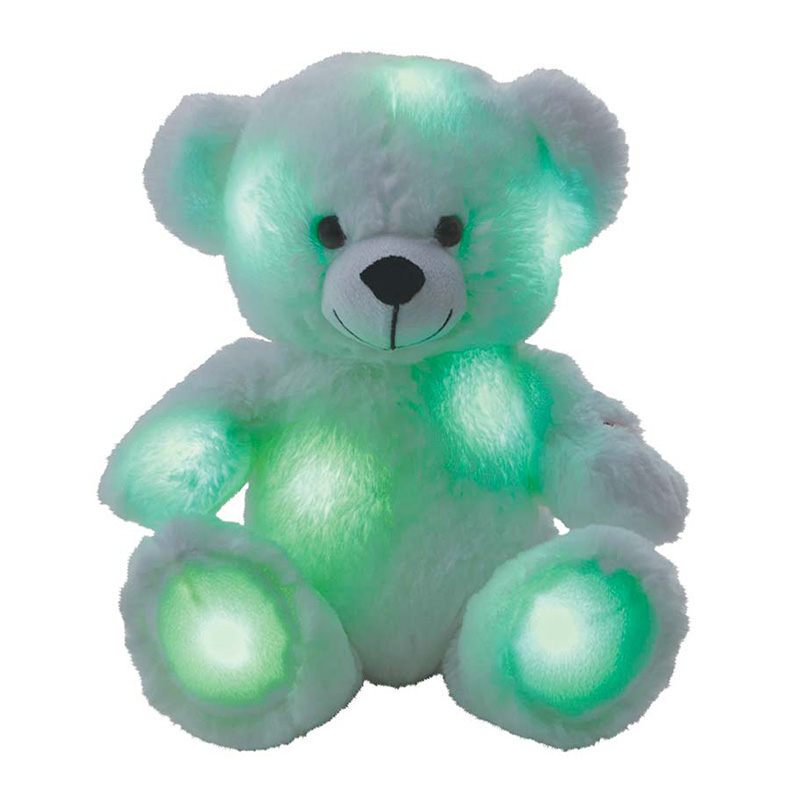
The fabric used in an LED plush toy must transmit and diffuse light in a way that looks intentional and beautiful rather than spotty or harsh. Different pile fabrics have very different light transmission properties.
KINWIN recommends short pile or Minky fabric for most LED plush applications. The even light diffusion of these fabrics produces the ‘whole toy glows softly’ effect that photographs beautifully and creates the most commercially appealing visual result. Long pile fabrics are generally avoided for LED integration because the pile absorbs and blocks light unevenly.
Short Pile Polyester (5-8mm)
Transmission: Good — even diffusion · Effect at night: Soft, even glow — the whole surface appears to light up
Best for: All-over glow effect; most LED plush applications
Minky / Crystal Super Soft
Transmission: Excellent — very even diffusion · Effect at night: Luxurious soft glow; slightly brighter than standard pile
Best for: Premium LED plush; sleep companion positioning
Medium Pile (10-15mm)
Transmission: Moderate — slight surface darkening at pile tips · Effect at night: Warm, textured glow with slight depth
Best for: Comfort and warmth aesthetic LED plush
Long Pile (20mm+)
Transmission: Poor — pile absorbs light, uneven surface · Effect at night: Patchy, uneven effect — not recommended
Best for: Avoid for LED integration
Translucent / Semi-Transparent
Transmission: Maximum — light passes directly through · Effect at night: High-intensity glow; LED locations visible
Best for: Specific novelty effects; not for standard plush LED
LED Placement and Battery Design — The Two Most Critical Engineering Decisions
LED Placement and Battery / Switch Design
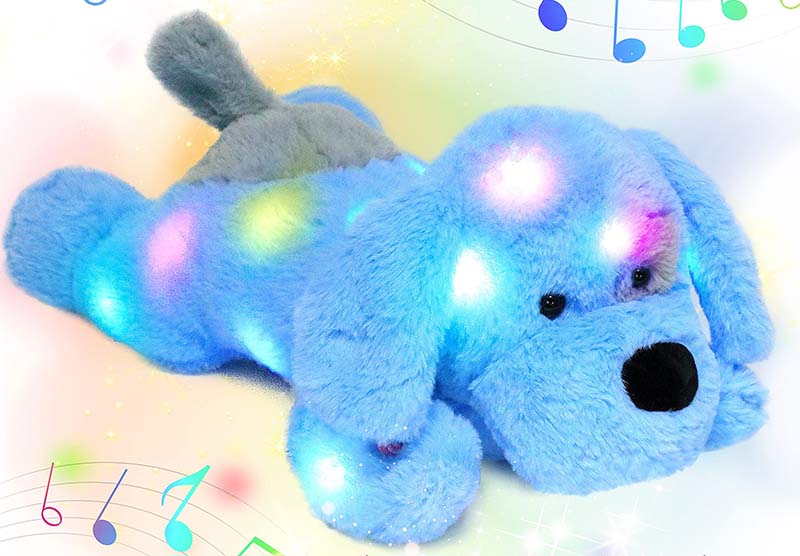
LED Placement and Character Design Integration
- Whole-body glow: LED module positioned centrally in the body cavity; no internal light-blocking panels; short pile fabric for even diffusion
- Eye glow effect: small LEDs positioned directly behind the face panel at eye position; light-directing fabric channels focus light to eye embroidery area
- Heart or belly glow: LED positioned behind a specific body area; surrounding areas may be partially light-blocked to concentrate effect
- Multi-zone glow: multiple LED sources at different body positions; each zone independently controllable in advanced configurations
- Avoid direct LED-to-fabric contact: LEDs pressed directly against pile fabric create hot spots and uneven distribution — spacing LEDs from fabric surface produces better diffusion
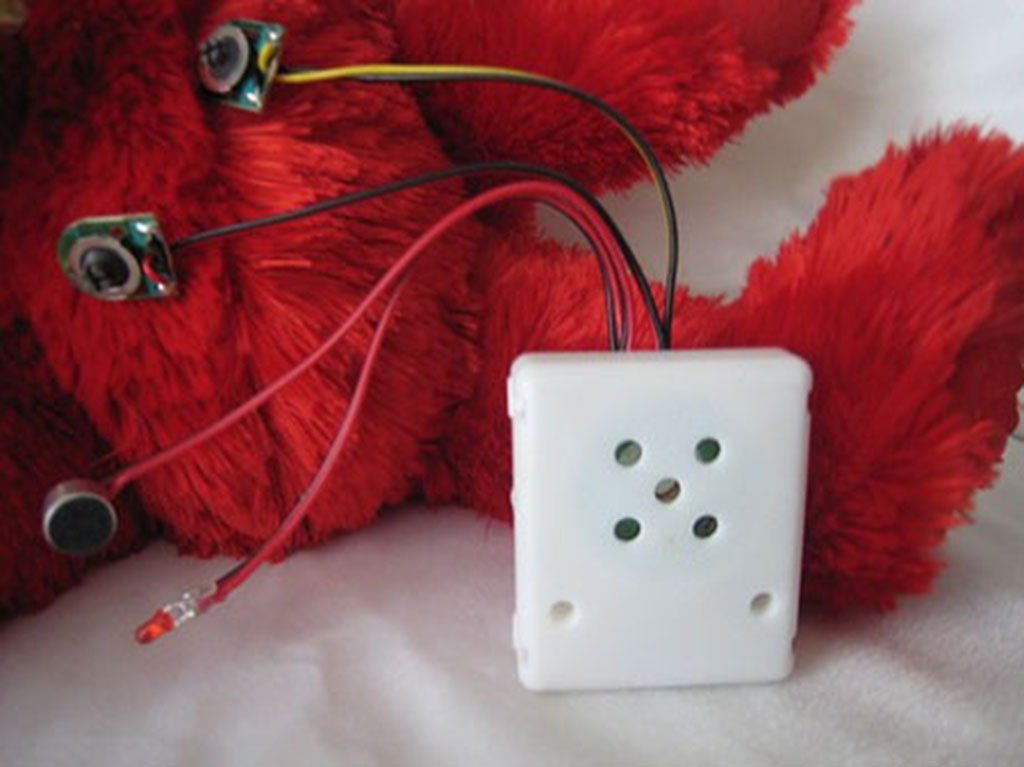
Battery and Switch Design — The Most Underspecified Element
- Battery access location: the most accessible and least intrusive position is typically the base of the toy or a side seam pocket — not the back center
- Screw vs snap closure: snap closure preferred for ease of use; screw closure provides better security for under-3 age grades where battery access must be controlled
- Battery type: standard AA or AAA preferred over button cells for non-age-restricted plush — widely available and easily replaced; button cell batteries require secure compartment for any product accessible to children under 3
- Switch position: ideally accessible without fumbling — side of body or base; not tucked under a limb or in an inconvenient position
- USB rechargeable option: for premium LED plush, built-in rechargeable battery with micro-USB or USB-C port eliminates battery replacement — adds cost and complexity but significantly improves user experience
Safety and Compliance for LED Plush Toys
IEC 62115 — Electric Toy Safety Standard — 6 Test Areas
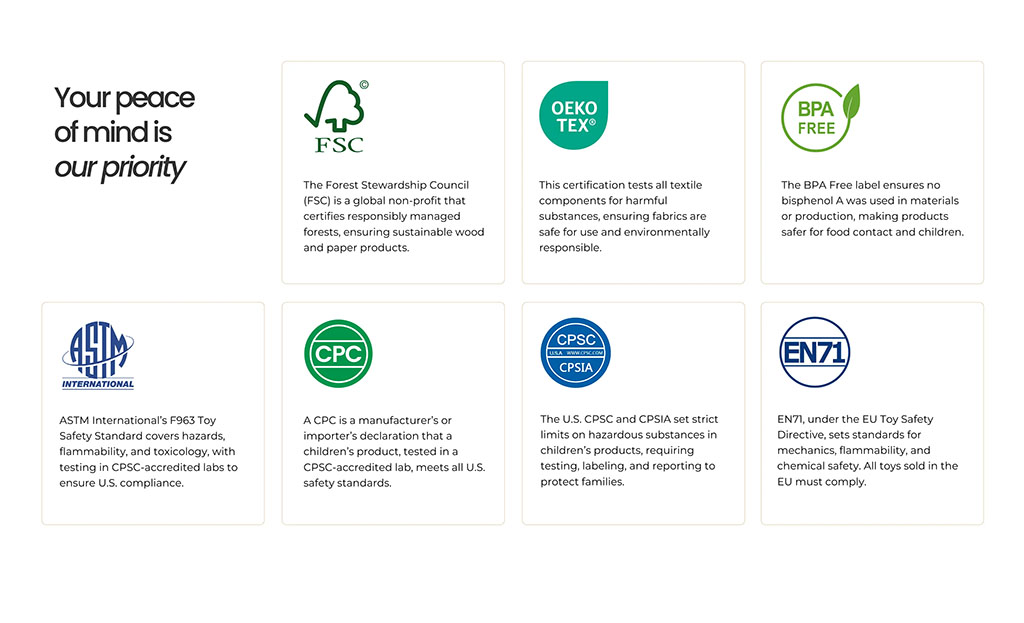
LED plush toys require additional safety testing and certification beyond standard plush toys — the electronic component triggers IEC 62115 compliance requirements in addition to EN71 and ASTM F963. IEC 62115 (European equivalent: EN 62115) is the international safety standard for electric toys — covering battery safety, thermal safety, acoustic safety, and electrical safety for all toys containing electronic components.
Battery Safety
Covers: Prevention of battery leakage, overheating, reversal
Plush relevance: Battery compartment design; protection against incorrect battery insertion
Thermal Limits
Covers: Surface and internal temperature limits during operation
Plush relevance: LED operating temperature; fabric not scorched by LED heat
Electrical Insulation
Covers: Prevention of accessible live parts; insulation integrity
Plush relevance: Wiring insulation within plush body; switch construction
Battery Compartment Security
Covers: Under-3 products require tool-secured battery compartments
Plush relevance: Screw-secured compartment for any LED plush accessible to under-3
Electromagnetic Compatibility
Covers: Radio frequency emissions within permissible limits
Plush relevance: Relevant for RGB controllers and rechargeable charging circuits
Acoustic Safety
Covers: Sound level limits if sound is also present
Plush relevance: Combined LED + sound plush require acoustic testing
Age Grading for LED Plush — The Most Important Compliance Decision
Age Grade Determination — 3 Levels and Their Design Requirements
The age grade of an LED plush toy is determined by its most restrictive component. KINWIN advises on correct age grading for each specific LED plush configuration during the design alignment phase — before any design decisions are finalized.
- Under-3 LED plush: technically achievable if battery compartment is adult-access-only (tool-secured) and LED module passes under-3 abuse testing without creating hazards — but requires careful design and is uncommon in practice
- 3+ LED plush: most LED plush programs — standard battery compartment with snap or screw closure; full IEC 62115 compliance; button cell batteries require tool-secured compartment
- 14+ LED plush: complex electronics, rechargeable batteries, or specific LED configurations may warrant 14+ classification — typically for display or collector formats
In practice, most brands developing LED plush for younger children choose a 3+ age grade rather than engineering the stricter under-3 compliance requirements. The design constraints for under-3 LED plush are significant and add cost — KINWIN advises on the commercial tradeoffs at the design alignment stage.
Compliance Documentation for LED Plush
- IEC 62115 / EN 62115 test report: from SGS, Intertek, or Bureau Veritas — required for all EU and most international markets
- CE Declaration of Conformity: covers both Toy Safety Directive (EN71) and Low Voltage Directive / Radio Equipment Directive as applicable
- EN71 Parts 1-3 test reports: mechanical, flammability, chemical — identical to standard plush
- ASTM F963 + CPSC CPC: for US market LED plush — electrical toy provisions apply
- Battery documentation: battery safety compliance documentation for rechargeable batteries where used
- REACH compliance: all non-textile components including electronic module housing assessed for restricted substances
Commercial Applications for LED Plush Toys
7 Applications — LED Format, Target Buyer and Key Design Requirement
Children's Night Light Plush
LED format: Warm white breathing / static glow
Buyer: Parents of young children (3+)
Key design req: Calm, non-stimulating light; auto-off timer preferred; safe battery access
Sleep Support / Calming Plush
LED format: Warm white or amber breathing mode
Buyer: Adults, children with sleep anxiety
Key design req: Breathing rhythm pace calibrated for relaxation; no blue light (disrupts sleep)
Premium Gift Plush
LED format: RGB color-changing, multi-mode
Buyer: Gift purchasers — birthday, Valentine’s, holiday
Key design req: Beautiful in-the-dark photography; impressive unboxing; USB rechargeable preferred
Character Merchandise
LED format: Character-color single glow or eye effect
Buyer: Fans of the character
Key design req: LED effect enhances character identity — glowing eyes, heart, or signature element
Event / Party Plush
LED format: Color-cycling or sound-reactive
Buyer: Event organizers, brand activations
Key design req: Visual impact in dim environments; memorable effect
Wellness / Therapeutic
LED format: Amber or warm white breathing pulse
Buyer: Adults, therapeutic use
Key design req: Breathing pace supports relaxation; no blue light
Display / Retail Feature
LED format: RGB multi-color
Buyer: Gift retailers, display units
Key design req: High visual impact for in-store display; impresses at point of sale
Why Brands Choose KINWIN for LED Plush Toys
Why Brands Choose KINWIN for LED Plush Toys
✓ In-house LED plush manufacturing: all electronic integration done in-house — no subcontracting of electronics to a separate facility
✓ Full LED format range: single-color static, breathing/pulsing, RGB color-changing, touch-activated, sound-reactive
✓ Fabric selection guidance for LED: KINWIN advises on the specification that produces the best light diffusion for each LED configuration
✓ LED placement engineering: internal module positioning optimized for even light distribution rather than relying on LED proximity to fabric
✓ Battery compartment design for age grade compliance: screw-secured for under-3 accessible products; snap-closure for 3+; USB rechargeable for premium
✓ IEC 62115 / EN 62115 full compliance: electronic toy safety testing coordinated through SGS, Intertek, or Bureau Veritas
✓ CE Declaration covering both Toy Safety and Low Voltage Directive requirements
✓ ASTM F963 + CPSC CPC for US market LED plush — electrical toy provisions included
✓ Age grade determination at design alignment stage — no compliance surprises after production
✓ 7-day standard sampling for LED plush after design alignment approval
✓ MOQ 500 pieces — LED plush accessible for brands at launch scale
A plush toy that glows tells a story that darkness cannot interrupt. KINWIN engineers the light that makes it happen.
Frequently Asked Questions — Plush Toys with LED Lights
Frequently Asked Questions — Plush Toys with LED Lights
Q1. What is the most common LED configuration in custom plush toys and why?
The most commercially successful LED plush configuration at KINWIN is warm white LED with a breathing / pulsing mode — a gentle pulsing glow that fades in and out approximately every 4-6 seconds. This configuration works across the widest range of commercial applications: it functions as a night light, supports sleep (the breathing rhythm is inherently calming), photographs and videos beautifully in dark environments, and appeals to both children and adults. It is also the simplest and most reliable electronic configuration, which means fewer points of potential failure and the most competitive unit cost of any LED format. RGB color-changing configurations are the second most popular — they produce more dramatic visual impact and photography performance, which makes them particularly effective for gift positioning and social media marketing. The choice between warm white breathing and RGB color-changing typically comes down to the product’s primary use context: sleep and comfort applications lean toward warm white breathing; gift and display applications lean toward RGB.
Q2. Is it possible to make LED plush toys safe for children under 3?
LED plush toys for children under 3 are technically possible but require specific design choices that most standard LED plush do not have. The primary challenge is battery security: button cell batteries — which are commonly used in simple LED modules — are a serious ingestion hazard and are not permitted in products accessible to children under 3 without a tool-secured compartment. For under-3 LED plush, KINWIN recommends: AA or AAA batteries in a tool-secured (coin-screw) compartment, not button cells; LED module and all wiring fully enclosed within the plush body with no accessible components; the complete LED assembly must pass under-3 abuse testing (bite test, pull test, torque test, drop test) without creating any hazard; full IEC 62115 and EN71 under-3 compliance testing. In practice, most brands developing LED plush for younger children choose a 3+ age grade rather than engineering the stricter under-3 compliance requirements — the design constraints for under-3 LED plush are significant and add cost. KINWIN advises on the compliance path for your specific target age grade at the design alignment stage.
Q3. How long do the LED lights last on battery power?
Battery life depends on the LED configuration, the number of LEDs, and the battery capacity. As general guidance for standard configurations: a warm white static glow with 3-5 LEDs on 3x AAA batteries typically runs 20-40 hours of continuous use; the same configuration with a breathing/pulsing mode runs somewhat longer because the LEDs are off for part of each cycle; an RGB color-changing configuration with 5-8 LEDs typically runs 8-20 hours depending on color and brightness. For products intended for overnight use (night light or sleep companion), KINWIN recommends an auto-off timer function — typically 15-30 minutes — so the LED turns off automatically after the child falls asleep, significantly extending battery life and preventing morning dead-battery surprises. USB rechargeable configurations provide more predictable performance: a fully charged internal battery typically provides 4-10 hours of use depending on LED configuration. KINWIN tests battery life for each specific LED configuration during development and can provide client-specific performance data.
Q4. Can the LED color match our brand's specific Pantone color?
Standard LED components are available in a range of fixed colors — warm white, cool white, red, green, blue, amber, pink, and combinations — but standard LEDs do not produce every Pantone color precisely. RGB LEDs can combine red, green, and blue channels to approximate most colors, but the resulting color in the final product depends on the fabric diffusion layer, the LED’s specific color output, and the viewing conditions. For brand color matching in LED plush, KINWIN’s approach is: identify the closest available LED color to your brand Pantone, produce a sample under the specific fabric, and assess the result against your brand color standard in person. In most cases, a visually satisfying approximation of a brand color is achievable — an exact Pantone match is not. KINWIN advises brands to prioritize the emotional quality of the light color (warm and calming, cool and energetic, vibrant and playful) over exact Pantone precision, because the LED light through fabric is always a color interpretation rather than a color reproduction.
Q5. Does adding LED lighting significantly increase the production timeline?
LED plush toys have a longer compliance testing timeline than standard plush because they require IEC 62115 / EN 62115 electronic toy safety testing in addition to standard EN71 / ASTM testing. IEC 62115 testing typically takes 14-21 working days at SGS, Intertek, or Bureau Veritas — compared to 10-14 days for standard EN71 testing. This adds approximately one week to the compliance testing phase. The production phase itself is not significantly longer for LED plush — the LED module installation adds a production step but is well within standard production timelines. Total first-order timeline for an LED plush OEM program is typically 15-18 weeks from design brief to delivery, compared to 13-16 weeks for a standard plush program. KINWIN runs compliance testing in parallel with production where possible to minimize the timeline impact. For brands planning LED plush programs with specific launch dates, the additional testing timeline should be factored into the production calendar from the outset.
If You Can lmagine lt,We Will Create lt!
1.Tell Us What You Need
Tell us as specific as possible of your needs and share your idea.
2.Get Solution & Quote
We will work on the best solution according to yourrequirements,the specific quote will be provided within 24 hours.
3.Approve for Mass Production
We will start mass production after getting your approval.