 Skip to content
Stuffed Animal QC Standards — Complete Reference Guide
Stuffed Animal QC Standards — Complete Reference Guide
Mechanical Tests · Chemical Standards · Workmanship Tolerances · Pull-Force Specs · Color ΔE Limits · Filling Density · EN71 / ASTM Reference
Quality control for stuffed animals is only as effective as the standards it measures against. Vague quality requirements — ‘the filling should feel right’, ‘the face should be symmetrical’, ‘the fabric color should match’ — produce inconsistent results because different people interpret them differently. Professional stuffed animal QC requires precise, quantified standards that leave no room for subjective interpretation.
This guide provides the complete QC standards reference that KINWIN applies to all stuffed animal production — covering mechanical performance, dimensional tolerances, workmanship standards, chemical compliance limits, and visual quality benchmarks. These standards are derived from EN71, ASTM F963, ISO 8124, and KINWIN’s own internal manufacturing specifications developed over 17+ years.
1. Mechanical Safety Standards — EN71 Part 1 / ASTM F963
1. Mechanical Safety Standards — EN71 Part 1 / ASTM F963
Mechanical safety standards define the physical hazards that stuffed animals must not present to children. These are the standards most directly related to child safety and have the most serious consequences for non-compliance.
Pull Force & Torque Standards
- Eyes & noses — toys for under 3 years: EN71 90N for 10 seconds / ASTM 66.7N / Torque 0.34 N·m
- Eyes & noses — toys for 3+ years: EN71 70N for 10 seconds / ASTM 44.5N / Torque 0.34 N·m
- Limbs & appendages: EN71 70N / ASTM 44.5N / Torque 0.34 N·m
- Clothing & accessories: EN71 35N / ASTM 33.4N / Torque 0.17 N·m
- KINWIN standard: 100% of units pull-tested — not statistical sampling
Seam Strength Standards
- Main body seams: ≥ 80N EN71 reference — KINWIN specification ≥ 100N
- Limb attachment seams: ≥ 70N EN71 — KINWIN ≥ 90N + bartack reinforcement
- Ear attachment: ≥ 70N EN71 — KINWIN ≥ 90N minimum
- Closing seam (hand-sewn): ≥ 50N — ladder stitch + lock-off
- Glass bead containment: ≥ 90N on all bead compartment seams — double-stitched + 100% tested
Sharp points & edges: zero tolerance after abuse testing (bite, pull, torque, drop). Wire armature in poseable toys requires 14+ age grade and appropriate warnings.
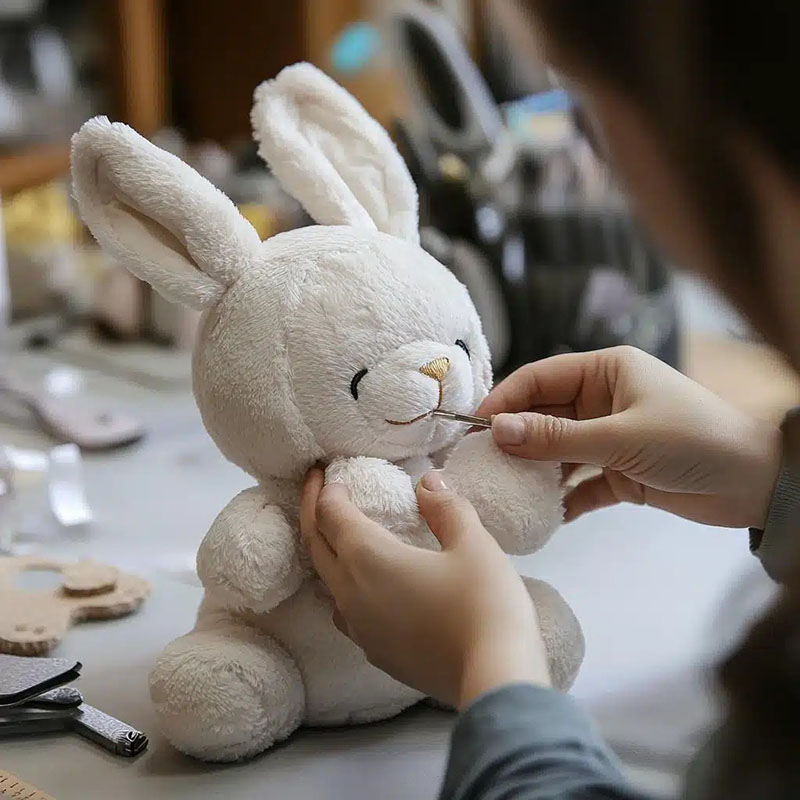
2. Workmanship Quality Standards — Dimensional Tolerances
2. Workmanship Quality Standards — Dimensional Tolerances
Workmanship standards define the acceptable limits of variation from the approved golden sample. These are the standards KINWIN’s inspectors use during 100% final inspection on every unit.
Dimensional Accuracy Standards
- Overall height: ±5% of specified height
- Head diameter: ±5mm maximum
- Body width: ±8mm at widest point
- Limb length: ±5mm root to tip
- Ear placement (L/R symmetry): ±3mm from centerline
- Eye placement — horizontal: ±1.5mm from face center
- Eye placement — vertical: ±1.5mm from nose centerline
- Nose placement: ±1.5mm from face center axis
- Embroidery logo position: ±2mm from spec reference point
Face Symmetry Standards
- Eye-to-eye horizontal alignment: commercial ±2mm → KINWIN ±1.5mm
- Eye-to-eye vertical alignment: commercial ±2mm → KINWIN ±1.5mm
- Eye placement from centerline: commercial ±2mm → KINWIN ±1.5mm
- Nose horizontal centering: commercial ±1.5mm → KINWIN ±1.0mm
- Mouth curve symmetry: visual match to approved sample + swatch reference
- Ear placement symmetry: commercial ±3mm → KINWIN ±2mm
KINWIN achieves face symmetry through physical placement templates produced from the approved golden sample — not by operator eye. The ±0.5mm absolute positioning accuracy comes from template use, not individual operator skill.
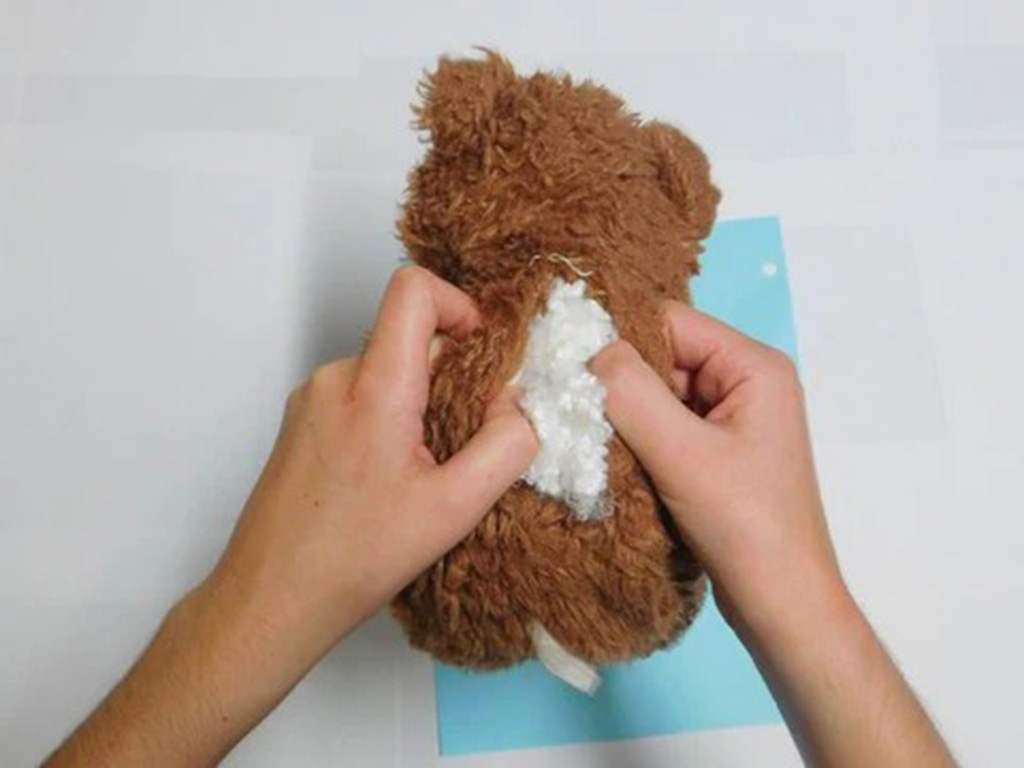
Filling Density & Workmanship Standards
Filling Density & Workmanship Standards
Filling should be specified as gram weight targets per body section — not vague descriptors like ‘soft’ or ‘medium’. KINWIN documents gram-weight targets for every body section in the tech pack and confirms fill feel against the approved golden sample at every production stage.
Filling Density Standards by Product Type
- Standard character plush: gram weight target per body section — acceptable variation ±10%
- Premium DTC character: gram weight target + golden sample feel verification — ±8% tolerance
- Weighted plush (glass beads): total bead weight + distribution per section — ±5% of total
- Plush pillows: PP cotton or memory foam to shape retention — golden sample visual match
- All formats: zero tolerance for visible lumps — uniform distribution required
Filling Gram Weight Reference Ranges (PP Cotton)
- 15 cm sitting character: 18–25g
- 25 cm sitting character: 40–55g
- 35 cm character: 75–100g
- 45 cm character: 120–160g
- These are starting points — confirm with physical sample evaluation
3. Stitching & Construction Workmanship Standards
3. Stitching & Construction Workmanship Standards
Construction workmanship standards define the acceptable quality of every sewn element in the stuffed animal. Each standard is linked to a defect classification — determining the consequence of non-compliance.
- Stitch density (machine sewing): 10–14 stitches per 25mm — below 8/25mm = Major defect
- Skipped stitches: zero tolerance in structural seams — any skipped stitch = Major defect
- Seam straightness: max 2mm deviation per 100mm — >3mm = Major defect
- Seam gap: zero visible gaps on main seams — any gap = Major or Critical defect
- Closing seam (ladder stitch): invisible from 30cm; secure with lock-off — visible stitches = Minor
- Thread ends: all trimmed to <3mm — >5mm thread end = Minor defect
- Puckering: no visible fabric puckering at seams — visible puckers = Minor/Major per severity
- Bartack reinforcement: required at all limb and ear attachment points — missing bartack = Major defect
4. Embroidery Quality Standards
4. Embroidery Quality Standards
Embroidery quality standards cover every aspect of face and logo embroidery — from stitch coverage and thread tension to placement accuracy and color matching.
- Stitch coverage: no base fabric visible through embroidery — visible gaps = Major defect
- Thread tension: no loops, no puckering, smooth surface — thread loops = Major defect
- Thread color accuracy: Pantone reference match — ΔE ≤ 2.5 vs thread swatch
- > ΔE 3.0 = Major defect
- Eye highlight dot: present and sized per approved sample — missing = Major defect
- Loose thread ends: all ends secured and trimmed — >3mm loose end = Minor defect
- Jump threads: no jump threads visible on face surface — visible jump = Minor defect
- Embroidery placement vs template: ±1.5mm from template reference points — >2mm = Major defect
- Logo embroidery legibility: all text and logo elements clearly readable — illegible text = Major defect
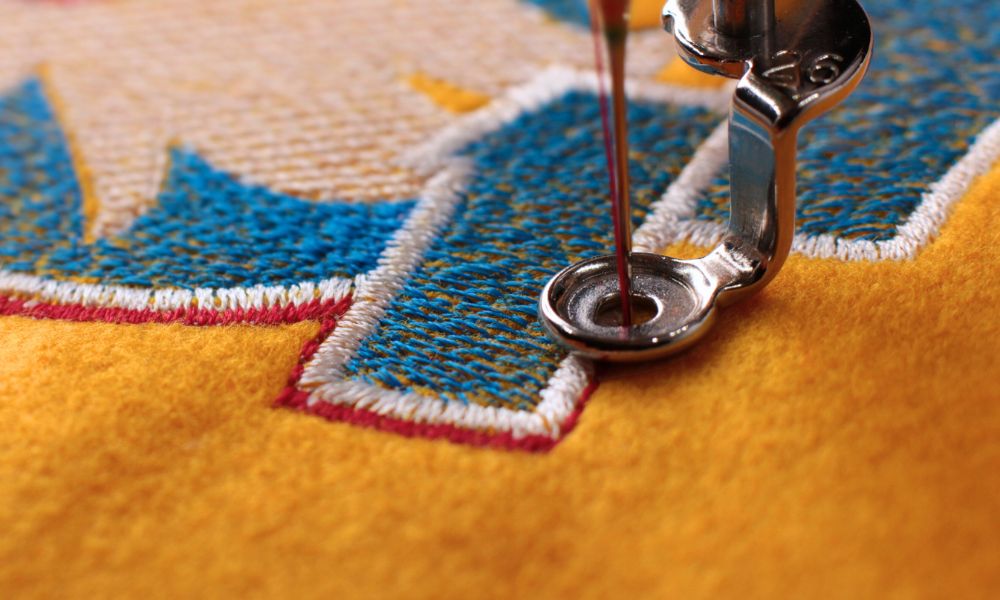
5. Color Quality Standards — ΔE Reference
5. Color Quality Standards — ΔE Reference
Color accuracy is assessed using the CIELAB ΔE formula under D65 daylight illuminant at 50cm viewing distance using physical reference swatches — not screen-based color comparison.
ΔE ≤ 2.0
Main Body Fabric
Fail at: ΔE > 3.0 = Major
vs Pantone TPX reference
ΔE ≤ 1.5
Face Panel Fabric
Fail at: ΔE > 2.5 = Major
Critical area — tighter standard
ΔE ≤ 2.5
Embroidery Thread
Fail at: ΔE > 3.5 = Major
vs approved thread swatch
ΔE ≤ 1.5
Batch-to-Batch
Fail at: ΔE > 2.0 = Major
vs previous approved batch
ΔE ≤ 2.5
Accessory Color
Fail at: ΔE > 4.0 = Minor/Major
per visibility of area
6. Chemical Compliance Standards
6. Chemical Compliance Standards
Chemical quality standards are non-negotiable safety requirements — not workmanship tolerances. Any product using materials that fail chemical compliance cannot legally be sold in regulated markets.
- pH value: EU textiles 4.0–8.5 / OEKO-TEX Class I 4.0–7.5
- Formaldehyde: EU children’s ≤30 mg/kg / OEKO-TEX Class I ≤20 mg/kg
- Lead (total): EU ≤160 mg/kg / US surface coating ≤90 ppm
- Cadmium: EU EN71-3 ≤75 mg/kg
- Chromium VI: REACH ≤0.5 mg/kg / OEKO-TEX not detectable
- Nickel (accessible metals): REACH ≤0.5 μg/cm²/week
- Phthalates (DEHP+DBP+BBP): REACH & CPSIA ≤0.1% / OEKO-TEX ≤0.05%
- Azo dyes (aromatic amines): EU REACH ≤30 mg/kg each amine / OEKO-TEX not detectable
- Allergenic dyes: OEKO-TEX listed as prohibited
KINWIN sourcing: OEKO-TEX certified suppliers only — eliminating chemical failure risk at source
7 & 8. Fabric Surface & Packaging / Labeling QC Standards
7 & 8. Fabric Surface & Packaging / Labeling QC Standards
Fabric Surface Quality Standards
- Visible stain: zero tolerance on visible areas — Critical/Major per size
- Pile matting: <5% of total surface area acceptable — ≥10% = Major defect
- Pile direction inconsistency: not visible at 50cm viewing distance — visible = Major
- Weaving defects (holes): zero tolerance — any hole = Critical defect
- Snags & pulled threads: >5mm in visible area not acceptable — Major defect
- Fabric thinning: zero tolerance in structural areas — any thinning = Major defect
Packaging & Labeling QC Standards
- Safety age warning label: present, correct language, correct age grade — missing/wrong = Critical
- CE / UKCA / ASTM mark: present per market requirement — missing = Critical defect
- Care instructions label: present and accurate — missing = Major defect
- Country of origin: present — ‘Made in China’ — missing = Major defect
- Brand label: present, correct position, correct artwork — missing = Major defect
- Barcode scanability: 100% scan success required — fail = Major defect
- FNSKU label (FBA): correct ASIN, scannable, correct placement — wrong/missing = Critical
How KINWIN’s QC Standards Compare to Industry Baseline
How KINWIN's QC Standards Compare to Industry Baseline
KINWIN’s internal QC specifications are set above the minimum regulatory requirements in every category — reflecting our commitment to producing products that not only comply but genuinely satisfy customers.
KINWIN Standard
- Eye pull force: 90N — KINWIN: 90N + 100% tested (not statistical sampling)
- Face symmetry: ±1.5mm with placement templates — not by operator eye
- Filling specification: gram-weight targets per body section
- Color standard: ΔE ≤ 2.0 vs Pantone TPX reference under D65
- Inspection method: 100% inspection on every unit
- Seam strength: ≥100N main seams (above EN71 ≥80N minimum)
- Chemical compliance: OEKO-TEX certified suppliers + 3rd party tested
Industry Common Practice
- Eye pull force: 90N per standard — often AQL-sampled only
- Face symmetry: ±2–3mm or visual match — subjective
- Filling specification: volume-based (‘soft/firm’) — not measurable
- Color standard: visual match (subjective) — no ΔE measurement
- Inspection method: AQL 2.5 sampling — accepts a statistical defect rate
- Seam strength: 80–90N — minimum compliance only
- Chemical compliance: supplier declaration — not independently verified
Quality standards only protect your brand when they are specific, documented, and consistently enforced — on every unit, in every batch.
How to Apply These Standards to Your Purchase Orders
How to Apply These Standards to Your Purchase Orders
Knowing the QC standards is only valuable if they are written into your purchase agreements and communicated clearly to your manufacturer before production begins.
- Reference the golden sample as primary quality benchmark — ‘Production units shall match the approved golden sample per the attached specifications’
- Specify AQL level: ‘Pre-shipment inspection shall be conducted per AQL 1.5 for major defects and AQL 0.65 for critical defects (ISO 2859-1)’
- Specify dimensional tolerances using the tables above — copy relevant rows into your PO spec sheet
- Specify color standards: ‘All fabric colors shall match approved Pantone TPX swatches within ΔE ≤ 2.0 under D65 illuminant’
- Specify pull force: ‘All eyes, noses, and attached components shall pass 90N pull force for 10 seconds per EN71-1 Section 8.4’
- Retain right to third-party inspection: ‘Buyer reserves the right to appoint a third-party inspection company to conduct pre-shipment inspection prior to balance payment’
KINWIN provides clients with a template quality specification document on request — contact our team to receive the full PO spec template.
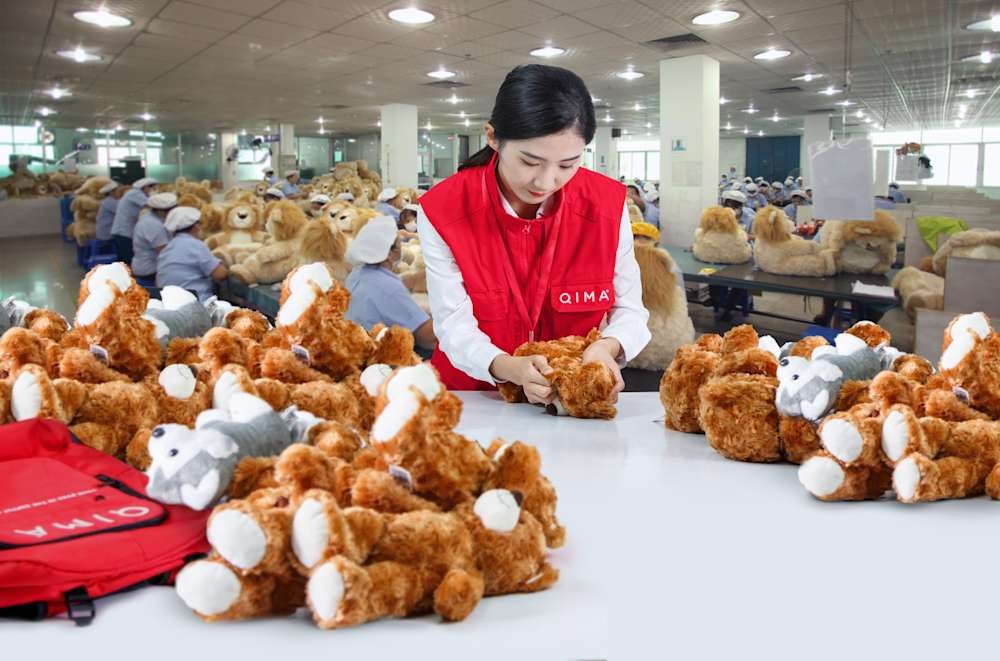
Why KINWIN’s QC Standards Protect Your Brand
Why KINWIN's QC Standards Protect Your Brand
✓ QC standards documented and available to clients before production begins
✓ Gram-weight filling specification for every body section — no vague descriptors
✓ Physical placement templates for face symmetry — ±1.5mm accuracy guaranteed
✓ ΔE ≤ 2.0 color standard measured against physical swatches under D65
✓ 100% pull force test on all eyes, noses, and attached components
✓ 100% final inspection on every unit — not AQL statistical sampling
✓ OEKO-TEX certified materials throughout — chemical compliance at source
✓ Third-party inspection welcomed at no additional charge
✓ Written QC inspection report provided with every shipment
✓ ISO 9001:2015 certified quality management system
Quality standards only protect your brand when they are specific, documented, and consistently enforced — on every unit, in every batch. KINWIN builds this discipline into every production program.
Frequently Asked Questions — Stuffed Animal QC Standards
Frequently Asked Questions — Stuffed Animal QC Standards
Q1. How do I write quality specifications into my purchase order with a plush toy manufacturer?
A professional purchase order quality specification should include: (1) reference to the approved golden sample as the primary quality benchmark; (2) dimensional tolerances for all key measurements (height, face placement, symmetry); (3) color standard using Pantone TPX references and ΔE limits under D65 illuminant; (4) pull force requirements for all attached components (90N for under-3 products per EN71); (5) AQL inspection level for pre-shipment inspection (AQL 1.5 for major defects recommended); (6) safety certification requirements (CE/EN71, ASTM F963/CPC as appropriate for target markets); (7) buyer’s right to third-party pre-shipment inspection. KINWIN provides clients with a template quality specification document on request.
Q2. What ΔE color difference is acceptable for a premium stuffed animal brand?
ΔE (Delta E) color difference thresholds depend on where the color is applied and how critical it is to brand identity: main body fabric colors — ΔE ≤ 2.0 is the premium standard (differences become noticeable above ΔE 2.0); face panel and critical character-defining colors — ΔE ≤ 1.5 recommended; embroidery thread colors — ΔE ≤ 2.5 typical; batch-to-batch consistency — ΔE ≤ 1.5 vs previous approved batch. All ΔE assessments should be made under D65 illuminant at 50cm viewing distance using physical reference swatches — not screen-based comparison.
Q3. What filling density should I specify — how many grams for a standard stuffed animal?
Filling density should be specified as gram weight per finished toy, not as a vague descriptor. Reference ranges for PP cotton: 15cm sitting character typically 18–25g; 25cm sitting character 40–55g; 35cm character 75–100g; 45cm character 120–160g. These are starting points — the exact target should be determined by producing a physical sample at the target fill and evaluating the feel against your intended product experience. Document the approved fill weight from the golden sample and specify it as the production target with ±10% tolerance.
Q4. How do I verify that a manufacturer is actually applying the QC standards they claim?
The most reliable verification methods in order of effectiveness: (1) Third-party pre-shipment inspection by SGS, Intertek, or Bureau Veritas — they physically measure and report against your specified standards independently; (2) Factory visit during production — observe the QC process, ask to see placement templates, verify weighing equipment is calibrated; (3) Request QC documentation — inspection checklists, defect logs, and corrective action records show whether quality is being systematically tracked; (4) Review the golden sample retention policy — manufacturers who retain and reference the physical golden sample throughout production have a stronger quality anchor; (5) Evaluate the inspection policy — manufacturers who apply AQL sampling (not 100% inspection) accept a defined defect rate.
Q5. Are EN71 and ASTM F963 quality standards or safety standards — what is the difference?
EN71 and ASTM F963 are safety standards — they define the minimum safety requirements for toys to protect children from physical, chemical, and electrical hazards. They are not workmanship or aesthetic quality standards. Passing EN71/ASTM F963 means a toy is safe; it does not mean the toy looks good, feels premium, or matches your design accurately. Quality standards — dimensional tolerances, color accuracy (ΔE), filling density, face symmetry, embroidery quality, seam workmanship — are commercially defined specifications that determine whether the product meets your brand’s quality expectations. A toy can pass all safety tests and still be commercially unacceptable due to poor workmanship. Professional plush toy programs require both: safety compliance documentation AND clearly specified workmanship quality standards.
If You Can lmagine lt,We Will Create lt!
1.Tell Us What You Need
Tell us as specific as possible of your needs and share your idea.
2.Get Solution & Quote
We will work on the best solution according to yourrequirements,the specific quote will be provided within 24 hours.
3.Approve for Mass Production
We will start mass production after getting your approval.
