
CE Certified Plush Toys — EU & UK Market Compliance Guide
CE Certified Plush Toys — EU & UK Market Compliance Guide
EN71 Parts 1-3 · CE Declaration · REACH · Technical File · UKCA · Amazon EU · Retail Ready · Full Documentation
CE marking is the legal passport for plush toys entering the European Union market. Without it, a plush toy cannot be sold in the EU — not in physical retail stores, not on Amazon EU marketplaces, not through any legitimate sales channel. CE marking is not a quality award or a voluntary certification: it is a legal requirement that carries personal liability for the responsible party if the product is non-compliant and causes harm.
KINWIN provides full CE certification for all plush toys manufactured for EU and UK market sale — including EN71 Parts 1, 2, and 3 testing through EU-accredited laboratories, REACH compliance documentation, EU Declaration of Conformity, CE mark application, and complete technical file compilation. Every EU-market plush toy order from KINWIN ships with a complete, legally valid CE certification package.
What CE Marking Actually Means
What CE Marking Actually Means
CE stands for Conformité Européenne — European Conformity. The CE mark is the manufacturer’s or importer’s declaration that the product meets all applicable EU directives and regulations. It is not issued by a third-party authority — it is self-declared by the responsible party based on supporting test evidence.
Who Is Legally Responsible
For plush toys manufactured in China and imported into the EU, the legal responsible party for CE compliance is typically the EU importer — the first party to place the goods on the EU market. This is the brand or company whose name and EU address appears on the Declaration of Conformity and product labeling. KINWIN (as the Chinese manufacturer) produces the products and provides all testing and documentation — but the legal responsibility for compliance rests with the EU importer.
Since January 2021, non-EU manufacturers must designate an EU Authorized Representative whose address appears on the product alongside the CE mark. KINWIN can advise on EU Authorized Representative services for brands who do not have an EU business entity.
The EU Toy Safety Directive — Applicable Standards for Plush Toys
The EU Toy Safety Directive 2009/48/EC — Applicable Standards
The EU Toy Safety Directive 2009/48/EC is the primary regulation governing toy safety in the European Union. It sets essential safety requirements across mechanical, physical, flammability, chemical, electrical, and hygiene properties for all toys placed on the EU market.
EN71 Part 1 — Mechanical & Physical
Tests: Small parts, sharp points & edges, pull force on attachments
Plush risk: Eyes, noses, accessories; seam integrity
EN71 Part 2 — Flammability
Tests: Surface flammability of pile fabrics; filling materials
Plush risk: Long pile fabrics; certain synthetic blends
EN71 Part 3 — Chemical Migration
Tests: Migration of 19 elements from accessible materials
Plush risk: Fabric dyes; plastic components; coatings
REACH Annex XVII
Tests: Restricted substances including azo dyes, phthalates
Plush risk: All fabric dyes and coatings
EN 62115 / IEC 62115
Tests: Electric toy safety (if applicable)
Plush risk: Sound modules, LED, electronic features
EN 71 Part 9 — Chemical Compounds
Tests: Organic chemical compounds in certain materials
Plush risk: Plastic accessories, fragrances
Age-Specific Requirements for Under-3 Products
For plush toys in the 0-3 age category: no small parts (even after foreseeable abuse testing), stricter chemical migration limits, stricter OEKO-TEX fabric requirements (Product Class I), no accessible cords longer than 220mm, and mandatory age warning labeling on the product and packaging.
The CE Certification Process for Plush Toys — Step by Step
The CE Certification Process — Every Step in the Correct Sequence
CE marking requires more than a test report — it requires a complete documentation package assembled in a specific structure.
Step 1
Product classification — confirm toy classification; identify applicable directives and standards
Responsible: KINWIN + Client · Output: Standards list
Step 2
Age grade determination — define target age group; identify additional requirements for under-3
Responsible: KINWIN advises · Output: Age grade + label requirements
Step 3
Risk assessment — identify all potential hazards; assess severity and likelihood
Responsible: KINWIN · Output: Risk assessment document
Step 4
Material pre-qualification — OEKO-TEX certified fabrics sourced; chemical risk eliminated
Responsible: KINWIN · Output: OEKO-TEX certificates
Step 5
Pre-production sample — representative sample produced for testing
Responsible: KINWIN · Output: Test-ready sample
Step 6
Laboratory testing — EN71 Parts 1, 2, 3; REACH; IEC 62115 (if electronic)
Responsible: SGS / Intertek / BV · Output: Test reports
Step 7
Technical file compilation — all design docs, test reports, risk assessment, labeling
Responsible: KINWIN + Client · Output: Technical file
Step 8
Declaration of Conformity — DoC drafted and signed by responsible party
Responsible: Client (EU importer) · Output: Signed DoC
Step 9
CE mark application — CE mark applied to product and/or packaging
Responsible: KINWIN · Output: CE-marked product
Step 10
Market surveillance readiness — technical file retained 10 years; available on request
Responsible: KINWIN + Client · Output: Compliant record-keeping

EN71 Part 1 — Mechanical and Physical Properties
EN71 Part 1 — Mechanical and Physical Properties
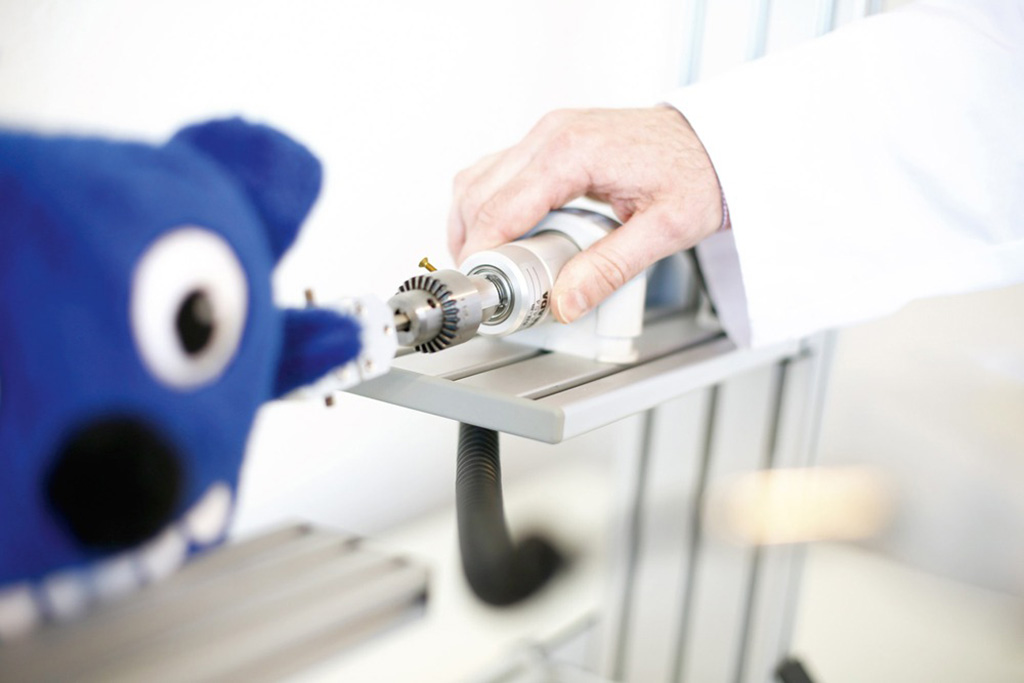
This is the safety engineering test — it simulates what a child can do to the toy through normal and foreseeable misuse, then checks for hazards created by that abuse.
- Small parts test: any component that detaches after abuse testing must not fit entirely within the small parts cylinder (31.7mm × 57.1mm)
- Sharp point test: no accessible sharp points after abuse testing — measured with calibrated sharp point tester
- Sharp edge test: no accessible sharp edges after abuse testing — measured with sharp edge tester
- Pull force test: eyes, noses, and all attachments must withstand 90N for 10 seconds (under-3) / 70N (3+)
- Torque test: attachments tested at 0.34 N·m for 10 seconds
- Abuse testing sequence: bite test, pull test, torque test, drop test — performed before final hazard assessment
EN71 Part 2 — Flammability
EN71 Part 2 — Flammability Testing
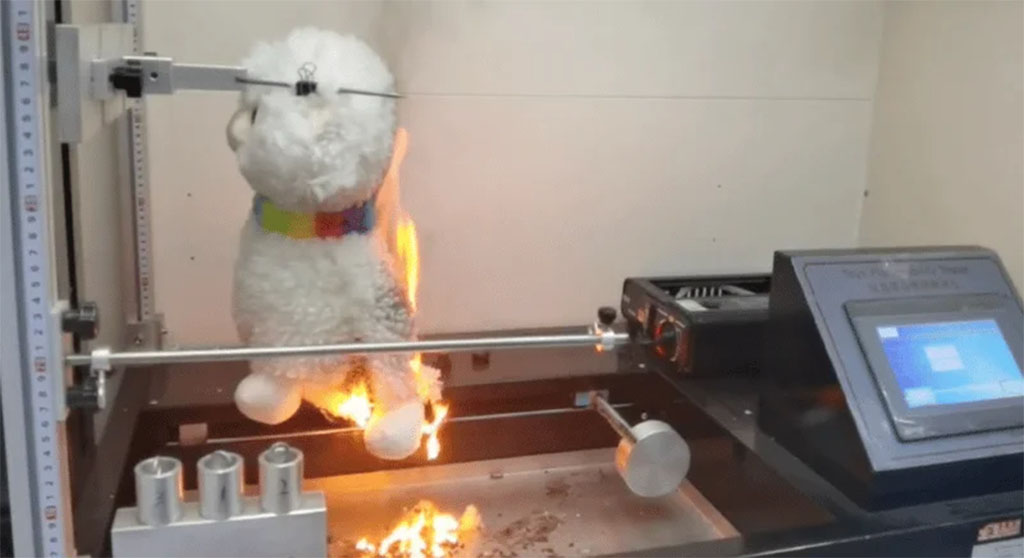
Flammability testing determines whether the plush toy’s fabric creates a fire hazard. The primary test for plush toys is surface flammability of the pile fabric — how quickly flame spreads across the pile surface after ignition.
- Not flammable: does not ignite or immediately self-extinguishes → Pass
- Slow burning: burns but below regulated spread rate → Pass
- Fast burning — superficial: flame spreads rapidly but only through pile surface → Fail
- Fast burning — structural: flame penetrates through fabric and filling → Fail
KINWIN pre-screens all long pile fabrics (15mm+) for flammability before confirming them for production — eliminating flammability failures before they reach the testing laboratory. Short pile polyester fabrics typically pass flammability testing without difficulty.
EN71 Part 3 — Migration of Certain Elements
EN71 Part 3 — Migration of Certain Elements
EN71 Part 3 tests whether hazardous chemical elements can be released from the toy’s accessible materials into acidic solution — simulating the conditions of a child mouthing the toy. Material samples are immersed in synthetic gastric fluid and measured by ICP-MS analysis.
- Antimony (Sb): 60 mg/kg — Polyester fiber catalyst residue
- Arsenic (As): 25 mg/kg — Mordant dyes
- Barium (Ba): 1,000 mg/kg — Pigment compounds
- Cadmium (Cd): 75 mg/kg — Bright yellow/orange dyes
- Chromium (Cr): 60 mg/kg — Chrome mordant dyes
- Lead (Pb): 160 mg/kg — Pigment dyes, coatings
- Mercury (Hg): 60 mg/kg — Biocide treatments
- Selenium (Se): 500 mg/kg — Pigment dyes
The CE Certification Documentation Package — What KINWIN Provides
The CE Certification Documentation Package — What KINWIN Provides
KINWIN’s CE certification package for each plush toy order is a complete, legally valid set of compliance documents — formatted for EU customs clearance, retail buyer submission, and Amazon EU Seller Central upload.
- EU Declaration of Conformity (DoC): product-specific, signed, dated, listing all applicable directives and standards
- EN71 Part 1 test report: mechanical and physical safety — from EU-accredited laboratory
- EN71 Part 2 test report: flammability — fabric and filling
- EN71 Part 3 test report: chemical element migration
- REACH compliance documentation: azo dye testing, phthalate declaration, SVHC screening
- OEKO-TEX Standard 100 fabric certificates: Product Class I for all fabrics
- EN 62115 test report: for all plush toys with electronic features
- CE mark artwork file: correct format CE mark for application to product labels and packaging
- Labeling compliance guide: mandatory label elements per EU Toy Safety Directive for your specific product
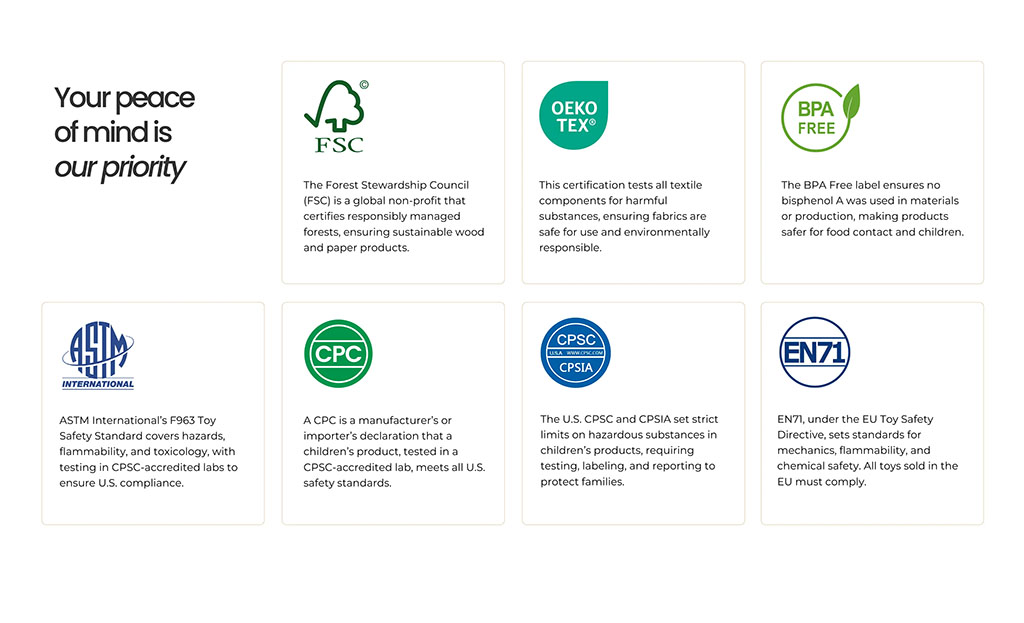
Mandatory Labeling Requirements for CE Marked Plush Toys
Mandatory Labeling Requirements — CE Marked Plush Toys
CE marking requires specific mandatory labeling on the product and/or packaging. Incorrect or missing labels are a compliance failure even if the product itself passes all safety tests.
CE Mark
Correct format; minimum 5mm height
Where: Product or packaging
Age Warning (under-3)
Warning symbol + text: ‘Not suitable for children under 36 months’
Where: Product AND packaging
Age Range (3+, 6+, etc.)
If applicable to specific age ranges
Where: Product or packaging
Manufacturer/Importer Name & Address
EU responsible party name and EU address
Where: Product or packaging
Country of Origin
‘Made in China’
Where: Product label or packaging
Toy Material Composition
Fabric and filling content (if textile toy)
Where: Packaging or hang tag
Care Instructions
Washing and care symbols
Where: Product label
Safety Warnings (if applicable)
Cord length warnings, weighted toy warnings
Where: Product and/or packaging
UKCA — The Post-Brexit UK Requirement
UKCA — The Post-Brexit UK Requirement vs CE
Since January 1, 2023, the UKCA mark is required for toys sold in Great Britain. UKCA requirements are technically equivalent to CE — EN71 Parts 1-3 testing using a UKAS-accredited laboratory — but the Declaration of Conformity, the authorized representative, and the mark itself are separate from CE.
Mark
CE (EU): CE mark
UKCA (GB): UKCA mark
Directive
CE (EU): EU Toy Safety Directive 2009/48/EC
UKCA (GB): UK Toy (Safety) Regulations 2011
Testing Standard
CE (EU): EN71 Parts 1-3 (EU notified body lab)
UKCA (GB): EN71 Parts 1-3 (UKAS accredited lab)
Declaration
CE (EU): EU Declaration of Conformity
UKCA (GB): UK Declaration of Conformity
Representative
CE (EU): EU Authorized Representative
UKCA (GB): UK Responsible Person
Markets
CE (EU): 27 EU member states + EEA
UKCA (GB): England, Scotland, Wales
Northern Ireland
CE (EU): CE mark accepted
UKCA (GB): CE mark accepted (Windsor Framework)
KINWIN provides both CE and UKCA certification for brands selling in both the EU and UK. The testing is largely overlapping and can often be conducted in parallel — minimizing additional cost and timeline impact for dual-market programs.
CE Certification for Amazon EU Marketplace Sellers
CE Certification for Amazon EU Marketplace Sellers
Amazon EU marketplaces (Amazon.de, Amazon.fr, Amazon.it, Amazon.es, Amazon.nl, Amazon.se, Amazon.pl) require toy listings to have valid CE certification documentation uploaded to Seller Central before the listing can be approved in the Toys & Games category. Non-compliance results in listing suppression and potentially account-level action.
- CE Declaration of Conformity: product-specific, signed, listing all applicable standards
- EN71 test reports: Parts 1, 2, and 3 — from an EU-recognized accredited laboratory
- All documents must be in the language of the marketplace (or at minimum English for review)
- Documents must be current — Amazon monitors expiry and may request updated documentation
- OEKO-TEX certificate: strongly recommended for plush toys in the children’s category
KINWIN provides all Amazon EU documentation in Seller Central-ready format — formatted for direct upload without modification. Product-specific documentation means one CE Declaration and one set of EN71 test reports per unique product design.
Most Common CE Compliance Failures for Plush Toys
Most Common CE Compliance Failures — And How KINWIN Prevents Them
Azo Dye Failure (EN71 Part 3 / REACH)
Fabric dyes containing banned aromatic amines — the most common chemical failure.
Prevention: OEKO-TEX certified fabric sourcing exclusively
Flammability Failure (EN71 Part 2)
Long pile fabric with high flame spread rate — particularly certain synthetic blends.
Prevention: Pre-screening of all long pile fabrics
Small Parts Failure (EN71 Part 1)
Eye or nose components that detach in pull/torque testing and fit the small parts cylinder.
Prevention: 90N pull test on 100% of units in production
Lead in Coatings (EN71 Part 3)
Printed labels or accessories with non-compliant paint or coating.
Prevention: OEKO-TEX fabric + certified accessory sourcing
Missing or Incorrect Mandatory Labeling
CE mark missing, wrong size, age warning absent, importer address missing.
Prevention: KINWIN’s labeling checklist verified on every order
Documentation Completeness Failures
Declaration of Conformity not signed, test reports expired, wrong product referenced.
Prevention: KINWIN’s document review before every order ships
Why Brands Choose KINWIN for CE Certified Plush Toys
Why Brands Choose KINWIN for CE Certified Plush Toys
✓ OEKO-TEX certified fabric sourcing eliminates the most common CE chemical failure before testing begins
✓ Flammability pre-screening on all long pile fabrics — prevents the second most common failure
✓ 100% pull force testing on all attached components in production — prevents small parts failures
✓ EN71 Parts 1, 2, 3 testing through SGS, Intertek, Bureau Veritas — globally recognized accredited laboratories
✓ CE Declaration of Conformity prepared and formatted correctly for EU market requirements
✓ UKCA certification alongside CE for brands selling in both EU and UK
✓ Amazon EU Seller Central-ready documentation format — upload without modification
✓ Technical file compilation and 10-year retention — meets EU documentation requirements
✓ Mandatory label compliance verified on every order before shipment
✓ 17+ years manufacturing for EU markets — experience with every CE compliance scenario

CE certification is not the finish line — it is the entry requirement. KINWIN ensures your plush toys meet it correctly, completely, and on time.
Frequently Asked Questions — CE Certified Plush Toys
Frequently Asked Questions — CE Certified Plush Toys
Q1. Does KINWIN's CE certification mean my product is automatically CE compliant?
KINWIN’s factory-level certifications (ISO 9001, BSCI, Disney FAMA) confirm our manufacturing systems meet professional standards — they are factory certifications, not product certifications. CE compliance is product-specific: your plush toy must be tested individually against EN71 Parts 1, 2, and 3, and a product-specific Declaration of Conformity must be prepared and signed by the EU-responsible party (typically you, as the importer). KINWIN coordinates all the testing, prepares all the documentation, and provides the complete package — but the Declaration of Conformity is signed under your name and EU address, because you are the legal responsible party for placing the product on the EU market.
Q2. Do I need separate CE certification for every product I sell in the EU?
Yes — CE certification is product-specific. Each unique product design requires its own set of EN71 test reports and Declaration of Conformity. However, there are efficiencies: for size variants using identical materials and construction (only scaled proportionally), a single test report may cover the full size range with testing conducted on the most critical size. For color variants of the same character using the same fabric and embroidery thread types from the same OEKO-TEX certified suppliers, a single chemical test report may cover multiple colorways. Design changes, material changes, or supplier changes typically require new testing. KINWIN advises on the most cost-efficient testing strategy for your specific product program.
Q3. How long does CE certification take and does it delay my production?
EN71 Parts 1-3 testing at an accredited laboratory typically takes 10-14 working days from sample submission to report issuance. For electronic plush toys requiring IEC 62115 testing, 14-21 days is typical. KINWIN minimizes the delay impact through parallel testing — submitting pre-production samples to the laboratory at the same time production preparation begins (material ordering, production scheduling). Since KINWIN sources exclusively OEKO-TEX certified fabrics, the risk of chemical compliance failure is very low, making parallel testing a reliable approach. For products using standard short-pile or medium-pile fabric, first-attempt pass rate at KINWIN is very high.
Q4. My product already has CE marking from a previous supplier — do I need to re-certify with KINWIN?
Yes — CE certification is specific to the product as manufactured by a specific manufacturer using specific materials. If you change your manufacturer (even for the same design), the new production uses different materials, different processes, and different quality systems. New EN71 testing is required to cover the materials and construction methods used by KINWIN. Additionally, the Declaration of Conformity references the specific manufacturer and materials — using a previous supplier’s CE documentation for goods manufactured by KINWIN is legally non-compliant and constitutes misrepresentation. KINWIN coordinates a new EN71 test program for every new manufacturing relationship — the cost and timeline are a one-time investment that covers your current order and all future reorders with KINWIN.
Q5. What happens if my CE certified plush toy is found to be non-compliant after it reaches the EU market?
Non-compliance discovered after market entry can have serious consequences: national market surveillance authorities can order product withdrawal from sale; online marketplaces (Amazon, etc.) can remove listings and suspend accounts; customs can seize goods at import for subsequent shipments; the EU responsible party (importer) faces potential civil liability and, in serious cases, criminal liability; and brand reputation damage from a compliance-related recall or withdrawal is significant and lasting. KINWIN’s approach to CE compliance is specifically designed to prevent post-market non-compliance: OEKO-TEX certified materials eliminate chemical risk, pre-screening eliminates flammability risk, and 100% production QC eliminates mechanical safety risk before any unit ships.
If You Can lmagine lt,We Will Create lt!
1.Tell Us What You Need
Tell us as specific as possible of your needs and share your idea.
2.Get Solution & Quote
We will work on the best solution according to yourrequirements,the specific quote will be provided within 24 hours.
3.Approve for Mass Production
We will start mass production after getting your approval.