 Skip to content
Plush Toy Quality Inspection — Complete Guide
Plush Toy Quality Inspection — Complete Guide
100% Unit Inspection · AQL Standards · Pre-Shipment Audit · Third-Party Inspection · Defect Classification · ISO 9001 Certified
Quality inspection in plush toy manufacturing is the system that stands between your brand and a batch of defective products reaching your customers. Done correctly, it is the most powerful brand protection mechanism in the supply chain. Done poorly — or outsourced entirely to trust in the manufacturer — it is an invisible risk that surfaces as returns, negative reviews, marketplace suspensions, and retail chargebacks.
This guide covers everything brands need to understand about plush toy quality inspection: the inspection types available, the defect classification system, what each inspection checks, how AQL sampling standards work, when third-party inspection makes sense, and exactly how KINWIN’s internal inspection system operates.
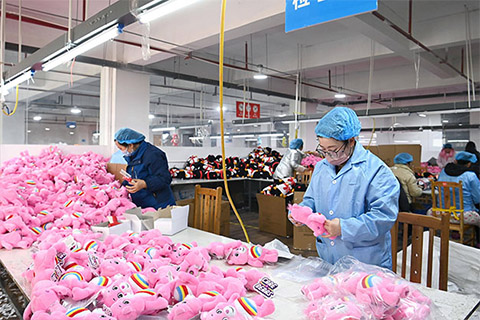
Types of Plush Toy Quality Inspection
Types of Plush Toy Quality Inspection
There are four primary inspection types in plush toy manufacturing. Each serves a different purpose and occurs at a different stage of the production process. KINWIN conducts all four as part of our standard production program.
Incoming Material Inspection
When: On fabric/material delivery
Purpose: Verify materials meet spec before production begins
Who: Factory QC team
During Production (DUPRO)
When: Production 30–40% complete
Purpose: Catch systemic defects early; correct before full run
Who: Factory QC team
Pre-Shipment Inspection (PSI)
When: Production 100% complete; before shipment
Purpose: Final conformity check vs golden sample
Who: Factory QC + optional 3rd party
Container Loading Inspection
When: During container loading
Purpose: Verify correct product loaded; carton integrity
Who: 3rd party or freight agent
Understanding AQL — Acceptance Quality Limit
Understanding AQL — Acceptance Quality Limit
AQL (Acceptance Quality Limit) is the international standard for statistical sampling inspection — ISO 2859-1. It defines the maximum acceptable defect rate for a production batch, and determines how many units to inspect from that batch to make a statistically valid quality assessment without inspecting every single unit.
AQL Levels for Plush Toys
- AQL 0.65 → Max 0.65% defective → Critical safety defects (sharp points, small parts, filling leakage)
- AQL 1.0 → Max 1.0% defective → Major functional defects (face asymmetry, filling issues)
- AQL 1.5 → Max 1.5% defective → Standard premium product inspection — KINWIN’s recommendation
- AQL 2.5 → Max 2.5% defective → Standard consumer product / mid-market
- AQL 4.0 → Max 4.0% defective → Non-critical products / lower tolerance
AQL Sample Sizes by Batch (AQL 1.5)
- 500 pieces → inspect 80 units → max 3 major defects allowed
- 1,000 pieces → inspect 125 units → max 5 major defects allowed
- 2,000 pieces → inspect 200 units → max 7 major defects allowed
- 5,000 pieces → inspect 315 units → max 10 major defects allowed
- 10,000 pieces → inspect 500 units → max 14 major defects allowed
Important: KINWIN’s internal production inspection does NOT rely on AQL sampling. We conduct 100% inspection on every unit. AQL sampling is the standard applied during third-party pre-shipment inspections — providing independent statistical verification of the finished batch.
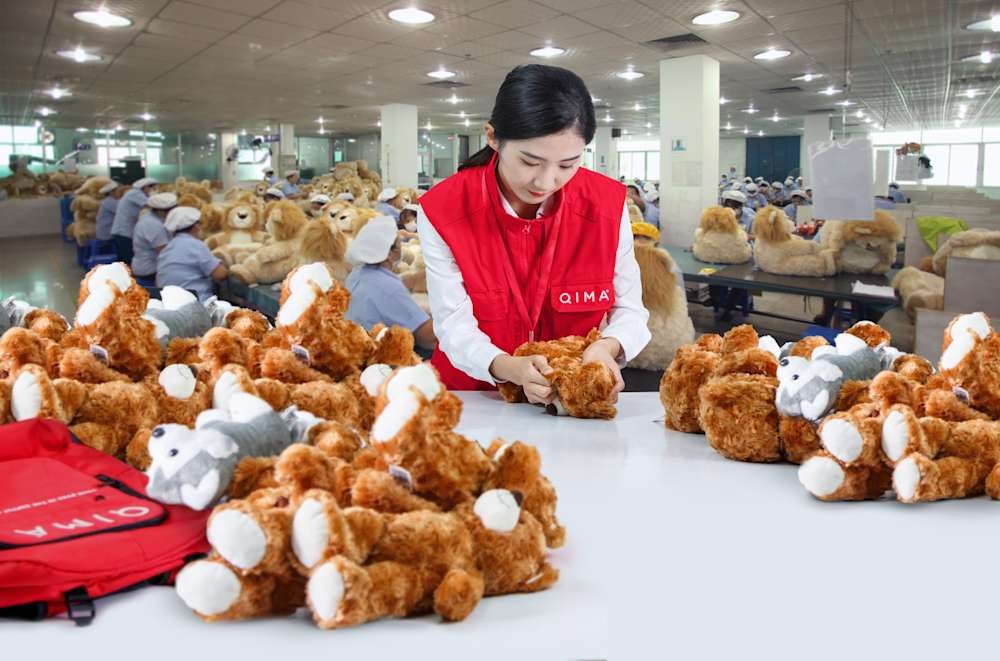
Plush Toy Defect Classification System
Plush Toy Defect Classification System
Not all defects are equal. The plush toy industry uses a three-tier defect classification system — Critical, Major, and Minor — each with different acceptance criteria and different consequences for the production batch.
Critical Defects
Zero Tolerance — Any unit rejected
- Detached or easily detachable small parts — choking hazard
- Sharp points or edges accessible after testing
- Exposed wire or rigid internal structure causing injury risk
- Filling material leakage — glass beads or toxic materials accessible
- Functional hazard in electronic toys — electrical exposure, battery leakage
- Chemical odor indicating non-compliant materials
- Incorrect or missing mandatory safety labels
Major Defects
AQL 1.5 — Cause likely returns if shipped
- Face asymmetry exceeding ±1.5mm from approved placement
- Wrong eye/nose/mouth thread color vs approved standard
- Embroidery coverage incomplete — significant stitch gaps
- Fabric color significantly different from Pantone reference (ΔE > 3.0)
- Seam opening — gap allowing filling to be seen or accessed
- Filling significantly under-specified — toy feels flat
- Fabric contamination (stain, oil, rust) larger than 5mm
- Sound module not functioning / LED not lighting
- Wrong product or wrong colorway in wrong packaging
Minor Defects
Acceptable with limits — Track for patterns
- Minor face placement deviation (< ±1.5mm)
- Small loose thread end (<5mm, trimmed in finishing)
- Minor fabric color variation within batch (ΔE 1.5–3.0)
- Small surface contamination (<3mm, removable)
- Slight pile direction inconsistency in non-prominent area
- Minor stitch tension variation in non-visible seam area
If a third-party inspection finds a major defect rate exceeding AQL 1.5, KINWIN initiates 100% sorting of the full batch — removing all defective units before re-inspection and shipment authorization.
KINWIN’s 5-Stage Internal Inspection System
KINWIN's 5-Stage Internal Inspection System
KINWIN’s internal quality inspection system is built around one principle: defects are caught at the point of creation, not discovered after the product is finished. This requires inspection at every production stage — not just at the end.
Stage 1: Incoming Material Inspection
Stage 1: Incoming Material Inspection
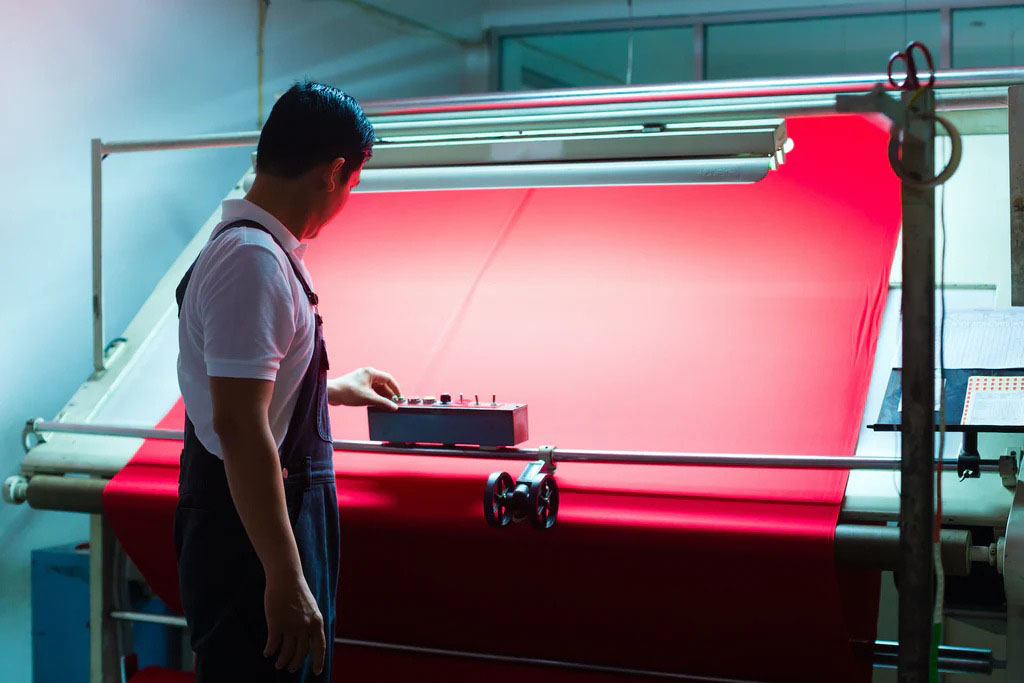
Every batch of fabric and materials arriving at KINWIN’s factory undergoes in-house quality inspection before approval for production. Any batch failing incoming inspection is quarantined and returned to supplier — it does not enter production.
- Fabric: color vs Pantone, pile height & density, surface defects, OEKO-TEX verification → Quarantine + return on failure
- PP Cotton: grade, cleanliness, fiber length, no contamination → Quarantine + return
- Glass Beads: size consistency, no sharp beads, certification → Quarantine + return
- Embroidery Thread: color vs reference, weight, no breakage → Replace with correct color
- Labels & Hangtags: text accuracy, barcode scan, safety warnings → Reprint if errors
- Electronic Components: function test, sound level, LED output → Replace defective units
Stage 2: In-Process Inspection by Production Station
Stage 2: In-Process Inspection by Production Station
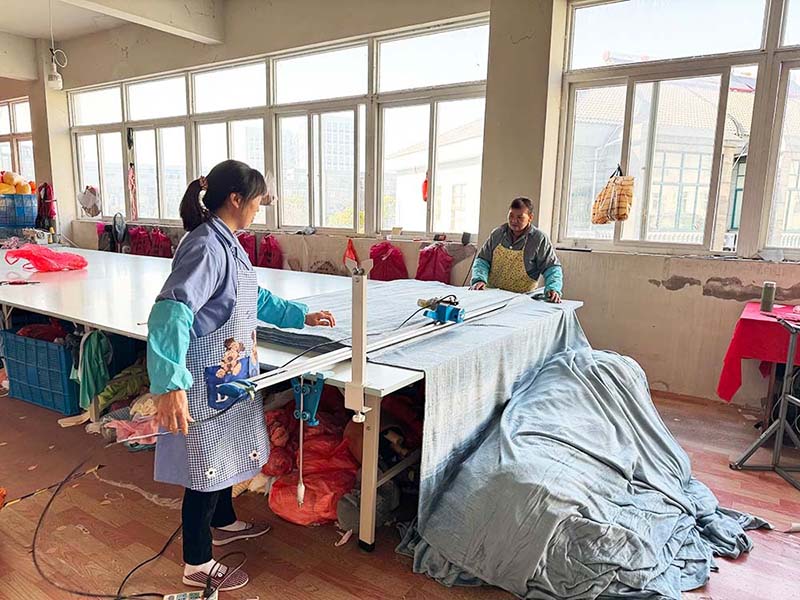
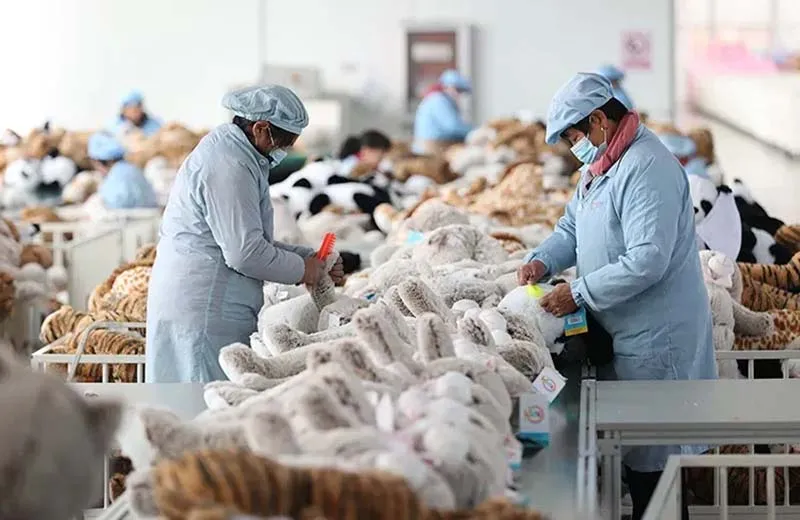
Quality inspection is performed at every production station — defects are caught at the point of creation. KINWIN’s in-process system means defective work is never built upon by subsequent production steps.
- Cutting: pile direction, piece dimensions, clean edges, no fabric defects — Every cut set
- Sewing: stitch density, seam straightness, correct seam allowance — Every 10th unit + random checks
- Stuffing: filling weight vs gram-weight target (spot-weighed), even distribution — Every 5th unit weighed
- Closing: seam strength, no visible gaps, ladder stitch quality — 100% visual
- Embroidery: symmetry, thread colors, stitch coverage, highlight dots — 100% visual
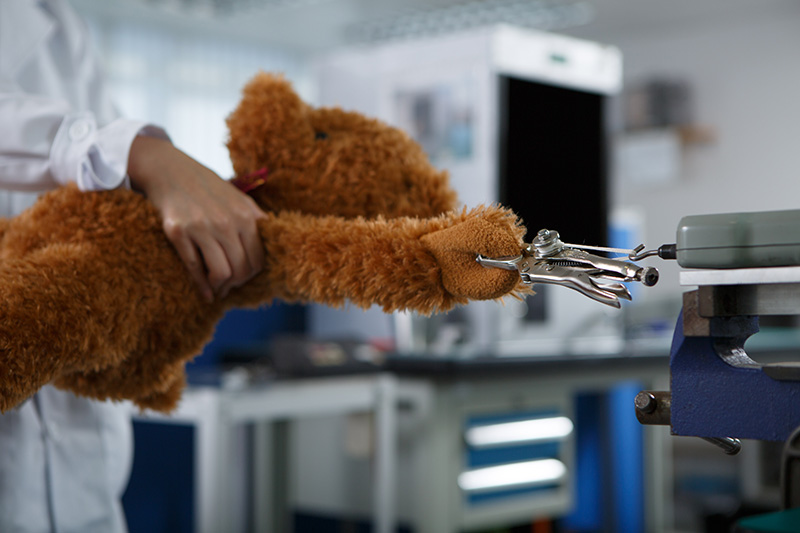
- Eye/Nose Attachment: pull-force test vs specification — 100% pull-tested
- Functional Modules: sound activation, LED function, volume level — 100% function test
Stage 3: Semi-Finished Product Inspection
Stage 3: Semi-Finished Product Inspection
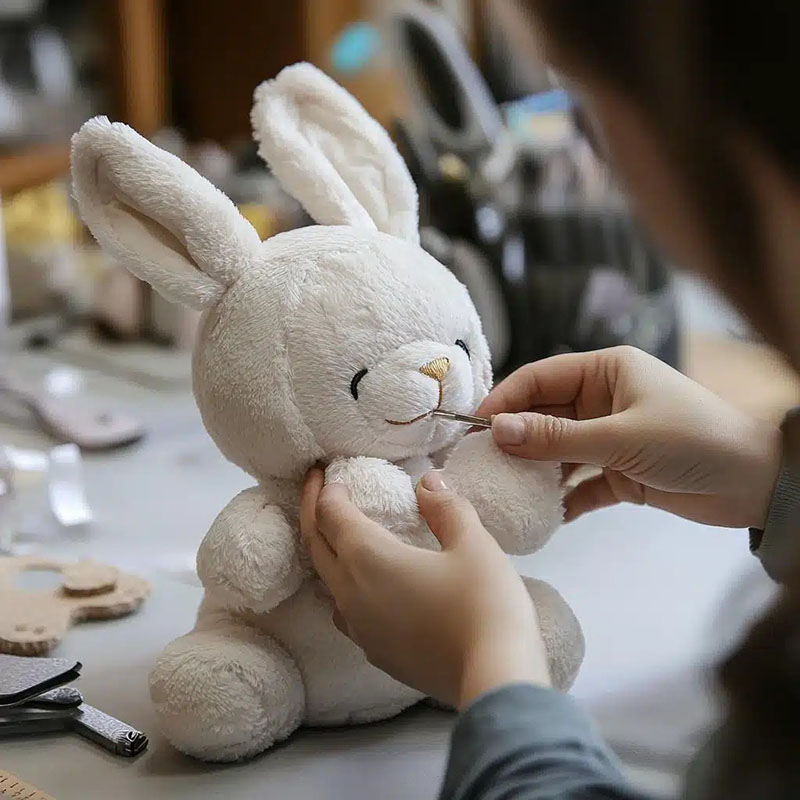
Before branding application (labels, hangtags), every unit undergoes a semi-finished product check comparing it against the golden sample. Units failing this check are reworked or rejected before branding is applied — preventing wasted branding material on defective products.
- Overall character shape and silhouette vs golden sample
- Face embroidery — symmetry, color, stitch coverage completeness
- Filling density — visual and tactile assessment vs golden sample
- Seam integrity across all seams
- Fabric surface condition — no stains, no matting
- For weighted toys: bead compartment integrity check
Stage 4: Final 100% Product Inspection
Stage 4: Final 100% Product Inspection
Every finished, fully labelled unit undergoes a comprehensive final inspection before being approved for packaging. Using a standardized checklist against the golden sample — every unit, no exceptions.
- Character shape: silhouette, proportion, 3D form vs golden sample
- Face accuracy: eye symmetry ±0.5mm, thread colors, expression
- Color accuracy: all fabric colors vs Pantone reference — ΔE ≤ 2.0
- Filling: density vs golden sample, even distribution, no lumps
- Seams: all seams closed, no gaps, no loose threads
- Safety elements: eye/nose pull test (90N force), no sharp points
- Labels: brand label, safety label, care label, age label — 100% present & correct
- Functional test: sound, LED, recording (if applicable) — 100% function
- Odor check: no chemical or abnormal odor
- Packaging: correct packaging, barcode scan valid
Stage 5: Pre-Shipment Audit
Stage 5: Pre-Shipment Audit
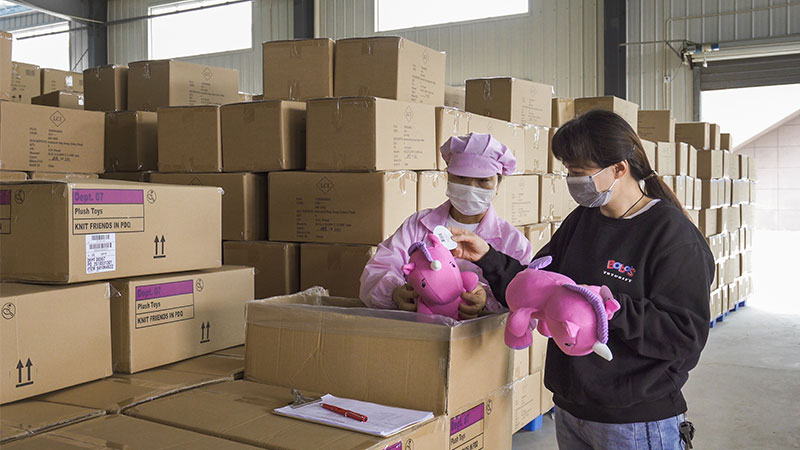
After 100% final inspection, a pre-shipment audit is conducted on randomly selected packed cartons — providing a secondary verification layer confirming that packed goods match specifications and packing was performed correctly.
- Random carton selection: 10% of cartons opened and inspected
- Units unpacked and compared against golden sample
- Packing list verification: unit count per carton, total carton count
- Carton labeling check: product code, quantity, dimensions, weight accuracy
- Compliance documentation completeness check
- FBA labeling verification (where applicable)
Third-Party Pre-Shipment Inspection — When and Why
Third-Party Pre-Shipment Inspection — When and Why
Third-party inspection provides independent verification of product quality — a check conducted by an inspection company with no financial interest in passing or failing the goods. KINWIN fully supports and welcomes third-party inspection at any stage of production.
When Third-Party Inspection Is Recommended
- First-time orders with a new manufacturer — verifying supplier claims before establishing trust
- High-value orders (above $30,000 USD) — inspection cost is small insurance relative to order value
- Retail compliance requirements — many retail buyers require third-party PSI reports
- Complex or high-specification products — electronic plush, weighted toys, licensed IP
- Previous quality issues — independent verification of improvement
- Large seasonal orders where a quality failure would be commercially catastrophic
How to Arrange Third-Party Inspection with KINWIN
- Appoint your preferred inspection company: SGS, Intertek, Bureau Veritas
- Notify KINWIN at least 5 working days before the planned inspection date
- KINWIN will have all goods ready, golden sample on-site, documentation prepared
- KINWIN does not charge additional fees for third-party inspection facilitation
- Inspection report shared with KINWIN — any failures addressed before shipment authorization
What Happens When Inspection Finds Defects
What Happens When Inspection Finds Defects
The response to inspection failures depends on the defect type, defect rate, and whether the inspection is internal or third-party. KINWIN’s protocol for handling each scenario:
Critical Defect Found
Any quantity — immediate action
- Production stops immediately at the relevant workstation
- Root cause identified and corrected
- All units produced since last confirmed-good unit are 100% inspected
- Critical defective units are scrapped — never repaired and reintroduced
- Production resumes only after root cause eliminated and fix verified
Major Defect Rate Exceeds AQL
Third-party inspection triggers full response
- KINWIN receives full inspection report with defect details
- Root cause analysis conducted — identify why defects occurred
- 100% sorting of full batch — all defective units removed
- Corrective action implemented to prevent recurrence
- Batch re-inspected before shipment authorized
- Rework and re-inspection costs borne by KINWIN for production-related defects
Minor Defect Rate Above Threshold
Process control investigation triggered
- High minor defect rates indicate process control issue
- Root cause investigated and process corrections implemented
- Corrective action documented
- Minor defects correctable at finishing stage addressed before packaging
- Non-correctable defects tracked for pattern analysis
Quality Inspection from the Client’s Perspective — Your Rights
Quality Inspection from the Client's Perspective — Your Rights
As a brand placing a manufacturing order, you have rights and options that many brands are not aware of. Understanding these empowers you to take appropriate quality protection measures for every order.
- You have the right to appoint a third-party inspector to inspect goods at the factory before shipment — at any time, with appropriate notice
- You have the right to request the production golden sample for review at any stage of production
- You have the right to factory visit with advance scheduling — quality transparency should not require a fight
- You have the right to receive a pre-shipment inspection report summarizing quality findings before authorizing payment of the balance
- You have the right to reject a shipment that fails agreed AQL quality standards before shipment — renegotiating is significantly harder after goods are shipped
- You have the right to know the specific quality criteria your products are being inspected against — ask to see the inspection checklist before production begins
Why KINWIN’s Inspection Standards Protect Your Brand
Why KINWIN's Inspection Standards Protect Your Brand
Quality inspection is not the last step — it is the system that runs through every step. At KINWIN, every unit earns its right to ship.
✓ 100% in-process inspection at every production station — defects caught at creation, not after completion
✓ 100% final inspection on every finished unit — not AQL sampling at the factory level
✓ Golden sample retained for entire production run and all reorders
✓ Standardized defect classification: Critical / Major / Minor with documented pass/fail criteria
✓ Third-party inspection welcomed and facilitated at no additional charge
✓ Pre-shipment audit with random carton sampling as secondary verification layer
✓ ISO 9001:2015 certified quality management system
✓ Written QC inspection report provided with every shipment
✓ Defect root cause analysis and corrective action documentation
✓ Disney FAMA factory audit passed — includes IP security and quality system verification
Quality inspection is not the last step — it is the system that runs through every step. At KINWIN, every unit earns its right to ship.
Frequently Asked Questions — Plush Toy Quality Inspection
Frequently Asked Questions — Plush Toy Quality Inspection
Q1. What is the difference between AQL inspection and 100% inspection?
AQL (Acceptance Quality Limit) inspection uses statistical sampling — a defined number of units are inspected from the batch based on batch size and AQL level, and the batch is accepted or rejected based on the defect count found in that sample. AQL inspection is time-efficient but accepts a statistical defect rate — meaning some defective units may ship within the acceptable AQL threshold. 100% inspection examines every single unit with no sampling. Every defective unit is individually identified and removed, eliminating the possibility of known defects being statistically accepted. KINWIN applies 100% inspection at our internal production stages. AQL sampling is then used by third-party inspection companies to independently verify the quality of the finished, inspected batch — providing a final statistical confirmation of batch quality after our 100% internal inspection.
Q2. Can I request a specific AQL level for my order's third-party inspection?
Yes. When arranging a third-party pre-shipment inspection, you specify the AQL level to be applied. KINWIN recommends: AQL 0.65 for critical defects (safety-related: small parts, sharp points, filling leakage) and AQL 1.5 for major defects (appearance and functional quality issues) for branded plush toy programs. Stricter AQL levels (0.4 or 0.65 for major defects) can be specified for high-value, IP-licensed, or premium products where quality standards are extremely high. The inspection company will confirm the sample size required based on your batch size and chosen AQL level before the inspection begins.
Q3. What happens if a third-party inspection finds my order failed?
If a third-party pre-shipment inspection results in a failure — meaning the defect count exceeds the agreed AQL limit — the standard resolution process is: (1) KINWIN receives the full inspection report with defect details; (2) root cause analysis is conducted; (3) KINWIN conducts 100% sorting of the full batch, removing all defective units; (4) corrective action is implemented to prevent recurrence; (5) the batch is re-inspected before shipment is authorized; (6) shipment only proceeds after re-inspection confirmation. The cost of reworking and re-inspection is borne by KINWIN when the defects are manufacturing-related. You should not authorize shipment payment until any inspection failure is resolved to your satisfaction.
Q4. How do I know what quality standard my plush toys will be produced to?
The quality standard is defined by the approved golden sample — the physical prototype you approved before production began. Every unit in the production run is measured against that golden sample in KINWIN’s internal inspection. The specific quality criteria (face symmetry tolerance of ±0.5mm, color accuracy ΔE ≤ 2.0, filling density match, seam integrity, etc.) are documented in KINWIN’s inspection checklist for your order. You can request to see this checklist before production begins — quality standards should never be a mystery. If you also engage a third-party inspection company, provide them with your golden sample and the agreed quality specifications so their inspection criteria align with yours.
Q5. Does KINWIN charge for facilitating third-party inspections at the factory?
No. KINWIN does not charge any additional fees for facilitating third-party pre-shipment inspections. We consider third-party inspection a legitimate part of a professional supply relationship — the inspector’s work is to verify that we have done what we committed to do, and we are confident enough in our quality standards to welcome that verification. To arrange a third-party inspection, simply notify KINWIN at least 5 working days before the planned inspection date, and let us know which inspection company you are using. We will have all goods ready, the golden sample available, and all documentation prepared for the inspector’s review. The only cost you bear is the inspection fee charged by your chosen inspection company.
If You Can lmagine lt,We Will Create lt!
1.Tell Us What You Need
Tell us as specific as possible of your needs and share your idea.
2.Get Solution & Quote
We will work on the best solution according to yourrequirements,the specific quote will be provided within 24 hours.
3.Approve for Mass Production
We will start mass production after getting your approval.
