
Plush Toy Quality Control
Plush Toy Quality Control
100% Unit Inspection · Golden Sample System · 6-Stage QC Process · ISO 9001 Certified · Third-Party Audit Ready · Zero-Defect Shipment Goal
Quality control in plush toy manufacturing is not a final step — it is a system that runs continuously from the moment raw materials arrive at the factory to the moment finished products leave for your warehouse. A single batch of defective toys generates consequences that cascade across your entire business: returns, negative reviews, marketplace listing suppression, retail chargebacks, and brand reputation damage that can take years to recover from.
KINWIN’s quality control system is designed around a single principle: defects are prevented through process, not caught through inspection alone. This guide explains every stage of KINWIN’s QC system — what is checked, how it is checked, who is responsible, and what happens when a defect is found.
The Golden Sample System — The Foundation of KINWIN’s QC
The Golden Sample System — The Foundation of KINWIN's QC
Every quality control system requires a reference standard — a physical benchmark against which all production is measured. At KINWIN, this is the golden sample: the final approved prototype that represents the exact quality standard every unit in the production run must match.
The golden sample is produced after all design revisions are complete and the client has given final approval. It is then used as the production benchmark throughout the entire run — not just at the beginning.
- Character proportions and three-dimensional shape
- Fabric type, pile length, color (Pantone reference)
- Filling density and distribution
- Face embroidery — symmetry, placement, thread colors
- Seam quality and stitch density
- Functional module performance (if applicable)
- Branding application — logo position, label placement
- Packaging specifications
The golden sample is retained by KINWIN throughout the production run and for all future reorders — ensuring that the 10th order looks identical to the 1st.

KINWIN’s 6-Stage Quality Control Process
KINWIN's 6-Stage Quality Control Process
Quality is built into every stage of production — not applied as a final check. Here is how KINWIN’s QC system operates across the full production lifecycle.
Stage 1: Incoming Material Inspection
Stage 1: Incoming Material Inspection
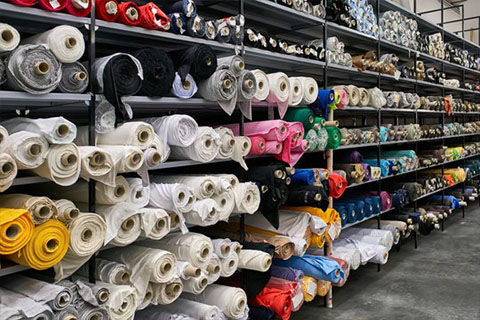
Every batch of raw materials — fabric, filling, thread, zippers, labels, packaging, electronic components — is inspected upon arrival before being approved for production use. Materials that fail incoming inspection are quarantined and returned to the supplier — they never enter production.
- Fabric: color vs Pantone reference, pile height, pile density, surface defects, OEKO-TEX verification
- PP Cotton: fiber grade, cleanliness, fiber length consistency, absence of contaminants
- Glass Beads: bead size consistency, no sharp or irregular beads, material certification
- Embroidery Thread: color vs Pantone reference, thread weight consistency, no knots or breakage
- Electronic Components: function test, battery compliance, sound level check
- Labels & Packaging: text accuracy, barcode scan test, color match, safety warnings correct
Stage 2: Pre-Production Pattern & Cutting Check
Stage 2: Pre-Production Pattern & Cutting Check
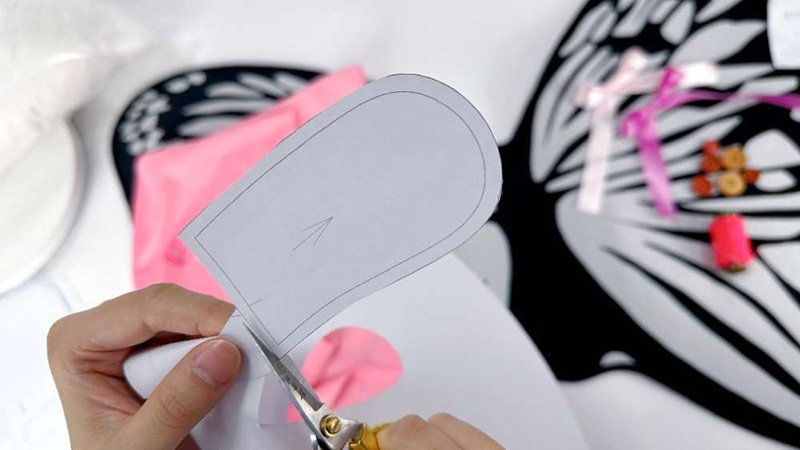
Before mass cutting begins, the production team conducts a pre-production alignment check against the golden sample and approved tech pack. This stage prevents the most costly defect type — a systematic error that affects every unit in the batch because the problem was introduced before production began.
- Pattern piece dimensions verified against tech pack specifications
- Fabric pile direction confirmed for all pattern pieces
- Color assignment to each pattern piece verified
- Embroidery placement templates confirmed against golden sample
- Filling weight targets confirmed per body section
- Production line briefing: QC standards communicated to all operators
Stage 3: In-Process Production QC
Stage 3: In-Process Production QC
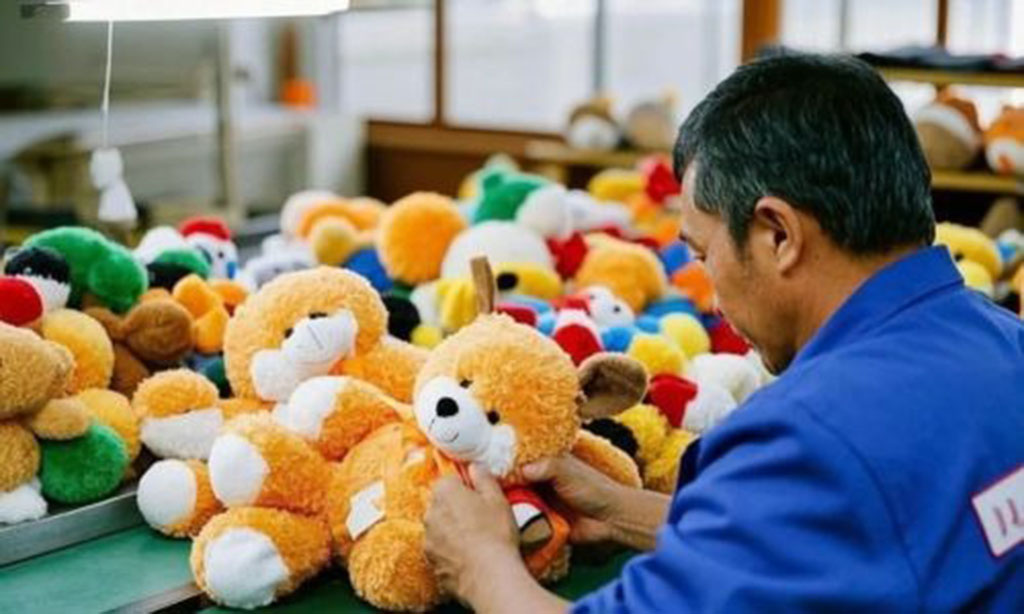
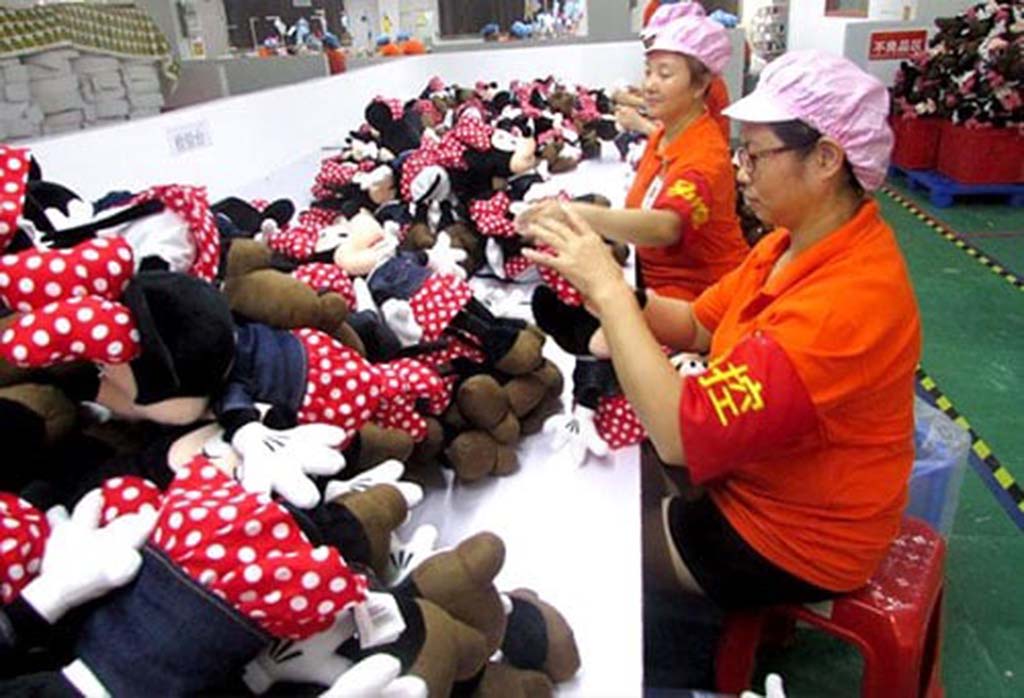
Quality inspection is performed continuously during production — not only at the end. KINWIN’s in-process QC system catches defects at the point of creation, before defective work is built upon by subsequent production steps. Any unit that fails is removed immediately, tagged, and tracked — allowing KINWIN to analyze defect patterns and address root causes during production.
- Cutting station: piece dimensions, pile direction, clean edges
- Sewing station: stitch density, seam straightness, correct seam allowance
- Stuffing station: filling weight per body section (spot-weighed), even distribution
- Closing station: seam strength, no visible gaps
- Embroidery station: face symmetry check, thread color match, stitch coverage
- Accessory attachment: pull-force spot checks on eyes, noses, buttons
- Functional module station: function test on every unit with electronic or sound modules
Stage 4: Semi-Finished Product Inspection
Stage 4: Semi-Finished Product Inspection
Before branding application is applied to finished toys, a semi-finished product check verifies the base construction quality of every unit. Units that fail are either reworked or rejected — they do not receive branding until the underlying quality issue is resolved.
- Overall shape and silhouette vs golden sample
- Face embroidery — symmetry, color accuracy, stitch completeness
- Seam integrity — all seams closed, no gaps, no loose threads
- Filling density — visual and tactile check vs golden sample
- Pile surface — no matting, no contamination, correct pile direction
- For glass bead filling: bead compartment integrity check
Stage 5: Final Product 100% Inspection
Stage 5: Final Product 100% Inspection
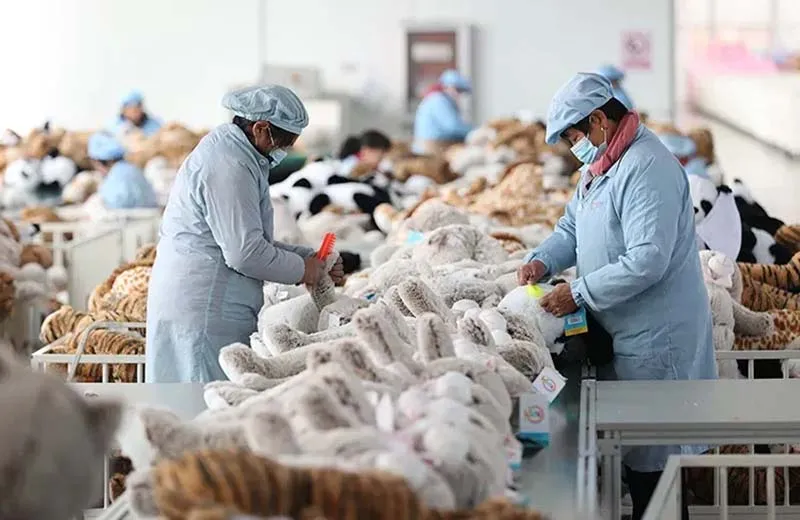
Every finished unit undergoes a comprehensive final inspection against the golden sample before it is approved for packaging and shipment. Units that fail any item on the final inspection checklist are rejected — defective units are never packaged and shipped.
- Character accuracy: overall shape vs golden sample, proportion, three-dimensional form
- Face embroidery: left-right symmetry, eye/nose/mouth position, thread colors, highlight dots
- Fabric surface: no stains, no matting, correct pile direction, no pulled threads
- Filling: density matches golden sample, no lumps or thin patches, even distribution
- Seams: all seams closed, no visible gaps, no loose thread ends
- Safety elements: all attached parts secure (pull test), no sharp points or edges
- Branding: logo position correct, label sewn correctly, hangtag attached
- Functional modules: sound test, LED test, recording test — per approved specifications
- Odor check: no chemical or manufacturing odor
- Packaging: correct format, barcode scan valid, safety labels present
Stage 6: Pre-Shipment Audit
Stage 6: Pre-Shipment Audit
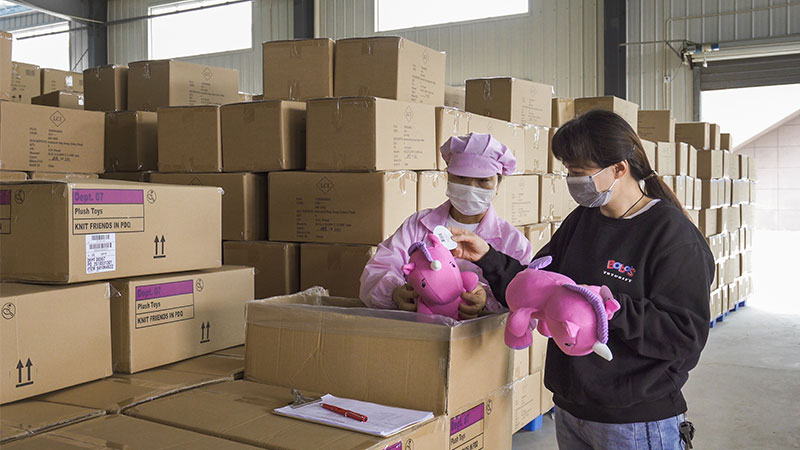
Before shipment is authorized, a final pre-shipment audit is conducted on the packed goods. This audit verifies that the physical product, the packaging, and the documentation all meet the approved specifications. Shipment is only authorized after the audit is completed and signed off.
- Random sampling of packed units — unpacking and comparing against golden sample
- Carton labeling verification — product code, quantity, dimensions, weight
- Packing list accuracy — quantity per carton, total carton count
- Compliance documentation completeness — test reports, certificates ready for shipment
- FBA label verification (where applicable) — FNSKU placement, suffocation warnings
- Third-party pre-shipment inspection available on request (SGS, Intertek, BV)
Common Plush Toy Defects — How KINWIN Prevents Each One
Common Plush Toy Defects — How KINWIN Prevents Each One
Understanding the most common defect types and their root causes is the foundation of effective defect prevention. Each card shows the root cause and KINWIN’s specific prevention measure.
Face Asymmetry
Root cause: no placement template; operator error.
KINWIN prevention: physical placement templates + in-process symmetry check on every unit.
Uneven Filling
Root cause: no weight specification; operator rushing.
KINWIN prevention: gram-weight targets per body section + spot-weight checks during stuffing.
Seam Splitting
Root cause: wrong thread, wrong stitch density.
KINWIN prevention: thread spec in tech pack + in-process seam check at closing station.
Color Variation
Root cause: no Pantone spec; different fabric batches.
KINWIN prevention: Pantone TPX specification + incoming fabric color check against reference.
Toy Goes Flat
Root cause: under-filling; low-grade PP cotton.
KINWIN prevention: premium PP cotton + density benchmark + golden sample comparison.
Chemical Odor
Root cause: non-certified dyes or materials.
KINWIN prevention: OEKO-TEX certified material sourcing + incoming material inspection.
Eye/Nose Detachment
Root cause: insufficient attachment; wrong method.
KINWIN prevention: pull-force spec in tech pack + 100% pull test on all attached components.
Pile Matting
Root cause: wrong fabric grade; compression in shipping.
KINWIN prevention: premium grade specification + packaging compression recovery test.
Embroidery Thread Loops
Root cause: wrong thread tension; operator error.
KINWIN prevention: tension calibration per fabric type + final visual inspection.
Loose Thread Ends
Root cause: missed trimming step.
KINWIN prevention: closing station check + final QC visual scan on every unit.
Certifications, Audits & Client Verification Options
Certifications, Audits & Client Verification Options
Quality Certifications & Third-Party Audits
KINWIN’s quality management system is supported by internationally recognized certifications that provide independent verification of our manufacturing standards.
- ISO 9001:2015 Quality Management System — covers all production processes, QC procedures, document control, and continuous improvement
- CE Certification — product safety compliance for EU market
- ASTM F963 — US toy safety standard compliance
- EN71 Parts 1–3 — European toy safety standard compliance
- BSCI Social Compliance Audit — ethical manufacturing and labor standards
- SGS / SMETA Ethical Trade Audit — supply chain transparency
- Disney FAMA Factory Audit — premium IP manufacturing compliance including IP security protocols
- FSC-certified packaging options — responsible forest sourcing
Third-party pre-shipment inspections (SGS, Intertek, Bureau Veritas) are available on request for any order — providing independent verification before shipment at a stage when defects can still be corrected.
How Clients Can Verify Quality During Production
Transparency is part of KINWIN’s quality commitment. Clients have multiple options for verifying production quality at every stage.
- Pre-production sample approval: every product starts with a fully approved sample — clients have hands-on access to the quality standard before mass production begins
- In-process photography: KINWIN provides production progress photos at key milestones (fabric cutting, first completed units, embroidery samples)
- Factory inspection visits: clients are welcome to visit KINWIN’s factory during production — advance notice required for scheduling
- Third-party inspection: clients may appoint SGS, Intertek, or BV to conduct independent pre-shipment inspection at KINWIN’s factory
- QC report: KINWIN provides a written QC inspection report summarizing findings from the final pre-shipment audit with every shipment
Why KINWIN’s Quality Control System Protects Your Brand
Why KINWIN's Quality Control System Protects Your Brand
At KINWIN, quality is not inspected in — it is built in. Our 6-stage QC system, golden sample benchmarking, and 100% inspection policy ensure that what you approved in sampling is exactly what arrives in your warehouse.
✓ 100% in-process inspection on every unit — not statistical sampling
✓ Golden sample system maintained for all products and all reorders
✓ 6-stage QC process from incoming materials to pre-shipment audit
✓ ISO 9001:2015 certified quality management system
✓ OEKO-TEX certified fabric sourcing — zero chemical compliance risk
✓ Defect root cause tracking — systematic prevention, not just individual correction
✓ Third-party inspection available on request (SGS, Intertek, BV)
✓ Complete QC documentation with every shipment
✓ Disney FAMA passed — verified IP manufacturing and security protocols
At KINWIN, quality is not inspected in — it is built in.
Frequently Asked Questions — Plush Toy Quality Control
Frequently Asked Questions — Plush Toy Quality Control
Q1. Do you inspect every single unit or use statistical sampling?
KINWIN conducts 100% inspection on every unit at both the in-process stage and the final product stage. We do not rely on statistical sampling (AQL) as our primary QC method. Statistical sampling is appropriate for very high-volume commodity manufacturing where some defect rate is accepted — but for custom branded plush toys, where a single defective batch can damage brand reputation and trigger mass returns, 100% inspection is the only appropriate standard. Our final pre-shipment audit then adds a secondary layer of random sampling from packed cartons as an additional verification step.
Q2. What happens if defects are found during production — do you stop the line?
The response depends on the nature and scale of the defect. For individual unit defects, the unit is removed from the line, reworked or rejected, and production continues. For systemic defects — where multiple consecutive units show the same defect pattern, indicating a process problem rather than individual operator error — production is stopped at that station. The root cause is identified, corrected, and verified before production resumes. KINWIN tracks defect patterns in real time during production specifically to catch systemic issues early before they affect the full batch.
Q3. Can I request a third-party inspection before shipment?
Yes, absolutely. KINWIN welcomes and fully supports third-party pre-shipment inspections by SGS, Intertek, Bureau Veritas, or any other accredited inspection body your brand requires. To arrange a third-party inspection, simply notify our production team 5-7 days before the planned inspection date — we will coordinate access and ensure the inspection team has the golden sample, tech pack, and all required documentation available on site. KINWIN’s quality confidence means we have no concern about independent verification — if you want a third party to verify our work, we consider it part of a professional supply relationship.
Q4. What quality documentation do you provide with each shipment?
With every shipment KINWIN provides: a QC inspection report summarizing the pre-shipment audit findings, material compliance certificates (OEKO-TEX, fiber certification), product safety test reports (CE/EN71, ASTM F963, CPSC CPC — as required by market), factory audit certificates (ISO 9001, BSCI, SGS/SMETA — as required by buyer), packing list, commercial invoice with correct HS code classification, and certificate of origin. For electronic toy products: IEC 62115 test report and EU Low Voltage Directive compliance documentation. All documents are formatted for customs clearance, retail buyer compliance submission, and marketplace listing requirements.
Q5. How do you maintain quality consistency on reorders placed months after the original production run?
Long-term consistency is maintained through KINWIN’s golden sample retention system. The approved golden sample for every product is stored securely at our facility indefinitely — it does not expire or get discarded after the original order. When a reorder is placed, the same golden sample is retrieved and used as the production benchmark, alongside the archived tech pack, material specifications, and digitized embroidery files. Before full production begins on a reorder, we also conduct a pre-production golden sample check — confirming all sourced materials match the original specifications. This system ensures that a reorder placed two years after the original production is visually indistinguishable from the first batch.
If You Can lmagine lt,We Will Create lt!
1.Tell Us What You Need
Tell us as specific as possible of your needs and share your idea.
2.Get Solution & Quote
We will work on the best solution according to yourrequirements,the specific quote will be provided within 24 hours.
3.Approve for Mass Production
We will start mass production after getting your approval.