 Skip to content
Plush Toy Production Process — From Design to Delivery
Plush Toy Production Process — From Design to Delivery
Design → Pattern Making → Material Sourcing → Sampling → Safety Testing → Mass Production → QC → Packaging → Shipment
Understanding how a plush toy is made — from the first design sketch to the moment finished toys arrive at your warehouse — helps you plan timelines accurately, communicate clearly with your manufacturer, and make better product decisions. Most brands underestimate the complexity of plush toy manufacturing because the finished product looks simple. It is not. A single custom plush toy involves dozens of sequential production steps, each requiring specialist skill and quality control.
This guide walks through every stage of KINWIN’s plush toy production process — what happens, why it matters, how long it takes, and what you as a brand need to provide or approve at each stage. Whether you are launching your first plush toy or optimizing an existing supply program, this is the complete picture.
Production Timeline Overview
Production Timeline Overview
The total production timeline for a custom plush toy — from first design submission to delivery at your destination — varies depending on product complexity, quantity, and destination. Here is a realistic guide for planning purposes.
Development & Production Phases
- Design alignment & tech pack: 3–7 days
- Material sourcing & confirmation: 3–7 days
- Prototype sampling: 7–15 days (7 standard; 10-15 for electronic/complex)
- Sample review & revision: 5–21 days (client-dependent)
- Safety testing: 10–14 days (can run parallel with production prep)
- Mass production: 25–35 days (after golden sample approval)
- QC, packaging & loading: 3–7 days

Freight & Total Timeline
- Sea freight — US West Coast: 15–22 days (port to port)
- Sea freight — US East Coast / EU: 25–35 days (port to port)
- Air freight: 3–7 days (higher cost; use for urgent replenishment)
- TOTAL — first order to US/EU: 12–18 weeks (from design submission to warehouse)
- TOTAL — reorder (no design changes): 8–10 weeks (production + freight)
We always recommend planning for 16 weeks for a first order to allow buffer for revision rounds and logistics.
The Complete Plush Toy Production Process — Stage by Stage
Stage 1 · Design Brief & Project Initiation
Stage 1 · Design Brief & Project Initiation
Everything begins with your brief. The quality of the design brief you provide directly determines how quickly and accurately sampling proceeds. A detailed, well-organized brief reduces revision rounds and compresses the total development timeline significantly.
What KINWIN needs from you at this stage:
- Character design reference (artwork files, sketches, photos, or physical samples)
- Size requirements (overall height or specific dimension targets)
- Material preferences (fabric type, filling material) if you have them
- Functional requirements (sound, LED, scent, weighted, etc.)
- Target markets (determines safety certification requirements)
- Branding requirements (logo, labels, hangtags, packaging)
- Target order quantity and desired production timeline
NDA is signed at this stage if required before any design materials are shared.
Stage 2 · Design Alignment & Tech Pack Preparation
Stage 2 · Design Alignment & Tech Pack Preparation
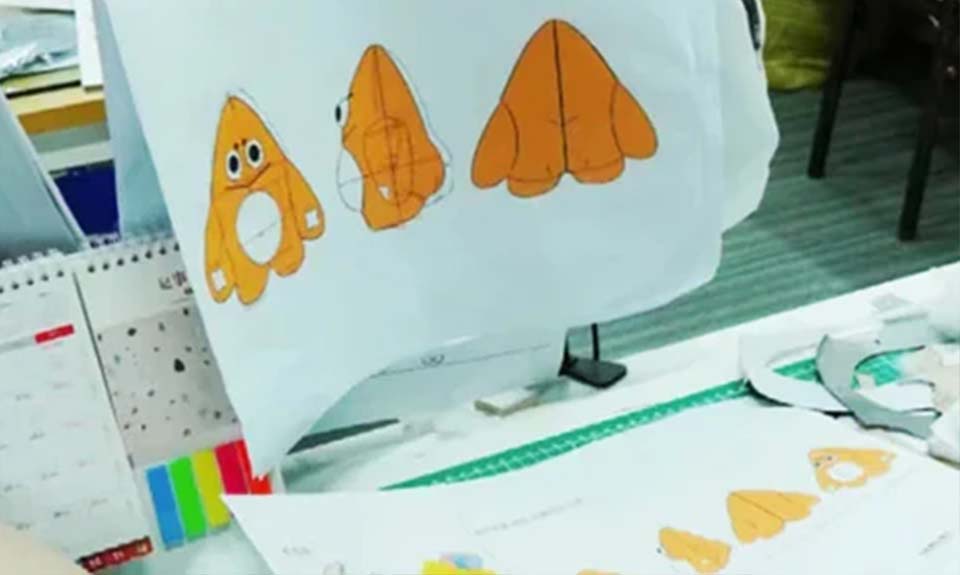
This stage is the most important investment in the entire development process — yet the one most frequently skipped by less experienced manufacturers. Design alignment prevents the misunderstandings between your creative vision and the pattern maker’s interpretation that cause first-sample rejection and costly revision cycles.
KINWIN prepares a design alignment document that confirms:
- Character proportions — head-to-body ratio, limb lengths, tail dimensions
- Facial feature placement — eye position, nose size and shape, mouth curve
- Color specifications — Pantone TPX references for each color zone
- Fabric and filling material selections
- Filling density targets (gram weight per body section)
- Branding application: logo size, position, and method
- Functional module placement (if applicable)
The tech pack is developed alongside the design alignment document — creating the complete manufacturing specification set that the production team works from throughout sampling and production.
Stage 3 · Material Sourcing & Confirmation
Stage 3 · Material Sourcing & Confirmation
Once the design alignment is approved, KINWIN’s material sourcing team procures and confirms all materials required for sampling: fabric, filling, embroidery thread, functional components, label materials, and packaging materials.
Fabric Color Confirmation
Physical fabric swatches in the specified colors are produced and submitted to the client for approval against Pantone TPX references before any cutting begins. This step prevents the most common and most visible sampling failure: wrong fabric color. If the swatch is not right, we source an alternative before committing fabric to sampling.
Material Quality Verification
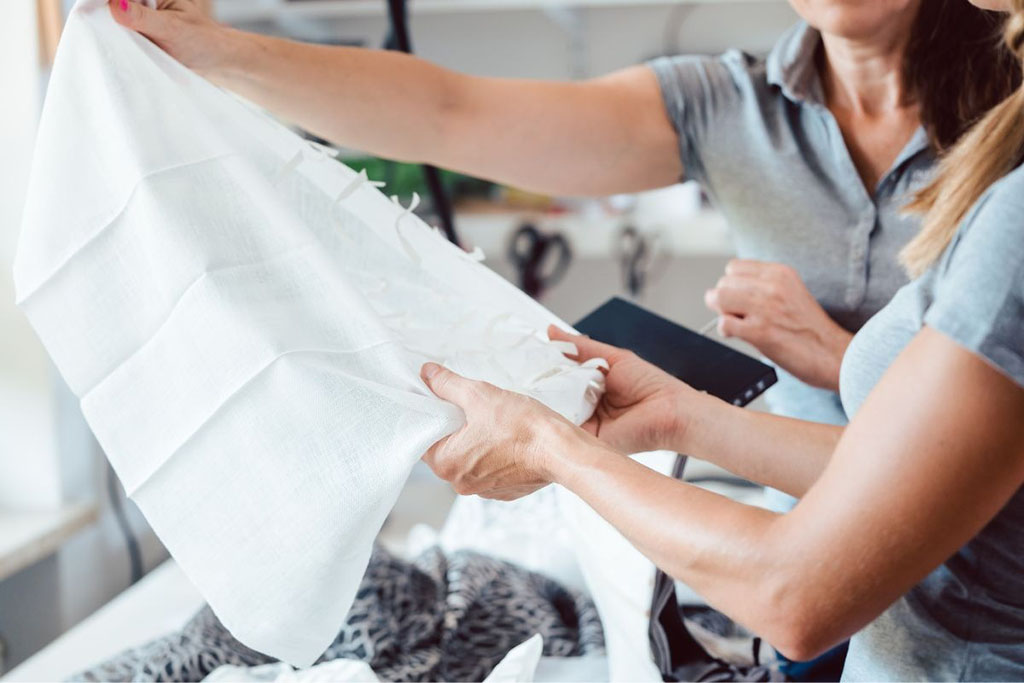
All incoming materials are inspected before use: fabric pile height and density, color consistency, OEKO-TEX certification verification, PP cotton fiber grade and cleanliness, glass bead size and quality (for weighted products), electronic component function test, and label text accuracy.
Stage 4 · Pattern Making
Stage 4 · Pattern Making
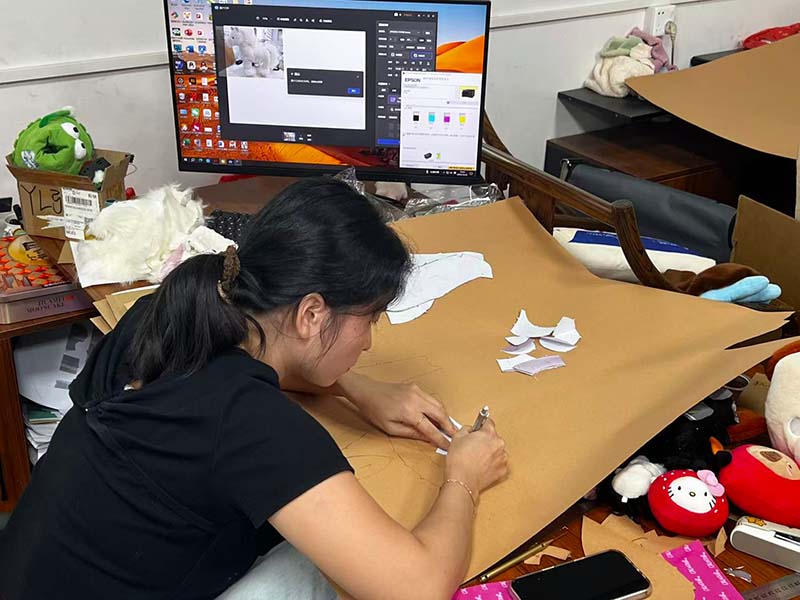
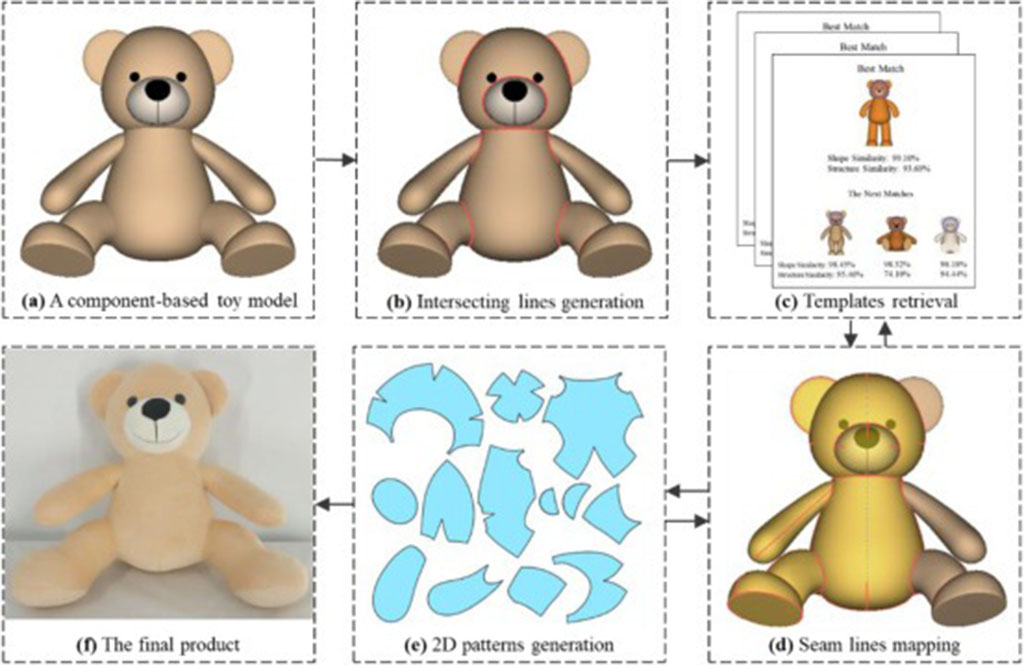
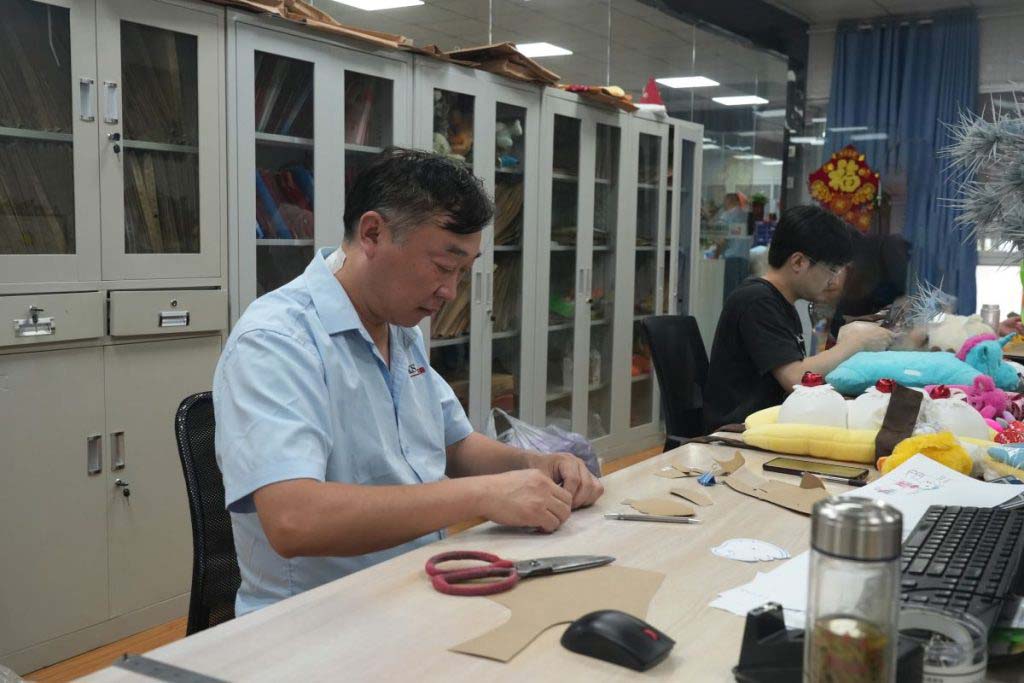
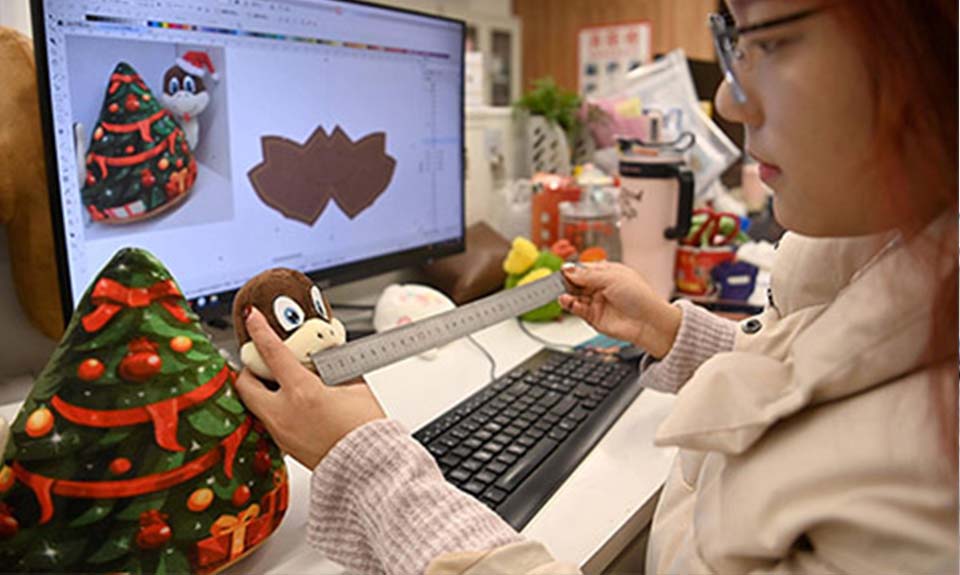
Pattern making is the craft at the heart of plush toy manufacturing. A senior pattern maker takes the approved design alignment document and tech pack, and hand-crafts and digitizes the complete set of construction patterns for every component of the toy.
Pattern components developed for a standard character plush toy:
- Body panels (front, back, side gussets)
- Head panels (crown, sides, chin, face panel)
- Limb components (arms, legs — upper and lower sections)
- Ear components (outer and inner panels)
- Tail component
- Accessories (clothing, hats, accessories worn by character)
- Bead compartment (for weighted products)
Each pattern piece is developed with precise seam allowances, pile direction markings, notch alignment marks, and construction sequence notes. Size grading is applied if multiple size variants are required — scaling all pattern pieces proportionally while maintaining character accuracy at every size.
Stage 5 · Prototype Sampling
Stage 5 · Prototype Sampling
The first physical prototype is hand-crafted by a senior pattern maker using the confirmed materials and completed patterns. KINWIN’s standard sampling turnaround is 7 working days from pattern completion — one of the fastest in the industry.
Sampling process steps:
- Fabric cutting — all pattern pieces cut in confirmed fabrics, pile direction consistent
- Component sewing — panels stitched together in construction sequence
- Turning & stuffing — sewn components turned right-side out, filled to specification
- Face embroidery — eyes, nose, mouth and detail elements stitched with placement template
- Component assembly — limbs, ears, tails attached to body
- Closing — final seams closed by hand
- Accessory attachment — additional elements added
- Functional module installation — sound, LED, or other modules installed and tested
- Internal QC review — pattern maker and QC team compare sample against design reference
The sample is photographed from multiple angles against a white background and shipped to the client alongside a detailed construction report. KINWIN provides unlimited revision rounds at no additional charge until the sample meets the client’s approval standard.
Stage 6 · Safety Testing
Stage 6 · Safety Testing
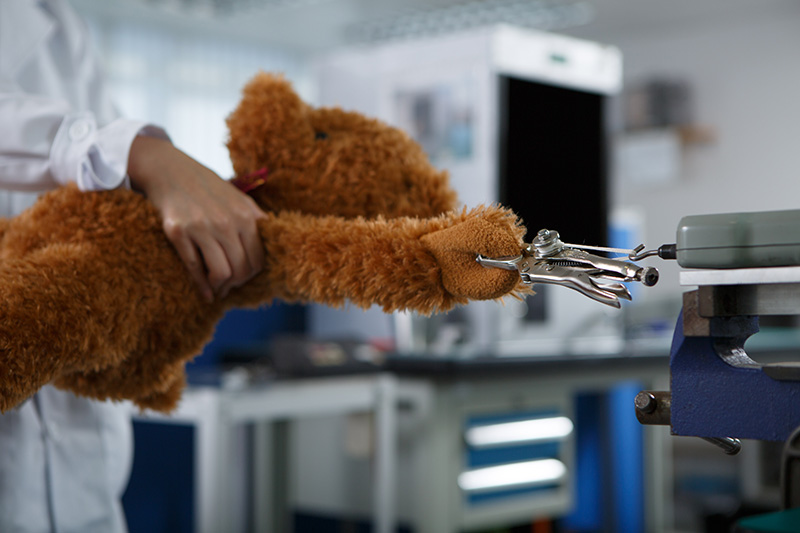
Once the sample is approved — or in parallel with the final revision round where timeline allows — pre-production samples are submitted to accredited third-party laboratories for safety testing.
- EN71 Parts 1–3 + CE — EU / UK — 10–14 days — Mechanical, flammability, chemical migration
- ASTM F963 + CPSC CPC — United States — 10–14 days — Mechanical, flammability, chemical, small parts
- IEC 62115 — Electronic toys — 14–21 days — Electrical safety, acoustic, thermal
- OEKO-TEX 100 — All markets — 7–10 days — Harmful substances, pH, colorfastness
KINWIN coordinates all safety testing with accredited laboratories (SGS, Intertek, Bureau Veritas) and provides the complete compliance documentation package: test reports, certificates, and declarations formatted for marketplace listing, retail buyer submission, and customs clearance.
Stage 7 · Mass Production
Stage 7 · Mass Production
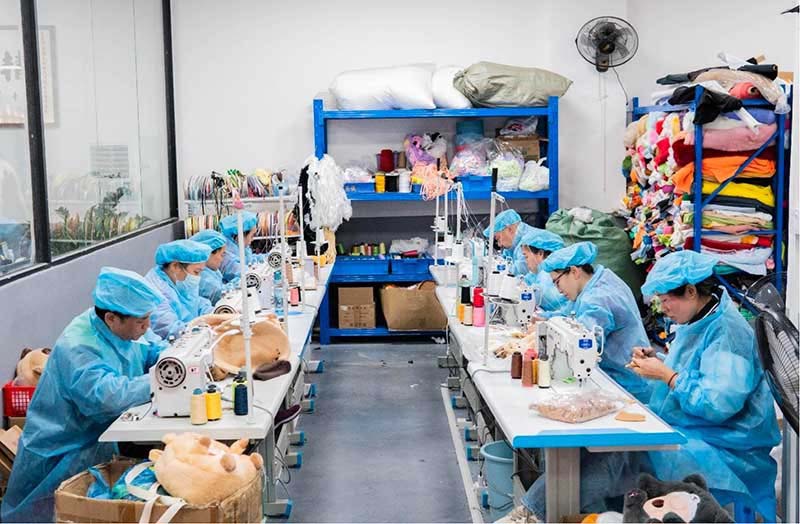
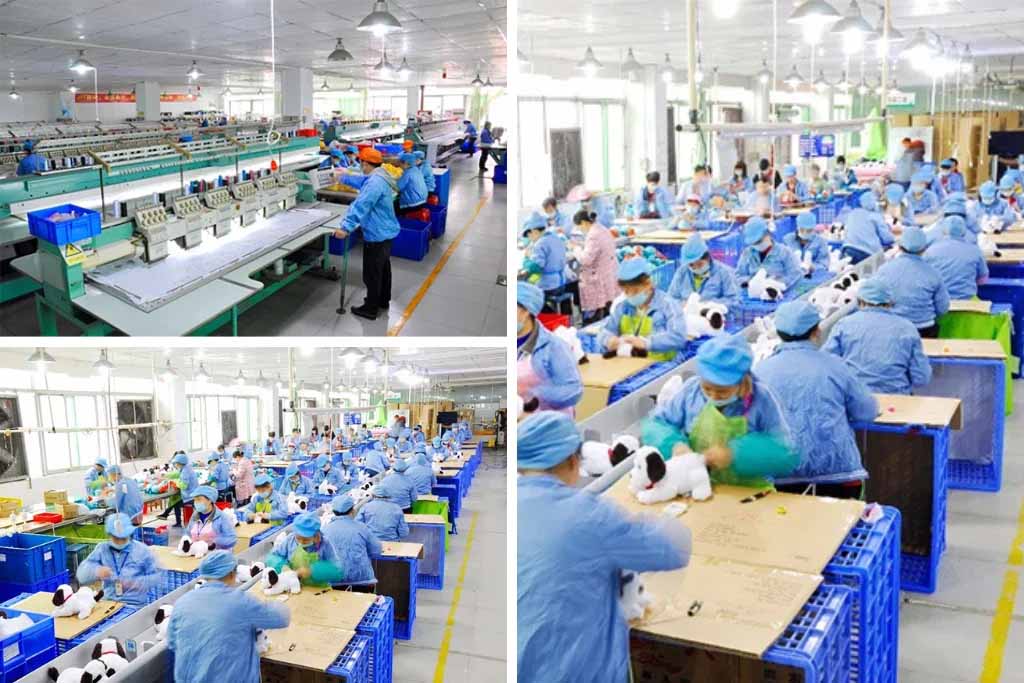
Mass production begins after the golden sample is approved and safety testing results are confirmed. KINWIN’s 15 dedicated production lines are organized into functional workstations — each operated by trained specialists in that specific production step.
Production line workflow:
- Station 1 — Fabric inspection & cutting: fabric inspected for defects, cut to pattern
- Station 2 — Component sorting & bundling: cut pieces sorted into production sets per toy
- Station 3 — Sewing: panels stitched in correct construction sequence
- Station 4 — Turning: sewn components turned right-side out through the opening
- Station 5 — Stuffing: PP cotton or specialty filling material loaded to gram-weight target
- Station 6 — Bead filling (weighted products): glass beads loaded, compartment sealed
- Station 7 — Closing: final seam closed by hand sewing with quality-grade thread
- Station 8 — Embroidery: face and logo embroidery using digitized files and templates
- Station 9 — Eye & nose attachment: attached with required pull-force specification
- Station 10 — Accessory & functional module assembly: clothing, accessories, electronics
- Station 11 — Final trimming: loose threads trimmed, pile groomed
- Station 12 — In-process QC: every unit compared against golden sample
Stage 8 · Labeling & Branding Application
Stage 8 · Labeling & Branding Application
After core construction and in-process QC, branding elements are applied to each unit.
- Woven brand label sewn into seam
- Safety and age warning labels applied per market requirements
- Country of origin label
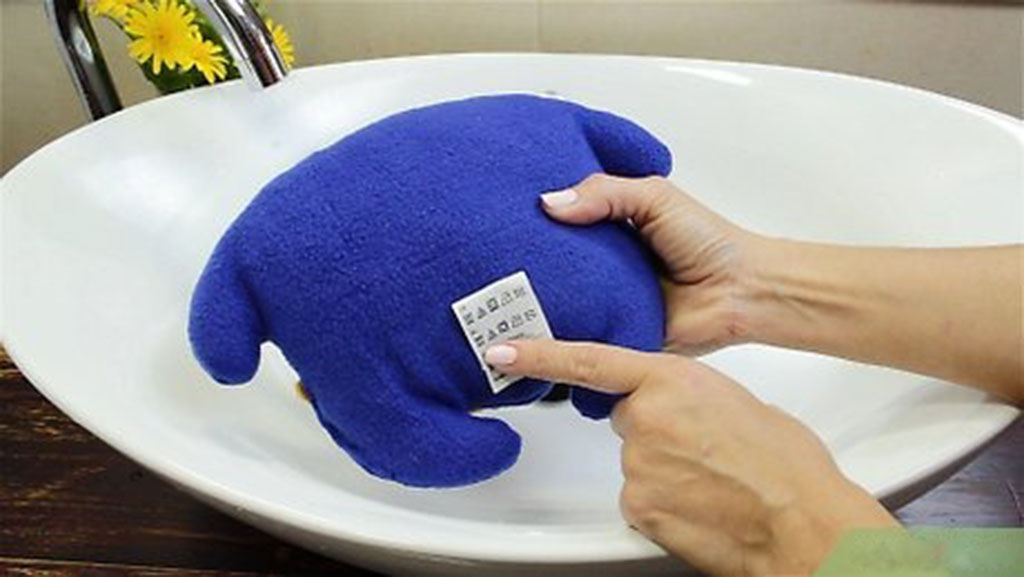
- Care instruction label
- Hangtag attached — contains brand story, character info, QR code, barcode
- Any additional brand-specific labeling per client specification
Stage 9 · Final Quality Inspection
Stage 9 · Final Quality Inspection
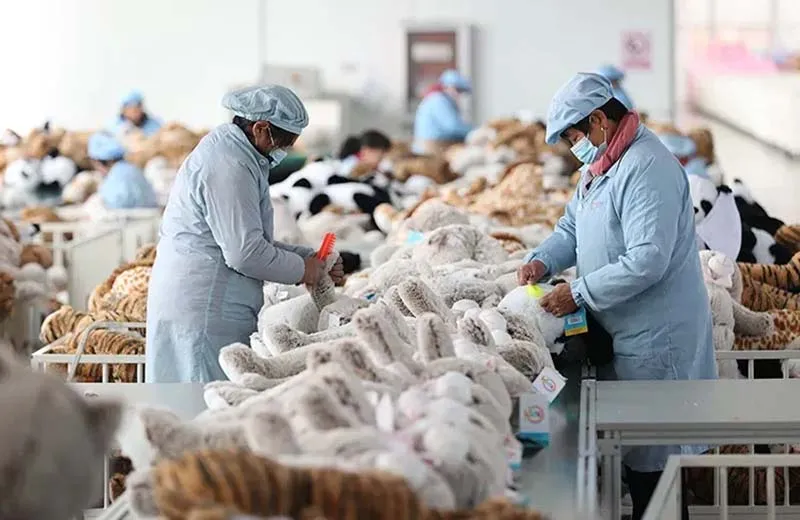
Every finished, labeled unit undergoes a comprehensive final quality inspection comparing it against the golden sample across all dimensions before it is approved for packaging.
Final inspection covers: character shape vs golden sample, face embroidery symmetry and color, fabric surface condition, filling density, seam integrity, safety element pull-force spot tests, functional module operation, label completeness, and odor check. Any unit failing any check is rejected and either reworked or scrapped.
Stage 10 · Packaging
Stage 10 · Packaging
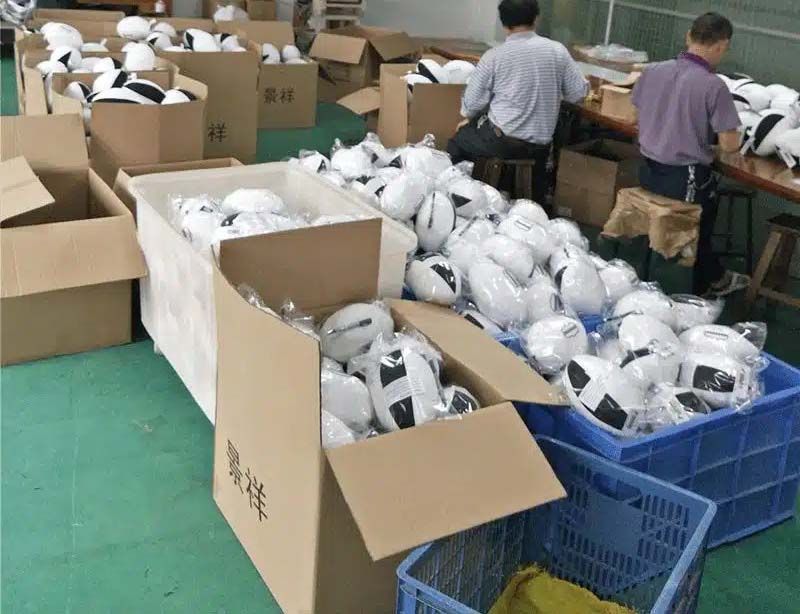
Approved units are packaged per the client’s specifications.
- Individual product packaging applied (poly bag, gift box, display box)
- FBA labeling where required (FNSKU, suffocation warning, age label on poly bag)
- Products packed into inner cartons per planogram or stacking specification
- Inner cartons packed into export outer cartons
- Carton weight verified under 22.6 kg for FBA compliance
- Carton labeling applied: product code, quantity, dimensions, gross/net weight
Stage 11 · Pre-Shipment Audit & Documentation
Stage 11 · Pre-Shipment Audit & Documentation
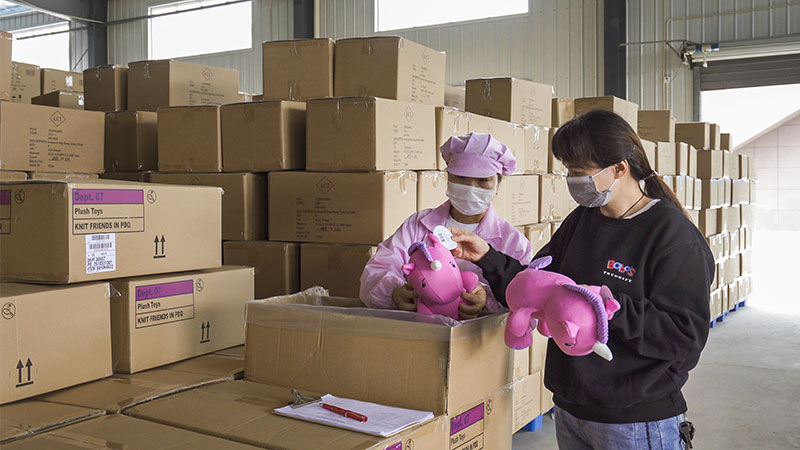
Before shipment authorization, a final pre-shipment audit is conducted — random sampling of packed cartons, unpacking and golden sample comparison, packing list verification, and documentation completeness check.
Shipment documentation prepared:
- Commercial invoice with HS code and declared value
- Packing list with carton details
- Safety test reports and compliance certificates
- Certificate of origin
- Bill of lading or airway bill
- QC inspection report
Stage 12 · Shipment & Delivery
Stage 12 · Shipment & Delivery
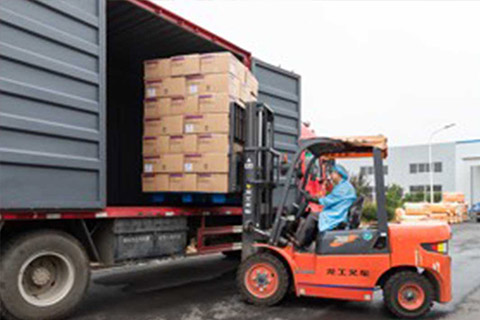
Goods are shipped via the agreed logistics method — sea freight (FCL or LCL), air freight, or express courier. KINWIN provides shipment tracking at every key milestone and proactive communication if any transit delays occur.
- Sea freight: most cost-effective for orders above 200 kg; 15–35 days transit depending on destination
- Air freight: fastest option for urgent orders or smaller quantities; 3–7 days transit
- Express courier: best for samples and small restocking shipments
- DDP (door-to-door) available: KINWIN handles all freight, customs, and last-mile delivery
- Amazon FBA direct shipment available with full FBA compliance from factory
Production Lead Time by Product Type
Production Lead Time by Product Type
Product complexity significantly affects both sampling and mass production lead times. Here is a realistic reference for each major plush toy format.
Standard Character Plush (15–45 cm)
Sampling: 7 days · Production: 25–30 days
Most common format.
Mini Keychain Plush (10–15 cm)
Sampling: 5–7 days · Production: 20–25 days
Simple construction.
Large Display Plush (60 cm+)
Sampling: 10–14 days · Production: 30–40 days
Complex pattern grading.
Weighted Plush
Sampling: 10 days · Production: 28–35 days
Bead containment engineering.
Electronic / Sound Plush
Sampling: 10–15 days · Production: 30–40 days
Module sourcing + testing.
AI Plush
Sampling: 12–15 days · Production: 35–45 days
Complex module integration.
Crochet-Style Plush
Sampling: 10 days · Production: 35–40 days
Specialist knit construction.
Blind Box Series (6–12 Characters)
Sampling: 14–21 days · Production: 35–45 days
Series coordination.
Why KINWIN’s Production Process Delivers Results
Why KINWIN's Production Process Delivers Results
At KINWIN, every stage of the production process is a commitment to the quality of the toy that arrives at your customer’s hands.
✓ 30+ senior pattern makers — the most critical skill in plush toy production
✓ 15 production lines — capacity for 200,000+ samples annually
✓ 7-day standard sampling — one of the fastest in the industry
✓ Design alignment document before sampling begins — prevents costly first-sample failures
✓ 100% in-process and final QC on every unit
✓ Safety testing coordinated in parallel with production prep — minimizes timeline
✓ Complete documentation: tech pack, QC report, compliance certificates, shipping docs
✓ Transparent milestone communication throughout the production lifecycle
At KINWIN, every stage of the production process is a commitment to the quality of the toy that arrives at your customer’s hands.
Frequently Asked Questions — Plush Toy Production Process
Frequently Asked Questions — Plush Toy Production Process
Q1. How long does it realistically take from my first design submission to receiving my first order?
For a standard custom plush toy (15-45 cm, no electronic features) shipped to the US or EU by sea: design alignment and material confirmation 5-10 days, sampling 7 days, sample review and revisions 7-21 days (highly variable), safety testing 10-14 days (can run parallel), mass production 25-35 days, QC and packaging 3-5 days, sea freight 20-35 days. Total realistic range: 12-18 weeks from design submission to warehouse arrival. We always recommend planning for 16 weeks for a first order to allow buffer for revision rounds and logistics. Reorders with no design changes are 8-10 weeks.
Q2. What is the single most common cause of production delays and how do you prevent it?
By far the most common cause of production delays is an extended sample revision cycle — where the first sample does not match the client’s vision and multiple revision rounds are required. This is almost always caused by insufficient design alignment before sampling begins. When a manufacturer goes straight from a rough sketch to sampling without a structured alignment process, the probability of first-sample rejection is very high. KINWIN prevents this through our design alignment document process — a structured confirmation of every design decision before sampling begins. This single step reduces average revision rounds significantly and is the most impactful schedule optimization in the entire production timeline.
Q3. Can safety testing run at the same time as mass production to save time?
Yes, and this is exactly what KINWIN recommends for most programs. Pre-production samples (which are production-equivalent in material and construction) can be submitted for safety testing at the same time as production preparation activities begin — material procurement, production scheduling, and line preparation. Since safety testing takes 10-14 days and production preparation takes 5-10 days, the testing is typically completed and approved by the time full production begins or shortly thereafter. The risk of this approach is that if a product fails safety testing and requires a material change, some production material procurement may need to be redone. For most programs where materials are pre-qualified OEKO-TEX certified, this risk is very low.
Q4. What happens at each production stage if I want to check quality during production?
KINWIN supports multiple client quality verification options throughout production: at the material confirmation stage, we send physical fabric swatches and color confirmation samples for your approval before cutting begins; during production, we provide milestone photography at key stages (cut fabric sets, first completed units, embroidery quality samples); at the final QC stage, we provide a written pre-shipment QC report; and at any stage, you may appoint a third-party inspector (SGS, Intertek, BV) to conduct an independent inspection at our factory. Factory visits are also welcome with advance scheduling. For clients who want maximum oversight on first orders, we recommend the third-party pre-shipment inspection as the most cost-effective independent verification option.
Q5. How is the production process different for a reorder vs a first order?
Reorders are significantly faster and simpler than first orders because the foundational development work is already complete. For a reorder with no design changes: the golden sample is retrieved from storage and used as the production benchmark without any sampling stage; all materials are re-sourced against the original specifications on file; a pre-production golden sample check confirms materials match before full production begins; and mass production proceeds directly from the approved specifications. The only new work is production itself, QC, packaging, and shipping. Typical reorder timeline: 25-35 days production + freight time = 8-10 weeks to delivery. If design changes are required for a reorder (new color, expression variant, size change), sampling for the changed elements is required before that variant enters production, adding 7-14 days depending on change complexity.
If You Can lmagine lt,We Will Create lt!
1.Tell Us What You Need
Tell us as specific as possible of your needs and share your idea.
2.Get Solution & Quote
We will work on the best solution according to yourrequirements,the specific quote will be provided within 24 hours.
3.Approve for Mass Production
We will start mass production after getting your approval.
