 Skip to content
Plush Toy Certification — Complete Market Access Guide
Plush Toy Certification — Complete Market Access Guide
CE · EN71 · ASTM F963 · CPSC · UKCA · OEKO-TEX · IEC 62115 · Global Market Access · Documentation Included
Plush toy certification is the process of independently verifying that your product meets the specific safety, chemical, and labeling requirements of every market where you sell. It is not optional. Selling plush toys without the correct certifications risks marketplace listing removal, import seizure at customs, product recalls, civil penalties, and legal liability — in addition to the direct safety risks to children if products are genuinely non-compliant.
KINWIN manages the complete certification process for every production order — from selecting the correct test standards for your target markets, coordinating testing with accredited laboratories, managing the certification documentation, to providing correctly formatted compliance files for marketplace upload, retail buyer submission, and customs clearance. This guide explains every certification relevant to plush toys, what it covers, and what KINWIN provides.
Certification by Target Market — Quick Reference
Certification by Target Market — Quick Reference
European Union
You need: CE Mark + EN71 Parts 1-3 + REACH
KINWIN provides: CE Declaration + EN71 test reports + REACH docs
United Kingdom
You need: UKCA Mark + EN71 Parts 1-3
KINWIN provides: UKCA Declaration + EN71 test reports
United States
You need: ASTM F963 + CPSC CPC
KINWIN provides: ASTM test report + Children’s Product Certificate
Australia
You need: AS/NZS 8124
KINWIN provides: AS/NZS test report + compliance documentation
Canada
You need: CCPSA + ASTM F963 equivalent
KINWIN provides: Test reports + compliance documentation
Amazon US
You need: ASTM F963 + CPSC CPC
KINWIN provides: Seller Central-ready format + test reports
Amazon EU (DE/FR/IT/ES)
You need: CE + EN71 + REACH
KINWIN provides: Seller Central-ready format + declarations
Amazon UK
You need: UKCA + EN71
KINWIN provides: Seller Central-ready format + declarations
Electronic toys (all markets)
You need: Above standards + IEC 62115
KINWIN provides: Electronic safety test report
All markets (fabric safety)
You need: OEKO-TEX Standard 100
KINWIN provides: OEKO-TEX certificates included
CE Certification for Plush Toys — European Union & UK
CE Certification for Plush Toys — European Union & UK
CE marking is the single most important certification for plush toys sold in Europe. It is the manufacturer’s declaration that the product complies with all applicable EU directives — primarily the EU Toy Safety Directive (2009/48/EC) for toys. Without CE marking, a plush toy cannot legally be sold in the EU, cannot be listed in the toy category on Amazon EU marketplaces, and will be detained at EU customs.
What CE Marking Requires
- EN71 Part 1 testing: mechanical and physical hazards — small parts, sharp points, pull and torque on attachments
- EN71 Part 2 testing: flammability — fabric and filling flammability
- EN71 Part 3 testing: migration of certain elements — chemical migration from accessible materials
- REACH compliance: restricted chemical substances across all materials
- Technical file: compiled test reports, risk assessment, design documentation
- EU Declaration of Conformity (DoC): signed document declaring compliance
- CE mark physically applied to product and/or packaging
KINWIN's CE Certification Deliverables
- EN71 Parts 1-3 test reports from EU-accredited laboratory
- REACH compliance documentation for all materials
- EU Declaration of Conformity — signed and formatted for customs and retail submission
- CE mark applied to product and packaging per directive requirements
- Technical file maintained for 10 years per EU Toy Safety Directive
UKCA — Post-Brexit UK Market
Since January 2023, toys sold in Great Britain (England, Scotland, Wales) must bear the UKCA (UK Conformity Assessed) mark rather than CE. The technical requirements are nearly identical to CE — EN71 Parts 1-3 testing — but require a UK-accredited (UKAS) laboratory and a separate UK Declaration of Conformity. CE marking remains valid in Northern Ireland under the Windsor Framework. KINWIN provides UKCA certification alongside CE certification for brands selling in both EU and UK markets.
ASTM F963 & CPSC Certification — United States
ASTM F963 & CPSC Certification — United States
The United States toy safety system combines a mandatory technical standard (ASTM F963) with a regulatory certification requirement (CPSC Children’s Product Certificate). Both are required for plush toys marketed to children — neither alone is sufficient.
ASTM F963 Test Areas for Plush Toys
- Mechanical & physical: Small parts, sharp points, pull force (15 lbs / 66.7N) — Relevant for eyes, noses, attachments
- Flammability: Surface flammability rate limits — All fabric and filling types
- Stuffing materials: Non-toxic, clean, no hazardous materials — PP cotton, all fillings
- Chemical substances: Lead ≤ 90ppm in surface coatings; phthalates ≤ 0.1% — Dyes, coatings, plastic accessories
- Noise-producing toys: Sound level limits — Sound module plush
- Electronic toys: Battery safety, electrical protection — All electronic plush
CPSC Children's Product Certificate (CPC) — Required Contents
- Product identification and description
- Identification of applicable CPSC children’s product safety rules
- Name and address of manufacturer or importer
- Contact information for records retention
- Name and address of CPSC-accepted testing laboratory
- Date and location of product testing
- Testing was conducted on a representative sample
Amazon US requires the ASTM F963 test report AND the CPC to be uploaded to Seller Central before toy listings are approved. Walmart, Target, and other major US retailers require both documents from all toy suppliers.
Platform-Specific Certification Requirements
Platform-Specific Certification Requirements
Each major selling platform has specific requirements for how certification documentation must be provided and formatted. KINWIN prepares all documentation in the correct format for each platform.
Amazon Certification Requirements by Marketplace
- Amazon.com (US): ASTM F963 test report + CPSC CPC → Seller Central > Product Compliance
- Amazon.co.uk (UK): UKCA Declaration + EN71 test reports → Seller Central > Product Compliance
- Amazon.de/.fr/.it/.es (EU): CE Declaration + EN71 test reports + REACH → Seller Central > Product Compliance
- Amazon.com.au (Australia): AS/NZS 8124 test report → Seller Central > Product Compliance
- Amazon.ca (Canada): ASTM F963 equivalent + CCPSA compliance → Seller Central > Product Compliance
- All Amazon toy listings: OEKO-TEX fabric certification recommended → Upload to compliance documentation
Amazon may request updated documentation at any time for listed products. KINWIN recommends refreshing certification documentation every 2 years and immediately after any material change to the product design or materials.
Retail Chain Certification Requirements
- Walmart (US): ASTM F963 + CPSC CPC + SMETA 2-pillar minimum — Supplier qualification portal
- Target (US): ASTM F963 + CPSC CPC + SMETA or equivalent — Vendor compliance program
- Argos / Smyths (UK): UKCA + EN71 + BSCI or SMETA — UK toy retailer requirements
- FNAC / Carrefour (EU): CE + EN71 + REACH + BSCI or SMETA — EU retailer standards
- Toys R Us (remaining markets): Market-specific safety certs + BSCI or audit equivalent — Varies by country
- Independent toy boutiques: CE or ASTM per market — OEKO-TEX valued by boutique buyers
OEKO-TEX Standard 100 — Why It Matters Beyond Compliance
OEKO-TEX Standard 100 — Why It Matters Beyond Compliance
OEKO-TEX Standard 100 is not a toy safety standard — it is a textile safety certification that tests fabric for harmful substances. For plush toys, OEKO-TEX certification is not legally mandatory in most markets, but it has become effectively mandatory for serious brands because it eliminates the most common and most costly fabric-related safety testing failures.
What OEKO-TEX Tests That EN71/ASTM Miss
- Azo dyes: Full banned azo colorant list tested (EN71-3 tests only 8 elements)
- Pesticide residues: 100+ pesticides tested (not covered by EN71/ASTM)
- Allergenic dyes: Listed prohibited dyes tested (not specifically covered by toy standards)
- pH value: Skin-compatible range required (not covered in toy standards)
- Formaldehyde: Strict limits for baby products (not in EN71/ASTM toy tests)
- Color fastness: Multiple fastness tests (not in toy safety standards)
Sourcing OEKO-TEX certified fabrics means most fabric-related chemical failures are prevented before the product goes to toy safety testing. This saves testing time, eliminates material change delays, and removes the most common compliance risk from the development process.
IEC 62115 — Electronic & Interactive Plush Toy Certification
IEC 62115 — Electronic & Interactive Plush Toy Certification
Any plush toy incorporating electrical components — sound modules, LED lighting, recording chips, vibration motors, AI conversation modules, or battery-powered features — is classified as an electric toy and must comply with IEC 62115 in addition to all standard toy safety requirements.
- Electrical safety: Insulation resistance, dielectric strength, leakage current — Leakage current ≤ 0.5mA
- Battery safety: Battery type specification, reversal protection, compartment access — Battery not accessible without tool
- Thermal safety: Surface temperatures during operation and fault conditions — Max 60°C accessible surfaces
- Acoustic safety: Maximum continuous sound output level — ≤ 85 dB(A) at 50cm continuous
- EMC: Electromagnetic compatibility (wireless/Bluetooth toys) — Per applicable radio regulations
- Cord & string safety: Cord length and attachment — Max 220mm accessible cord length
For EU market electronic plush toys, the Low Voltage Directive (LVD 2014/35/EU) and Radio Equipment Directive (RED 2014/53/EU, for wireless features) apply in addition to the Toy Safety Directive. KINWIN coordinates all additional directives for electronic plush toys targeting the EU market.
The Certification Process — How It Works with KINWIN
The Certification Process — How It Works with KINWIN
KINWIN manages the complete certification workflow — from selecting the correct test standards to delivering formatted documentation ready for your use.
Step 1
Confirm target markets and regulatory requirements
Timeline: Day 1 · Who: KINWIN + Client
Step 2
Select correct test standards for each market
Timeline: Day 1 · Who: KINWIN
Step 3
Material pre-qualification: OEKO-TEX certified fabrics sourced
Timeline: During design phase · Who: KINWIN
Step 4
Pre-production samples prepared for testing
Timeline: After sample approval · Who: KINWIN
Step 5
Samples submitted to accredited laboratory
Timeline: Day 1 of testing · Who: KINWIN + Lab
Step 6
Testing completed; reports issued
Timeline: Day 10-14 · Who: Lab
Step 7
Pass: proceed to production / Fail: root cause + material change
Timeline: Immediate · Who: KINWIN
Step 8
Compliance documentation package assembled
Timeline: Before shipment · Who: KINWIN
Step 9
Documentation delivered in format ready for each platform
Timeline: With shipment · Who: KINWIN → Client
What KINWIN’s Certification Documentation Package Includes
What KINWIN's Certification Documentation Package Includes
Every production order from KINWIN ships with a complete certification documentation package — organized by target market and formatted for immediate use.
For EU / UK Market Orders
- EU Declaration of Conformity (DoC) — signed, dated, product-specific
- UKCA Declaration of Conformity (for UK) — separate from EU DoC
- EN71 Part 1 test report (mechanical and physical safety)
- EN71 Part 2 test report (flammability)
- EN71 Part 3 test report (chemical element migration)
- REACH chemical compliance documentation
- OEKO-TEX Standard 100 fabric certificates (product class I)
- IEC 62115 / EN 62115 test report (electronic toys only)
- CE mark artwork file for packaging design use
For US Market Orders
- ASTM F963 test report from CPSC-accepted laboratory
- Children’s Product Certificate (CPC) — issued per CPSC requirements
- OEKO-TEX Standard 100 fabric certificate
- CPSIA General Certificate of Conformity (GCC) where applicable
- Amazon Seller Central formatted compliance package
For All Orders (Standard Inclusions)
- OEKO-TEX Standard 100 fabric certificates
- Commercial invoice with correct HS code (9503.00 classification)
- Packing list
- Certificate of origin (China)
- QC pre-shipment inspection report
- GRS certificates (eco material orders)
- FSC certificate reference (FSC packaging orders)
Common Certification Mistakes That Cost Brands Money
Common Certification Mistakes That Cost Brands Money
Most certification failures and compliance problems are preventable. These are the most costly mistakes KINWIN’s team sees from brands new to plush toy manufacturing.
Mistake 1
Assuming supplier certification covers your product. A manufacturer’s own CE certification does not mean your specific product is CE certified — the product must be tested independently. KINWIN’s factory certifications are factory-level; your product requires product-level testing and a product-specific Declaration of Conformity.
Mistake 2
Relying on paper declarations without third-party test reports. A Declaration of Conformity without underlying third-party test reports is not valid. The declaration must be supported by actual laboratory test reports from an accredited testing body.
Mistake 3
Testing the wrong product. Test reports must be for the specific product being sold — not a similar product or a previous version. Material changes, design changes, or supplier changes may require re-testing.
Mistake 4
Missing the CPC for US market toys. Many brands obtain the ASTM F963 test report but forget the CPSC Children’s Product Certificate (CPC). Both are required — Amazon will reject toy listings that have the test report without the CPC.
Mistake 5
Applying CE mark to UK-only products without UKCA. Since January 2023, CE mark is not valid for Great Britain — UKCA is required. Brands selling in both EU and UK need both CE and UKCA documentation.
Mistake 6
Allowing certifications to expire without renewal. Amazon monitors certification expiry and can remove listings when documentation is no longer current. KINWIN tracks certification status for active client programs.
Mistake 7
Not obtaining electronic toy certification for plush toys with sound/LED features. Many brands correctly certify their standard plush but fail to obtain IEC 62115 certification when the same character is launched with a sound module variant.
Why KINWIN’s Certification Management Protects Your Business
Why KINWIN's Certification Management Protects Your Business
✓ Market-specific test standard selection: KINWIN identifies the correct standards for every target market combination
✓ OEKO-TEX pre-qualification: all fabrics certified before testing begins — prevents most chemical failures
✓ Accredited laboratory partners: SGS, Intertek, Bureau Veritas — globally recognized and accepted
✓ Parallel testing: safety testing runs alongside production preparation — saves 10-14 days
✓ Complete documentation package: formatted for every platform and use case
✓ Failure resolution: if testing fails, KINWIN identifies root cause and recommends corrective action
✓ Certification tracking: KINWIN monitors certification validity for ongoing client programs
✓ Electronic toy certification: full IEC 62115 + LVD + RED coordination for electronic plush
✓ Multi-market documentation: simultaneous EU + US + UK + AU certification programs managed from a single production order
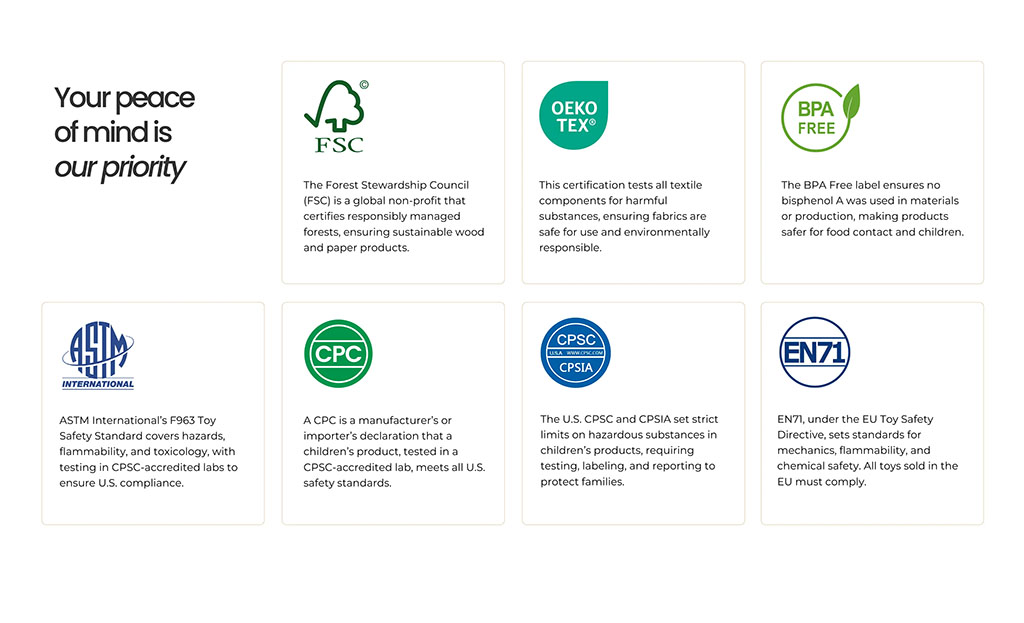
The right certification opens every door your product needs to enter — KINWIN makes sure every door is open before your product ships.
Frequently Asked Questions — Plush Toy Certification
Frequently Asked Questions — Plush Toy Certification
Q1. Who is responsible for obtaining plush toy certification — the manufacturer or the brand?
Legal responsibility for product certification in most markets falls on the party who places the product on the market — typically the brand (importer or first seller) rather than the manufacturer. For the EU, the responsible party is the manufacturer (if EU-based) or the EU-authorized representative / importer (if the manufacturer is outside the EU). For the US, the importer or domestic manufacturer issues the CPC. In practice, KINWIN coordinates all testing and prepares all documentation on behalf of our clients — but the Declaration of Conformity and CPC are issued under the client brand’s name and address, reflecting their legal responsibility. KINWIN’s role is to make this process seamless — the legal accountability remains with the brand.
Q2. Can one certification cover multiple product variants of the same character?
It depends on how similar the variants are. For size variants using identical materials and construction — only scaled proportionally — a single test report typically covers all sizes (testing conducted on the most critical size, usually smallest). For color variants using identical materials with different fabric colors — a single test report may cover multiple colorways if the fabric dyes are from the same certified supplier range. For variants with different materials (different fabric type, different filling, different accessories) — separate testing is required. For variants with electronic features added to a standard plush — IEC 62115 electronic testing is required for the electronic variant in addition to standard toy tests. KINWIN advises on the most efficient testing strategy for multi-variant programs.
Q3. How long does certification take and does it delay my production timeline?
Standard plush toy certification testing (EN71 Parts 1-3 or ASTM F963) takes 10-14 working days at an accredited laboratory. Electronic toy testing (adding IEC 62115) takes 14-21 days. KINWIN minimizes timeline impact through parallel testing — submitting pre-production samples to the laboratory at the same time production preparation begins (pattern making, material procurement, production scheduling). For products using OEKO-TEX certified fabrics (which KINWIN sources exclusively), chemical compliance risk is very low, making parallel testing a safe and effective approach. Total time saved versus sequential testing: 10-14 days, representing a significant portion of total development time.
Q4. What happens if my plush toy fails certification testing?
Test failures require identifying the root cause and implementing a corrective change before re-testing. Common failure scenarios and resolutions: mechanical failure (eye pull force insufficient) → increase attachment force specification or switch to embroidered features; flammability failure → source alternative fabric with confirmed lower flammability; chemical failure (azo dyes in non-certified fabric) → replace fabric with OEKO-TEX certified alternative; chemical failure (lead in coating) → source certified-compliant alternative coating. After the corrective change is made, revised samples are re-submitted for testing. KINWIN covers re-testing and re-sampling costs when the failure is caused by a material or design element we recommended — if we recommended a fabric that failed, we take responsibility for making it right.
Q5. Do I need separate certification for each country or does one cover multiple markets?
There is significant test overlap between markets — particularly between EU (EN71) and UK (EN71) which use the same technical standard. However, separate Declarations of Conformity are required (EU DoC and UK DoC separately). Between EU (EN71) and US (ASTM F963), there is substantial test method overlap in mechanical and chemical testing, but the standards are not interchangeable — separate test reports are required for each market. Most accredited laboratories can run EN71 and ASTM F963 testing in parallel on the same samples, which is more cost-efficient than sequential testing. KINWIN recommends a single coordinated testing program covering all your target markets simultaneously — identifying the union of all required tests, running them in parallel, and generating market-specific documentation from the combined results.
If You Can lmagine lt,We Will Create lt!
1.Tell Us What You Need
Tell us as specific as possible of your needs and share your idea.
2.Get Solution & Quote
We will work on the best solution according to yourrequirements,the specific quote will be provided within 24 hours.
3.Approve for Mass Production
We will start mass production after getting your approval.
