 Skip to content
Anime Plush Manufacturer — Custom Soft Figures, Chibi Plush & Character Merchandise
Anime Plush Manufacturer — Custom Soft Figures, Chibi Plush & Character Merchandise
Chibi & Standard Proportions · Accurate Costume Construction · Eye Translation Expertise · IP Compliance · CE/ASTM · MOQ 500 pcs
The global anime merchandise market is one of the fastest-growing categories in licensed consumer products — and plush figures are among the highest-demand format within it. Anime fans are exacting consumers: they know the characters deeply, notice accuracy failures immediately, and share both praise and criticism widely across social media. Manufacturing anime plush well requires genuine expertise in translating the specific aesthetic conventions of anime and manga illustration into three-dimensional soft toy form — a translation that involves more than technical skill. It requires understanding what makes an anime character recognizable, and what makes a plush version of that character feel authentically right.
KINWIN manufactures custom anime and manga character plush for IP licensing programs, anime merchandise brands, doujin creators, gaming companies, and independent character designers. Our 17+ years of plush manufacturing experience includes deep specialization in the specific construction challenges anime characters present — from chibi proportions and complex hairstyle construction to accurate costume reproduction and the delicate art of translating geometric anime eyes into embroidered form.
The Anime-to-Plush Translation Challenge
What Changes in the 2D-to-3D Translation — 7 Key Elements
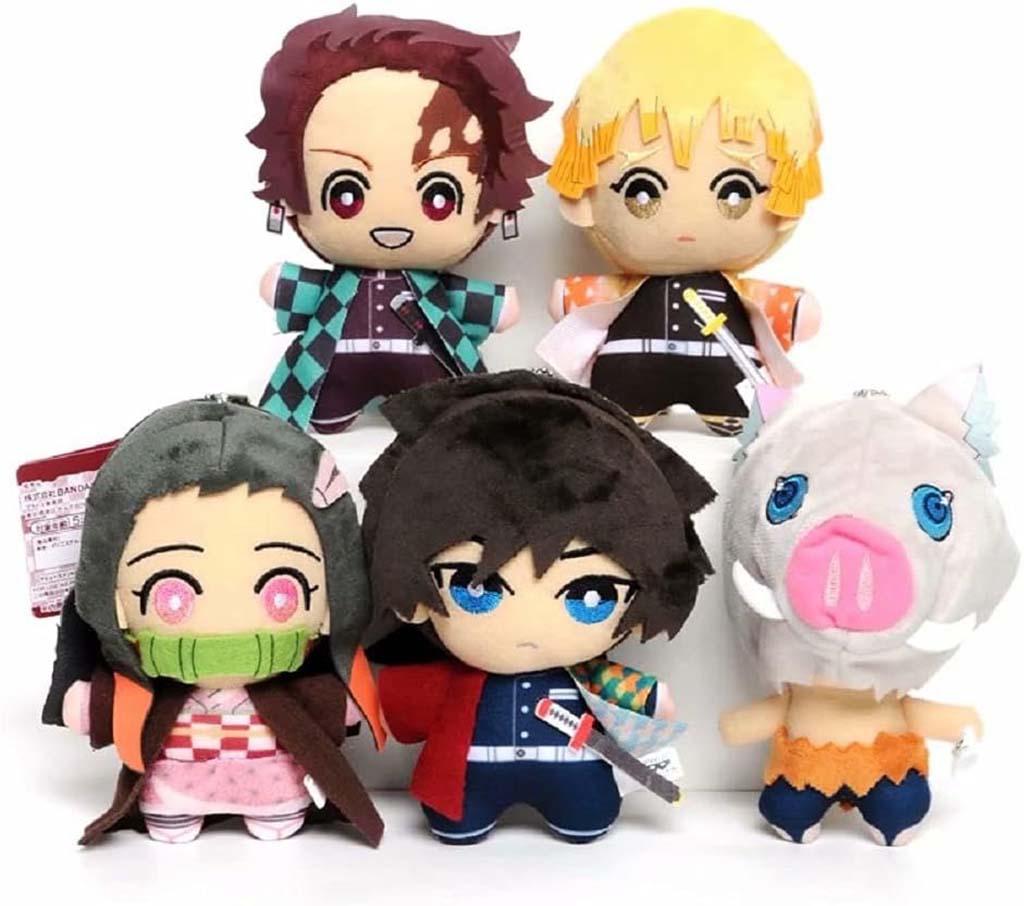
Anime characters are designed specifically for two-dimensional representation. The visual conventions that define the anime aesthetic — large geometric eyes, complex structured hair, sharp angular features, flat shading, extreme body proportions — are inherently two-dimensional conventions that do not exist in three-dimensional physical reality.
The difference between a plush figure that fans love and one they criticize as ‘off-model’ is almost always in the translation decisions: which 2D conventions were preserved, which were adapted, and whether the adaptation preserved the character’s essential personality even when the geometry changed.
Eye Shape
2D: Precise geometric: star, heart, crescent, gradient iris
3D reality: Must be embroidered — cannot be geometrically precise
Approach: Design embroidery to capture emotional essence, not geometric precision
Hair
2D: Sharp, structured, often defying gravity
3D reality: Fabric requires softening; wire support for specific styles
Approach: Multiple fabric panels + wire where needed; maintain silhouette
Body Proportions (chibi)
2D: 3:1 to 4:1 head-to-body ratio (exaggerated)
3D reality: Works well in plush — head shape engineering critical
Approach: Specialized multi-panel head construction for roundness
Sharp Facial Edges
2D: Angular jaw, sharp chin, defined cheekbones
3D reality: Plush fabric rounds all edges inherently
Approach: Accept softening; compensate through face panel shaping
Flat Shading
2D: Cel-shaded color with no texture
3D reality: Pile fabric has inherent texture and pile direction
Approach: Color zone panel construction replicates shade blocking
Costume Detail
2D: Fine linework, buttons, insignia
3D reality: Minimum embroidery feature size ~3mm
Approach: Simplify fine details; replicate structural costume elements
Skin Tone
2D: Specific anime skin palette
3D reality: OEKO-TEX fabric in matched skin tones
Approach: Pantone TPX fabric matching to character reference
Chibi Plush — The Most Popular Anime Plush Format
Chibi Proportion Guidelines and Head Construction
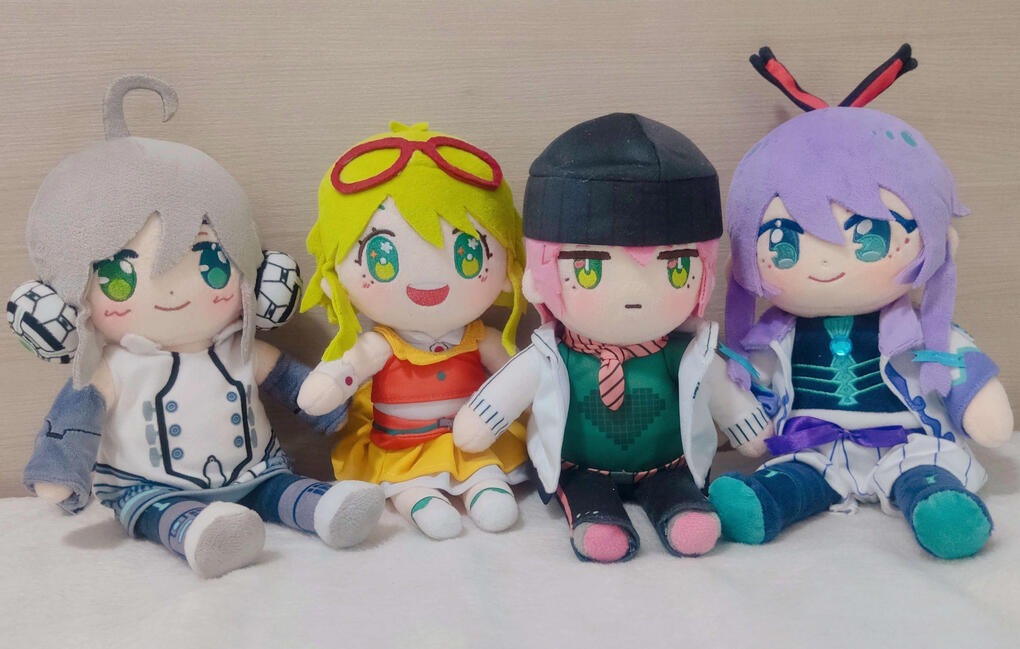
Chibi (also called ‘deformed’ or SD — Super Deformed) style is the dominant format for anime merchandise plush worldwide. The chibi aesthetic — oversized head with simplified, cute facial features on a small, rounded body — translates exceptionally well into plush toy form because the exaggerated proportions align naturally with the ‘cute’ design language that makes plush toys appealing.
- Ultra chibi / Nendoroid-style: 3:1 or higher head-to-body ratio · 6+ panel rounded head, neck joint · Best at 15-20cm · Collector figures, gashapon fans
- Standard chibi: 2.5:1 to 3:1 · 5-6 panel head construction · Best at 20-30cm · General anime fan market
- Semi-chibi: 2:1 to 2.5:1 · 4-5 panel head, more body detail · Best at 25-35cm · Character-focused fans
- Standard anime proportions: 1.5:1 to 2:1 · Standard head, full-height body · Best at 30-45cm · Premium collector market
The head construction is the most technically demanding aspect of chibi plush manufacturing. A chibi character’s head must be genuinely round — not flat or ovoid — when stuffed, which requires careful multi-panel pattern engineering. KINWIN’s senior pattern makers specifically develop chibi head patterns with shaped seam curves that produce consistent roundness across production runs. This is the single most common point of failure in low-quality chibi plush: a head that is flat from the side, or misshapen in production.
Anime Hair Construction — The Most Distinctive Manufacturing Challenge
Hair Construction Approaches by Style — 7 Types
Anime hairstyles are among the most character-defining design elements — and the most challenging to replicate in plush form. Complex, structured anime hair typically combines: specific directional spikes or swept shapes, multiple color zones within the hair, unusual hair accessories, and silhouette shapes that are often dramatically distinctive.
Simple Spike / Swept (single direction)
Method: Stiffened fabric panels, lightly wired
Colors: Multiple Pantone-matched fabrics · Durability: Good · Complexity: Medium
Complex Multi-Spike (e.g. Dragonball style)
Method: Individual wired panels per spike
Colors: Multiple color zones · Durability: Good with care · Complexity: High
Long Flowing Hair
Method: Long pile fabric panels in hair color
Colors: Full color range · Durability: Very good · Complexity: Medium
Twin Tails / Pigtails
Method: Separate stuffed fabric tails attached at head
Colors: Any color · Durability: Very good · Complexity: Medium
Voluminous / Large Hair Silhouette
Method: Large shaped fabric panels + internal stiffening
Colors: Full color range · Durability: Good · Complexity: High
Multi-Color Gradient Hair
Method: Separate fabric panels for each color zone
Colors: Up to 5-6 zones practical · Durability: Good · Complexity: High
Hair with Accessories (clips, ribbons)
Method: Accessories as separate sewn-on fabric components
Colors: Any color · Durability: Very good · Complexity: Medium-High
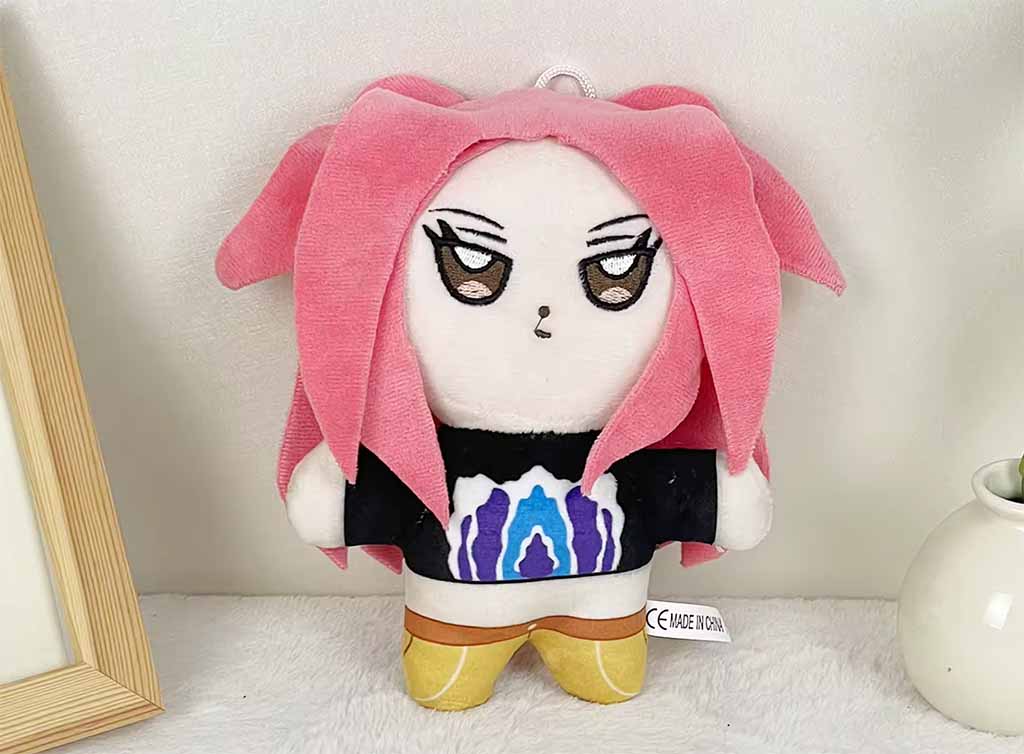
Wire armature in hair spikes requires an age grade of 14+ because wire that breaks through fabric creates a sharp hazard. For anime plush intended for general fan distribution including younger audiences, KINWIN engineers spike shapes using stiffened (interfacing-reinforced) fabric without wire — maintaining the silhouette while keeping the product safe for all age grades. For collector-grade adult anime plush (explicitly 14+), wire-supported hair is available for maximum visual accuracy.
Eye Design — The Most Commercially Critical Translation Decision
Eye Type Translation Reference — 7 Anime Eye Types
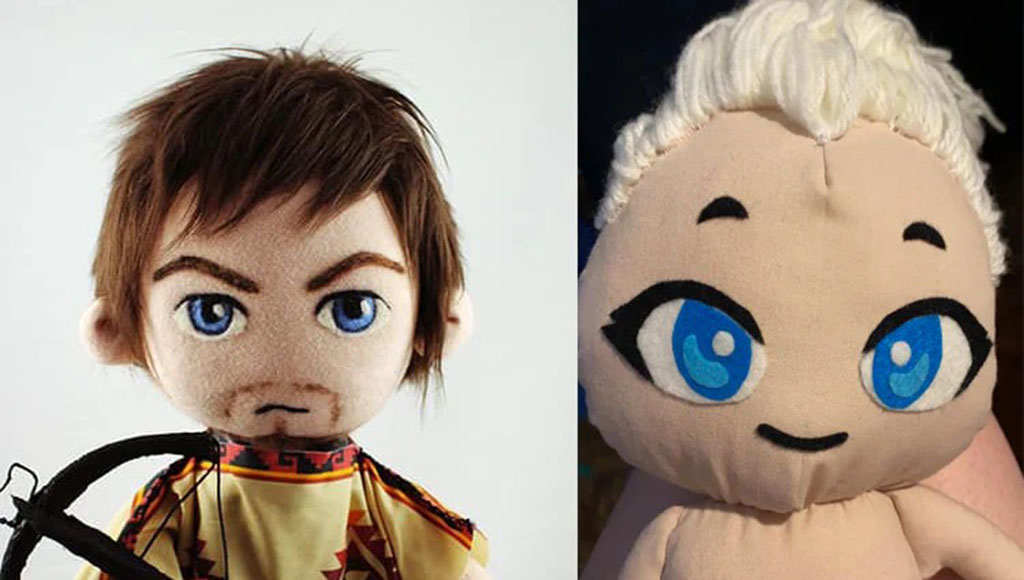
Eyes are the soul of an anime character’s identity — and translating them from 2D illustration into embroidery is the most consequential design decision in anime plush manufacturing. The wrong eye interpretation breaks the character identity entirely. The right interpretation creates an immediate emotional recognition: fans look at the face and think ‘that’s them.’
KINWIN uses physical placement templates for all anime character eye embroidery — ensuring left-right symmetry within ±1.0mm across all units in the production run. For anime plush, where fans will scrutinize facial accuracy closely, this precision standard is non-negotiable. Eye symmetry failure is one of the most cited quality complaints in anime plush reviews, and it is entirely preventable with the correct production controls.
Standard Anime Eye (large oval)
2D design: Gradient iris, multiple highlight dots, detailed pupil
Embroidery approach: High-contrast oval with white highlight; simplified iris
Key challenge: Symmetry — ±1mm placement tolerance
Star-Shaped Eyes
2D design: Precise geometric star pupils
Embroidery approach: Multi-point star embroidery — interpreted, not precise
Key challenge: Star points must feel intentional not random
Heart Eyes
2D design: Perfect heart pupils
Embroidery approach: Rounded heart embroidery
Key challenge: Heart shape readability at small scale
Heterochromia (different color eyes)
2D design: Different iris colors L vs R
Embroidery approach: Separate left/right thread colors
Key challenge: Color accuracy to character reference
Half-Closed / Sleepy Eyes
2D design: Partially covered by eyelid
Embroidery approach: Extended upper lid embroidery over iris
Key challenge: Correct partial-coverage proportion
Swirl / Spiral Eyes
2D design: Geometric spiral pupils
Embroidery approach: Concentric circle embroidery
Key challenge: Spiral must read clearly at production scale
Sparkling / Shiny Eyes
2D design: Multiple highlight dots, high-gloss appearance
Embroidery approach: Multiple white highlight points; rich dark base
Key challenge: Highlight placement symmetry
Costume and Uniform Accuracy in Anime Plush
Costume Construction Hierarchy and Color Accuracy
Costume Construction Hierarchy
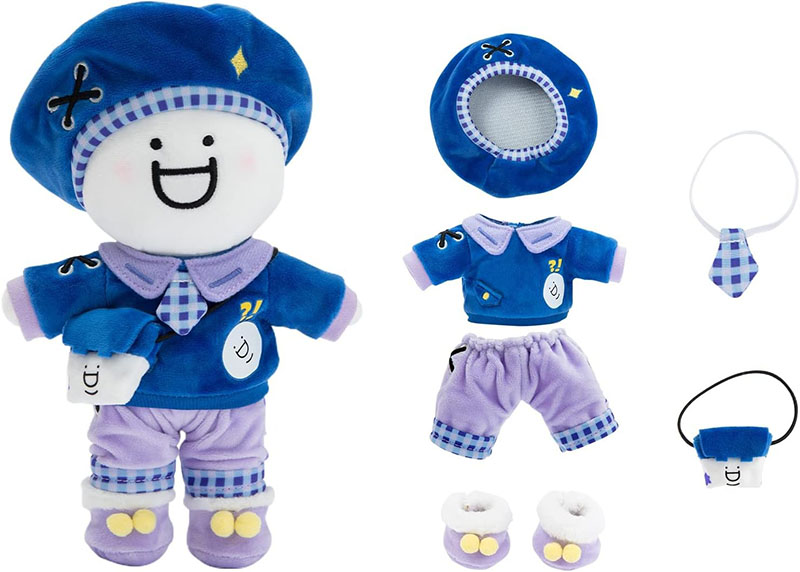
- Color blocking first: the primary color zones of the costume are the most important element — collar color, jacket color, trim colors must be accurate fabric panels
- Distinctive accessories second: weapons, bags, iconic accessories that are character-defining should be included as fabric components even if simplified
- Structural costume elements third: lapels, bows, belts, buttons should be represented through fabric construction or embroidery
- Fine linework simplified: detailed piping, insignia, very fine patterning should be represented at a level achievable in embroidery (minimum ~3mm feature size) rather than attempted in full detail and failing
- Removable accessories as options: for collector-grade anime plush, removable costume elements (capes, weapons, hats) can be sewn-on removable components — age grade must be assessed for any detachable parts
Color Accuracy for Anime Characters
Anime characters have highly specific color identities — the particular shade of an iconic orange jumpsuit, the specific blue of a beloved character’s hair, the exact yellow of a fan-favorite mascot’s body — where even slight color deviation is immediately noticed by fans. KINWIN uses Pantone TPX color matching for all anime character fabric sourcing, with physical swatch confirmation from the client before production begins. For characters where official color standards exist (some major IP provide official Pantone references), these are followed precisely.
IP Licensing for Anime Plush — What You Need Before Manufacturing
IP Licensing Requirements — Documentation Before Production
Manufacturing plush figures of existing anime characters requires proper licensing from the IP rights holder. KINWIN manufactures anime merchandise under licensing authorization — we do not manufacture unlicensed reproductions of copyrighted characters, and we require documentation of licensing authorization before beginning production of any identifiable existing character.
For IP holders licensing their own original anime/manga characters, standard NDA protection applies and no additional licensing documentation is required beyond the NDA. For independent artists and doujin creators producing plush of their own original characters, KINWIN treats these as standard OEM character development programs.
- License agreement: a copy of the licensing agreement between your company and the IP rights holder, confirming the right to manufacture plush toys
- Character style guide (if provided): official color specifications, approved character variants, and usage restrictions
- Territory restrictions: licensing is typically territory-specific — confirm that your license covers the countries where the products will be distributed
- Product category approval: some licenses require specific product category approval — confirm plush toys are covered
- Approval process: many licensors require pre-production sample approval — KINWIN coordinates this process and produces approval samples if required
Anime Plush Market Segments — Who Buys and What They Expect
Market Segments — 6 Anime Plush Buyer Profiles
Licensed Retail Plush
Buyers: Toy chains, anime retailers, online stores
Accuracy: High — fan market scrutiny
Volume: 5,000–100,000+ pcs
Convention / Event Merchandise
Buyers: Anime conventions, event merch tables
Accuracy: Very high — direct fan purchase
Volume: 500–5,000 pcs
Collector-Grade Plush Figures
Buyers: Adult collector market (18+)
Accuracy: Maximum — display quality
Volume: 500–3,000 pcs
Doujin / Indie Creator Merch
Buyers: Fan artist commissions, Kickstarter
Accuracy: High — personal creator reputation
Volume: 500–2,000 pcs
Gaming Company Merchandise
Buyers: Game character plush for player rewards
Accuracy: High — player recognition required
Volume: 1,000–20,000 pcs
Subscription Box Anime Plush
Buyers: Monthly anime box curations
Accuracy: Medium-High — curated exclusives
Volume: 1,000–10,000 pcs
Why Anime Brands Choose KINWIN
Why Anime Brands Choose KINWIN for Custom Plush Manufacturing
✓ Deep experience with anime-specific construction: chibi proportion engineering, hair construction, eye embroidery — not generic plush skills
✓ Design alignment document process: every 2D-to-3D translation decision confirmed before sampling
✓ ±1.0mm eye embroidery placement tolerance: the precision standard anime fan markets demand
✓ Pantone TPX color matching for character-accurate fabric sourcing
✓ Wire armature hair options for 14+ collector-grade figures; safe wire-free alternatives for general market
✓ IP compliance: licensing documentation reviewed before production; NDA standard for all original characters
✓ Disney FAMA approval: demonstrates IP security protocols that satisfy licensing requirements from major entertainment IP holders
✓ 7-day standard sampling after design alignment approval
✓ Unlimited free revisions — particularly important for anime plush where character accuracy requires iterative refinement
✓ Series development: multi-character programs coordinated from a shared design language
✓ MOQ 500 pieces — accessible for indie creators, doujin programs, and convention merchandise
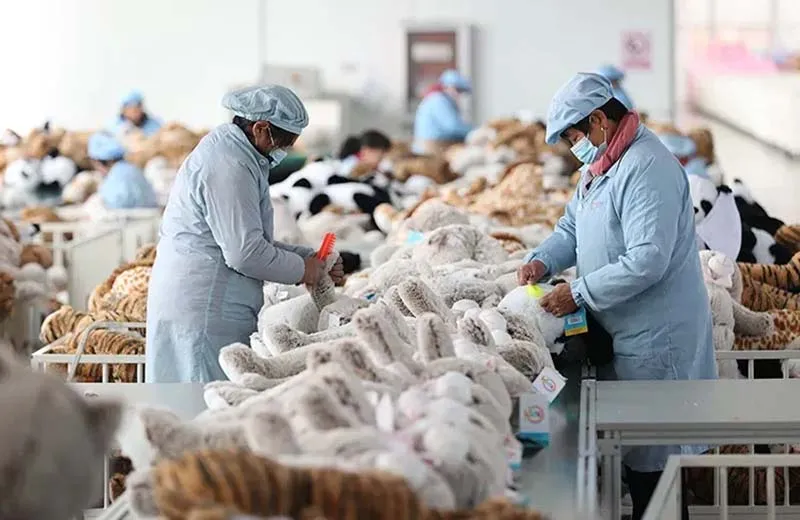
Anime fans know their characters. KINWIN manufactures anime plush with the precision and care that knowledge demands.
Frequently Asked Questions — Anime Plush Manufacturer
Frequently Asked Questions — Anime Plush Manufacturer
Q1. How accurately can KINWIN replicate a specific anime character's design in plush form?
KINWIN targets 95%+ character similarity to the approved reference — meaning the character is immediately recognizable to anyone who knows the source material. The translation from 2D illustration to 3D plush always involves some degree of adaptation: geometric eye shapes become embroidered interpretations, sharp hair edges soften, fine linework simplifies to embroidery-achievable representations. The design alignment document process is specifically designed to make every adaptation decision visible and explicit before sampling begins — so clients can approve the interpretation approach before committing to a physical prototype. For anime plush, where the failure mode is ‘doesn’t look like the character,’ this upfront alignment is the most important step in the entire development process. Clients who provide detailed reference materials (multiple character views, official color references, costume detail sheets) and engage actively in the design alignment review consistently achieve higher first-sample accuracy than those providing minimal reference.
Q2. Can KINWIN make chibi plush that look genuinely round rather than flat?
Yes — head roundness in chibi plush is a specific engineering challenge that KINWIN’s senior pattern makers are specifically trained to solve. The round appearance of a stuffed chibi head comes from how the fabric panels are shaped and how the seam curves are designed, not from how it is stuffed. A head constructed from a simple front and back panel will always be flat regardless of how it is filled. KINWIN engineers chibi heads from 5-7 shaped panels with carefully calculated seam curves that control how the head rounds when stuffed — producing consistent roundness from every angle, including the profile view that most commonly shows flatness in lower-quality chibi plush. The head panel design is reviewed in the design alignment document before sampling, so head shape issues are identified and resolved before the first physical prototype is produced.
Q3. I want to produce plush of an anime character I have licensed. What do I need to provide KINWIN?
For a licensed anime character, KINWIN needs: (1) Licensing documentation — a copy or summary of your license agreement confirming authorization to manufacture plush toys of the character, territory coverage, and any specific requirements from the licensor; (2) Character reference materials — official character sheets if available from the licensor, or high-resolution character artwork showing front, back, and side views; official color specifications (Pantone or hex references) if provided; (3) Costume details — detail references for any costume elements that must be accurately reproduced; (4) Licensor approval process — if the licensor requires pre-production sample approval, inform KINWIN at the brief stage so we coordinate the approval sample production into the development timeline; (5) Age grade and market — which markets the product will be distributed in, and the target age grade, determines certification requirements. With this information, KINWIN can provide a detailed development plan and quotation within 24 hours.
Q4. What is the best size for anime chibi plush for convention merchandise sales?
For convention merchandise, the 20-25cm sitting height range is the strongest-performing size: large enough to feel premium and display the character’s design clearly, small enough to fit in a convention tote bag and to price at $25-$45 — the sweet spot for convention impulse purchase. Mini keychain formats (8-12cm) are strong secondary sellers at conventions for attendees who want something at a lower price point ($10-$18) or who have limited bag space. For convention programs with limited table space, a two-size strategy (standard 20-25cm + mini 8-12cm) captures both the full-commitment buyer and the impulse buyer without requiring a wide SKU range. If budget allows only one size, the 20-25cm range consistently outperforms in fan merchandise convention settings. For premium convention exclusive or Kickstarter reward tier products, 30-35cm at $45-$65 positions well as a collectible.
Q5. Can KINWIN produce a series of anime character plush from the same series/game with consistent quality across all characters?
Yes — multi-character series development is one of KINWIN’s core strengths for anime merchandise programs. The key to consistent quality across a character series is a shared design language established at the start of the program: the same eye style approach, the same chibi proportion framework, the same fabric quality tier, and the same costume construction standards applied consistently across all characters in the series. KINWIN coordinates multi-character anime series by developing the first character as the design template — establishing all shared decisions — then developing subsequent characters within that established framework. Golden samples for all characters in the series are retained permanently, ensuring that new characters added to the series later (and reorders of existing characters) are produced to the same standard. Series programs also benefit from combined volume pricing — total series volume across all characters determines the pricing tier, making multi-character anime merchandise programs significantly more cost-efficient than ordering each character as an independent single design.
If You Can lmagine lt,We Will Create lt!
1.Tell Us What You Need
Tell us as specific as possible of your needs and share your idea.
2.Get Solution & Quote
We will work on the best solution according to yourrequirements,the specific quote will be provided within 24 hours.
3.Approve for Mass Production
We will start mass production after getting your approval.
