 Skip to content
Plush Toy Safety Standards Overview
Plush Toy Safety Standards Overview
CE · EN71 · ASTM F963 · CPSC · UKCA · OEKO-TEX · IEC 62115 · REACH · Global Compliance
Plush toys are one of the most heavily regulated consumer product categories in the world — because they are designed for children. Every country where you sell has specific safety standards your plush toy must meet before it can legally be sold, listed on marketplaces, or placed on retail shelves. Understanding these standards is not optional. Non-compliance risks marketplace listing suspension, product recalls, import holds, retail chargebacks, and legal liability.
This overview covers every major plush toy safety standard across all key global markets — what it is, what it tests, which markets require it, and what brands need to do to achieve compliance. KINWIN coordinates all safety testing through accredited laboratories and provides complete compliance documentation with every production order.
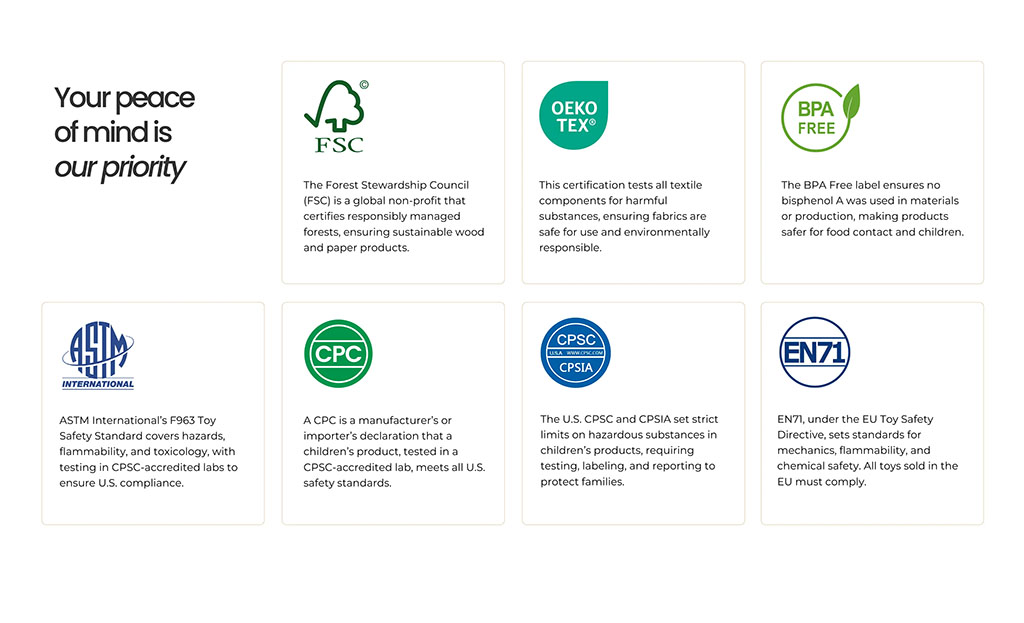
Quick Reference — Safety Standards by Market
Quick Reference — Safety Standards by Market
EN71 Parts 1–3 + CE Mark
European Union
Lab: EU Notified Body
Required for: All toys for children
EN71 Parts 1–3 + UKCA Mark
United Kingdom
Lab: UKAS-accredited lab
Required for: All toys post-Brexit
ASTM F963 + CPSC CPC
United States
Lab: CPSC-accepted lab
Required for: All children’s toys
AS/NZS 8124
Australia
Lab: NATA-accredited lab
Required for: All toys
CCPSA + ASTM F963 equivalent
Canada
Lab: Accredited lab
Required for: Children’s products
OEKO-TEX Standard 100
All Markets
Lab: OEKO-TEX association
Required for: Fabric safety
ST Mark (voluntary) + PFOS/PFOA
Japan
Lab: JAST
Required for: Recommended for retail
IEC 62115 / EN 62115
Electronic Toys
Lab: Accredited lab
Required for: Any toy with electronics
REACH Regulation
EU Chemical Compliance
Lab: EU authority
Required for: All products sold in EU
CE Mark & EN71 — European Union & UK
CE Mark & EN71 — European Union & UK
CE marking is the mandatory conformity marking for toys sold in the European Union. It is not a test — it is a manufacturer’s declaration that the product complies with all applicable EU toy safety legislation, primarily the EU Toy Safety Directive (2009/48/EC). To apply the CE mark legally, plush toys must pass EN71 testing through an accredited laboratory.
EN71 Part 1 — Mechanical & Physical Properties
- Small parts test: any part that detaches and could be swallowed by a child under 3 must not pass through a defined cylinder (31.7mm × 57.1mm)
- Pull and torque tests on attached components: eyes, noses, buttons must withstand pull forces (90N) and torque without detaching
- Sharp points test: no accessible sharp points after testing
- Sharp edges test: no accessible sharp edges after testing
- Bite test: simulates a child biting or sucking on the toy
- Noise test: sound-producing toys must not exceed 85 dB(A) at 50 cm distance
EN71 Part 2 — Flammability
Tests whether the toy’s fabric and filling materials present a fire hazard. Surface fabric pile flammability is the primary test for plush toys. Slow-burning fabrics pass; fast-burning pile fabrics fail. Long pile fabrics — particularly those with certain fiber compositions — require careful pre-testing before confirming for production.
EN71 Part 3 — Migration of Certain Elements
Tests for migration of potentially toxic chemical elements from materials that could be mouthed or sucked by children. Eight elements are tested: antimony (Sb), arsenic (As), barium (Ba), cadmium (Cd), chromium (Cr), lead (Pb), mercury (Hg), and selenium (Se). All fabric dyes and coatings used in plush toys must be free from these elements above defined limits.
ASTM F963 & CPSC — United States
ASTM F963 & CPSC — United States
ASTM F963 is the mandatory toy safety standard for the United States. All toys marketed to children under 14 must comply with ASTM F963. For plush toys sold to children under 12, a CPSC Children’s Product Certificate (CPC) — based on third-party testing at a CPSC-accepted laboratory — is additionally required.
ASTM F963 covers broadly the same hazard categories as EN71 but with US-specific test methods and limits. Key test areas for plush toys:
- Mechanical and physical tests: small parts, sharp points, sharp edges, bite simulation, pull and torque on attachments
- Flammability: ASTM F963 Section 4.2 — fabric and filling flammability
- Heavy metals: lead content in surface coatings (must not exceed 90 ppm under CPSIA) and substrate materials
- Phthalates: DEHP, DBP, and BBP must not exceed 0.1% in accessible plastic parts
- Stuffing and filling: non-toxic certification for all filling materials
- Noise-producing toys: sound level limits
The CPSC Children’s Product Certificate (CPC) must be issued by the manufacturer or importer and must identify: the product, the applicable CPSC rule, the accredited lab and test date, and the manufacturer/importer. It must be furnished to retailers and is required for Amazon US toy listings.
UKCA Mark & OEKO-TEX Standard 100
UKCA Mark & OEKO-TEX Standard 100
UKCA Mark — United Kingdom (Post-Brexit)
Following Brexit, the UK has its own product conformity marking system: UKCA (UK Conformity Assessed). For toys sold in Great Britain (England, Scotland, Wales), UKCA marking replaced CE marking from January 2023. CE marking remains valid in Northern Ireland under the Windsor Framework.
- UKCA requires the same EN71 Parts 1–3 testing as CE but through a UKAS-accredited laboratory
- UK Declaration of Conformity (DoC) must be issued — separate from EU Declaration of Conformity
- UKCA mark must be physically applied to product or packaging (minimum 5mm height)
- UK Responsible Person: brands without a UK-based entity must appoint a UK Responsible Person
KINWIN provides EN71 test reports from UKAS-accredited laboratories and assists with UK Responsible Person arrangements for brands without a UK entity.
OEKO-TEX Standard 100 — Global Fabric Safety
OEKO-TEX Standard 100 is an independent testing and certification system for textile raw materials and finished goods. For plush toys, OEKO-TEX certification of the fabric confirms that every component has been tested for harmful substances and is safe for skin contact.
- Product Class I — Babies & young children (under 3): Most stringent
- Product Class II — Items with direct skin contact: High
- Product Class III — Items without direct skin contact: Standard
- Product Class IV — Decoration and furnishings: Basic
OEKO-TEX tests for over 100 substances including pH value, formaldehyde, heavy metals, pesticide residues, allergenic dyes, color fastness, banned azo dyes, PVC plasticizers, and biocides. KINWIN sources OEKO-TEX certified fabrics for all plush toys, with Class I certification for products intended for babies and young children.
REACH — EU Chemical Compliance
REACH — EU Chemical Compliance
REACH (Registration, Evaluation, Authorisation and Restriction of Chemicals) is the EU regulation governing chemical substances in products sold in the European market. For plush toys, REACH compliance means that all materials — fabrics, dyes, filling, coatings, accessories — must not contain restricted substances above permitted concentration limits.
- Azo dyes — Banned if releasing >30mg/kg specific amines — Risk area: Fabric dyes
- Heavy metals — Lead, cadmium, chromium(VI), mercury strictly limited — Risk area: Dyes, coatings, accessories
- Phthalates — DEHP, DBP, BBP <0.1% in accessible parts — Risk area: Plastic accessories
- Formaldehyde — Limited in textile for children — Risk area: Fabric finishing
- Nickel — Limited in prolonged skin contact metals — Risk area: Metal accessories
- PAHs — Limited in rubber & plastic parts — Risk area: Rubber elements
- PFAS (Annex XVII) — Restrictions on certain PFAS compounds — Risk area: Water-resistant coatings
KINWIN’s material sourcing exclusively uses OEKO-TEX certified fabrics and REACH-compliant materials, with chemical compliance documentation available for all orders.
IEC 62115 — Electric Toy Safety
IEC 62115 — Electric Toy Safety
IEC 62115 is the international safety standard for electric toys — any toy incorporating electrical components including batteries, motors, light sources, or electronic modules. For plush toys, this standard applies to all products with sound modules, LED lighting, recording chips, vibration motors, AI conversation modules, or any other electronic feature.
Key IEC 62115 test areas for electronic plush toys:
- Electrical safety: insulation resistance, dielectric strength, leakage current limits
- Battery safety: correct battery type specification, anti-reversal design, battery compartment security
- Thermal safety: temperature limits during operation under normal use and fault conditions
- Acoustic safety: maximum sound output levels — for sound module plush toys
- Electromagnetic compatibility (EMC): for toys with wireless or Bluetooth functionality
- Cord and string hazards: any cords or strings on electronic toys
For the EU market, electronic plush toys must also comply with the Low Voltage Directive (LVD 2014/35/EU) in addition to the Toy Safety Directive. For the US market, ASTM F963 includes electronic toy safety requirements that overlap significantly with IEC 62115.
Age Grading & Warning Labels — A Critical Compliance Element
Age Grading & Warning Labels — A Critical Compliance Element
Age grading — assigning a minimum suitable age to your plush toy — is not optional. It is a mandatory labeling requirement that determines which safety tests apply and which safety warnings must appear on the product and packaging.
0+ (birth and up)
All EN71/ASTM tests; strictest small parts; no long pile
Keep away from fire; adult supervision
0–3 years
Strict small parts test; no detachable parts
Not suitable for children under 3
3+ years
Standard EN71/ASTM tests
Age warning on packaging
6+ years
Standard tests; some features permitted
Age grading on packaging
14+ / collector
Reduced requirements in some markets
Adult collectible labeling
The ‘Not suitable for children under 3 years’ warning — and its equivalent in local languages — is mandatory on all products not meeting the under-3 safety requirements. For Amazon FBA, this warning must appear on the poly bag. KINWIN applies all required age grading labels and safety warnings correctly for every target market.
How to Achieve Plush Toy Safety Compliance — Step by Step
How to Achieve Plush Toy Safety Compliance — Step by Step
KINWIN manages the complete safety compliance process for all production orders. Here is how compliance is achieved for a typical plush toy program.
Step 1 · Material Pre-Selection
KINWIN sources only OEKO-TEX certified fabrics and REACH-compliant materials, eliminating the highest chemical compliance risks before sampling begins.
Step 2 · Design Compliance Review
KINWIN’s tech pack process reviews design for compliance risks: small parts that may detach, fabric flammability characteristics, sharp points, noise levels for sound modules.
Step 3 · Age Grading Confirmation
Correct age grade determined based on design characteristics, confirming which tests apply and which safety warnings are required.
Step 4 · Pre-Production Sample Preparation
Production-equivalent samples prepared for third-party testing — samples must use the exact same materials and construction as mass production.
Step 5 · Third-Party Laboratory Testing
Samples submitted to SGS, Intertek, or Bureau Veritas for required standards. EN71, ASTM F963, IEC 62115, OEKO-TEX, and REACH testing coordinated.
Step 6 · Test Report Review & Compliance Action
Any failures identified and design or material changes made before mass production. KINWIN covers re-sampling for failures caused by our material recommendations.
Step 7 · Documentation Package Assembly
CE Declaration, test reports, CPC, OEKO-TEX certs, REACH reports compiled for the order and formatted for marketplace, retail buyer, and customs use.
Step 8 · Labeling & Marking Production
CE/UKCA mark, age grading, safety warnings applied per market requirements. FBA poly bag labeling verified before packaging.
Most Common Plush Toy Safety Compliance Failures
Most Common Plush Toy Safety Compliance Failures
KINWIN’s 17 years of compliance experience has identified the most common reasons plush toys fail safety testing. Understanding these prevents the most costly mistakes.
Small Parts Failure
Root Cause: Eyes/noses with insufficient attachment force
Prevention: Spec attachment force in tech pack; 100% pull test on every unit
Azo Dye Failure
Root Cause: Non-certified fabric dyes
Prevention: OEKO-TEX certified fabric only — no exceptions
Flammability Failure
Root Cause: Fast-burning pile fabric
Prevention: Pre-test fabric before confirming; use certified alternatives
Lead Content Failure
Root Cause: Non-compliant surface coating
Prevention: Source certified-compliant coating materials only
Sharp Points Failure
Root Cause: Wire or rigid elements inside toy
Prevention: Design review before sampling — eliminate internal hard elements
Noise Level Failure
Root Cause: Sound module too loud
Prevention: Test and specify sound level in tech pack before module ordering
Filling Toxicity
Root Cause: Uncertified filling materials
Prevention: Certified PP cotton or eco fiber only — with documentation
KINWIN’s Safety Compliance Infrastructure
KINWIN's Safety Compliance Infrastructure
Safety compliance is not a box to check — it is the foundation of a brand’s license to sell. KINWIN builds compliance into every product from day one.
✓ CE certified — EU Toy Safety Directive compliance
✓ ASTM F963 certified — US toy safety standard compliance
✓ EN71 Parts 1–3 tested and certified
✓ ISO 9001:2015 quality management system
✓ BSCI & SGS/SMETA social compliance certified
✓ Disney FAMA factory audit passed
✓ OEKO-TEX certified fabric sourcing for all products
✓ Laboratory partnerships: SGS, Intertek, Bureau Veritas
✓ Complete compliance documentation with every order: CE Declaration, test reports, CPC, OEKO-TEX certs
✓ Documentation formatted for Amazon Seller Central, retail buyer submission, customs clearance
✓ Labeling compliance: correct CE/UKCA marks, age grades, safety warnings per target market
Safety compliance is not a box to check — it is the foundation of a brand’s license to sell. KINWIN builds compliance into every product from day one.
Frequently Asked Questions — Plush Toy Safety Standards
Frequently Asked Questions — Plush Toy Safety Standards
Q1. If my plush toy passes EN71, does it also pass ASTM F963?
There is significant overlap between EN71 and ASTM F963 — both cover mechanical and physical hazards, flammability, and chemical safety. However, they are not identical. Test methods, pass/fail criteria, and specific limits differ between the two standards. A toy that passes EN71 Part 3 chemical migration testing does not automatically pass ASTM F963 chemical requirements, because the element limits and test methods differ. For brands selling in both EU and US markets, we recommend conducting both standards simultaneously — laboratories like SGS and Intertek can run EN71 and ASTM F963 testing in parallel, sharing some test samples, which is more cost-efficient than running them sequentially.
Q2. Does OEKO-TEX certification replace EN71 or ASTM testing?
No. OEKO-TEX Standard 100 tests fabric for harmful substances in the textile itself — it is a fabric safety certification, not a finished toy safety certification. EN71 and ASTM F963 test the complete finished toy for all relevant hazards including mechanical hazards (small parts, sharp points), flammability of the complete toy, and chemical migration from all accessible materials. OEKO-TEX certification of your fabric is a strong supplementary credential — it eliminates the risk of fabric-related chemical compliance failures and is increasingly required by retailers — but it does not replace EN71 or ASTM F963 testing on the finished toy.
Q3. Do I need separate safety testing for each size variant of the same character?
Not necessarily. If size variants use identical materials, construction methods, and components — only scaled up or down — the same test report typically covers all sizes, provided the test is conducted on the most critical size (usually the smallest, as small parts hazards are most relevant). However, if different sizes use different materials (e.g., different fabric types, different filling densities, different eye/nose attachment methods), separate testing may be required. KINWIN advises on the most efficient testing strategy for multi-size programs — often a single comprehensive test covers the full range, significantly reducing compliance costs.
Q4. What happens to my Amazon listing if my safety certificates expire?
Amazon requires that safety test reports be current and from accredited laboratories. While Amazon does not publicly specify exact expiry intervals, most retailers and marketplace platforms consider test reports valid for 1–3 years, provided the product design and materials have not changed. If Amazon requests updated documentation for a product already listed, failure to provide it within the specified window can result in listing suppression. KINWIN recommends proactively refreshing safety test reports every 2 years for active products, or immediately if any material change is made to the product. We track certification status for all active client programs and provide advance notice when renewals are approaching.
Q5. Can KINWIN help if my plush toy fails safety testing?
Yes. When a safety test failure occurs, KINWIN’s compliance team analyzes the test report, identifies the root cause of each failure, and recommends the specific material or design change required to achieve compliance. Common failures and their solutions: small parts failure → increase attachment force specification or replace with embroidery; azo dye failure → replace fabric with OEKO-TEX certified alternative; flammability failure → source certified flame-retardant fabric alternative; sharp points → redesign internal structure. After the corrective change is made, revised samples are submitted for retesting. KINWIN covers the re-sampling cost for failures caused by our material recommendations — if we recommended a fabric that failed, we take responsibility for the resampling.
If You Can lmagine lt,We Will Create lt!
1.Tell Us What You Need
Tell us as specific as possible of your needs and share your idea.
2.Get Solution & Quote
We will work on the best solution according to yourrequirements,the specific quote will be provided within 24 hours.
3.Approve for Mass Production
We will start mass production after getting your approval.
