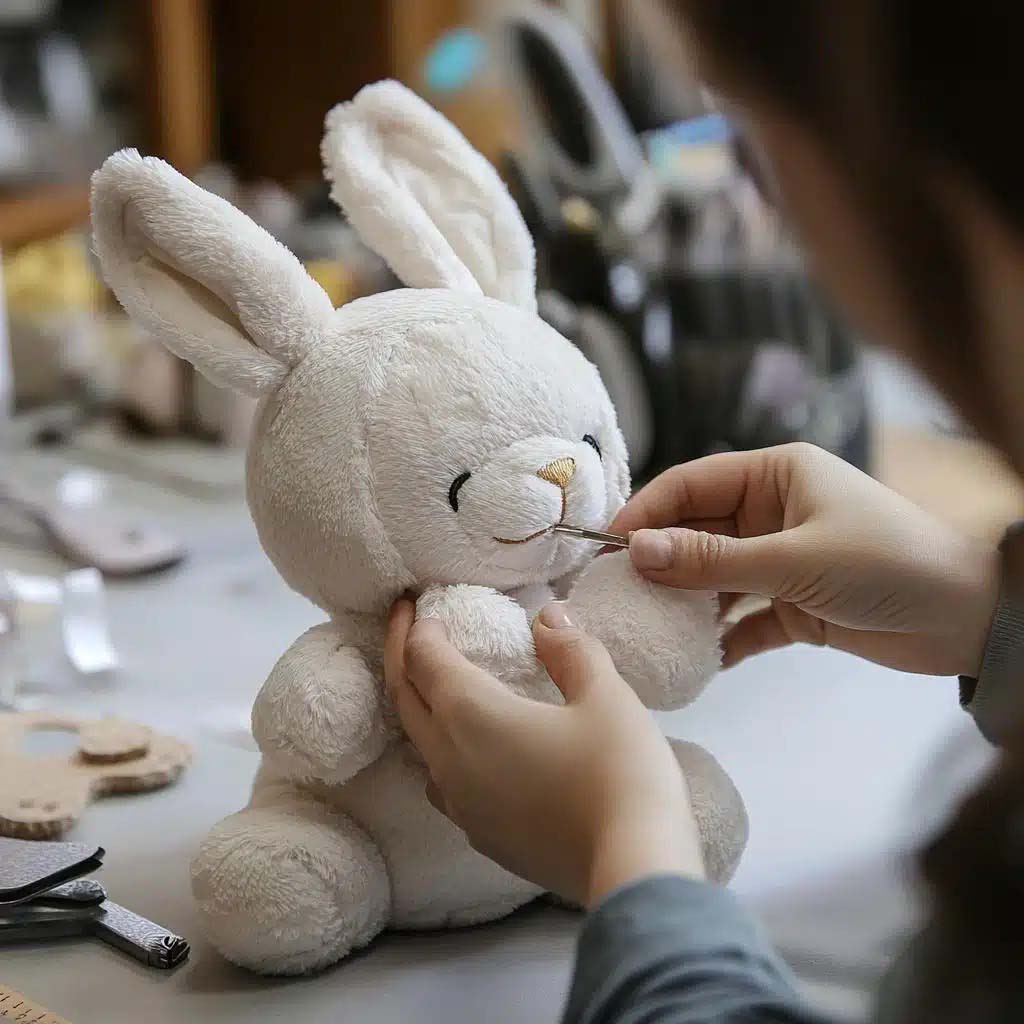
A ball plush looks simple, but it’s one of the easiest shapes to “almost get right” and still feel wrong in hand. If the panels don’t match, the toy becomes lumpy. If the seams aren’t smooth, the ball looks uneven in photos. I’m Amanda from Kinwin, and in this guide I’ll show you how I build a round ball plush that stays consistent in shape, softness, and durability—both for sampling and for mass production.
To make a ball plush successfully, focus on six controls: pattern structure, fabric choice, cutting symmetry, seam technique, stuffing density, and production standardization. When these are managed well, a ball plush can be one of the strongest products for gifting, sports-themed promotions, mascots, and collectible series because it is simple, cute, and highly scalable.
What pattern structures are commonly used to create ball-shaped plush toys?
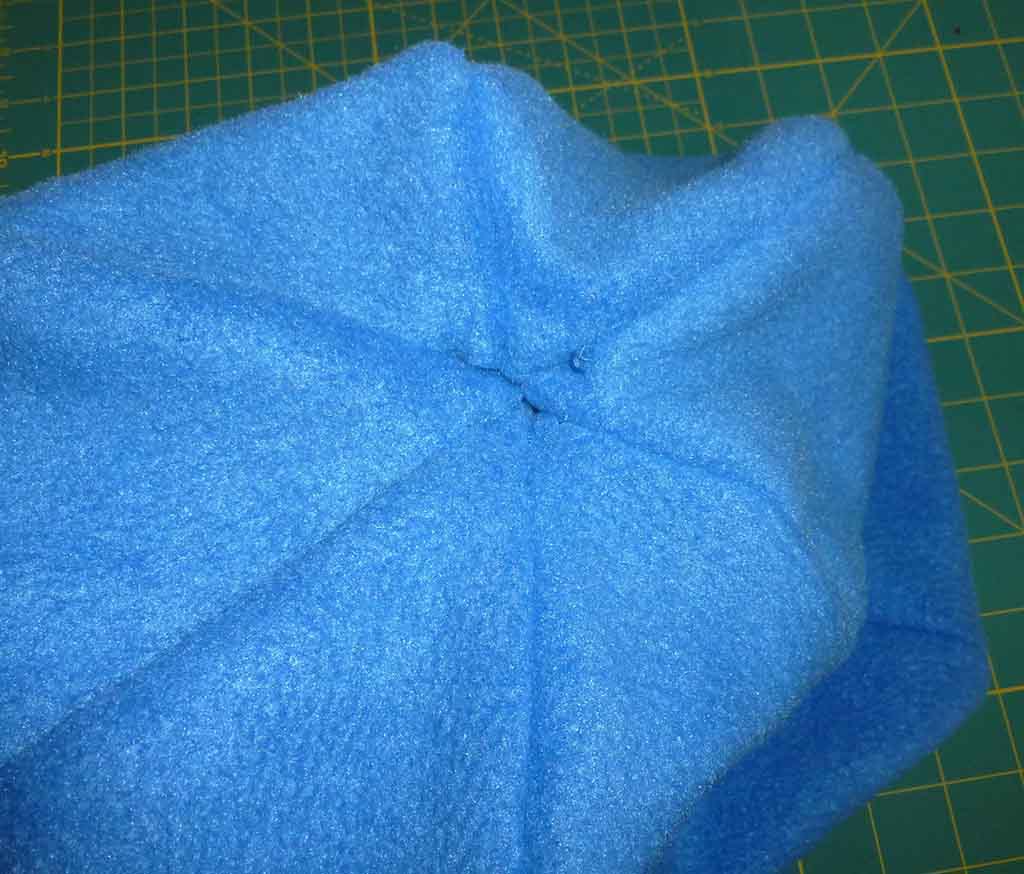
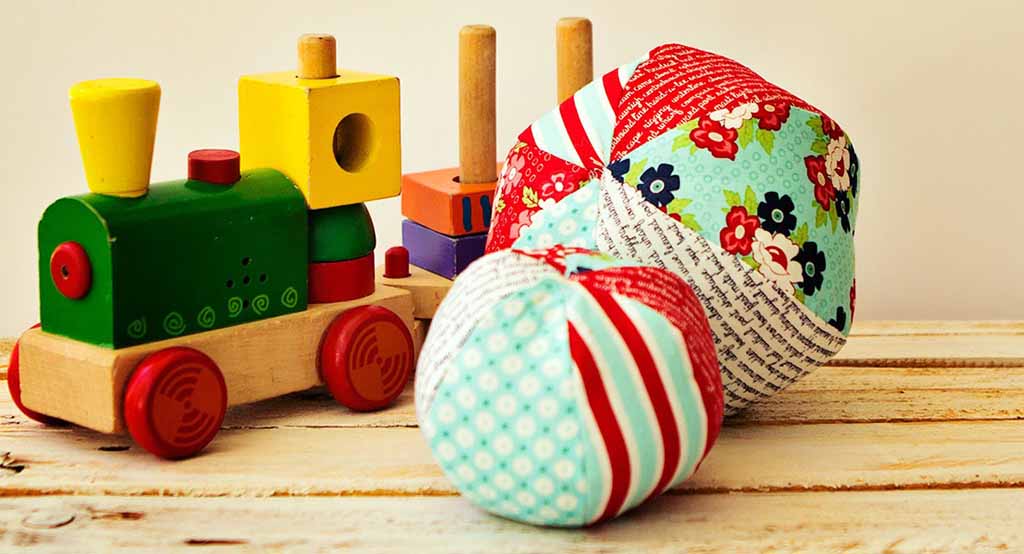
A ball plush is created by combining curved panels into a closed sphere. In production, I choose the panel structure based on three factors: how smooth the ball should look, how complex the printing or color blocking is, and how easy the sewing line will be to control.
The most common pattern structures include:
- 6-panel “orange slice” sphere (classic and efficient)
- 8-panel sphere (more control and smoother curvature)
- 12-panel sphere (high roundness, more labor)
- Soccer-style panels (visual style, complex alignment)
For B2B projects, I often start with 6 panels because it balances shape and cost. If the ball must look very smooth in close-up photos, 8 or 12 panels can improve the roundness.
| Pattern structure | Panel count | Roundness level | Sewing difficulty | Best use case |
|---|---|---|---|---|
| 6-panel “slice” | 6 | Good | Medium | General ball plush, mascots |
| 8-panel | 8 | Very good | Medium–High | Premium gifting and display |
| 12-panel | 12 | Excellent | High | Collector-grade plush |
| Soccer-style | Many | Depends | High | Sports-themed products |
| Two-piece sphere | 2 | Medium | Low | Simple stress balls (not best for plush) |
Which fabrics and stuffing materials work best for round plush consistency?
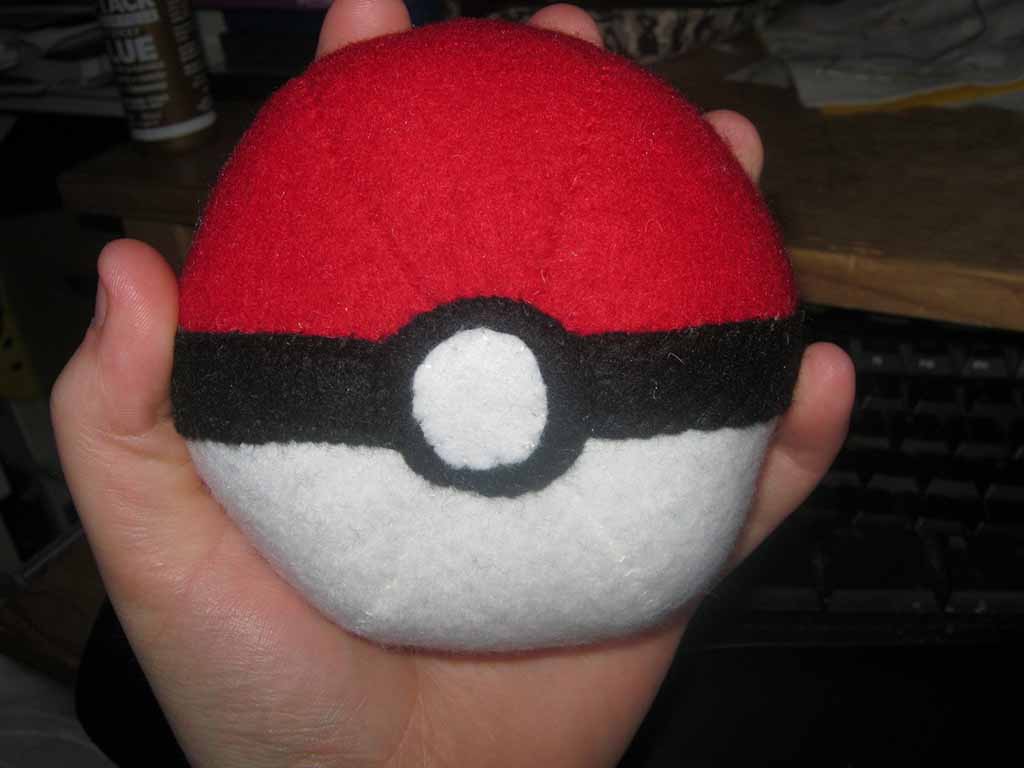
Roundness is not only a pattern issue. Fabric stretch and stuffing rebound decide whether the ball stays smooth over time.
For ball plush consistency, I recommend:
- Short pile plush or smooth minky-like fabric for clean shape
- Fabrics with controlled stretch (too stretchy causes distortion)
- High-rebound polyester fiberfill to avoid lumpy areas
If you use very long pile fabric, the ball can still be round, but the pile hides the seam line and can make the ball look larger or less defined. That can be good for “cute,” but not always good for “precision.”
| Material choice | Why it helps roundness | Best for | Risk | How to control it |
|---|---|---|---|---|
| Short pile plush | Shows smooth curvature | Photo-ready ball plush | Seams visible if poor | Clean seam finishing |
| Minky-like fabric | Smooth touch, neat look | Premium mini plush | Marks and flattening | Better packaging and QC |
| Velour/velvet | Rich look | Gift items | Can show seam tension | Stitch consistency |
| High-rebound fiberfill | Reduces lumps | All ball plush | Cost slightly higher | Define fill grade in spec |
| Low-grade fill | Lower cost | Budget promos | Mats and clumps | Avoid for ball shapes |
How do cutting accuracy and panel symmetry affect final ball shape?
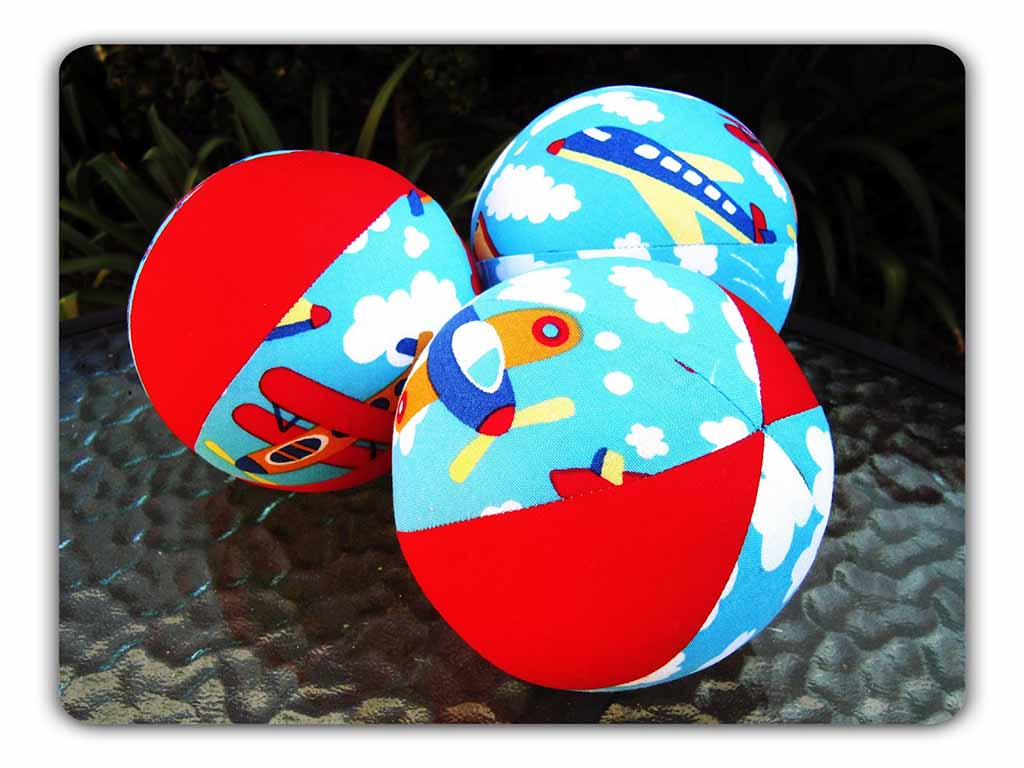
Cutting accuracy is a top factor for a ball plush. If one panel is even 2–3 mm off, the sphere can twist, and seams will “pull” into a spiral. Customers may not know why it looks wrong, but they will feel it.
For a true ball:
- Each panel must match length and curvature
- Seam allowance must be consistent across all panels
- Fabric pile direction should be consistent if the fabric has a nap
In factories, we control this through precise templates, accurate cutting tools, and panel pairing rules. For smaller ball plush (keychain size), tolerance must be even tighter because small differences become more visible.
| Cutting factor | What happens if it’s wrong | Visual result | Hand-feel result | Best control method |
|---|---|---|---|---|
| Panel length mismatch | Panels fight each other | Twisted seam lines | Uneven firmness | Template + measurement check |
| Curve inconsistency | Sphere becomes irregular | Flat spots | Lumps | Standardized die-cut shapes |
| Seam allowance variation | One side pulls | Spiral look | Stress on seams | Sewing guides + training |
| Pile direction mismatch | Light reflects unevenly | “Patchy” look | None | Mark nap direction in cutting |
| Panel pairing errors | Mixed sizes in assembly | Inconsistent ball | Inconsistent | Sort and bundle panels by size |
What stitching and seam techniques ensure smooth, even curvature?
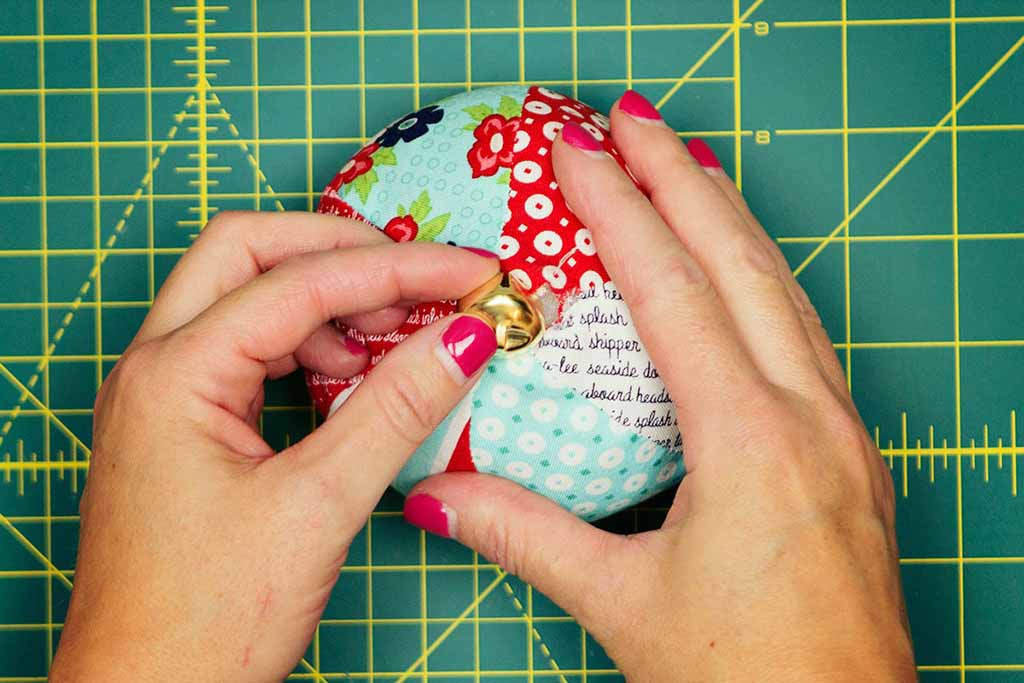
Even if cutting is perfect, poor stitching can ruin the curve. The goal is to make seams that are strong but not bulky, and that allow the ball to turn smoothly without puckering.
What works best for ball plush:
- Even stitch length and tension
- Smooth seam grading (reduce bulk where panels meet)
- Strong backstitch at stress points
- Careful turning method to avoid seam distortion
For a clean look, seam intersections should align tightly. If you have 6 or more panels, the top and bottom “meeting points” must be controlled so they do not form a messy knot.
| Seam technique | Benefit | Why it matters for spheres | Common mistake | Fix |
|---|---|---|---|---|
| Consistent stitch tension | Prevents puckering | Curved seams magnify tension | Uneven machine settings | Standard machine setup |
| Balanced seam allowance | Keeps curve smooth | Bulk creates bumps | Too wide seams at intersections | Trim and grade seams |
| Reinforced seam start/end | Improves durability | High tension areas | Weak seam lock | Backstitch or lock stitch |
| Clean intersection control | Better roundness | Panels converge at points | Misalignment | Mark notches clearly |
| Turning-friendly seam | Protects shape | Distortion occurs when turned | Forcing turn | Use correct turning opening |
How can stuffing density be controlled for softness and durability balance?
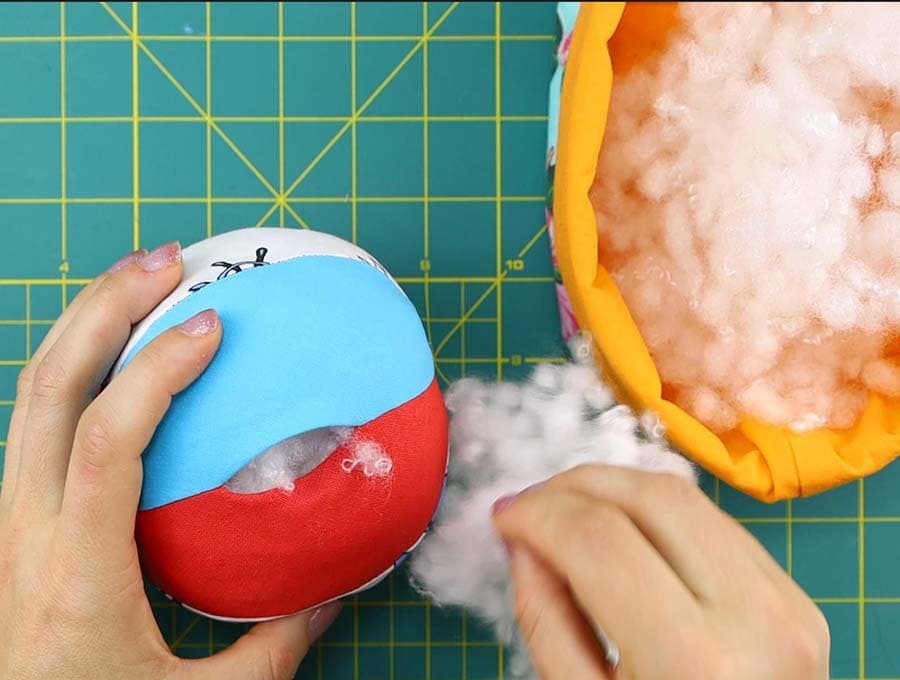
Stuffing density is where comfort and durability meet. A ball plush should feel soft, but not collapse. If it is under-stuffed, it becomes wrinkled and loses shape. If it is over-stuffed, seams stretch and the ball becomes hard.
I control stuffing density with two rules:
- Define a target fill weight range for each size
- Use “fill zoning” even in a ball (slightly firmer near seam intersections)
A practical method:
- Fill in small layers, then rotate and massage
- Check roundness by rolling on a flat surface
- Compare firmness to a golden sample
| Stuffing control | What it achieves | Why it matters | Risk if ignored | Simple QC check |
|---|---|---|---|---|
| Fill weight range | Consistent firmness | Prevents batch variation | Random feel | Weigh fill per unit |
| Layered stuffing | Smooth interior | Stops lumps | Hard clumps | Massage test |
| Zoning at intersections | Better shape stability | Points stay round | Flat poles | Squeeze check top/bottom |
| Golden sample comparison | Stable hand-feel | Keeps brand consistent | Customer complaints | Touch and roll test |
| Rolling test | Roundness check | Finds flat spots | Uneven curvature | Roll on table, observe wobble |
How do manufacturers scale ball plush production while maintaining shape uniformity?
Scaling ball plush is easier than scaling complex character plush, but only if you lock the system early. The biggest risk in mass production is variation: different fabric lots, different panel accuracy, different stuffing levels, and inconsistent seam tension across lines.
At Kinwin, I scale ball plush production through:
- Locked pattern and panel templates
- Standard cutting process with strict tolerance
- Bundled panel sets per unit (to prevent mixing)
- Defined seam settings and training for curved stitching
- Stuffing weight control by size
- A final shape inspection step that includes rolling and symmetry checks
When these controls are stable, ball plush becomes a high-efficiency product for promotions, sports brands, theme parks, and seasonal gift programs.
| Scale control | What it standardizes | How it is applied | What it prevents | Buyer benefit |
|---|---|---|---|---|
| Pattern lock | Panel geometry | Approved master template | Drift in roundness | Stable reorders |
| Cutting tolerance | Panel accuracy | Measurement checkpoints | Twisted balls | Better photo consistency |
| Panel bundling | Unit consistency | Bundle panels as a set | Mixed sizes | Lower defect rate |
| Sewing parameters | Seam quality | Fixed machine settings | Puckering | Strong durability |
| Stuffing specs | Hand-feel | Weight range + training | Hard/soft variation | Better reviews |
| Final shape QC | Roundness | Roll + symmetry check | Missed defects | Lower returns |
Conclusion
A great ball plush depends on panel symmetry, controlled stitching, and consistent stuffing density to keep a smooth, round shape. At Kinwin, we help global buyers develop scalable ball plush programs with locked patterns, stable materials, and reliable QC for uniform production. Contact me at [email protected] or visit kinwintoys.com to discuss your next plush project and explore how our factory can support your success.